

Radio Control: Scale
Bob and Dolly Wischer
THE DC/RC CLUB of the Washington, D. C. area conducted its first annual scale meet at the Bealton, Va. Flying Circus Aerodrome in September. It promises to become another great scale contest in the footsteps of the already famous Rhinebeck series. Twenty-five entrants flew in four classes including Sport Scale, 1/2A, Sailplane, and a new Team Scale event in which the builder must not be the flier. It is hoped that the latter arrangement will bring out those excellent scale projects that are too often produced by builders that are not proficient as fliers. The team concept is being expounded as the cure to one of the ills in competition, to get some of the hangar queens out onto the flying field.
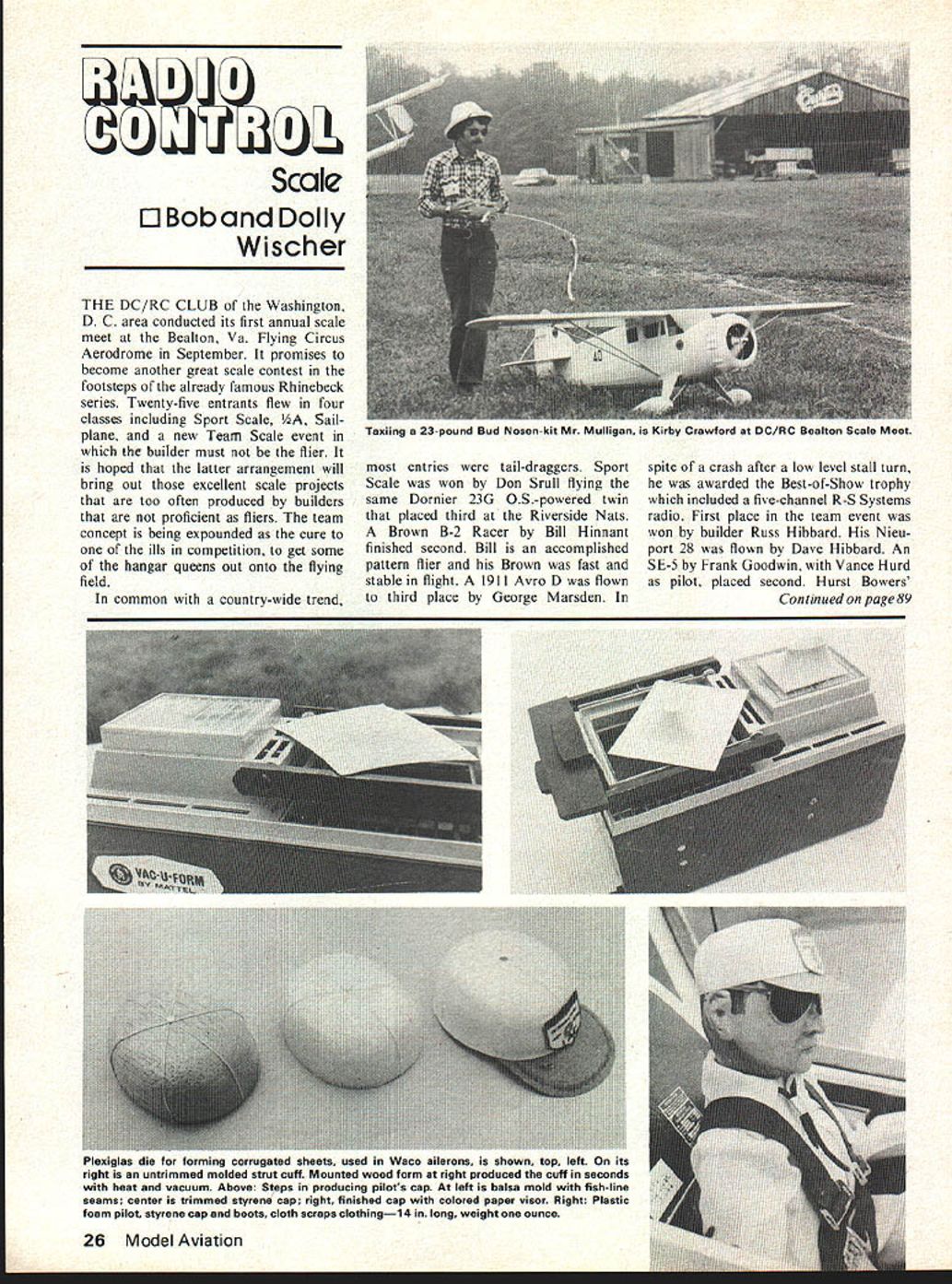
In common with a country-wide trend, most entries were tail-draggers. Sport Scale was won by Don Srull flying the same Dornier 23G O.S.-powered twin that placed third at the Riverside Nats. A Brown B-2 Racer by Bill Hinnant finished second. Bill is an accomplished pattern flier and his Brown was fast and stable in flight. A 1911 Avro D was flown to third place by George Marsden. In spite of a crash after a low level stall turn, he was awarded the Best-of-Show trophy which included a five-channel R-S Systems radio. First place in the team event was won by builder Russ Hibbard. His Nieuport 28 was flown by Dave Hibbard. An SE-5 by Frank Goodwin, with Vance Hurd as pilot, placed second. Hurst Bowers' Boeing F4B2, also piloted by Dave Hibbard, finished third. The scale plane that attracted the most attention didn't compete in the contest. A quarter-scale Mr. Mulligan from a Nosen kit was flown by Kirby Crawford in the model airshow that followed the meet. At 23 pounds it did not meet rule requirements. Power is a 1.6 cu. in. Roper chain-saw engine on ignition, shielded from the Kraft radio only by an aluminum firewall. The Saturday flying was followed by a charcoal broiled hamburger and hot dog cookout and hangar party.
Vacuum Forming Small Parts:
Producing light-weight small plastic parts with the aid of a Mattel Vac-U-Form toy has many advantages. Parts can be reproduced in any quantity at minimum cost and effort. Every part is exactly like the mold and is a duplicate of the preceding part. Its possibilities are limited only by the user's imagination. The easiest material to form is .010" to .015" thick sheet styrene, obtainable from hobby shops, art stores, and plastic supply houses. Other materials are formable, such as clear acetate butyrate sheet, for making transparent parts.
A Vac-U-Form is a toy that was popular 20 years back, but many are still available from stores that sell reconditioned toys. Try garage and rummage sales or any thrift shop. Another source might be a store or factory bulletin board. Our machine cost 25 cents at a local Goodwill Store, and would be a bargain at ten times that amount. The machine consists of a frame for holding the 3 X 3½" sheet of plastic over a heating element; a mount for the form and a single-stroke vacuum pump, all mounted on a box support. When buying a used one, check the operation of the element and pump. The pump pulls the heated plastic over the form to instantly produce a part. The form must have slightly tapered sides, known as the draft angle, in order to extract it from the molded part.
One of the first uses I made of this tool was the production of two dozen sheets in corrugated shape for the ailerons on a Waco Cabin YKS-6. The 3½" length limitation meant that three pieces were required for each surface, but the joints are all but invisible when made along a corrugation. The material used for the form was ¼" Plexiglas acrylic sheet, chosen because it gives very sharp corners in the impression it produces, and its smoothness leaves no blemishes in the finished part. A dense hardwood, such as birch, would likely have done as well. Grooves of exact depth and spacing were machined into the Plexiglas with a hollow-ground blade in a circular table saw, set at 45 degrees, and just barely extending above the saw table. One edge of the Plexiglas is then cut away with the saw to connect all of the corrugation grooves for air flow, and a single hole is drilled in this area to evacuate the air into the pump during the forming process. The Plexiglas form is set into the support provided in the Vac-U-Form, and held in place with two layers of ¼" wide masking tape. The tape serves as a vacuum seal. After the styrene part was formed, it was cut to shape with scissors and fastened to hollow balsa ailerons with epoxy cement.
Dummy pilots can easily be molded, including clothing and shoes, using parts of dolls as the molds. A complete pilot made in this manner will weigh less than one ounce. The mold for a pilot's cap can be carved and sanded from balsa since an absolutely smooth cap is not really desirable. Wood grain from the balsa or other softwood will offset into the styrene and be visible. The seams in a cap can be reproduced by cementing pieces of fish line across the top of the wood mold. A cap is then completed by the addition of a construction paper visor, held in place with contact cement. Ordinary model cement and dope will dissolve styrene. It can be sprayed with light, dry coats of dope without damage, but a wet coat will cause warping and a change in shape. Enamel, epoxy, and most other paints are harmless to styrene.
Navigation lights are best molded from clear butyrate sheet. The red and green color can then be applied on the inside to give the appearance of transparent lenses. Some strobe lights have a shape that will not permit molding. These have a ring in the lens that will lock the mold into the lens so that it cannot be extracted. In this respect, vacuum molding is the same as any other type, in that parts cannot be removed if there is back draft. The condition exists whenever a part is smaller at the base than at the top. A draft angle, or taper, must be used on the sides of the mold for easy extraction from the part.
Small fairings, strut cuffs, louvers, inspection covers, air scoops, hinges and doors can all be duplicated in quantity and with minimum weight penalty. A rudder cable lead-out fairing that is fastened in place with screws can have the screw heads reproduced as a part of the fairing by adding pin heads to the mold. The part requires only trimming and painting before cementing in place.
A New Competition Class: A stimulating suggestion for a new competition class of semi-scale models is offered by Bob Lophshure. This is the "Innovators Class." The plane need not be modeled after a specific prototype but may be a combination of several planes, even by different manufacturers. The purpose is to create a new plane, scale-like in appearance, that may closely resemble a particular aircraft or may only bear similarity. The main idea is to bring back the fun to RC.
One of the class features Bob advocates is the combining of two people as a team, one the designer-builder, and the other the pilot. Builder and pilot would need to be a team for at least two years or lose their standing in the class. The builder and pilot could be the same person only in a division for homebuilders. In either division the plane would be judged on scale-like flight and on ingenuity with realistic appearance. It would be interesting to see what scale modelers could produce if given free reign in designing plans to their own ideas without the hindrance of having to faithfully copy an existing design.
Bob Wischer, R1, S-221 Lapham Peak Rd., Delafield, WI 53018.
Transcribed from original scans by AI. Minor OCR errors may remain.

