
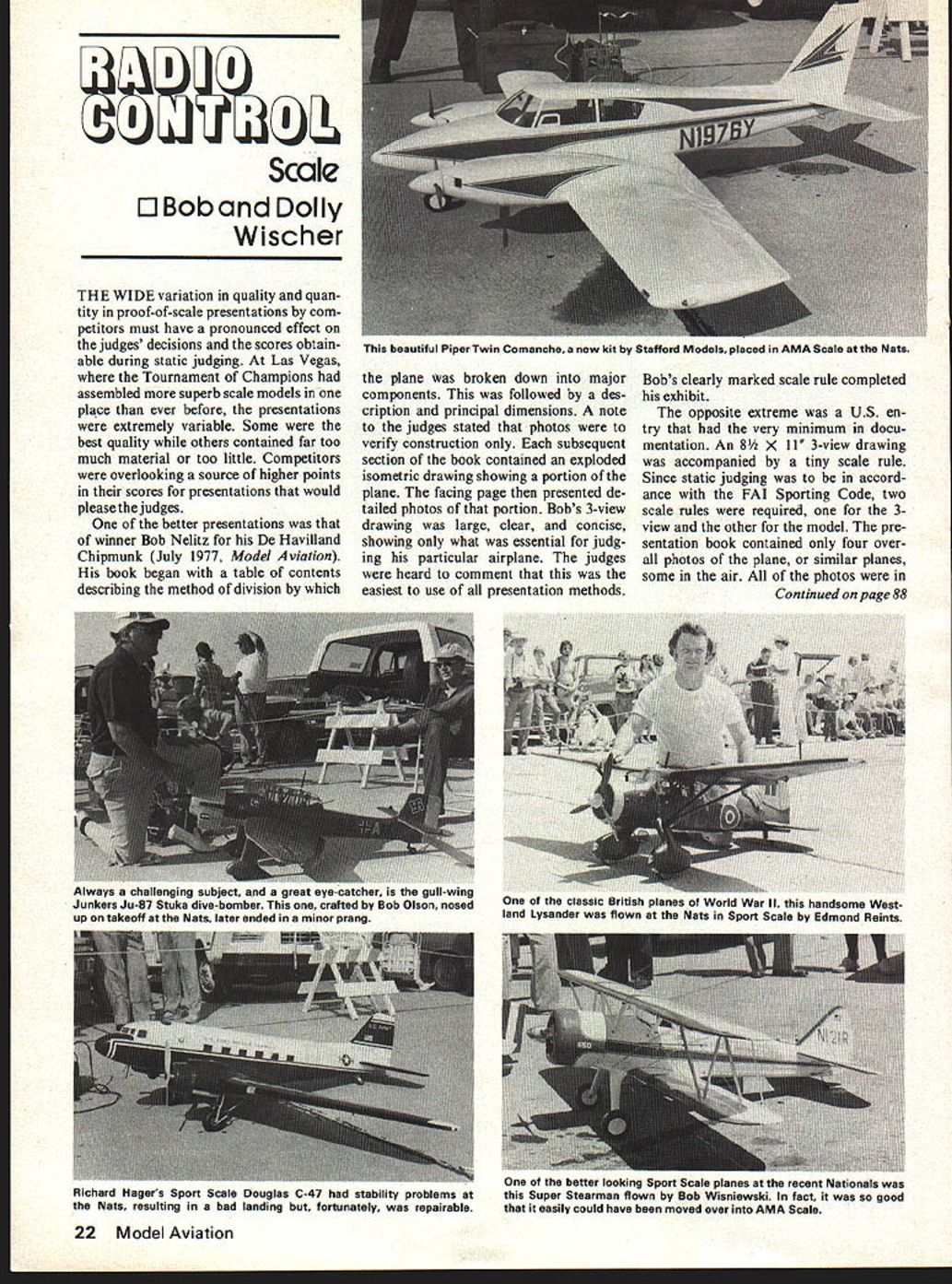
Radio Control: Scale
Bob and Dolly Wischer
THE WIDE variation in quality and quantity in proof-of-scale presentations by competitors must have a pronounced effect on the judges' decisions and the scores obtainable during static judging. At Las Vegas, where the Tournament of Champions had assembled more superb scale models in one place than ever before, the presentations were extremely variable. Some were the best quality while others contained far too much material or too little. Competitors were overlooking a source of higher points in their scores for presentations that would please the judges.
One of the better presentations was that of winner Bob Nelitz for his De Havilland Chipmunk (July 1977, Model Aviation). His book began with a table of contents describing the method of division by which the plane was broken down into major components. This was followed by a description and principal dimensions. A note to the judges stated that photos were to verify construction only. Each subsequent section of the book contained an exploded isometric drawing showing a portion of the plane. The facing page then presented detailed photos of that portion. Bob's 3-view drawing was large, clear, and concise, showing only what was essential for judging his particular airplane. The judges were heard to comment that this was the easiest to use of all presentation methods. Bob's clearly marked scale rule completed his exhibit.
The opposite extreme was a U.S. entry that had the very minimum in documentation. An 8 1/2 x 11" 3-view drawing was accompanied by a tiny scale rule. Since static judging was to be in accordance with the FAI Sporting Code, two scale rules were required, one for the 3-view and the other for the model. The presentation book contained only four overall photos of the plane, or similar planes, some in the air. All of the photos were in
RC Scale/Wischers
color, but were half-tone type from magazines, lacking in detail. There were none of the necessary detail photos required by judges to accurately grade a model. The lack of documentation must have cost static points for an otherwise excellent plane.
In third place in the final standings was the PZL Wilga entered by Phil Moore, of England. His fidelity standing was eleventh, indicating something lacking in the plane or in his documentation. Since the plane was a masterpiece we examined his documentation and found the reason for his low score. His 3-view drawing was good, but it showed too many variants of the plane, with no indication as to which sketches the judges were to follow. The scale rule furnished was very small, difficult to read, with markings that were not clear. There were eleven color photos, 3 1/2 X 5" in size, too small to be really helpful to the judges, and the minimum in number. Better documentation could easily have given him the six points needed to put him in second place, where the prize would have been $500 more. The plane deserved better.
The other English entry, Dennis Bryant with his Bristol Bulldog, came properly prepared. His scale rule was finely marked, made of wood, and had a sliding caliper to make the judges job as easy as possible. It was graduated with frequent pencil markings. Surprisingly, his 3-view was a rather muddy print, not a good way to influence the critics. There were additional small 3-views in his book showing too many variants, confusing and unnecessary. It must be recognized that a plane of this vintage is not easy to document. His few photos were half tones. Other photos were in an RAF fighter book with pages marked, not a bad idea, except that the photos were of doubtful value. It was evident that Dennis had competed previously in international meets. His cockpit photos and sketches were superior.
An example of over-documentation was the two stuffed books of 8 X 10" photos furnished by George Rose for his exceptional Curtiss Hawk P6-E. George had done a praiseworthy job of researching the prototype and was reluctant to give up any of his valued information recorded in the photos. They were actually too good as they showed such great detail that the judges were able to find fault. There is seldom sufficient time for close scrutiny of such vast quantities of information, and confusion can be detrimental. The 3-view was a large, clear pair of drawings prepared by Paul Matt and published in his Historical Aviation Album, an excellent source. George had made his rule from a yardstick, not easy to use.
A number of contestants used photos of their model during construction, and this practice is of some value if a similar photo of the prototype can be used for comparison. Judges prefer photos of the full-size plane. Model photos that show construction methods in the quest for ingenuity points are generally not considered acceptable. At least four contestants had included model photos. Another four contestants had made their own 3-view drawings, requiring approval from the builder of the prototype or by the National Scale Committee. All of these competitors were skilled draftsmen and one, Dave Platt, had published his drawing, making it acceptable according to the rules. Scale rules varied from simple short wood strips to elaborate plastic six footers with finely lined graduations and press-type numerals. The simple rulers were not really adequate, and did not meet the required FAI specifications. In this respect an AMA meet is different in that only one short ruler is necessary, for use on the drawing.
Documenting obscure aircraft would appear to be one of the tougher assignments in scale modeling and yet these are the planes that some builders find most satisfying. Granger Williams' Curtiss F6C-4 Hawk falls into this class. The prototype was unique, converted from a Hawk P-1, and information is very difficult to acquire. Granger had found excellent 5 X 7" cut-away and cockpit photos. His drawing was one of the classic William Wylam 3-views, with a folding rule made from thin plastic strips. Many modelers are aroused by the classic beauty of the planes of this era, but few will spend the time and energy needed for their research.
A proper presentation, whether for AMA or Sport Scale, must be carefully thought out, with the correct information in the suitable amounts, assembled in an easily indexed manner. Photos should appear in proper sequence, labeled, showing detail on the prototype that is duplicated on the model, carefully omitting any available photos that show detail not duplicated, and also omitting those photos that could lead to controversy between the judges. Photos can be either black and white, color, or a mixture, with many contestants now using all color.
If color is used, the photos should be made by a process that does not change the hues from that of the original. The preferred color process to obtain accurate facsimiles would be the use of a good negative film, Kodacolor II as an example, with prints produced by a reliable processor, such as one of the Eastman color labs. If the first set of prints appear to have improper color balance, try again, as a second set may be more nearly correct, even from the same negatives. Prints made from slides are seldom satisfactory for our purposes. Keep in mind that judges are not easily convinced that the print hues are wrong. The ultimate persuader is a photo of your model with the prototype. All photos should be mounted between clear plastic sheets obtainable from stationery stores and presented in a loose-leaf folder.
Preferably, the 3-view drawing should be large with fine lines and without muddy background smudges. Drawings from a printing press are usually clean and contrasty. A print made by the ammonia process from a clean tracing will have maximum contrast, especially if the lines were drawn with India ink. When extra 3-view drawings are submitted, or when additional sketches show variants of the subject aircraft, those portions that do not apply should be crossed out, with a note to the effect that they do not describe the model. The modeler cannot expect a high score from a frustrated judge.
Bob Wischer, Rt. 1, S-221 Lapham Peak Road, Delafield, WI 53018.
Transcribed from original scans by AI. Minor OCR errors may remain.

