
Radio Control: Scale
Bud Atkinson
THIS MONTH I want to talk about a subject I have had requests and questions about for some time. I don't remember seeing too much written about flaps, and how to install and operate them properly. There have been some misgivings and doubts about the proper use of flaps. Have no fear, there is no mystery or secrets about flaps. You must understand them and use them as intended, just the same as ailerons or elevator. I can remember way back when, before ailerons, in the old Smog Hog days, when flaps were thought to be a no-no on an RC model.
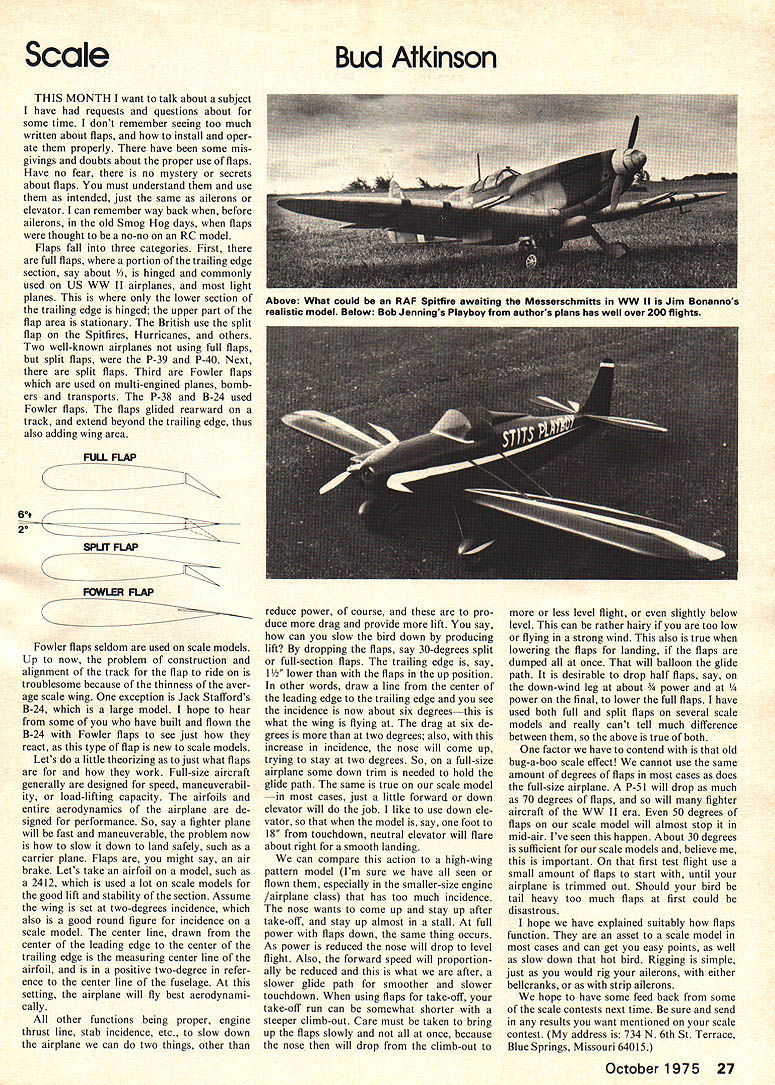
Flaps fall into three categories. First, there are full flaps, where a portion of the trailing edge section, say about 1/3, is hinged and commonly used on US WW II airplanes, and most light planes. This is where only the lower section of the trailing edge is hinged; the upper part of the flap area is stationary. The British use the split flap on the Spitfires, Hurricanes, and others. Two well-known airplanes not using full flaps, but split flaps, were the P-39 and P-40. Next, there are split flaps. Third are Fowler flaps which are used on multi-engined planes, bombers and transports. The P-38 and B-24 used Fowler flaps. The flaps glided rearward on a track, and extend beyond the trailing edge, thus also adding wing area.
FULL FLAP
SPLIT FLAP
FOWLER FLAP
Fowler flaps seldom used on scale models. Up to now, the problem of construction and alignment of the track for the flap to ride on is troublesome because of the thinness of the average scale wing. One exception is Jack Stafford's B-24, which is a large model. I hope to hear from some of you who have built and flown the B-24 with Fowler flaps to see just how they react, as this type of flap is new to scale models.
Let's do a little theorizing as to just what flaps are for and how they work. Full-size aircraft generally are designed for speed, maneuverability and load-lifting capacity. The airfoils and entire aerodynamics of the airplane are designed for performance. So, say a fighter plane will be fast and maneuverable, the problem now is how to slow it down and land safely, such as a carrier plane. Flaps are, you might say, an air brake. Let's take an airfoil on a model, such as a 2412, which is used a lot on scale models for the good lift and stability of the section. Assume the wing is set at two-degrees incidence, which also is a good round figure for incidence on a scale model. The center line, drawn from the center of the leading edge to the center of the trailing edge, is the measuring center line of the airfoil, and is in a positive two-degree in reference to the center line of the fuselage. At this setting, the airplane will fly best aerodynamically.
All other functions being proper, engine thrust line, stab incidence, etc., to slow down the airplane we can do two things, other than reduce power, of course, and these are to produce more drag and provide more lift. You say, how can you slow the bird down by producing lift? By dropping the flaps, say 30-degrees split or full-section flaps. The trailing edge is, say, 1/2° lower than with the flaps in the up position. In other words, draw a line from the center of the leading edge to the trailing edge and you see the incidence is now about six degrees—this is what the wing is flying at. The drag at six degrees is more than at two degrees; also, with this increase in incidence, the nose will come up, trying to stay at two degrees. So, on a full-size airplane some down trim is needed to hold the glide path. Same true on scale models; just a little forward down elevator will do the job. I like to use down elevator when the model is, say, one foot to 18" from touchdown; neutral elevator will flare about right. Smooth landing.
We can compare this action to a high-wing pattern model (I'm sure we have all seen or flown them, especially in the smaller-size engine/airplane class) that has too much incidence. The nose wants to come up and stay up after takeoff, stay up almost to stall with full power. Flaps down, same thing occurs. As power is reduced the nose will drop to level flight. Also, the forward speed will be proportionally reduced. What you get after is a slower glide path and a smoother, slower touchdown using flaps. On takeoff, the take-off run can be somewhat shorter and climb-out steeper. Care must be taken bringing up the flaps slowly once airborne because the nose will drop; climb-out is less, and level flight slightly below level can be rather hairy, too low, especially in strong wind. Also true lowering flaps in landing—if flaps are dumped all at once that will balloon the glide path. It is desirable to drop half flaps, say on the downwind leg at about 1/2 power, and on final lower full flaps.
I have used both full and split flaps on several scale models and really can't tell much difference between the two. Both react in about the same way. One factor we have to contend with is that old bug-a-boo scale effect — we cannot use the same amount of degrees of flaps in most cases as does the full-size airplane. A P-51 will drop as much as 70 degrees of flaps, and many fighter aircraft of the WW II era used 50 degrees. On our scale models even 50 degrees of flaps will almost stop the model in mid-air. I've seen this happen. About 30 degrees is sufficient on scale models, I believe. Important: on first test flights use a small amount of flaps to start with until your airplane is trimmed out. Should the bird be tail heavy, too much flap at first could be disastrous.
I hope we have explained suitably how flaps function. They are an asset to a scale model in most cases and can get you easy points, as well as slow down that hot bird. Rigging is simple, just as you would rig your ailerons, with either bellcranks or pull-pull, or as with strut ailerons.
We hope to have some feed back from some of the scale contests next time. Be sure and send in any results you might have mentioned on your scale contest. (My address is: 73A N. 6th St. Terrace, Blue Springs, Missouri 64015.)
Transcribed from original scans by AI. Minor OCR errors may remain.

