

Radio Control: Scale
Bob and Dolly Wischer
PROTECT THOSE PLANES: 1977 was the year of travel for us. Two trips to each coast, most of which was in the family van, could have been damaging to the scale models that rode over the short, thick, truck springs. A sectional sofa from our living room, with springs, and a five-inch-thick foam upholstery pad, is carried in the van for protection; the models ride in regal splendor, safe from vibration and road shocks. Four years ago, when the van was new, we carried the Douglas M2 Mailplane without protection for 1600 miles through New England, and then to the Kitchener-Waterloo Scale Rally in Canada. On its first flight the aileron servo locked in right turn and the Douglas spiraled steeply to its end, or so we thought. One of the wires to the aileron plug had crystallized due to vibration. Even when carried in a car or wagon, planes should be protected with foam when being transported for any distance.
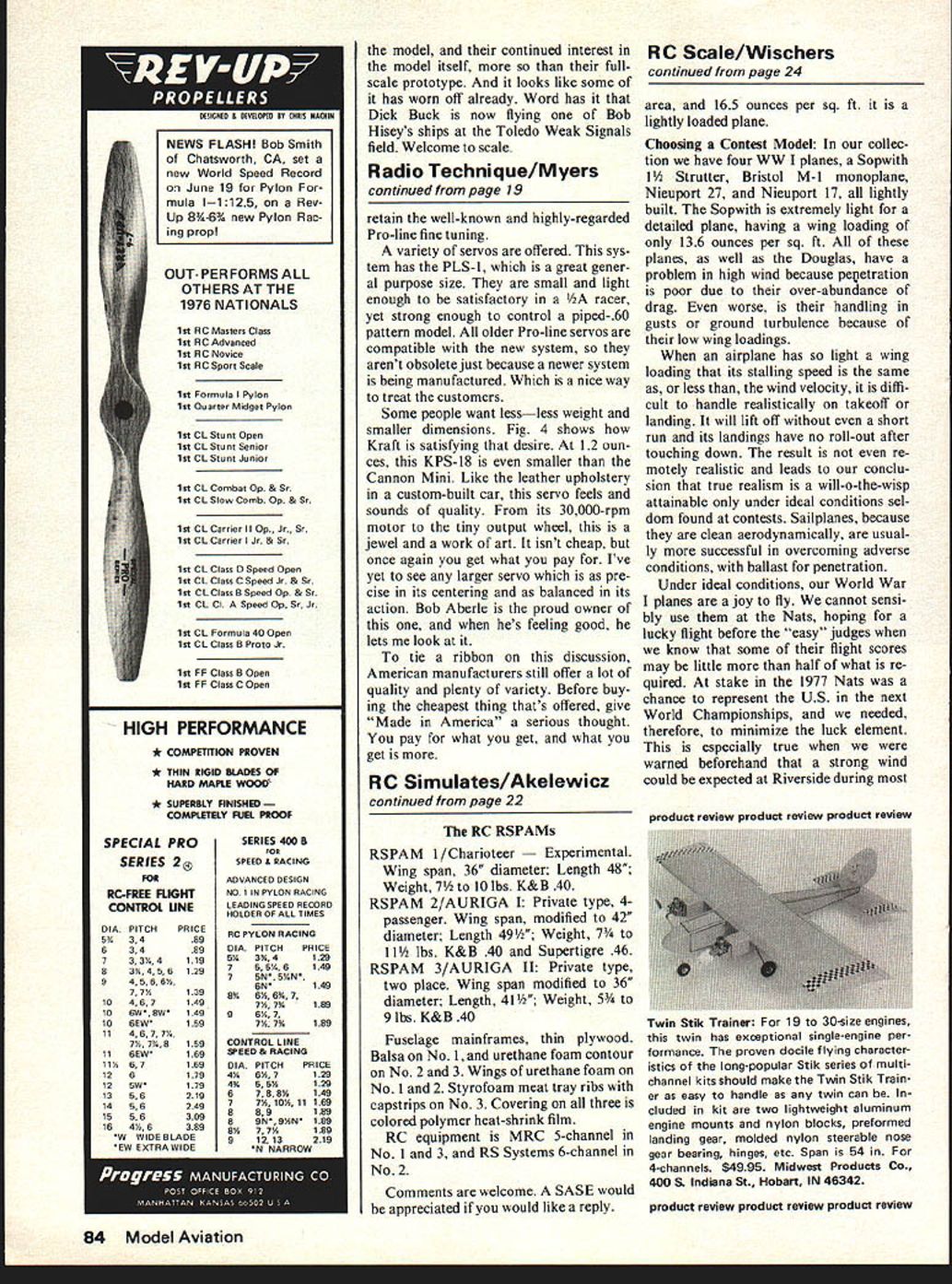
Last winter the Douglas was rebuilt. The fuselage parts were reassembled and two new right wing panels were constructed. A new HP .61 FS engine, with muffler pressure, was installed to overcome the natural slowness of a plane burdened with drag from struts, wires, two wings and large wheels. Performance was much improved. Williams Brothers new Golden Age wheels were substituted for the original Smooth Contour wheels, saving a half pound in weight and giving the 1927 design a touch of added realism. At 1400 sq. in. of wing area, and 16.5 ounces per sq. ft., it is a lightly loaded plane.
Choosing a Contest Model:
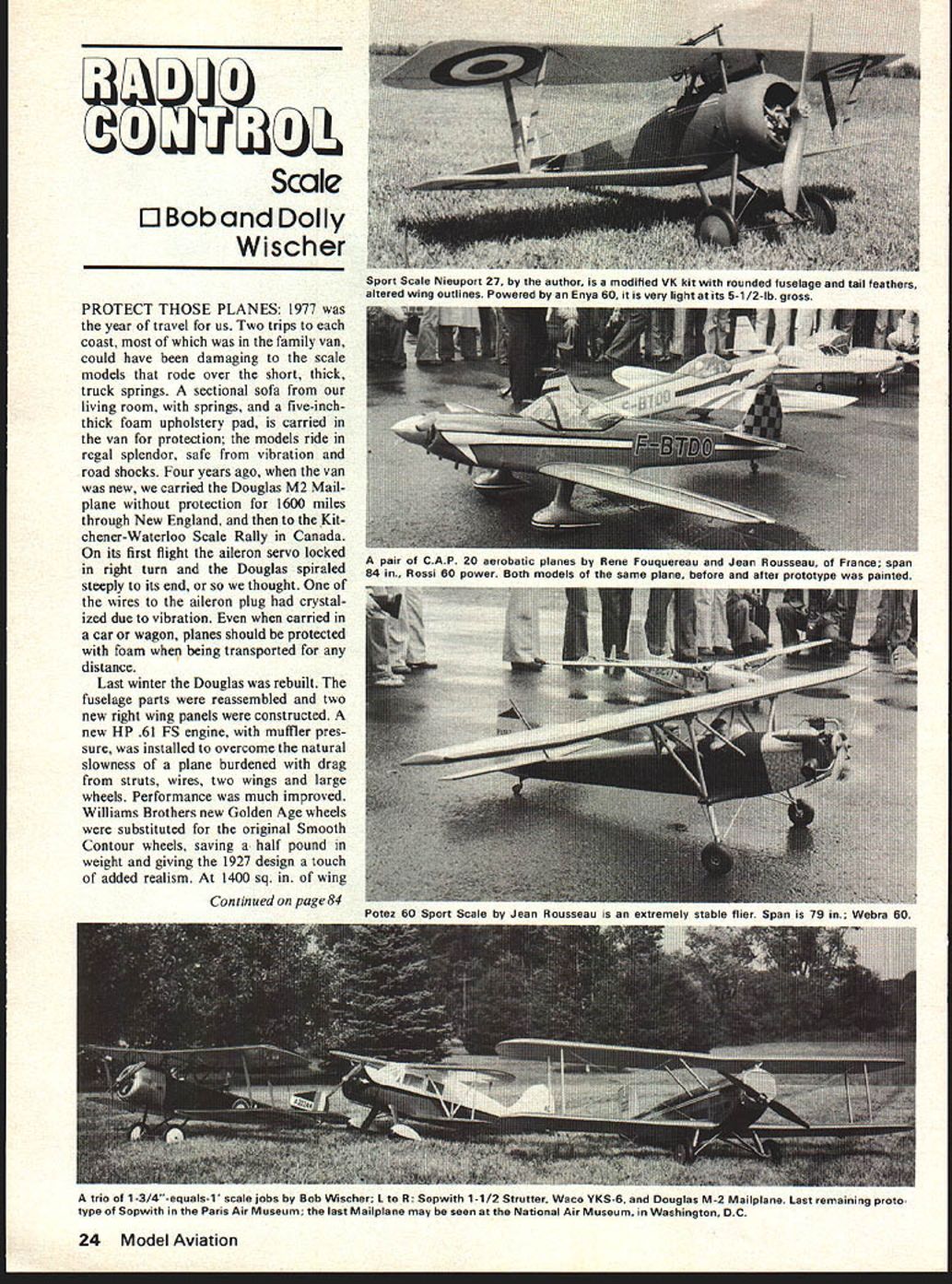
In our collection we have four WW I planes, a Sopwith 1½ Strutter, Bristol M-1 monoplane, Nieuport 27, and Nieuport 17, all lightly built. The Sopwith is extremely light for a detailed plane, having a wing loading of only 13.6 ounces per sq. ft. All of these planes, as well as the Douglas, have a problem in high wind because penetration is poor due to their over-abundance of drag. Even worse, is their handling in gusts or ground turbulence because of their low wing loadings.
When an airplane has so light a wing loading that its stalling speed is the same as, or less than, the wind velocity, it is difficult to handle realistically on takeoff or landing. It will lift off without even a short run and its landings have no roll-out after touching down. The result is not even remotely realistic and leads to our conclusion that true realism is a will-o'-the-wisp attainable only under ideal conditions seldom found at contests. Sailplanes, because they are clean aerodynamically, are usually more successful in overcoming adverse conditions, with ballast for penetration.
Under ideal conditions, our World War I planes are a joy to fly. We cannot sensibly use them at the Nats, hoping for a lucky flight before the "easy" judges when we know that some of their flight scores may be little more than half of what is required. At stake in the 1977 Nats was the chance to represent the U.S. in the next World Championships, and we needed, therefore, to minimize the luck element. This is especially true when we were warned beforehand that a strong wind could be expected at Riverside during most of each day. The choice of plane subject, for the serious modeler, is therefore a compromise when, with competitive spirit, he hopes for a high placing in the result. We have often felt that our choice of planes sometimes had no chance to win, but the satisfaction of building, possessing, and flying the ship was reward enough.
It is true that the plane with the lightest wing loading at the Nats had the highest flight score. It is also true that it was really a Sport Scale plane entered in AMA Scale as a protest against pattern-type flights. The high-flight-score Brandenberg Flying Boat was expected to fly well, unencumbered with all the detail needed in AMA scale. In this respect, it was not consistent and was wisely kept grounded during the windy and gusty fourth round.
Sports events, such as platform diving and figure skating, have an advantage over scale contests. Their judges are usually persons who were performers at one time. Our contest directors may be knowledgeable, but they cannot hope to educate a team of judges who have only seen contemporary planes at the airport. Present rules do not limit entries to known types. A modeler is privileged to build whatever he likes and has the right to expect fair judging no matter how obscure his subject, but he should not expect judges to be aware of its capabilities. Only in World Championships, and recently at Las Vegas, is the judging of consistently high quality.
Report From Paris:
At the December meeting of the Committee for International Aeromodelling (C.I.A.M.), held at the Paris headquarters of the FAI, a decision was made that clears the way in 1979 for a change in model weight for R/C Scale, from 5 kg (11 lbs.) to 6 kg (13.22 lbs.). Engine size remains the same at .61 cu. in. maximum. This brings FAI models more nearly into alignment with the 15 lbs. permitted under AMA rules.
It actually affects only those builders who now have, or plan to build, planes for FAI competition. In effect, it permits construction of larger planes, which then can have sufficient wing area to avoid becoming the proverbial "lead sleds." In the past, a model could be kept under 11 pounds only by limiting its size, with the result that wing loadings approached the maximum of 32.76 ounces per sq. ft. The fixed weight of electronics and engine now becomes a smaller percentage of the gross weight.
For RC and CL Scale a significant change in static and flight scoring will become effective immediately. The complexity K factor in static scoring has been deleted while fidelity and craftsmanship K factors are now combined as follows:
- Fuselage K = 10
- Wing or equivalent K = 10
- Tail surface or equivalent (empennage) K = 9
- Landing gear K = 9
- Propulsion unit(s) K = 8
- Cockpit and cabin detail K = 4
- Finish color and markings K = 11
- Special ingenuity K = 4
In addition to reducing the judges' work load, this will change the scoring method by which certain types of planes previously benefited. As an example, a model of a plane with a metal fuselage could have been awarded high points because of the prototype complexity, with points then multiplied by the K factor to give an advantage to that type of plane. Under the new scoring system, a fabric-covered fuselage is equal to metal, because it is now scored only for fidelity and craftsmanship.
The new arrangement becomes more nearly in alignment with the AMA scoring system which ideally gives all planes an equal chance to compete, regardless of prototype age, type of construction, materials used, or shape.
To replace the complexity points previously given for individual parts of the plane, there is a new complexity bonus for RC and CL Scale. In order to compensate models of complex prototypes for their inherent disadvantages in flight, the following bonuses shall be awarded in the form of percentage of the total flight score:
Wings % Bonus
- Monoplane 0
- Biplane (single bay) 5
- Biplane (double bay) 10
- Triplane 15
- Quadruplane 20
Engines
- Single 0
- Two engines 10
- Three engines 15
- Four engines 20
- Above four 25
Landing gear
- Fixed Tricycle 0
- Fixed—one or two wheel 5
- Retractable tricycle 10
- Retractable—one or two wheel 10
General
- Pre-1914 design 10
Notes: In order to qualify for the multiple engine bonus, the power ratio of the engines must be as per prototype, and all engines must operate. Judges shall decide upon the appropriate % bonus to be applied to the flight score of each model during the static scoring procedure.
The 10% additional points for retracting the landing gear at first glance appear to be high, but they approximate the amount awarded under AMA rules. A really large percentage could be built up if some enterprising researcher discovers a four-engine quadruplane with retracts. We know from past experience that the plane would need the 50% additional flight points, as it would be operating under an enormous handicap. Multi-engine planes are the most likely candidates to benefit from the bonus system.
Other changes affecting the 1978 World Championship in England include the stipulation that the cruising speed of the prototype must be stated on the flight scoring form to assure more accurate scoring of realism in flight. For RC Scale, the taxi maneuver is now the same as that specified in AMA rules, except that, after landing, there is no taxi back to hangar. A dummy pilot is now mandatory for maximum flight points and its weight is included in the model weight. The number of landing circles is now reduced to one and its diameter is now 25 meters. All rules are now frozen for the next four years. The only changes that can be made are in the ratios of K factors and complexity bonus percentages, with totals remaining the same.
Las Vegas Scale Event: Word has just arrived from Walt Schroder of Model Airplane News that there will be no museum-type scale contest in 1978. Reasons given were the extra days of work involved and the burden placed upon Bill Bennett and his staff in conducting a contest which virtually lasts two whole weeks. Since the 1978 Tournament of Champions will be all Standoff Scale models of full-size aerobatic airplanes, Bill feels that they will still have quite a bit to offer the scale buffs. Bill Bennett says: "We are all very sorry that this concept of a dual contest did not work out and I want to personally apologize to all scale builders for excluding it from next year's contest."
Bob Wischer, Rt. 1, S-221 Lapham Peak Road, Delafield, WI 53018.
Transcribed from original scans by AI. Minor OCR errors may remain.

