
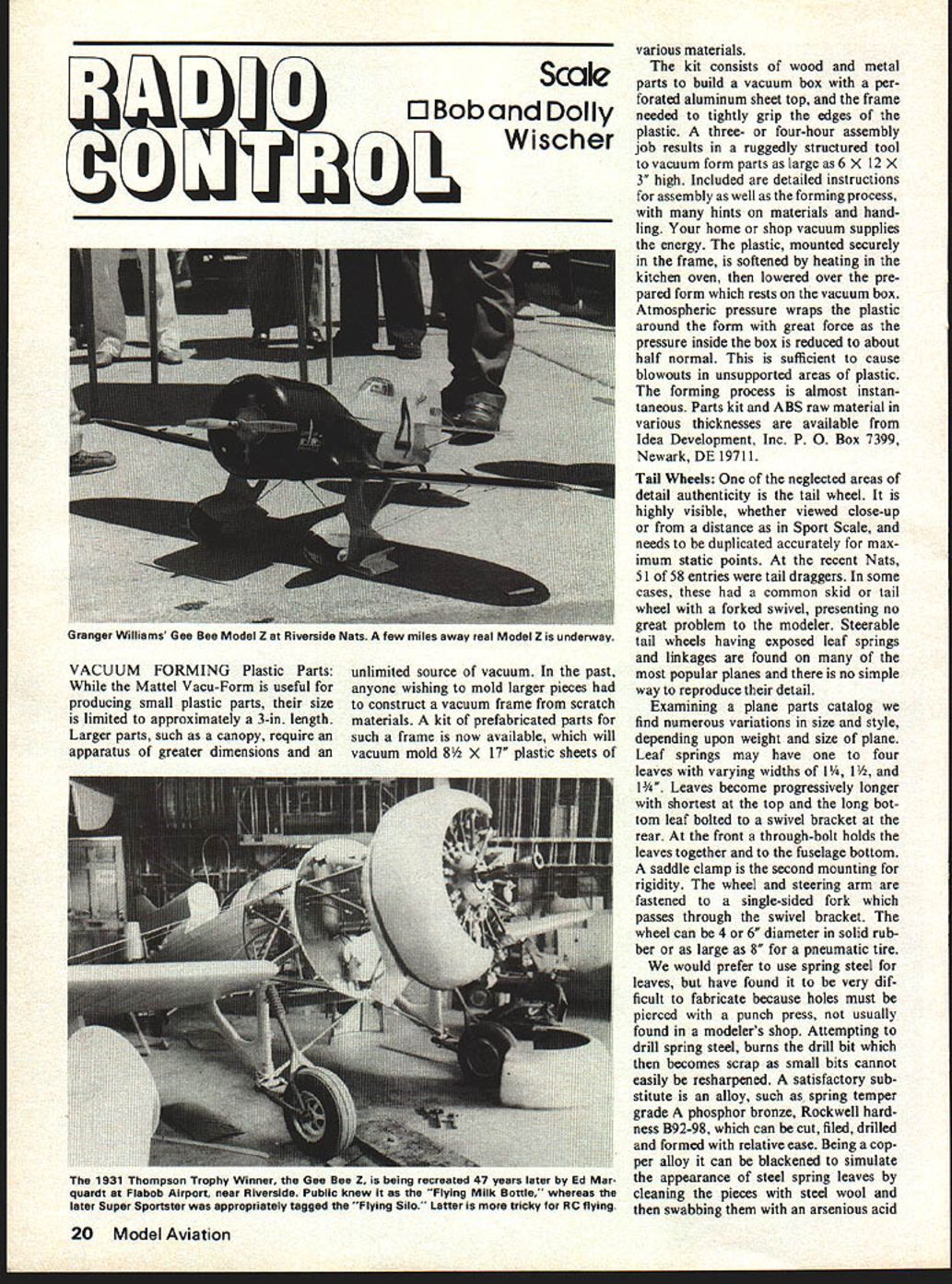
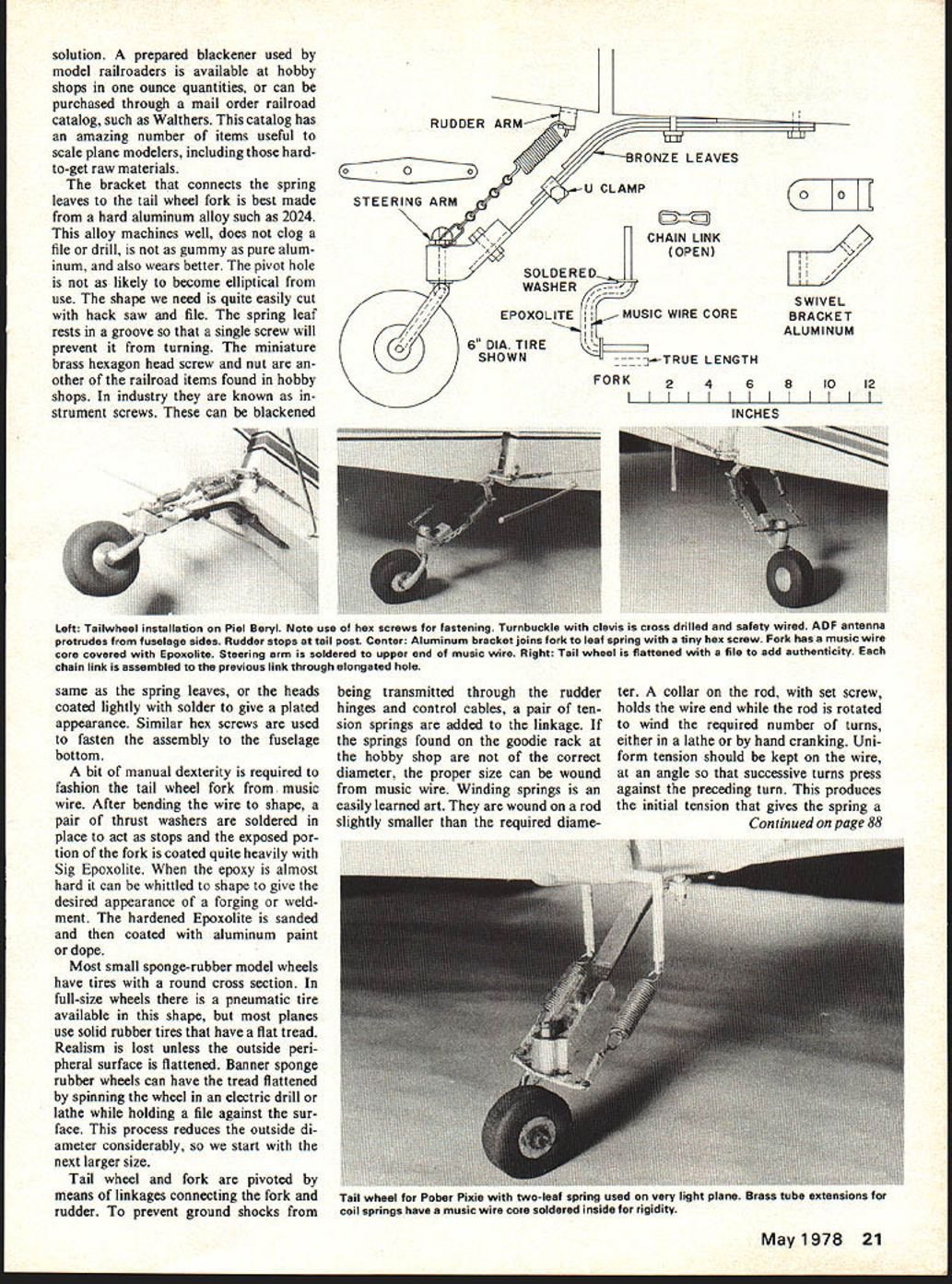
Radio Control: Scale
Bob and Dolly Wischer
VACUUM FORMING Plastic Parts: While the Mattel Vacu-Form is useful for producing small plastic parts, their size is limited to approximately a 3-in. length. Larger parts, such as a canopy, require an apparatus of greater dimensions and an unlimited source of vacuum. In the past, anyone wishing to mold larger pieces had to construct a vacuum frame from scratch materials. A kit of prefabricated parts for such a frame is now available, which will vacuum mold 8-1/2 X 17" plastic sheets of various materials.
The kit consists of wood and metal parts to build a vacuum box with a perforated aluminum sheet top, and the frame needed to tightly grip the edges of the plastic. A three- or four-hour assembly job results in a ruggedly structured tool to vacuum form parts as large as 6 X 12 X 3" high. Included are detailed instructions for assembly as well as the forming process, with many hints on materials and handling. Your home or shop vacuum supplies the energy. The plastic, mounted securely in the frame, is softened by heating in the kitchen oven, then lowered over the prepared form which rests on the vacuum box. Atmospheric pressure wraps the plastic around the form with great force as the pressure inside the box is reduced to about half normal. This is sufficient to cause blowouts in unsupported areas of plastic. The forming process is almost instantaneous. Parts kit and ABS raw material in various thicknesses are available from Idea Development, Inc. P. O. Box 7399, Newark, DE 19711.
Tail Wheels: One of the neglected areas of detail authenticity is the tail wheel. It is highly visible, whether viewed close-up or from a distance as in Sport Scale, and needs to be duplicated accurately for maximum static points. At the recent Nats, 51 of 58 entries were tail draggers. In some cases, these had a common skid or tail wheel with a forked swivel, presenting no great problem to the modeler. Steerable tail wheels having exposed leaf springs and linkages are found on many of the most popular planes and there is no simple way to reproduce their detail.
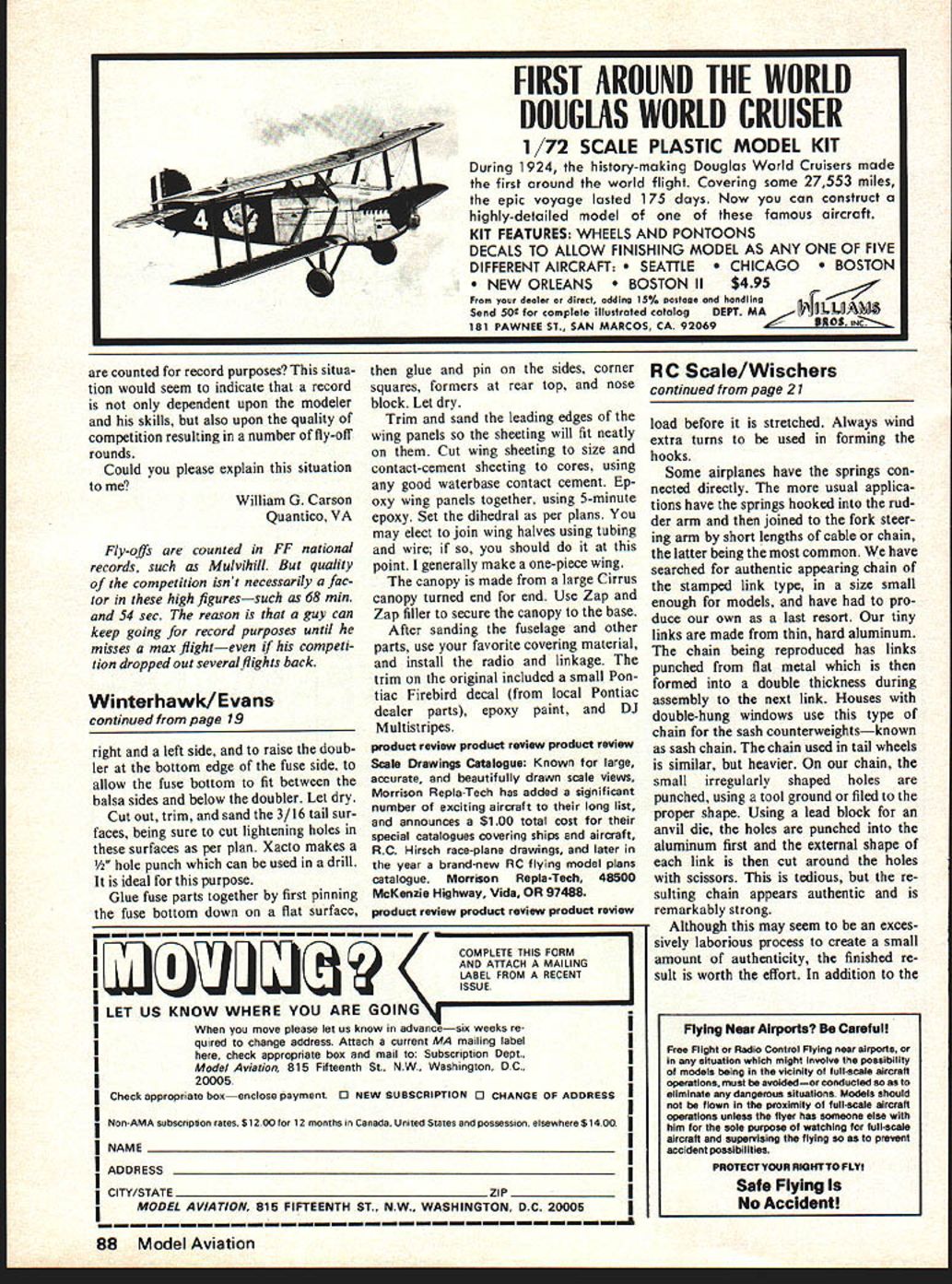
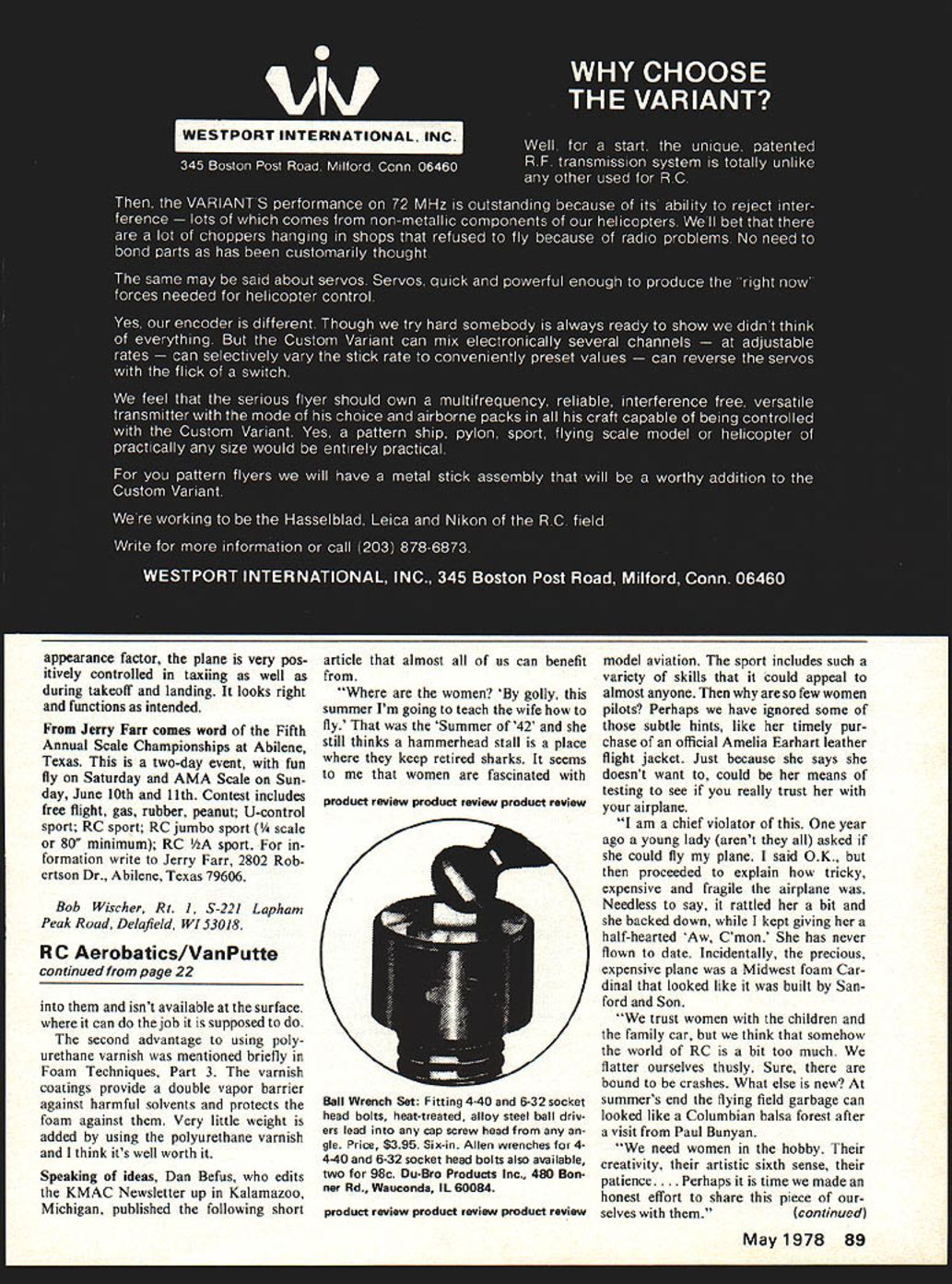
Examining a plane parts catalog we found numerous variations in size and style, depending upon weight and size of plane. Leaf springs may have one to four leaves with varying widths of 1¼, 1½, and 1¾". Leaves become progressively longer with shortest at the top and the long bottom leaf bolted to a swivel bracket at the rear. At the front a through-bolt holds the leaves together and to the fuselage bottom. A saddle clamp is the second mounting for rigidity. The wheel and steering arm are fastened to a single-sided fork which passes through the swivel bracket. The wheel can be 4 or 6" diameter in solid rubber or as large as 8" for a pneumatic tire.
We would prefer to use spring steel for leaves, but have found it to be very difficult to fabricate because holes must be pierced with a punch press, not usually found in a modeler's shop. Attempting to drill spring steel, burns the drill bit which then becomes scrap as small bits cannot easily be resharpened. A satisfactory substitute is an alloy, such as spring temper grade A phosphor bronze, Rockwell hardness B92-98, which can be cut, filed, drilled and formed with relative ease. Being a copper alloy it can be blackened to simulate the appearance of steel spring leaves by cleaning the pieces with steel wool and then swabbing them with an arsenious acid. A prepared blackener used by model railroaders is available at hobby shops in one ounce quantities, or can be purchased through a mail order railroad catalog, such as Walthers. This catalog has an amazing number of items useful to scale plane modelers, including those hard-to-get raw materials.
The bracket that connects the spring leaves to the tail wheel fork is best made from a hard aluminum alloy such as 2024. This alloy machines well, does not clog a file or drill, is not as gummy as pure aluminum, and also wears better. The pivot hole is not as likely to become elliptical from use. The shape we need is quite easily cut with hack saw and file. The spring leaf rests in a groove so that a single screw will prevent it from turning. The miniature brass hexagon head screw and nut are another of the railroad items found in hobby shops. In industry they are known as instrument screws. These can be blackened same as the spring leaves, or the heads coated lightly with solder to give a plated appearance. Similar hex screws are used to fasten the assembly to the fuselage bottom.
A bit of manual dexterity is required to fashion the tail wheel fork from music wire. After bending the wire to shape, a pair of thrust washers are soldered in place to act as stops and the exposed portion of the fork is coated quite heavily with Sig Epoxolite. When the epoxy is almost hard it can be whittled to shape to give the desired appearance of a forging or weldment. The hardened Epoxolite is sanded and then coated with aluminum paint or dope.
Most small sponge-rubber model wheels have tires with a round cross section. In full-size wheels there is a pneumatic tire available in this shape, but most planes use solid rubber tires that have a flat tread. Realism is lost unless the outside peripheral surface is flattened. Banner sponge rubber wheels can have the tread flattened by spinning the wheel in an electric drill or lathe while holding a file against the surface. This process reduces the outside diameter considerably, so we start with the next larger size.
Tail wheel and fork are pivoted by means of linkages connecting the fork and rudder. To prevent ground shocks from being transmitted through the rudder hinges and control cables, a pair of tension springs are added to the linkage. If the springs found on the goodie rack at the hobby shop are not of the correct diameter, the proper size can be wound from music wire. Winding springs is an easily learned art. They are wound on a rod slightly smaller than the required diameter. A collar on the rod, with set screw, holds the wire end while the rod is rotated to wind the required number of turns, either in a lathe or by hand cranking. Uniform tension should be kept on the wire, at an angle so that successive turns press against the preceding turn. This produces the initial tension that gives the spring a
Radio Control: Scale
load before it is stretched. Always wind extra turns to be used in forming the hooks.
Some airplanes have the springs connected directly. The more usual applications have the springs hooked into the rudder arm and then joined to the fork steering arm by short lengths of cable or chain, the latter being the most common. We have searched for authentic appearing chain of the stamped link type, in a size small enough for models, and have had to produce our own as a last resort. Our tiny links are made from tin, hard aluminum. The chain being reproduced has links punched from flat metal which is then formed into a double thickness during assembly to the next link. Houses with double-hung windows use this type of chain for the sash counterweights—known as sash chain. The chain used in tail wheels is similar, but heavier. On our chain, the small irregularly shaped holes are punched, using a tool ground or filed to the proper shape. Using a lead block for an anvil die, the holes are punched into the aluminum first and the external shape of each link is then cut around the hole with scissors. This is tedious, but the resulting chain appears authentic and is remarkably strong.
Although this may seem to be an excessively laborious process to create a small amount of authenticity, the finished result is worth the effort. appearance factor, the plane is very positively controlled in taxiing as well as during takeoff and landing. It looks right and functions as intended.
From Jerry Farr comes word of the Fifth Annual Scale Championships at Abilene, Texas. This is a two-day event, with fun fly on Saturday and AMA Scale on Sunday, June 10th and 11th. Contest includes free flight, gas, rubber, peanut; U-control sport; RC sport; RC jumbo sport (1/4 scale or 80" minimum); RC 1/2 A sport. For information write to Jerry Farr, 2802 Robertson Dr., Abilene, Texas 79606.
Bob Wischer, Rt. 1, S-221 Lapham Peak Road, Delafield, WI 53018
Transcribed from original scans by AI. Minor OCR errors may remain.

