
Radio Control
Scale
Bob & Dolly Wischer
GLOW HEAT for Older Engines: The Ross twin .60 engines were always a favorite of scale modelers because they were easily fitted into the cowl of any plane that used a flat four- or six-cylinder engine. The appearance of two cylinders through the open cowl front offered very desirable scale authenticity. The Ross carburetor was good for its day, but modern carbs afford a much greater reliability at idle. The tendency for one glow plug to cool off and quit while idling was always a possibility and the firing cylinder could not overcome the drag of the dead piston and rod while maintaining level flight in a heavy ship. The addition of airborne batteries for supplying glow heat meant adding more weight but was good insurance against an unwanted landing with only half an engine.
Red Scofield of GE Battery Division points out that a single 4-ampere nickel cadmium D cell (not the 1-1/2-amp D cell) will supply sufficient current to heat two glow plugs to a bright red when they are connected in parallel. The single cell is capable of a 10-amp discharge while the two plugs draw about 6 amps, and the limiting factor is time. A freshly charged cell has a life of only one-half hour if used continuously for heating two plugs, but the addition of a small switch operated by the throttle servo to supply power only at idle will extend the life of the cell to many flights. Glow heat is also useful for an ultra-reliable idle on single-cylinder engines. Compact switches for this application are the miniature snap action type made by Unimax or Micro, which can be actuated directly by the servo arm. The normally open contacts are used, which close when the throttle servo goes to its low position. If the engine can be started quickly with an electric starter, no external starting glow battery is needed.
The throttle control on the transmitter is moved toward idle until the click of the switch is heard and then the starter is applied. For extended hand cranking it is better to use an external battery.
The method we use for connection of the external battery is through a closed circuit miniature phone jack which breaks the circuit to the internal battery when the phone tip plug is inserted. Connections to the glow plugs are made by means of brass collars that are set-screwed to the plugs. Most important, all wiring should be no smaller than no. 18 stranded with lengths as short as possible to avoid a voltage drop. For long leads use heavier wire. Wiring and glow plugs then can be hidden inside the cowl with no need to provide holes for the glow connector. The phone jack is easily concealed. Wires from an external battery, if used, must be properly polarized so that the insertion of the phone plug does not cause a momentary short.
For reliable starting of cowled-in engines we use a pair of 4-ampere nickel cadmium batteries, either wet cells or D cells. These are connected in series with a 6-ampere diode which acts as a voltage regulator to reduce the 2.4 volts to a useable 1.4 volts. With this arrangement, we have a large supply of available current which provides a brilliant glow in either one or two plugs. Our Fox plugs last several seasons and many of our older engines still have their original plugs. Nickel cadmiums in series are a boon to winter flying as they can be used to heat the engine through the plug and will start an engine even when it is badly flooded. All connections should be made through solder lugs. The leads from battery to plane, no. 18 wire, should be kept short, 12" to 18". These ideas are intended to show an approach to the solution of the scale modeler's special problems and can be improved upon.
Other Mini Switch Applications:
Electric wheel brakes are useful when taxiing, although not a necessity. In the Precision Scale class of competition flying, the taxi maneuver to the hangar, with main wheels stopping within the marked circle, will add points. To accomplish this in a manner requiring minimum installation, a miniature snap-action switch is mounted above the elevator servo so that it is actuated by the servo arm on full down elevator. A pair of 450-mah A-A size nickel cadmium cells for 2.4 volts will energize two Aeropiccola electric brakes which are connected in parallel. The braking action with two cells will bring a 9-pound plane to a gentle stop. Three cells will provide a more drastic action but we have found that some planes will try to nose over. Brakes are never used at high speed. They are intended for taxi only.
By adding two switches to the rudder servo, to be actuated by full right or left rudder, a differential steering action can be obtained as an aid to taxiing in a high wind. The normally closed contacts are used, to be opened by full rudder servo action. The switch for the right brake is opened by left rudder. In operation, down elevator is applied to energize the brakes and then rudder, in one direction or the other, cuts off energy to the unwanted brake. In normal taxiing there is no brake action until down elevator is applied. Down elevator is used rather than up elevator because, with a tail-wheel plane, full up elevator is used for every stall landing, and brake action at landing speed is not desirable.
Individual brakes weigh slightly more than 1 ounce, 2 pen cells weigh 1 1/2 ounces, and each switch weighs 1/4 ounce for a total of about 4 ounces, not including wiring. Wire size is preferably no. 20. The A-A pen cell nickel cadmiums are charged as often as the servo flight pack. Aeropiccola electric brakes are obtainable from Hobby Lobby and other complete suppliers.
A number of years ago, circuits were published that employed the signal from unused receiver channels for proportional operation of brakes without switches. We prefer the automatic operation by actuation from existing servos. Sport Scale competitors and noncompeting fliers add brakes for their satisfaction to gain scale-like operation. From our experience, they add to realism in taxi operations. Some of our planes, without brakes, are impossible to stop on pavement with engine idling. On grass fields brakes are not really required.
First Steps into RC Scale:
We receive letters from modelers who are inspired to build, for their first radio controlled plane, a multi-engine ship with retracting landing gear and flaps, in addition to other operating features. We prefer not to discourage an ambitious person because it is possible he may eventually succeed and become active in our sport and hobby. We advise that the first attempt in RC should be a simple trainer-type plane, even when the person has had previous experience in free flight or control-line. The possibility of loss or damage during the learning process is too great and the step from control-line to radio control is more demanding than is expected. A scale model is less expendable than a trainer.
Another common question asked is in regard to sources of drawings and information about a particular prototype. The modeler has seen a photo or a small kit and desires to enlarge the drawings to a size suitable for RC and is searching for an easy and quick method or procedure. Our advice is to multiply all dimensions by a suitable factor and do the job mathematically, with an electronic calculator if available. The question of material strength when enlarging a kit can best be answered by copying what others have done on larger planes. Quite often, we search our memories and find that a drawing for the desired plane has already been published and is available through one of the plans services, or there may be a kit for the plane. For a first step in RC Scale modeling this is the way to go, using the experience of the designer to determine strength requirements and building methods.
Toledo Again:
Radio Control Scale has made rapid progress in the number of participants and credit for this must be given to the increase in Sport Scale activity. Approximately half of the products, kits and displays at Toledo this year were scale oriented, or that is what it seemed to our prejudiced outlook. Most of the new kits for large engines are scale. Large engines, as well as prop drive units for standard glow engines, are slanted toward the scale model market. Fox and Midwest were each showing two-cylinder engines. The Quadra engine was in evidence in many planes, some builders insisting it must be mounted solidly to avoid vibration problems, others equally vocal in favor of rubber mounts for identical reasons. Andy Sheber was showing a prop drive unit with a 2-to-1 reduction ratio for the Quadra engine that converts the usual 16 pounds thrust to 20 pounds.
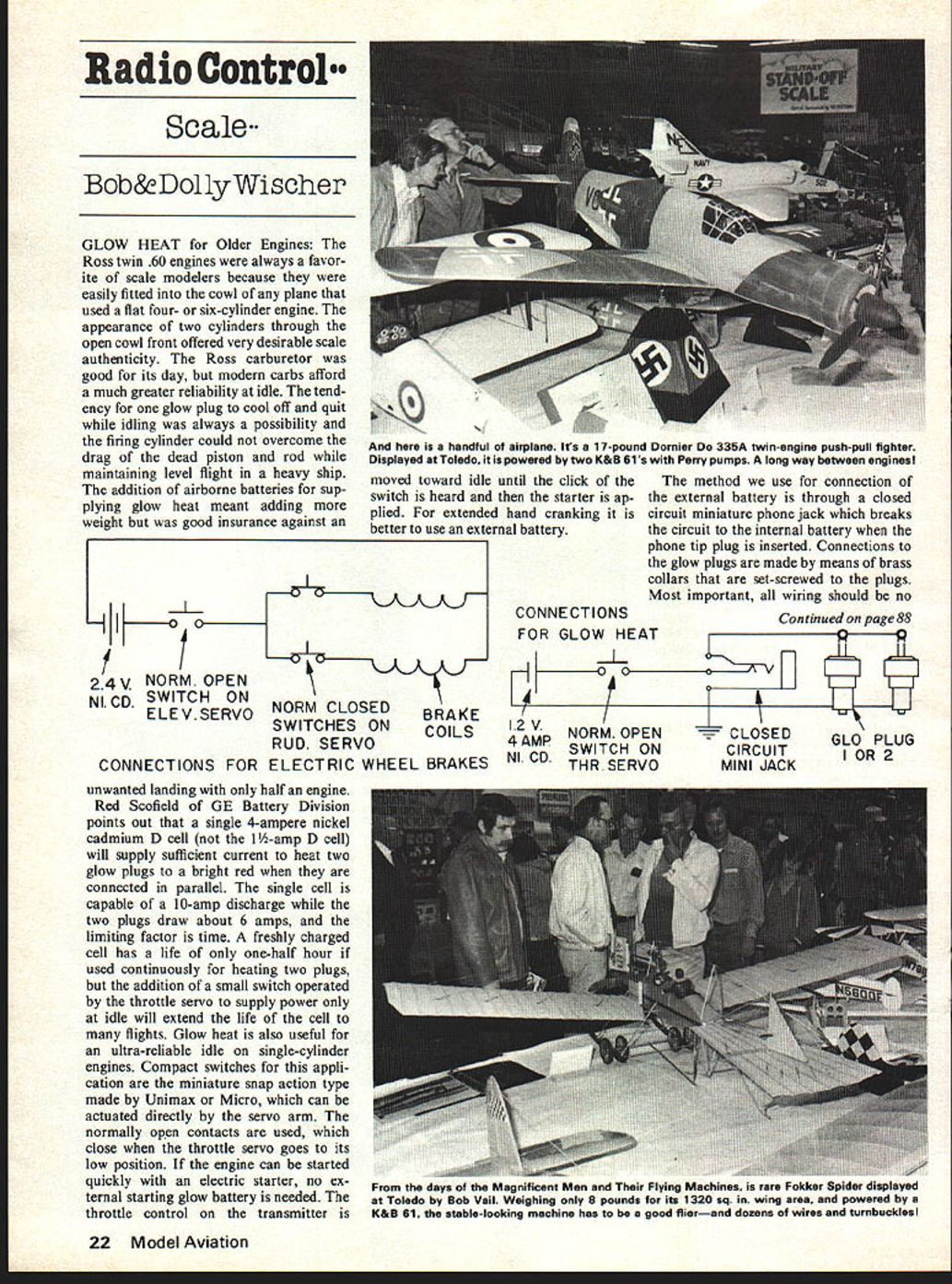
Ducted fan applications appeared in greater numbers this year. A new design by Duane Johnson will be kitted by World Engines. It employs a shrouded fan and a twin installation as shown mounted in a McDonnell Douglas F-15. Duane uses Supertigre X.40's with exhaust throttles only. The plane handles in the air very similar to a pusher ship.
Quarter-size and one-third-size models were considered large in the past. This year a half-size Aeronca Champion appeared. We heard that it weighed over 30 pounds (Editor: Some say 75 lbs.).
An exhibitor that attracted the attention of many scale modelers was the Eastcraft Specialty Products display of Lecta-Start on-board engine starters which were being used to start engines of all sizes, including Quadra. They had found a way of eliminating exhaust fumes so that engines could be started and run in the exhibit building. This product seems to spark the imagination of scale modelers and is being seen with increasing frequency at the flying field.
Bob Wischer, Rt. 1, S-221 Lapham Peak Road, Delafield, WI 53018.
Transcribed from original scans by AI. Minor OCR errors may remain.

