
Radio Control: Scale
Bob & Dolly Wischer
Practice Planes
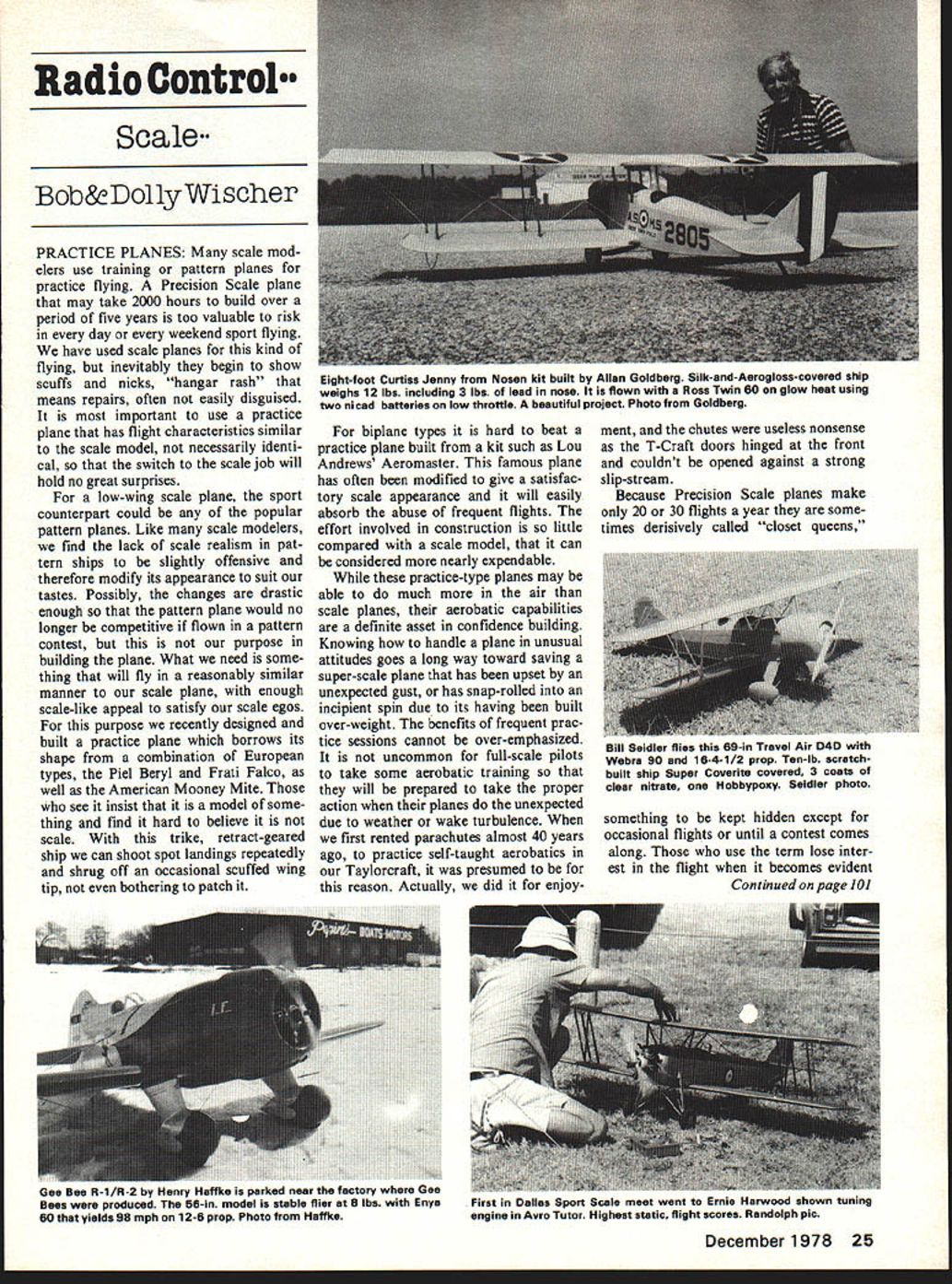
Many scale modelers use training or pattern planes for practice flying. A precision-scale plane that may take 2,000 hours to build over a period of five years is too valuable to risk in everyday or every-weekend sport flying. We have used scale planes for this kind of flying, but inevitably they begin to show scuffs and nicks—hangar rash—that means repairs, often not easily disguised. It is most important to use a practice plane that has flight characteristics similar to the scale model, not necessarily identical, so that the switch to the scale job will hold no great surprises.
For a low-wing scale plane, the sport counterpart could be any of the popular pattern planes. Like many scale modelers, we find the lack of scale realism in pattern ships slightly offensive and therefore modify their appearance to suit our tastes. Possibly the changes are drastic enough so that the pattern plane would no longer be competitive if flown in a pattern contest, but this is not our purpose in building the plane. What we need is something that will fly in a reasonably similar manner to our scale plane, with enough scale-like appeal to satisfy our scale egos.
For this purpose we recently designed and built a practice plane which borrows its shape from a combination of European types—the Piel Beryl and Frati Falco—as well as the American Mooney Mite. Those who see it insist that it is a model of something and find it hard to believe it is not scale. With this tricycle, retract-geared ship we can shoot spot landings repeatedly and shrug off an occasional scuffed wingtips, not even bothering to patch it.
For biplane types it is hard to beat a practice plane built from a kit such as Lou Andrews' Aeromaster. This famous plane has often been modified to give a satisfactory scale appearance and it will easily absorb the abuse of frequent flights. The effort involved in construction is so little compared with a scale model that it can be considered more nearly expendable.
While these practice-type planes may be able to do much more in the air than scale planes, their aerobatic capabilities are a definite asset in confidence building. Knowing how to handle a plane in unusual attitudes goes a long way toward saving a super-scale plane that has been upset by an unexpected gust, or has snap-rolled into an incipient spin due to its having been built over-weight. The benefits of frequent practice sessions cannot be over-emphasized. It is not uncommon for full-scale pilots to take some acrobatic training so that they will be prepared to take the proper action when their planes do the unexpected due to weather or wake turbulence.
When we first rented parachutes almost 40 years ago to practice self-taught aerobatics in our Taylorcraft, it was presumed to be for safety. Actually, we did it for enjoyment, and the chutes were useless nonsense as the Taylorcraft doors hinged at the front and couldn't be opened against a strong slipstream.
Because precision-scale planes make only 20 or 30 flights a year they are sometimes derisively called "closet queens"—something to be kept hidden except for occasional flights or until a contest comes along. Those who use the term lose interest in the flight when it becomes evident that it didn't crash on takeoff. The surest way for us to convince other modelers to try their hands in scale is to prevent accidents by being well practiced on other planes before attempting flights with our scale models. The often-heard excuse that scale planes are hard to fly and easily damaged or crashed is then no longer valid.
Scale Wheels
The more avid scale buffs have been making their own tires, complete with side-wall lettering, for a number of years. We first saw these at Toledo on a De Havilland Hornet built by Dario Brisighella. He displayed the machined molding dies that were used to form his tires from silicone rubber.
At the Woodvale World Championships, the first-place winning Fournier of Mick Reeves also had a handmade tire on its single landing wheel, complete with legible lettering on the sidewalls. Mick had used silicone rubber in a rather thick section to support the weight. The lettering was scale size, which is quite small and therefore difficult to engrave in the molding die. This is an example of the extensive effort required for a world-class model, and the effect of the rule which states that each FAI contest entrant must make a declaration of those items used on the plane that were not made by the builder. On most planes, wheels and tires appear on the list of parts and quite often they are the only parts purchased. For FAI or precision-scale competition every possible detail is made by the builder.
Robart is now producing their Universal Scale Wheels with lettering on the sidewalls. Hubs are molded of high-strength Lexan. Tires are low-rebound thermoplastic rubber with "Continental Deutsches Fabrikat 690 X 200" on one side and the wing-foot insignia with "Goodyear All Weather 32 X 8 Airplane" on the other side. When using these wheels, we have found it necessary for maximum realism to remove the gloss from the tire material. This happens naturally with age, but the user may wish to hasten the process by buffing with fine sandpaper or by rubbing very gently with a cloth moistened in dope thinner.
Robart now furnishes instructions for three alternative methods of inflating the tires to withstand the load of heavier scale models. These include the use of dry ice or Alka-Seltzer as pressurizing agents. Also described is the old method of refrigerating the wheel to cause contraction of the air with the sealing screws loosened. The screws are then rapidly tightened and the trapped air expands at room temperature to pressurize the tire.
The hub discs furnished by Robart can be modified to more closely resemble prototype wheels by reworking them. The center of the disc can be removed by drilling and filing to leave a rim. A new disc of plywood or styrene plastic is then epoxied to the back to give depth to the hub disc. Small bits of tubing and hex screw heads are then epoxied in place. This is an ideal use for the new Hobbypoxy thixotropic epoxy glue which stays put when applied and does not run. The discs are painted with dull aluminum Floquil to resemble the wheel castings of the prototype. The appearance improvement is worthwhile, even for a sport-scale plane, where the detail can be seen from a distance.
A problem we have had with the Robart tires is the flat spot that occurs on the tires when a model stands in one position for a prolonged period. We solved this by making a balsa stand to support the plane at the axles to remove the load from the tires. The flat spot is difficult to remove and the model will bounce unrealistically while taxiing if the flats persist. Pressurizing helps round out a flattened tire. Another method suggested by Mike Gertz is to stuff Robart tires with firm poly foam, in preference to frequent inflation. We have also used two sets of wheels, one for display and the other for flying. The display tires are stuffed with balsa discs, cut into segments for easy assembly. They would not be suitable for flying as they are very hard and would absorb no landing shock.
Flap Effectiveness
The use of flaps on prototype airplanes has become so common that almost any model of a modern plane will likely use them. There seems to be no agreement between modelers as to their effect on takeoff or landing and, in our experience, this is no surprise. Even between similar planes the effect of flaps is hard to predict until the plane is flown. On one plane they are a complete disappointment as they seem to have no effect whatever, while another plane is definitely slowed when flaps are applied. Very likely there is a good explanation for the variation, but our lack of aerodynamic knowledge obscures the reason.
There is an increase in lift and drag when flaps are lowered. If the model is flying at or near cruising speed, the increase in lift will cause a momentary climb or ballooning. At the same time the additional drag will slow the plane and cause a steepening of the glide angle. The steeper angle, for a modeler attempting a spot landing, is an advantage as it makes the point of touchdown more predictable. On some planes there is an additional effect of an increase in stability when flaps are lowered. The plane seems to find a groove where it is undisturbed by wind conditions. Having been slowed by drag, the controls become less effective and small stick movements have less effect on the glide path.
Most of the advantages of flaps on full-scale planes are of small consequence on a model. This is especially true when flaps are used on takeoff. There is no good reason to increase drag and models do not require an increase in lift, except for the four-engine, 120-pound monsters with marginal power we have seen recently.
If the addition of flaps and their actuating mechanism with a servo adds a large amount of weight to the model, it could very well nullify any benefits derived from their use. The trim change when flaps are lowered could be a source of problems at a time when it is least appreciated. This is especially true if the contest judges ask for a low-level fly-by flap demonstration.
We have not yet seen a model using Fowler flaps as employed on modern jet airliners. With these there is an increase in wing area as well as an effective change in angle of incidence. A model using such flaps would most likely be quite large and the flaps could be effective.
FAI Scale Meeting
At the Woodvale Scale World Championships a meeting of the CIAM Scale Subcommittee was called by chairman Helmut Zeigler to discuss the following items:
- No downgrading of realism in flight would occur because of a visible receiver antenna, unless it spoiled the plane's appearance drastically.
- A plane damaged during flight could be repaired by a group rather than by the builder alone without violating the "builder of the model" rule, because it was reasoned that the plane had already been static judged.
- Electric starters carried in the plane and actuated by radio signal would not be awarded points for engine starting on the ground unless the starter had been constructed by the contestant. Restarting the engine in the air would be eligible for receiving a score if this was normally done by the prototype, such as the Fournier and Ryson-powered gliders. The final decision on ground starts would rest with the judges at the contest.
- The rule to require a ten-second straight flight will be amended so that the starting point for the maneuver need not be over the landing circle. This avoids the problem of a very fast plane going out of sight in ten seconds.
- The judges should have the right to require a contestant to demonstrate his retracting landing gear in the air and in full view. The operation is difficult to see when the plane is at a distance after takeoff and the judges should be aware of cycle time and the time lag between retracting gear legs.
- In calling maneuvers, the landing need not be called separately unless it is an emergency, such as occurs when an engine dies.
- The question of definition of a biplane for scoring under the new complexity-bonus system would be left to the judges. A stub wing or a very small wing of a sesquiplane would not make the plane a biplane in the true sense.
Bob and Dolly Wischer Rt. 1, S-221 Lapham Peak Road, Delafield, WI 53018
Transcribed from original scans by AI. Minor OCR errors may remain.

