
Radio Control: Scale
Bob & Dolly Wischer
Instability Revisited
The model is a splendid example of scale beauty, the culmination of a year's earnest effort, and this is the moment the builder has awaited. The excitement builds as the engine is started, the needle valve set to the optimum, and all controls checked. The plane is taxied to take-off position, throttle opened, it accelerates down the runway, lifts off too early, flips on its back, and with a sickening sound returns to earth with parts scattering. Why? What happened? Was it pilot error or a hidden flaw in construction? Radio problems? Probably none of these was the real culprit here.
Too often we hear of models that are difficult to handle, whether kit or scratch built. The complaint most heard involves a tendency to snap-roll, usually during takeoff, landing, or turning maneuvers. Numerous faults in construction or balance can result in the destructive snap-roll.
Causes of snap-rolls
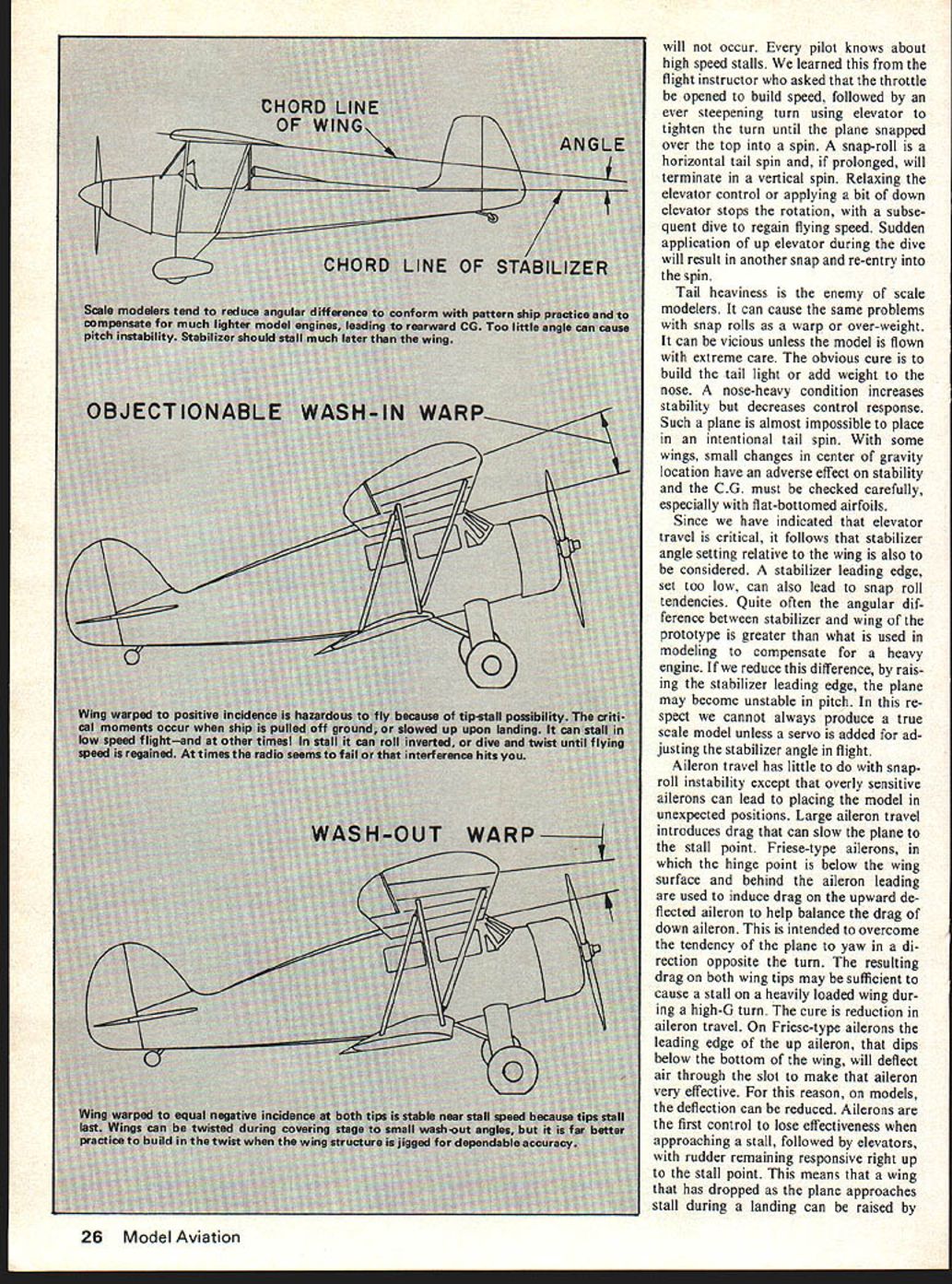
- Warped wings. Warps caused by working on a warped bench or by overly tight covering can produce wash-in (angle of incidence increases toward the tip). This makes the tips stall before the root, causing sudden tip stall and a snap-roll, especially in slow flight (takeoff, landing, or steep turns).
- Over-weight models and excessive elevator travel. An under-powered, over-burdened wing can be stalled by an imperceptible stick movement. The pilot may instinctively pull back rather than push forward to regain speed, resulting in a snap-roll.
- Tail heaviness. A tail-heavy model behaves like a warped or over-weight model and can be viciously unstable.
- Misplaced center of gravity (C.G.). Small changes in C.G., particularly with some wing sections (flat-bottom airfoils), can adversely affect stability.
- Stabilizer angle set incorrectly. A stabilizer leading edge set too low relative to the wing can lead to snap-roll tendencies.
- Aileron design and travel. Overly sensitive ailerons or excessive aileron travel can place the model in unexpected attitudes or introduce drag that contributes to a stall during high-G turns.
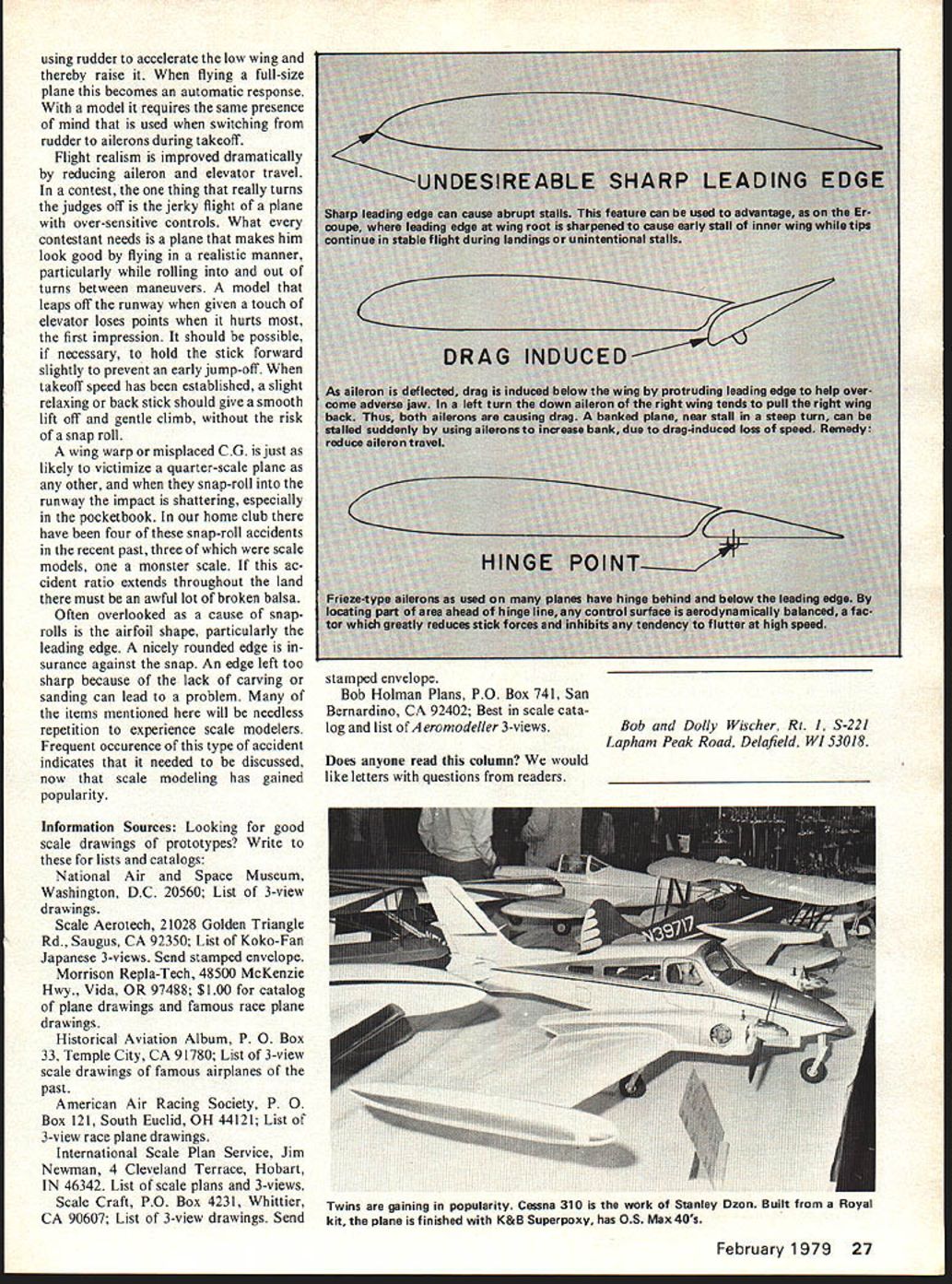
- Airfoil leading edge. A sharp or insufficiently rounded leading edge can promote sudden stalls; a well-rounded edge is insurance against snaps.
Wash-in vs. wash-out — design remedies
Warps are common causes of snap-rolls. The cure is prevention: work on a flat surface and use low-shrink covering materials and dope. Where design changes are acceptable:
- Use wash-out. The prototype method of wash-out (reducing incidence toward the tip so tips stall after root) should be used on models to ensure positive lateral stability. Wash-out also helps with inverted flight by reducing snap tendency.
- Increase tip thickness. On a tapered wing, increase tip airfoil thickness (for example, root ~13% chord, tip ~14–15% chord) so the root stalls before the tip. When building foam cores, proper templates make the transition easy.
Our Emeraude has a built-in 3-1/2-degree wash-out at the tips to prevent tip stall.
Weight, elevator travel, and handling
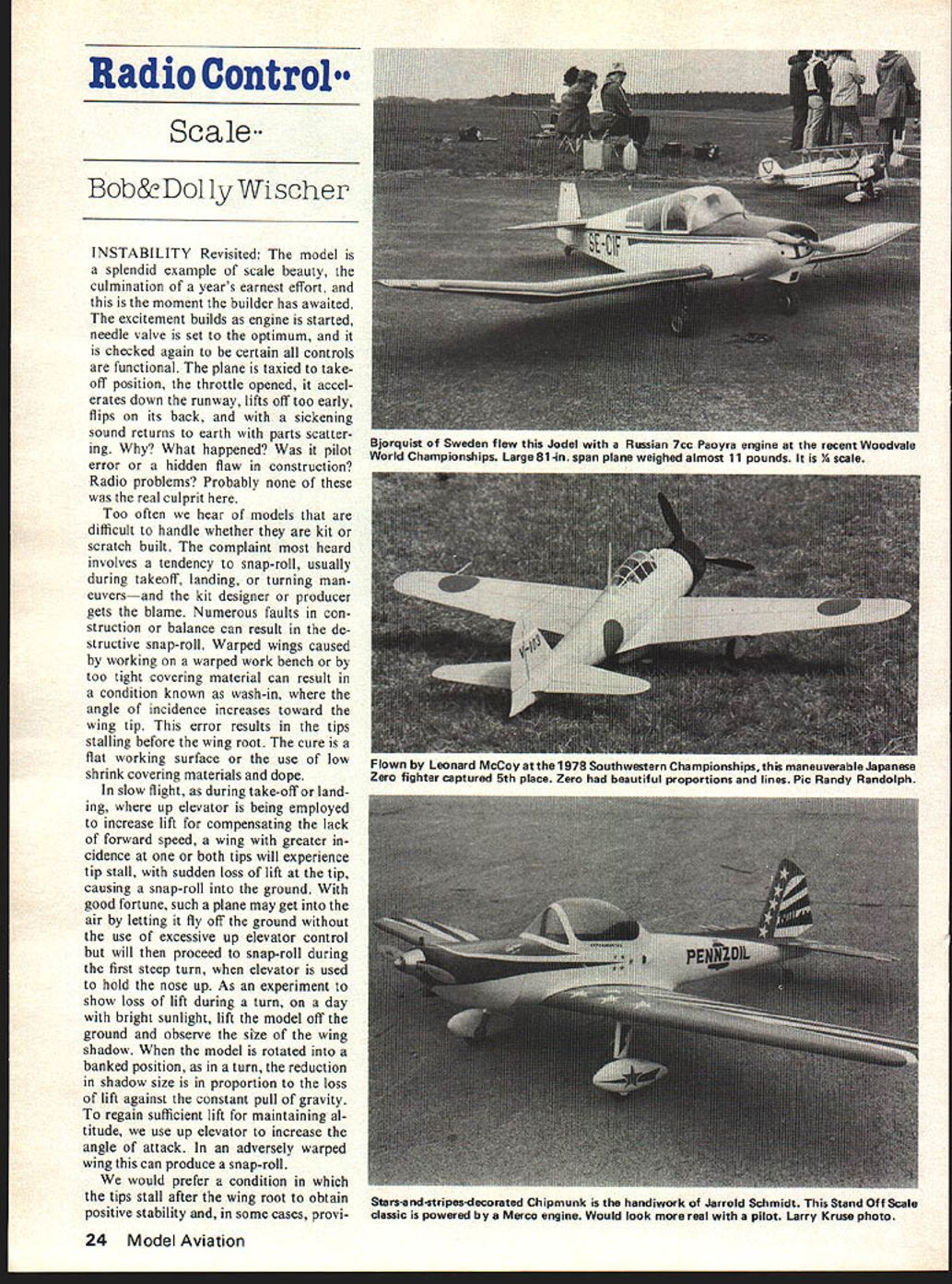
Of 23 planes flown in the recent Scale World Championships at Woodvale, only two were under ten pounds and most were near the 11-pound limit (13 pounds in 1979). With large enough wing area these weights are permissible, but high weight combined with low wing area and an undetected warp can spell disaster.
Elevator travel is critical. For example, a 10-pound plane with one inch of elevator travel from neutral may snap-roll at the bottom of a loop where speed and G-forces are greatest. Reducing elevator travel and flying larger loops can cure the problem; in one case we had to cut elevator travel in half and add a longer elevator horn to regain safe handling.
Taxiing with flaps or up-elevator to increase lift at low speed is dangerous if tips have greater incidence — tip stall can occur before liftoff and cause a snap-roll. Once airborne, excessive up-elevator in steep turns can produce the same effect.
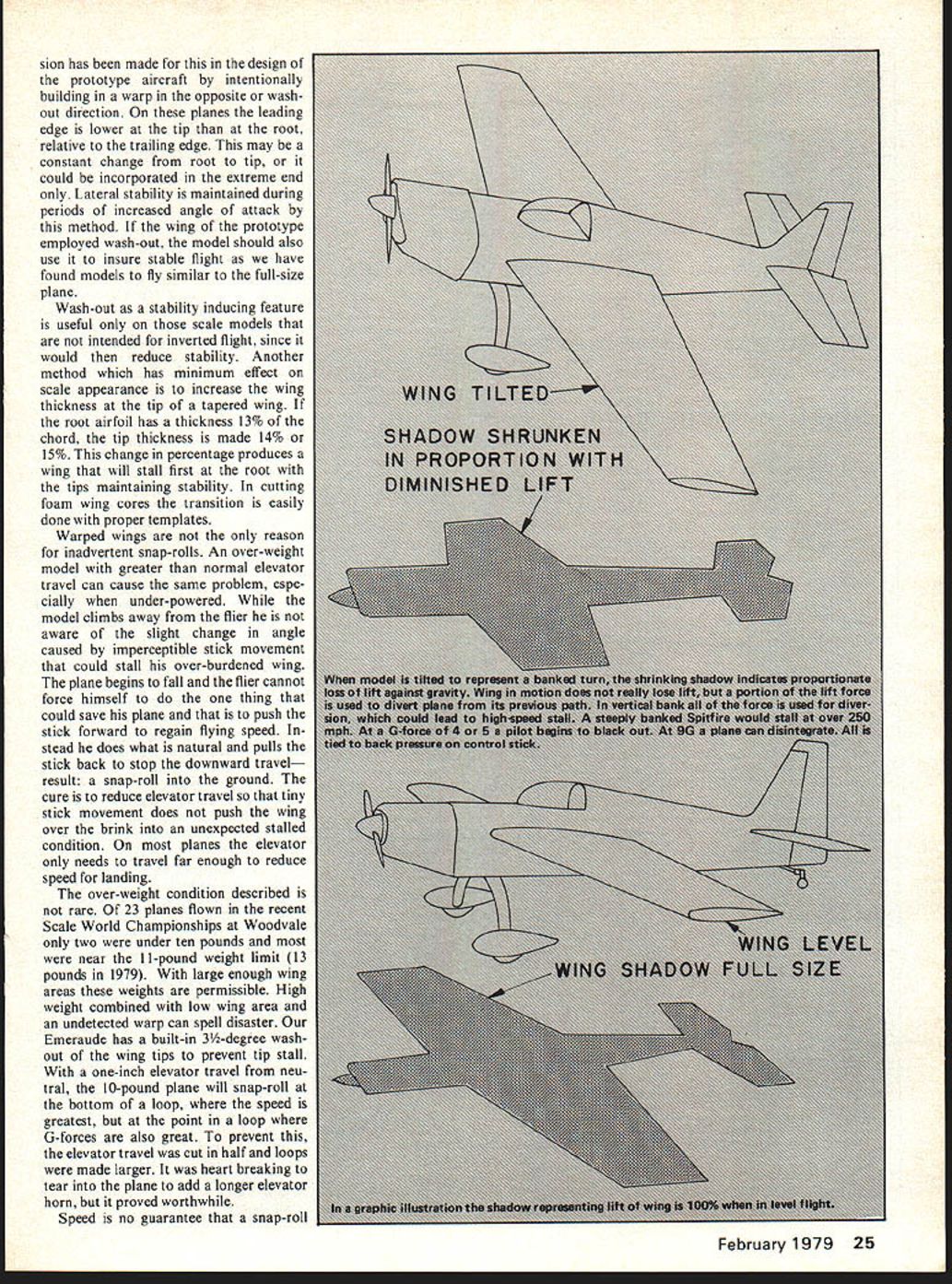
As a simple experiment to demonstrate loss of lift in a turn: on a bright sunny day lift the model off the ground and observe the size of the wing shadow. When the model is banked, the reduction in shadow size is proportionate to the loss of lift against gravity. To maintain altitude the pilot uses up-elevator to increase angle of attack; in an adversely warped wing this can induce a snap-roll.
High-speed stalls and recovery
Every pilot knows about high-speed stalls. One instructive drill is to open the throttle to build speed, then tighten the turn with increasing elevator until the plane snaps over into a spin. A snap-roll is essentially a horizontal tail spin and, if prolonged, can become a vertical spin. Relaxing or applying a bit of down elevator stops the rotation, followed by a dive to regain flying speed. Sudden application of up elevator during the dive will cause another snap and re-entry into the spin.
Tail heaviness and C.G.
Tail heaviness is the enemy of scale modelers. It can cause snap-rolls like those from warps or overweight. The obvious cures are to keep the tail light or add nose weight. A nose-heavy model is more stable but less responsive; it is almost impossible to place such a plane into an intentional tail spin. Check C.G. carefully, especially with flat-bottom airfoils where small shifts have large effects.
Stabilizer angle and in-flight adjustment
Because elevator travel and stabilizer angle affect pitch stability, set the stabilizer relative to the wing carefully. Many full-size prototypes have stabilizer/wing angle differences greater than is commonly used in models to compensate for heavy engines. Reducing that difference (raising the stabilizer leading edge) can make the model pitch-unstable. To be perfectly scale, an in-flight adjustable stabilizer (servo-adjusted) may be necessary.
Ailerons, Frise types, and control effectiveness
Aileron travel by itself has little to do with snap-roll instability, except that overly sensitive ailerons can place the model in unexpected attitudes. Large aileron deflections increase drag and can slow the plane toward stall. Frise-type ailerons (hinge below the wing surface, trailing the aileron leading edge) induce drag on the upward deflected aileron to counter adverse yaw; however, the added drag on a heavily loaded wing during a high-G turn may be sufficient to cause a stall. The cure is reduced aileron travel.
On Frise ailerons, the up aileron's leading edge dips below the wing bottom and deflects air through the slot, increasing effectiveness; therefore, model deflection can be reduced. Ailerons are the first control to lose effectiveness approaching a stall, then elevators, while rudder usually remains responsive up to the stall. If a wing drops on approach, using rudder to accelerate the low wing can help raise it. This requires the same presence of mind as switching from rudder to aileron during takeoff.
Flight realism and contest handling
Flight realism is dramatically improved by reducing aileron and elevator travel. In contest flying, jerky flight from over-sensitive controls turns judges off. Competitors need models that make them look good by flying realistically, particularly rolling into and out of turns between maneuvers. A model that leaps off the runway at a touch of elevator loses points from the very first impression. It should be possible to hold the stick forward slightly to prevent an early jump-off; when takeoff speed is established, a slight relaxing or back stick should give a smooth lift-off and gentle climb without snap-roll risk.
A wing warp or misplaced C.G. can equally victimize a quarter-scale plane, and when they snap-roll into the runway the impact is shattering—especially to the pocketbook. In our club there have been four snap-roll accidents recently, three of them scale models and one a very large scale. If this ratio is widespread, there's an awful lot of broken balsa.
Airfoil shape
Often overlooked is the airfoil leading edge. A nicely rounded leading edge is insurance against snap-rolls. An edge left too sharp because of lack of carving or sanding can lead to problems.
Many of these items will be needless repetition to experienced scale modelers, but the frequent occurrence of this type of accident indicates the subject needed discussion now that scale modeling has gained popularity.
Information Sources
Looking for good scale drawings of prototypes? Write to these for lists and catalogs:
- National Air and Space Museum, Washington, D.C. 20560 — List of 3-view drawings.
- Scale Aerotech, 21028 Golden Triangle Rd., Saugus, CA 92350 — List of Koko-Fan Japanese 3-views. Send stamped envelope.
- Morrison Repla-Tech, 48500 McKenzie Hwy., Vida, OR 97488 — $1.00 for catalog of plane drawings and famous race plane drawings.
- Historical Aviation Album, P.O. Box 33, Temple City, CA 91780 — List of 3-view scale drawings of famous airplanes of the past.
- American Air Racing Society, P.O. Box 121, South Euclid, OH 44121 — List of 3-view race plane drawings.
- International Scale Plan Service, Jim Newman, 4 Cleveland Terrace, Hobart, IN 46342 — List of scale plans and 3-views.
- Scale Craft, P.O. Box 4231, Whittier, CA 90607 — List of 3-view drawings. Send stamped envelope.
- Bob Holman Plans, P.O. Box 741, San Bernardino, CA 92402 — Best in scale catalog and list of Aeromodeller 3-views.
Does anyone read this column? We would like letters with questions from readers.
Bob and Dolly Wischer Rt. 1, S-221 Lapham Peak Road Delafield, WI 53018
Transcribed from original scans by AI. Minor OCR errors may remain.

