
Radio Control: Scale
Bud Atkinson
A FUNNY THING happened at the contest the other day! It seems Stand-off Scale is attracting many types of aircraft — which is good. We want all flying machines to be able to compete, and that's what it's all about! Now, at a contest this summer a serious modeler asked if he could enter a helicopter in Stand-off Scale. He, or anyone else, should not be denied to enter anything, be it a helicopter or an ornithopter (that's a wing-flapper, son!) and everything in between.
The problem is that our rules, as they stand, are more or less for a conventional-type aircraft. I think we need to expand on Stand-off, and on AMA Scale rules, to somehow allow the more or less unorthodox aircraft, maybe, a set of side rules, so to speak. Helicopters can't and don't, as a rule, loop or roll. I know it's been done by Mike Bosh of Germany. I saw it performed at last year's Nats, but generally speaking, full-size 'copters don't and can't do maneuvers like these. Here, also, is a point to bring up on standard fixed-wing aircraft; some reasonable proof should be given for maneuvers performed by the full-size aircraft. I'm sure a C-47 didn't do rolls or a J-3 Cub outside-loops — but back to the unorthodox aircraft.
I have done some model 'copter flying myself and am acquainted with what the average 'copter can do compared to its full-size counterpart. For instance, smooth take-off, the mandatory maneuver figure-eight, fly-by, etc. A 'copter can do straight out and return, touch-and-go — say a spot touch, or set down and go, or take-off. They are capable of wing-over (without wings — I think you know what I mean), be judged on hover ability, cargo pick up, rocket firing or bomb drop. I'm sure you other bugs can come up with realistic helicopter maneuvers. How about it, Walt Schoonard, old buddy? The essence of the whole thing is to allow everyone and every type aircraft. How about the Hindenburg in that other magazine; wouldn't that be something as a dirigible? But I don't know how one pilot could fly five transmitters as required on the movie model. Scale is expanding by leaps and bounds and can become even more popular. After all, what do the spectators at a contest want to see? Realism, that's what. So, readers, let your wishes be known to your scale contest board members.
Here is something of interest to all scale builders: RC AMA and Stand-off Scale, and, I'm sure, Control-line Scale. Ira Keeler, 330 Azalea Way, Vacaville, Calif. 95688, is custom building scale props from a Nieuport to a B-17 and just about any other aircraft. These scale props are hand-carved of hardwood and are very detailed. He also will lathe turn scale spinners. He has a listing of 20-25 of the more standard aircraft props, such as P-51, Spitfire, Hellcat, etc.
Helicopters
ALMOST EVERYONE has a pet engine that they invariably install in each new model they build. This will, in most cases, fulfill the power needs of the particular model; however, the helicopter is a different breed. To start with, your favorite engine ran out in front of the fast-moving model and was never loaded until vertical climb was called for. Also, it had an 11-12 in. fan turning somewhere near 12,000 rpm, forcing a great deal of cool, fresh air over the head. These are ideal conditions for your favorite engine.
None of this holds true in a helicopter. To start with, the engine is usually completely closed in and has a loaded condition from about 4,000 to 14,000 rpm. It also has a muffler radiating heat like a pot-belly stove. The cooling fan is never more than 3 to 4 in. in diameter and quite inefficient. The end result is that your favorite engine has created an unbelievable lack of power problem. This lack of power makes for sloppy control, lack of blade speed, and an untrimmable helicopter. Because the machine won't lift off the tail swings around opposite rotor direction; begin to add pitch to main and tail-rotor, the problem gets worse. You then tweak the needle valve to get a few revs, the engine gets hotter, so do you! After flyless days you conclude fault at the crazy machines. A friend told me I would fly anyhow. Crazy machines will fly beyond your wildest imagination.
Never too much power is the answer. I don't mean to put down any particular helicopter, but if the machine is designed around one specific engine, it is going to be a problem sooner or later when you need more power and have to re-engineer the whole set-up.
Walt Schoonard
We have discussed the problem at length, and now it is time to talk about a solution. The solution is a Schnuerle-ported engine, and the best two so far are the Webra Speed and the O.S. Max Schnuerle. These engines run very cool and have a broad power curve and produce amazing power even when running blubbering rich. At a recent Florida RC Helicopter fly-in, there were at least three well-built, properly set up helicopters that the experts could not get to fly because they were victims of the pet engine problem. There were a couple of others that were limited to a specific engine that could hardly fly even in the hands of experts. Duplicates of the machines flying all day long — the only difference, to speak of, was that they had plenty of power from Schnuerle engines. He will make any prop or spinner, so send for the listing he has at the above address.
If he doesn't have your prop he can make it, but will have to have pictures and complete information concerning your special scale prop. I have seen one of his scale props for a T-28 and it was a beauty. I believe a nice scale prop really enhances a fine scale ship, be it AMA or Stand-off. I know there are no points as such for scale props in Stand-off. Under general appearance, if you were a judge, I'm sure you would award an airplane points with a nice scale-like prop over a flying prop. It's like a pilot versus no pilot. Oh yes, Ira's WWI props are of laminated wood, using correct wood. How about that scale fans?
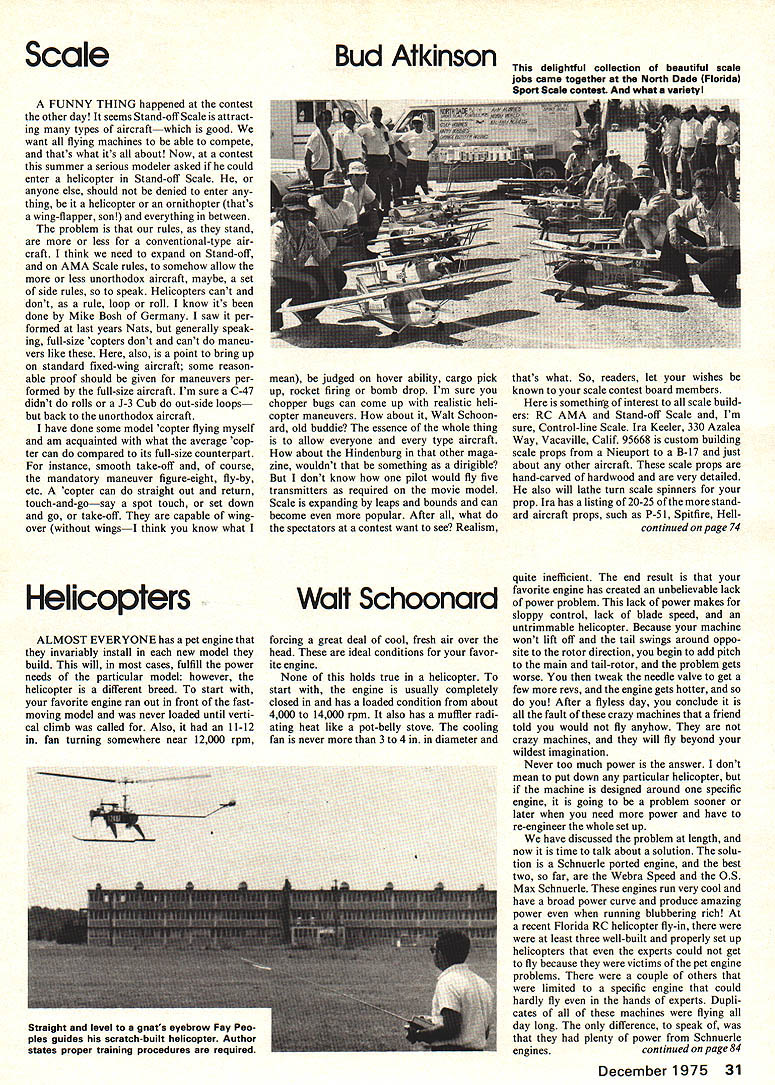
One of the early Spring Stand-Off Scale contests held this year was the North Dade RC club contest of North Miami, Fla., held at Amelia Earhart field in North Dade. By the information sent me by George Hall, the club president, a fine turn-out was on hand in ideal weather and, by the picture George sent, a real variety of fine scale birds were there. My old buddy, Harold Bronstein, who is a past Tangerine Grand Champion and an ardent scale flier, was the CD for the contest. The contest was broken down into two classes A and B, I assume Expert and Novice. The A winners were 1st, Dave Platt, FW-190 (what else?); 2nd, Art Johnson, P-82; and Joe Hancock, Waco YMF-5 taking 3rd. B-class winners were James Homer, 1st, with a beautiful Liberty Sport; Pete Hendricks, 2nd, with a Cessna 206; and third was 14-year-old John Tanner with a Cessna 150. I'm elated over the variety of aircraft.
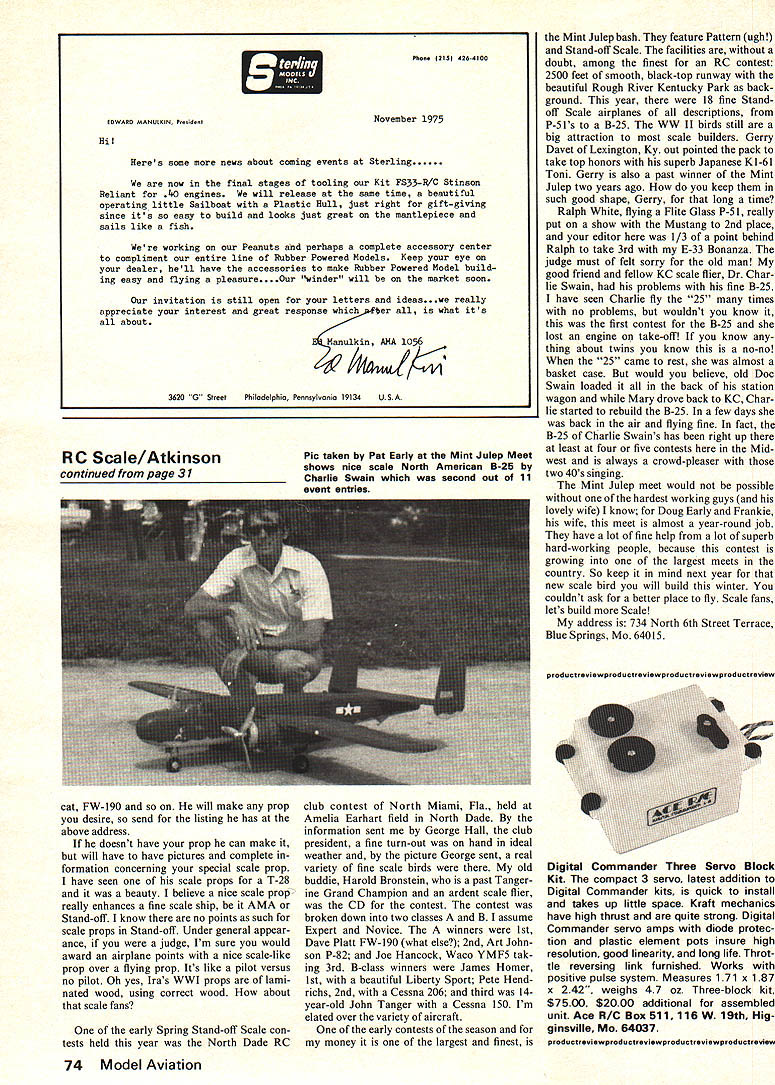
The Mint Julep bash. They feature Pattern (ugh!) and Stand-off Scale. The facilities are, without a doubt, among the finest for an RC contest: 2,500 feet of smooth, black-top runway with the beautiful Rough River Kentucky Park as background. This year, there were 18 fine Stand-off Scale airplanes of all descriptions, from P-51's to a B-25. The WWII birds still are a big attraction to most scale builders. Gerry Davet of Lexington, Ky. out pointed the pack to take top honors with his super Japanese Ki-61 Tony. Gerry is also a past winner of the Mint Julep two years ago. How do you keep them in such good shape, Gerry, for that long a time?
Ralph White, flying a Flite Glass P-51, really put on a show with the Mustang to 2nd place, and your editor here was 1/3 of a point behind Ralph to take 3rd with my E-33 Bonanza. The judge must have felt sorry for the old man! My good friend and fellow RC scale flier, Dr. Charles Swain, had his problem with his B-25. I have seen Charlie fly the '25' many times with no problems, but wouldn't you know it, this was the first contest for the B-25 and she lost an engine on take-off! If you know anything about twins, you know this is a no-no! When the '25' came to rest, she was almost a basket case. But would you believe, old Doc Swain loaded it all into the back of his station wagon and while Mary drove back to KC, Charlie started to rebuild the B-25. In a few days she was back in the air and flying fine. In fact, the B-25 of Charlie Swain's has been right up there at least four or five contests here in the Midwest and is always a crowd-pleaser with those two .40's singing.
The Mint Julep meet would not be possible without one of the hardest working guys (and his lovely wife) I know; for Doug Early and Frankie, this meet is almost a year-round job. They have a lot of fine help from a lot of superb hard-working people, because this contest is growing into one of the largest meets in the country. So keep it in mind next year for that new scale bird you will build this winter. You couldn't ask for a better place to fly. Scale fans, let's build more Scale!
My address is: 734 North 6th Street Terrace, Blue Springs, Mo. 64015.
Transcribed from original scans by AI. Minor OCR errors may remain.

