
Radio Control: Scale
Bob & Dolly Wischer
Trends in Scale
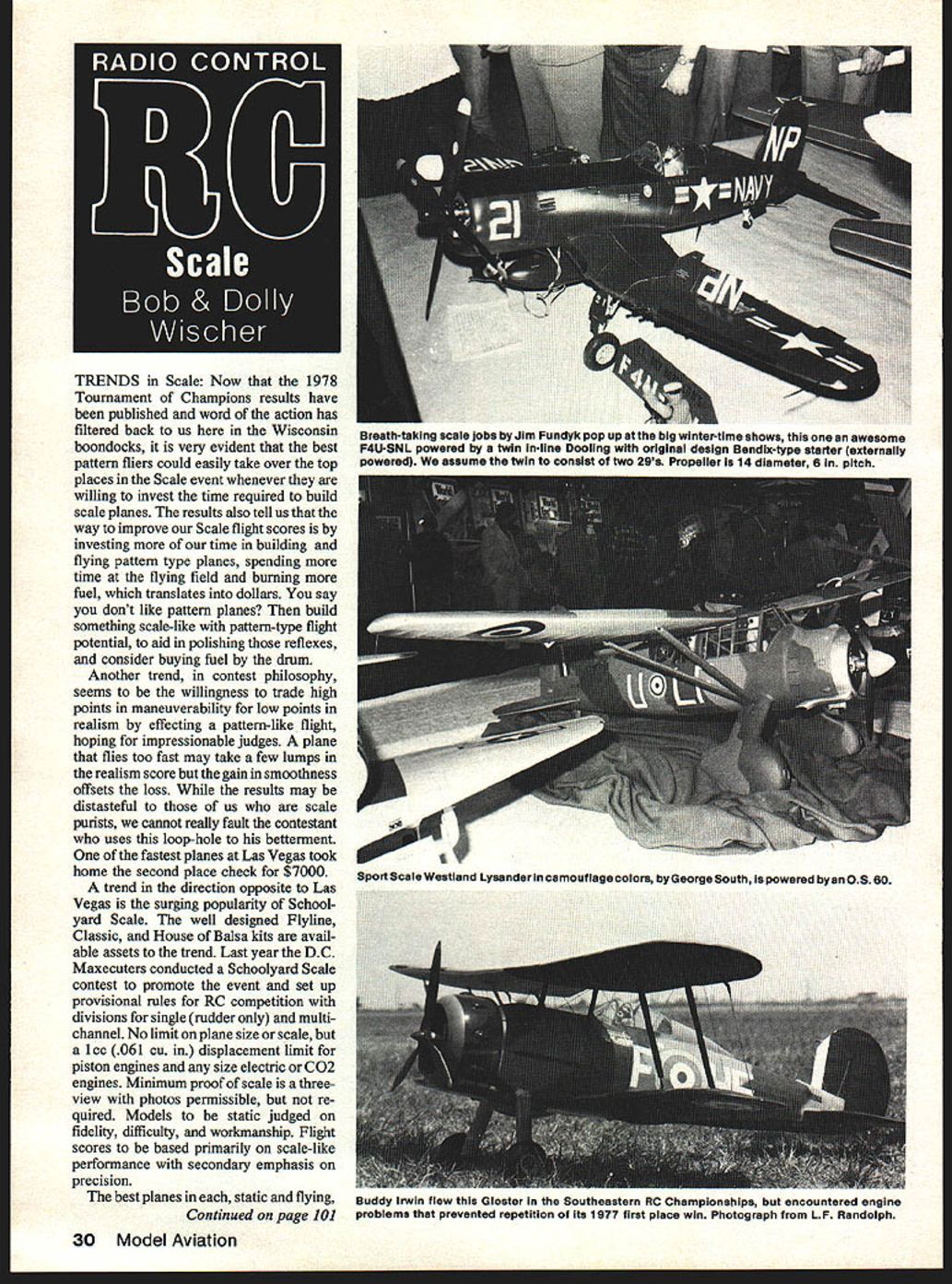
Now that the 1978 Tournament of Champions results have been published and word of the action has filtered back to us here in the Wisconsin boondocks, it is very evident that the best pattern fliers could easily take over the top places in the Scale event whenever they are willing to invest the time required to build scale planes. The results also tell us that the way to improve our Scale flight scores is by investing more of our time in building and flying pattern-type planes, spending more time at the flying field and burning more fuel, which translates into dollars. You say you don't like pattern planes? Then build something scale-like with pattern-type flight potential to aid in polishing those reflexes, and consider buying fuel by the drum.
Another trend, in contest philosophy, seems to be the willingness to trade high points in maneuverability for low points in realism by effecting a pattern-like flight, hoping for impressionable judges. A plane that flies too fast may take a few lumps in the realism score but the gain in smoothness offsets the loss. While the results may be distasteful to scale purists, we cannot really fault the contestant who uses this loophole to his betterment. One of the fastest planes at Las Vegas took home the second-place check for $7,000.
A trend in the direction opposite to Las Vegas is the surging popularity of Schoolyard Scale. The well-designed Flyline, Classic, and House of Balsa kits are available assets to the trend. Last year the D.C. Maxecuters conducted a Schoolyard Scale contest to promote the event and set up provisional rules for RC competition with divisions for single (rudder-only) and multi-channel. No limit on plane size or scale, but a 1 cc (.061 cu. in.) displacement limit for piston engines and any size electric or CO2 engines. Minimum proof of scale is a three-view with photos permissible, but not required. Models to be static judged on fidelity, difficulty, and workmanship. Flight scores to be based primarily on scale-like performance with secondary emphasis on precision.
The best planes in each category, static and flying, receive a score of one, with second place a score of two, etc. The winner has the lowest combined score of static plus flight. Rudder-only planes are hand-launched while multi-channel are ROG (rise off ground). Both perform straight flight, a procedure turn, straight return, a figure-eight pattern followed by maneuvers within the capability of the prototype, and a spot landing.
- In single-channel, five flight points are deducted for every minute over five-minute duration, with a seven-minute limit.
- In multi-channel, the flight-time limit is seven minutes.
- A notable change from old-time rudder-only is the absence of provision for motor control to keep a model from climbing out of sight. Presumably a fuel shut-off timer is used to terminate the flight.
Report From Paris
As a member of the FAI Scale Subcommittee representing the U.S., I attended the plenary session of the Committee for International Aeromodeling (CIAM) in Paris, Nov. 30–Dec. 1. Two agenda matters affecting Scale were to be decided by vote.
The first dealt with maximum engine displacement for multi-engine planes. Traditionally, CIAM has not favored increasing displacement above the present 10 cc (.61 cu. in.) total for any number of engines. A proposal from Austria asked for 20 cc for multi-engine planes while retaining the single-engine limit at 10 cc. Their reason was that the efficiency of multiple smaller engines is less than that of a single engine of the same total displacement, forcing competitors to construct large models near the 6-kg weight limit to have a chance to win. Knowing the history of previous CIAM rejections, the sub-committee voted to recommend a watered-down limit of 15 cc for twins (two .45s) and 20 cc total for three or more engines (three .40s or four .30s). The CIAM delegates surprisingly voted to accept the change.
The second proposal, from the U.S., was for approval of the provisional RC Stand-off Scale rules as official for inclusion in World Championship competition, in addition to current FAI Scale rules. The reason was the growing worldwide popularity of RC Stand-off Scale activity on its own merits. Stand-off had been intended to lead to more FAI Scale modeling, but this had not occurred. The proposal was debated at great length; most sub-committee members felt acceptance of Stand-off Scale would have a detrimental effect on FAI Scale and therefore opposed making the provisional rules official. Only the U.S. member voted in favor, and the sub-committee went on record as not recommending official status. However, when the full CIAM session delegates were asked to vote, they did not accept the sub-committee recommendation and the proposal was overwhelmingly passed by a 16 to 6 vote, indicating that most countries feel the tide of Stand-off Scale is growing.
It will be a number of years before all conditions are met and the rule book is changed to include Stand-off Scale, but the 1980 World Championships at Ottawa, Canada for RC and CL Scale will include the International Stand-off meet. Contests will need to be conducted using the provisional rules. The international meets in Sweden and England did not qualify because rules were not followed and no subsequent report was made to the FAI.
For the future we can expect proposals to change the complexity bonus, which also applies to Stand-off Scale (SOS):
- Delete the 10% bonus for two-bay biplanes and replace it with 10% for biplanes with under-cambered wings.
- Consider deleting bonus points for biplanes with semi- or fully-symmetrical airfoil wings because it was thought they fly too much like monoplanes.
- Discuss deletion of the 5% bonus points for a one-wheeled landing gear because the plane is not as prone to nosing over on landing as a two-wheeled gear.
- For SOS, it was suggested the ratio of static to flight scores, now approximately 1/6–1/2, should be changed to 1/3 because judges were scoring too high in static and the event stresses flight rather than the plane. This met with opposition because it would limit the choice of planes to those that fly well.
- There was a suggestion that craftsmanship scoring should be dropped because it is too difficult to distinguish between craftsmanship and fidelity in Stand-off. This was opposed by most members on the basis that fidelity concerns accuracy of outline while craftsmanship concerns how well the work was executed; the difference should be evident.
Nine nations were represented in the Scale sub-committee: Switzerland, West Germany, Mexico, Japan, Yugoslavia, France, Canada, U.K., and U.S.A. Committee members were questioned individually about activity in Free Flight Scale and Control Line Scale in their countries. Free Flight is active in the U.K. and U.S. only, with Control Line in the U.S. only. Canada will include Control Line Scale in its 1980 World Championships. Both France and England pointed out that the change from a weight limit of 5 kg to 6 kg, which occurs in 1979 for RC Scale, is illegal in their countries where the law of the land prohibits heavier planes. Large planes have been flown in England only with special permission. It appears doubtful that mammoth scale can achieve great success in those countries as it has in the U.S. and Canada.
The meetings are conducted in English and it is an educational experience to exchange views and positions with representatives from other nations. It is also important for our views to be considered internationally. Even though we have only one voice which may be in the minority, we were heard and Stand-off Scale will indeed become a World Championship event.
Educational Contribution
From the Scale Dimension newsletter of the Scale Squadron of Southern California, a story by Buzz Watson:
"I had an interesting experience with my Ryan PT-22. The plane was made from Bob Holman drawings, exact scale, 2" to the foot, scratch-built. The Ryan flies like a trainer — straight down the runway on takeoff, smooth and solid on landings. The landing gear is more than strong enough for the 6½ lb. weight.
"I thought it would be interesting to have the pilot in the front cockpit fall out with a parachute. The idea was fine but the $4.50 pilot was molded in the sitting position, which made it difficult to fall freely. His feet would hang up under the instrument panel or possibly catch on the windshield. I had to modify the pilot, cut his midsection so it was flexible. I made the parachute out of silk at $6.00 a yard, about 28" in diameter, with 20 shroud lines. (Thanks to Larry's wife Cindy for doing the seams on the machine.) Two harness straps attached to the pilot's back. The parachute opens every time. Works great. That's all well and good, but in order to get a good free fall, I had to cut off the pilot's boots.
"Flight test day was successful, five complete jumps in a row, no problems that weekend. The following weekend I thought it would look more authentic to have the pilot coming down with feet. I glued his boots back on. The Ryan took off nice and smooth, about a nine score. It climbed to jump altitude, about 150 feet. I rolled the Ryan on its back and watched in horror as the pilot's feet hung up on the windshield. The chute came out, opening and yanking the pilot out of the cockpit and catching the elevator on the way out, almost ripping it off the airplane.
"With no elevator control, you can guess what happened. The parachute opened fine but the plane was going to crash. Under the circumstances the only thing I could do was chop the throttle, try to use ailerons to roll right side up, but to no avail. The Ryan spiraled down to the asphalt and went splat! About 45 seconds later the chute landed nice and soft on the dirt. What more could a movie director ask for? A perfect take! That will be $2,000 please. By the way, Bert Baker witnessed the whole thing. The Ryan is repairable. By some miracle it didn't damage the wing or landing gear. Of course the nose was gone. The pilot will be back in the air—less parachute."
We conclude with another quotation from the Scale Squadron newsletter, this by editor John W. Wheeler:
"This year we included AMA Scale in our contest. The quality of some of the airplanes entered in this class left something to be desired. Would you believe an AMA World War II entry with no retracts? Or a high-wing aircraft so underpowered and uncontrollable, it just barely completed two recognizable maneuvers, takeoff and landing, and neither very well? There were many Sport Scale planes which, if entered in AMA Scale, would have been more deserving of the trophies and prizes.
"It is this writer's opinion many of these Sport Scale planes would have had a better advantage in AMA Scale, due to their extensive detail and excellent craftsmanship. Because of the type of scoring in the AMA class, they would have received full credit for their detail and superb craftsmanship.
"The question in point appears to be: Should there be certain added requirements to insure only high-quality aircraft are entered in this class of competition? Should we follow pattern-type rules for mandatory advancement from Sport Scale after three first-place wins and force good aircraft and fliers into this class? Should there be better quality trophies and higher-value prizes for AMA class to draw more entries? Mandatory AMA class aircraft when exterior and cockpit detail are added?
"The answer to all of this: Read your AMA rule book on the requirements for entering AMA class. If your aircraft has these necessary requirements, then change your presentation book, make a scale ruler and enter your aircraft in AMA class. You might find you'll come out a winner!"
Bob and Dolly Wischer Rt. 1, S-221 Lapham Peak Road Delafield, WI 53018
Transcribed from original scans by AI. Minor OCR errors may remain.

