
Radio Control: Scale
Bob & Dolly Wischer
One of the season's earliest all-scale contests is the 7th Annual Mint Julep meet at Rough River Dam State Resort Park in Kentucky, sponsored by the Southern Indiana R/C Modelers. The site is a paved airstrip in the park, complete with camping facilities, lodge, cottages and a large meeting room for the Saturday evening banquet. With 38 entries, the meet has increased in size.
The Mint Julep contest, directed by Dale Arvin, has an innovative approach to rules making. Two basic groups, Expert and Sportsman, were subdivided into Division I for military or civil planes with retracting landing gear or racing aircraft, and Division II for light planes without retracts.
Recognizing that inadequate judging is one of the sore spots in model contests, the sponsors decided to do something about run-away scoring. Four judges were used for static and flight scoring, with the high and low scores of each group being discarded. The remaining two scores were then added. The total score was the sum of the static score and the average of the best two flight scores of the four rounds flown. Consistency was therefore required for a high place in the results.
Discarding the high and low scores was a well-chosen device, as it was noted that in our case the high was 45% above the low. Some clubs have initiated training programs to help reduce the wide spread in scores. With the tremendous increase in scale activity, there is certainly a need for a pool of trained judges, especially those with a knowledge of full-size aircraft construction. Scale modeling is directly related to prototypes.
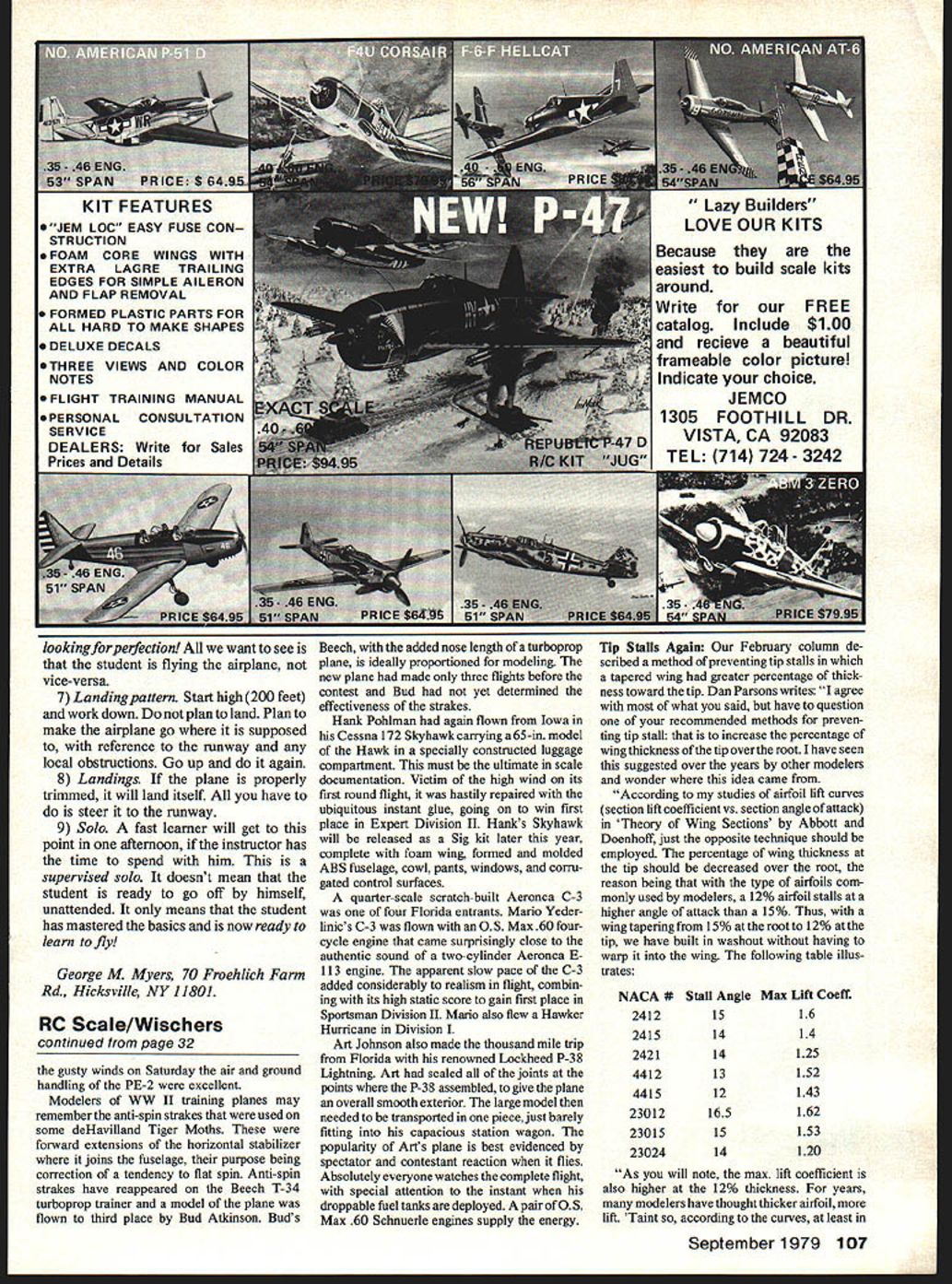
As could be expected in a meet of this size, there were some extraordinary models present. Bob Underwood's new Petlyakov PE-2 USSR WWII twin-engine bomber was outstanding in its first-place win, in spite of some rather severe damage due to a capricious gust of wind before round one. Fellow competitors helped to reassemble the fuselage and tail surfaces in time for its first flight. Bob used a pair of HP .40 engines in the 81‑in. model, which was very light, at 12.5 pounds, for a plane with numerous operating features. The main and tail wheels retracted, with operating doors; there were flaps and dive brakes, and two external bombs dropped from high altitude with amazing accuracy. They descended with a considerable thud as the lightweight bombs had been loaded with clay to prevent drift in the strong wind. The plane is of balsa construction covered with 3/4‑ounce fiberglass cloth and polyester resin, sanded to a metal-like surface before application of the weathered finish.
Even during the gusty winds Saturday, the air and ground handling of the PE-2 was excellent.
Modelers of WWII training planes may remember anti-spin strakes used on some de Havilland Tiger Moths — forward extensions where the horizontal stabilizer joins the fuselage — the purpose being the correction of a tendency to flat spin. Anti-spin strakes have reappeared.
Bud Atkinson's Beech T-34 turboprop trainer model, flown to third place, was ideally proportioned. Bud had added nose length and a turboprop installation; he made three flights before the contest but had yet to determine the full effectiveness of the strakes.
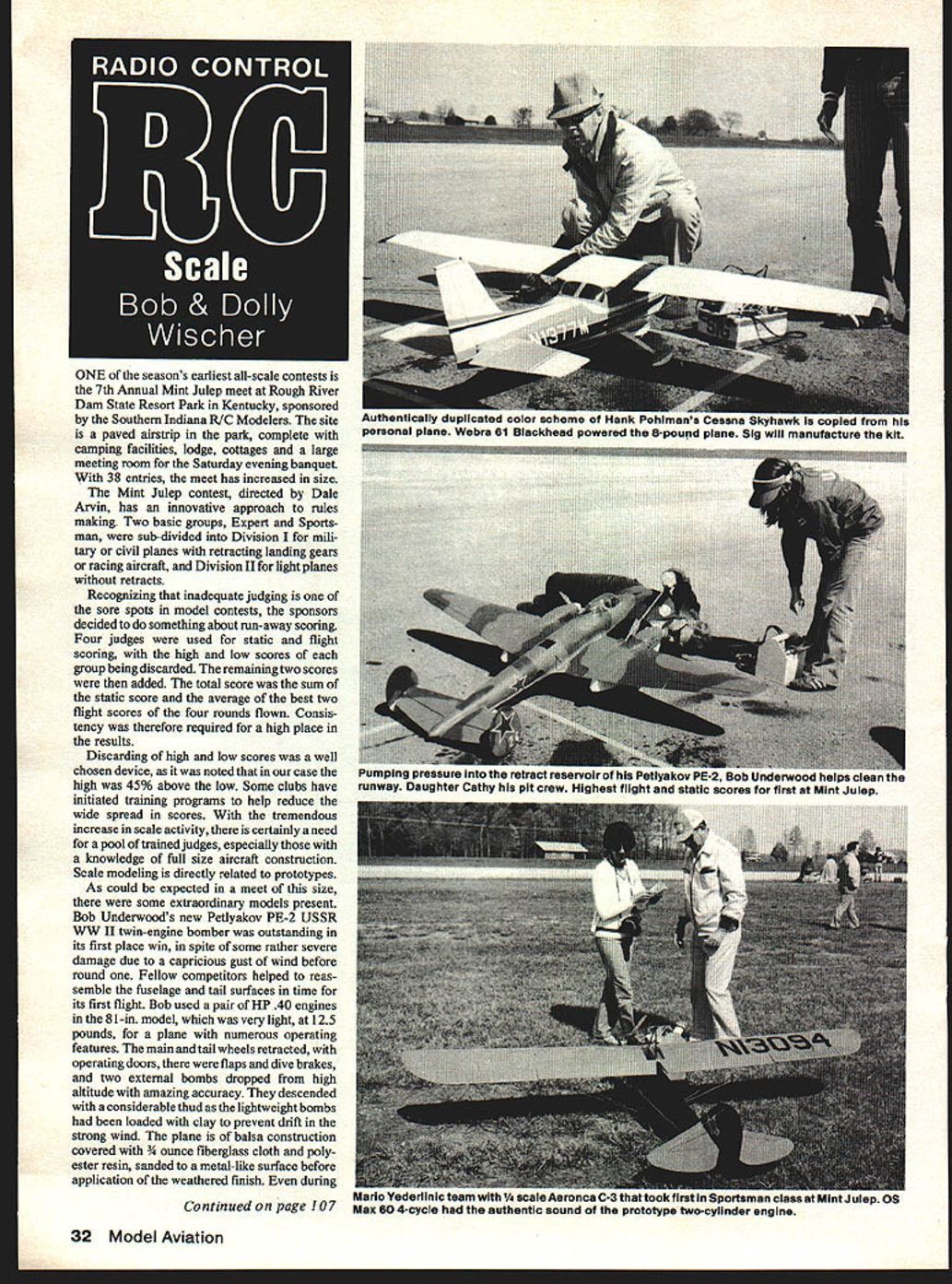
Hank Pohlman again flew his Iowa Cessna 172 Skyhawk carrying a 65‑in. model. Victim of high wind in its first-round flight, it was hastily repaired with ubiquitous instant glue and went on to win first place in Expert Division II. Hank's Skyhawk will be released by Sig as a kit later this year, complete with foam wing, formed/molded ABS fuselage, cowl, pants, windows and corrugated control surfaces.
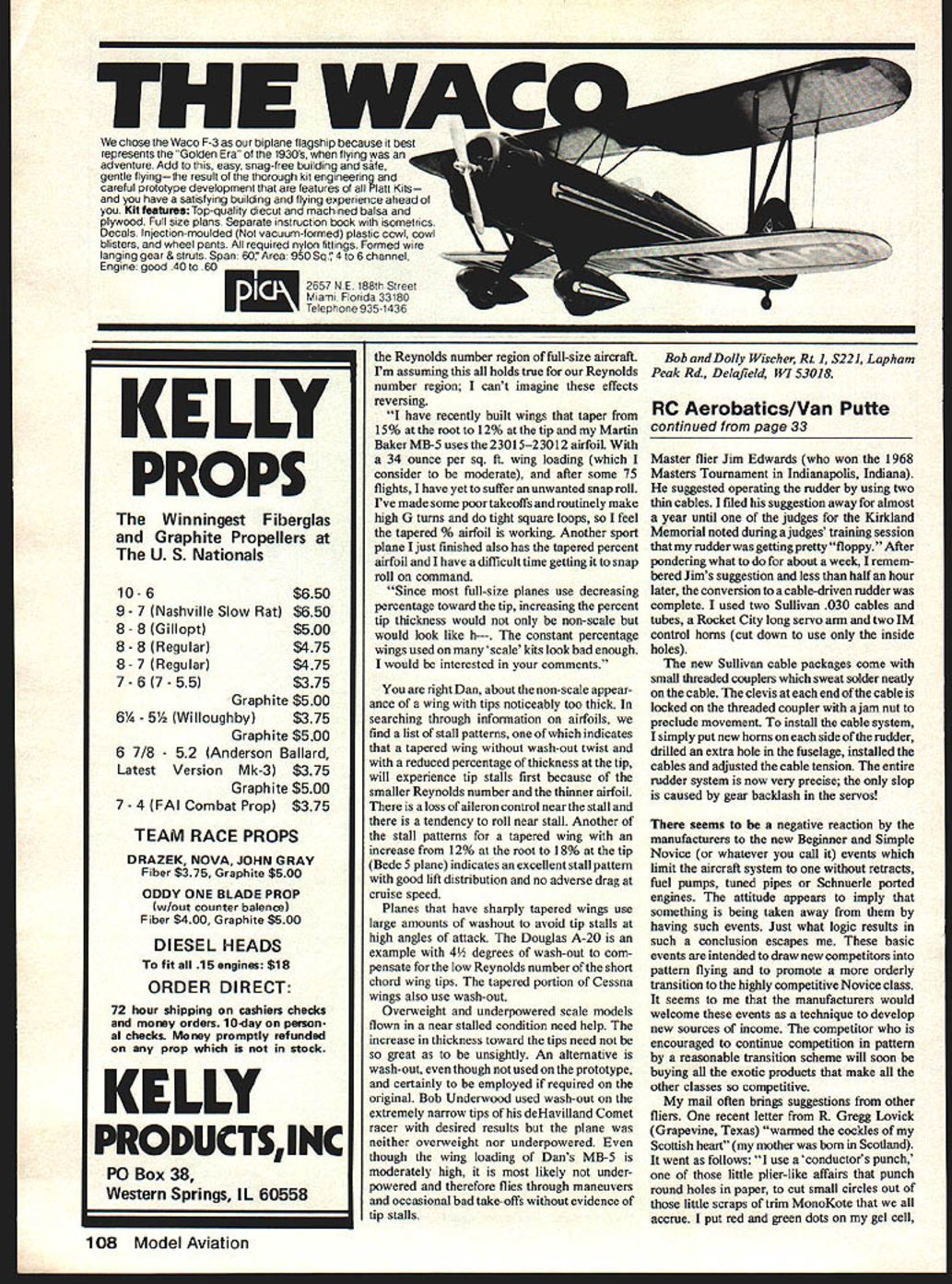
A quarter-scale scratch-built Aeronca C-3 entry from Florida, flown by Mario Yederlinic with an OS Max 60 four-cycle engine, took first in the Sportsman class. Mario also flew a Hawker Hurricane in Division I.
Art Johnson also made the thousand-mile trip from Florida with his renowned Lockheed P-38 Lightning. Art had faired all of the joints at the points where the P-38 assembled to give the plane an overall smooth exterior. The large model then needed to be transported in one piece, just barely fitting into his capacious station wagon. The popularity of Art's plane is best evidenced by the attention it created when it flew. Absolutely everyone watches the complete flight, with special attention to the instant when its droppable fuel tanks are deployed. A pair of O.S. Max .60 Schnuerle engines supply the energy.
The consistent winner of high static score in Sportsman Division II was Mario Yederlinic's C-3.
Tip Stalls Again:
Our February column described a method of preventing tip stalls in which a tapered wing had a greater percentage of thickness toward the tip. Dan Parsons writes:
"I agree with most of what you said, but have to question one of your recommended methods for preventing tip stall: that is to increase the percentage of wing thickness of the tip over the root. I have seen this suggested over the years by other modelers and wonder where this idea came from.
"According to my studies of airfoil lift curves (section lift coefficient vs. section angle of attack) in Theory of Wing Sections by Abbott and von Doenhoff, the opposite technique should be employed. The percentage of wing thickness at the tip should be decreased over the root, the reason being that with the type of airfoils commonly used by modelers, a 12% airfoil stalls at a higher angle of attack than a 15%. Thus, with a wing tapering from 15% at the root to 12% at the tip, we have built-in washout without having to warp it into the wing. The following table illustrates:"
- NACA # — Stall Angle — Max Lift Coeff.
- 2412 — 15 — 1.6
- 2415 — 14 — 1.4
- 2414 — 14 — 1.25
- 4412 — 13 — 1.52
- 4415 — 12 — 1.43
- 23012 — 16.5 — 1.62
- 23015 — 15 — 1.53
- 23024 — 14 — 1.20
"As you will note, the max. lift coefficient is also higher at the 12% thickness. For years, many modelers have thought 'thicker airfoil, more lift.' 'Taint so,' according to the curves, at least in the airfoils listed above.
"This refers to the Reynolds number region of full-size aircraft. I'm assuming that all holds true for our Reynolds number region; I can't imagine these effects reversing.
"I have recently built wings that taper from 15% at the root to 12% at the tip and my Martin Baker MB-5 uses the 23015‑23012 airfoil. With a 34 ounce per sq. ft. wing loading (which I consider to be moderate), and after some 75 flights, I have yet to suffer an unwanted snap roll. I've made some poor takeoffs and routinely make high-G turns and do tight square loops, so I feel the tapered % airfoil is working. Another sport plane I just finished also has the tapered percent airfoil and I have a difficult time getting it to snap roll on command.
"Since most full-size planes use decreasing percentage toward the tip, increasing the percent tip thickness would not only be non-scale but would look like the constant-percentage wings used on many 'scale' kits that look bad enough. I would be interested in your comments."
You are right, Dan, about the non-scale appearance of a wing with tips noticeably too thick. In searching through information on airfoils, we find a list of stall patterns, one of which indicates that a tapered wing without washout twist and with a reduced percentage of thickness at the tip will experience tip stalls first because of the smaller Reynolds number and the thinner airfoil. There is a loss of aileron control near the stall and there is a tendency to roll near stall. Another of the stall patterns for a tapered wing with an increase from 12% at the root to 18% at the tip (Bede 5 plane) indicates an excellent stall pattern with good lift distribution and no adverse drag at cruise speed.
Planes that have sharply tapered wings use large amounts of washout to avoid tip stalls at high angles of attack. The Douglas A-20 is an example with 4½ degrees of washout to compensate for the low Reynolds number at the short-chord wing tips. The tapered portion of Cessna wings also use washout.
Overweight and underpowered scale models flown in a near-stalled condition need help. The increase in thickness toward the tips need not be so great as to be unsightly. An alternative is washout, even though not used on the prototype, and certainly to be employed if required on the original. Bob Underwood used washout on the extremely narrow tips of his de Havilland Comet racer with desired results, but the plane was neither overweight nor underpowered. Even though the wing loading on Dan's MB-5 is moderately high, it is most likely not underpowered and therefore flies through maneuvers and occasional bad take-offs without evidence of tip stalls.
George M. Myers 70 Froehlich Farm Rd. Hicksville, NY 11801
Transcribed from original scans by AI. Minor OCR errors may remain.

