
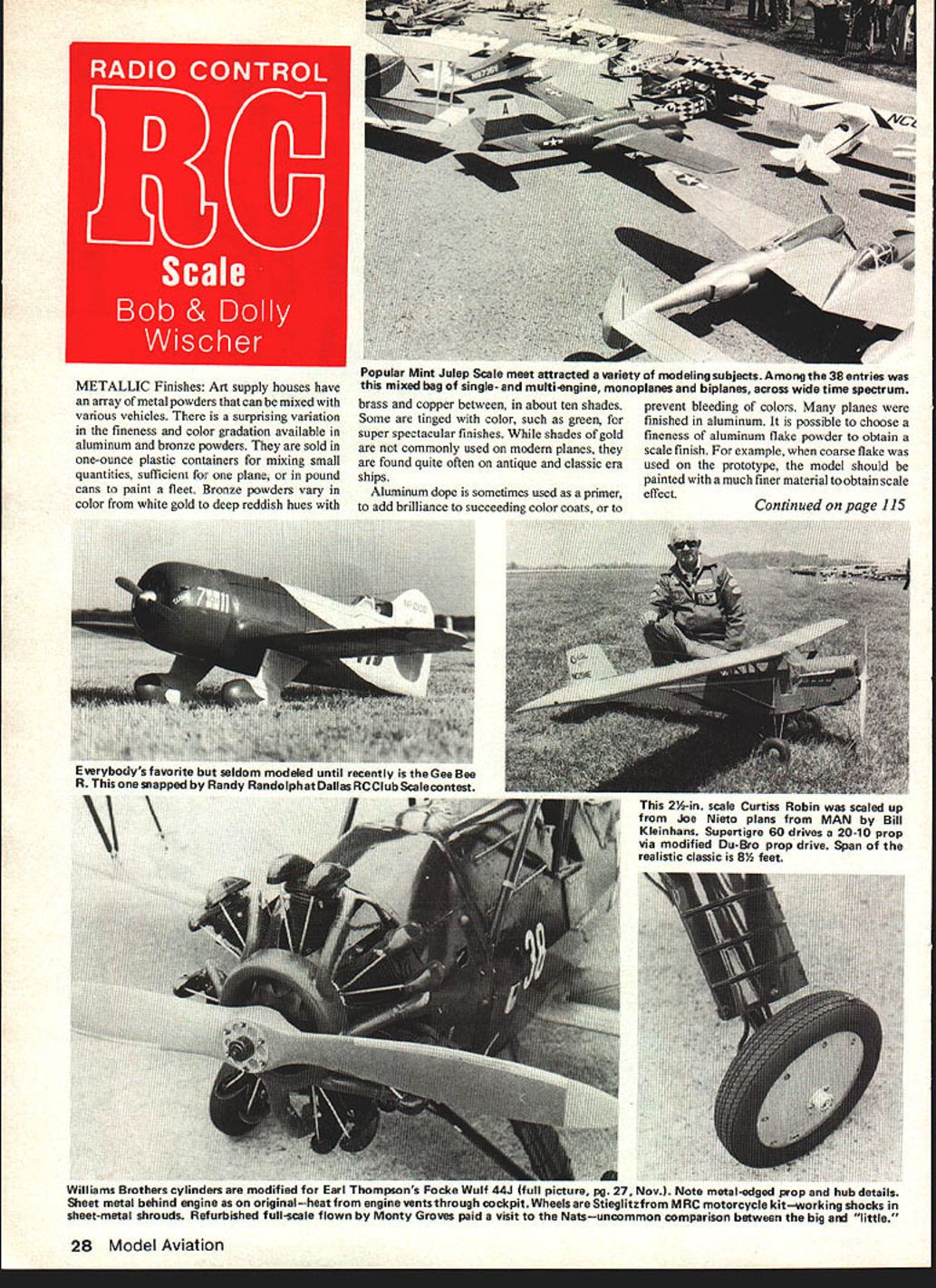
Radio Control: Scale
Bob & Dolly Wischer
Metallic Finishes
Art supply houses have an array of metal powders that can be mixed with various vehicles. There is a surprising variation in the fineness and color gradation available in aluminum and bronze powders. They are sold in one-ounce plastic containers for mixing small quantities—sufficient for one plane—or in pound cans to paint a fleet. Bronze powders vary in color from white gold to deep reddish hues, with brass and copper between, in about ten shades. Some are tinged with color, such as green, for super-spectacular finishes. While shades of gold are not commonly used on modern planes, they are found quite often on antique and classic airships.
Aluminum dope is sometimes used as a primer to add brilliance to succeeding color coats or to prevent bleeding of colors. Many planes were finished in aluminum. It is possible to choose a fineness of aluminum flake powder to obtain a scale finish. For example, when coarse flake was used on the prototype, the model should be painted with a much finer material to obtain a scale effect.
Both bronze and aluminum powders have a property that makes them very desirable for model finishing. The flakes overlap to form a continuous film even when applied in a very thin layer, so minimum weight is added. As an example, a one-ounce vial of bronze powder, mixed with thin dope, will easily cover a five-foot-span model in one coat with no evidence of transparency, for a lightweight finish. Aluminum powder will do the same job with even less weight. Because bronze powder is heavier while suspended in dope, it must be stirred well before spraying as it settles quickly.
The matter of fineness of finish has been a point of contention among scale modelers for ages. Microscopic examination of a hand-rubbed finish will show the presence of minute scratches formed by the abrasive rubbing compound. Shouldn't a 1/5-scale model have scratches 1/5 the size of those on the prototype? Wouldn't this be obvious on a model? In competition it is difficult to convince a static judge that a high-gloss finish is justified because of diminution of surface defects due to scale effect. Most people think that the model finish should duplicate the original, with no variation in the degree of gloss.
Powdered metal finishes are difficult to apply evenly with a brush. The edge of each brush stroke becomes plainly visible, leaving telltale traces even after drying. Apparently the brushing causes some of the metal flakes to stand on edge. Spray equipment is required to obtain a first-class finish. Our preference is to use a one-horsepower compressor with a spray gun of sufficiently large pattern to cover a wing with one or two passes. This leaves a wet coat that permits the metal flake to flatten into a continuous membrane with no visible edges. A large wing is completely sprayed in a few seconds on each side. Powdered metal finishes are not easy to touch up after repairs. We use an air brush to help disguise the patched area.
For maximum gloss in spraying, we use a blush-retardant thinner to slow down drying, particularly in humid weather. Our usual ratio is 60% dope to 40% thinner. An ounce of powdered bronze or 1/3 ounce of aluminum will make 1-1/2 pints of spraying material, the approximate quantity to fill a spray gun container. Acceptable results can be obtained with large variations in these ratios. If the finish is too transparent, add more powder or use a second coat. Metal flake finishes have amazing covering power.
Canopy Adhesion
Within the past few months we have had two experiences with canopies being blown off during flight. The lift on a canopy due to the slipstream is quite strong. One canopy was epoxied in place and then secured with ten brass pins forced into the fuselage along its edges. At high speed the canopy exploded into the slipstream. The remains were found later with all of the pins bent at right angles. We have come to the conclusion that epoxy does not form a permanent bond with Plexiglas. The new canopy was installed using Weldwood RC-56 glue and only two pins at the front.
The second mishap occurred at the Nats when our Piel Beryl lost 80% of its canopy, also 1/32" Plexiglas. The adhesive was affected by the 100+ degree temperatures on the runway. This canopy had been fastened to a brass-tube frame using 1/32" thick double-adhesive Fasson foam tape. The tape had aged for three years and lost some of its stickiness. The new canopy is fastened in the same manner and we have made a mental note to check its adhesion in hot weather.
The foam tape is cut into 1/8" wide strips and applied to a 1/4" diameter brass tube frame. The 1/32" plastic canopy is lowered carefully over the frame and pressed onto the tape. Adhesion is instantaneous. The plastic cannot be moved once it touches the tape, so its location must be correct on the first try. The bond between tape and plastic is permanent; the bond between tape and tube is dependent upon the amount of pressure applied during application and the deflection of the tape in wrapping around the tube.
The amount of lift generated by a sloping windshield followed by an airfoil-shaped canopy must be considerable. Sport Aviation magazine describes a canopy problem on a 190-mph homebuilt Mustang II. It was found that the canopy needed to be held down securely all along its lower edges to stop the lifting action that caused large gaps to form. The canopy frame required stiffening and latching down in as many places as possible. This is another example of the parallel problems that we face along with experimental aircraft builders.
Sport Scale models with permanently fastened canopies will be less susceptible to problems of this nature. Sliding or hinged canopies will likely be affected and, watching from the ground, lifting will not be perceptible. Take our word for it—lift is present. When a canopy jettisons, it hits the fin. Fasten it tightly or build a strong fin. Fortunately, the loss of a canopy seems to have no effect on flight characteristics, but loss of a fin and rudder might prove disastrous.
Nats Notes
Dan Parsons and Ted White flew their Martin-Baker MB-5 fighters in Sport Scale. Dan also flew the same plane in Pattern, which gives some idea of its capabilities. Ted's low passes and steep turns on the deck stirred cheers and applause. It was hard to tell whether the crowd was cheering his skill and daring or encouraging even lower passes. There is no question that Ted is a superb showman and pilot. A Webra Speed 61 gives the plane performance similar to Formula I. Ted had the fifth highest individual flight score and it would be interesting to see what change would come with an effort to fly near scale speed.
The only fast planes at the Nats that appeared to be flying at scale speed were the three ducted-fan entries of Bob Violett and Dennis Grady's Skyhawk A-4s, and the Me 262 twin of Tom Cook. At the other end of the speed range, a 9-foot PT-22 was flown so slowly by Bob Karlsson that it appeared to be below scale speed, although it probably wasn't.
Larry D'Attilio had been experiencing elevator flutter with his Fokker D.23 push-pull twin, solved by using double control rods. This was a last-ditch effort at Lincoln, just before flying began. He decided upon a test flight to prove that the addition was working, drove to the Lincoln Skyknights field and on the way met misfortune. A truck going in the opposite direction, loaded with steel reinforcement for concrete, lost part of its load. It demolished the left front of Larry's car and only a swerve kept it from penetrating the windshield. Was he concerned about the closeness of injury or possible death? A true modeler, his first act was to examine the plane, then to assess the damage to the car.
If spectator interest is a measure, RC Scale must be the ultimate challenge in modeling. At the end of a difficult subject, spontaneous acknowledgement of a large audience is reward for months or years spent in development and construction. This acclaim, combined with competitive spirit and opportunity to see masterpieces in action, are the forces that bring us together at our Nats.
Walt Returns
Walt Moucha, who has been absent from the contest scene for a while, has returned. Walt now lives in our area, at Menominee, Michigan, where he has joined forces with Balsa, USA. He appeared at two events in the Milwaukee area: RC Hobbies' First Annual Scale Jamboree, and later at the Sport and Precision Scale contest conducted by Milwaukee Flying Electrons. The Jamboree attracted 27 scale models. The contest had 19 entrants, two of which were in Precision class.
Walt's planes for both events were a 1/4-scale Piper Cub and a 1/3-scale Sopwith Pup, which promptly walked off with first place in both non-military and military Sport Scale events. Both are kits produced by Balsa, USA. Walt's Fly Baby also finished second in Precision Scale class to give him a total of three hand-crafted trophies. These were plaques mounting a copper wire skeleton of a Fokker D-7 having a span of 7 1/2".
His 26-pound Sopwith uses a Quadra engine for remarkably realistic flights, no doubt the result of Walt's experience in WW I Rhinebeck events. The Pup is finished with Coverite, left natural on bottom surfaces and given a light coat of flat olive drab on top, rubbed to produce weathering.
Super-Detailed Drawings
Morrison Repla-Tech offers a series of drawings showing greater exterior detail than is ordinarily seen. The Starduster Too is shown in 12 configurations and color schemes on two 24" x 35" sheets. Such a wide choice of subjects for this popular homebuilt is a luxury seldom enjoyed by modelers. Some are shown with the main wheel location moved rearward for reduced ground-looping tendencies and smoother lift-off. This is a field modification by builders that would be as helpful to modelers as it proved to be on the prototype. The graceful semi-elliptical swept-wing biplane Starduster has the potential of becoming a modeling favorite.
For ducted-fan advocates, Morrison has produced super-detailed plans in four sheets for the General Dynamics F-16 fighter with production versions F-16A and B. Other ducted-fan possibilities on Morrison drawings include the F-14 Tomcat, MiG-25 Foxbat and Yak-36 Forger. The catalog is available for 50c from Morrison Repla-Tech, 48500 McKenzie Hwy., Vida, OR 97488.
Bob and Dolly Wischer Rt. 1, S-221 Lapham Peak Road Delafield, WI 53018
Transcribed from original scans by AI. Minor OCR errors may remain.

