
Radio Control: Scale
Bob and Dolly Fischer
RC Equipment for Scale
In the not-too-distant past, scale modelers who wanted interior detailing were faced with the problem of servo location and space. The large servos ordinarily mounted near the center of gravity interfered with cabin or cockpit detail because that is also the location for passengers. Four or five cumbersome, heavy servos hidden from view often had to be relocated rearward, producing a tail‑heavy condition.
Miniature servos solve many of these problems, since they can be hidden under seats and beneath the floor. Tiny integrated‑circuit servos use the full 4.8 volts across their motors (minus a small voltage drop through output transistors), which makes them very quick in response. The older discrete‑component servos, with only 2.4 volts at the motor, were slower. The smaller servos use diminutive, low‑inertia motors to decrease transit times.
Do we really need the high‑speed servos of modern RC outfits in scale models? From our experience, the smoothest flying plane in our collection is the one with the slowest servos, helped by control surfaces with minimum travel. To reduce sensitivity around neutral we have modified servo travel by inserting 180‑ to 220‑ohm resistors at each end of the feedback potentiometer to stretch travel. This also increases travel time and slows the servo further. Care must be taken when adding resistors to avoid hitting stops on older servos with linear outputs, which would cause high current drain. Servos with rotary outputs do not have this problem. This modification is one of the electronic tricks we use to obtain smooth, scale‑like flight and to help conceal our nervousness while performing before judges.
A similar effect can be obtained with transmitters that have non‑linear stick pots, such as the Royal Omega. Plastic or carbon instrument potentiometers are tapered at the center to make servos less sensitive near neutral while keeping full servo travel. This is ideal for scale modeling when greater control surface movement is needed for ground handling (especially on tail‑draggers) but minimal travel is desired around neutral. With such a transmitter the pilot can have small stick sensitivity near neutral and full travel when needed. The ratio between servo travel and trim travel can be altered to suit the plane’s flight characteristics and can be visually checked by the expanded‑scale voltmeter on the front panel. This feature avoids the problem found on some scale planes where reducing control travel is impractical because linkages are buried in scale structure.
Features of the Royal Omega include:
- Non‑linear stick pots to reduce sensitivity near neutral
- Expanded‑scale voltmeter for visual calibration
- Mixer option for flaperons
- Programmable timer with a tiny loudspeaker that counts minutes (up or down) and beeps for low battery voltage
- Standard features such as servo reversing and dual programming
- Offered in kit form and calibratable without an oscilloscope via the front panel meter
We have yet to build our first quarter‑scale plane and therefore are not really qualified to answer many inquiries about servo size and power requirements. Among those flying large planes there is diversity of opinion. Walt Moucha flies a 1/3‑size Sopwith Pup with standard servos (e.g., Kraft 15) mounted near the center of gravity, using long balsa pushrods to tail surfaces. This is an extreme example of what can be done with standard 29‑oz‑in torque servos; Walt wins contests with the aerobatic model, proving control is not marginal. We would like to hear from anyone using smaller, lighter 20‑oz‑in torque servos on large planes with success.
Kitchener‑Waterloo 1979: The All Scale Rally
Kitchener‑Waterloo, Ontario, Canada, enjoyed two days of fair weather for this year’s All Scale Rally. There was an enormous turnout of scale models—160 this year, two more than the record 1978 gathering. Extraordinary and exceptional planes abounded, and the rally is an ideal place to gather ideas for future projects and new materials.
Notable models and builders included:
- Dave Landvater: 40%‑scale Pitts (now with a Quadra engine) performing spectacular low‑altitude maneuvers including a lomcevak.
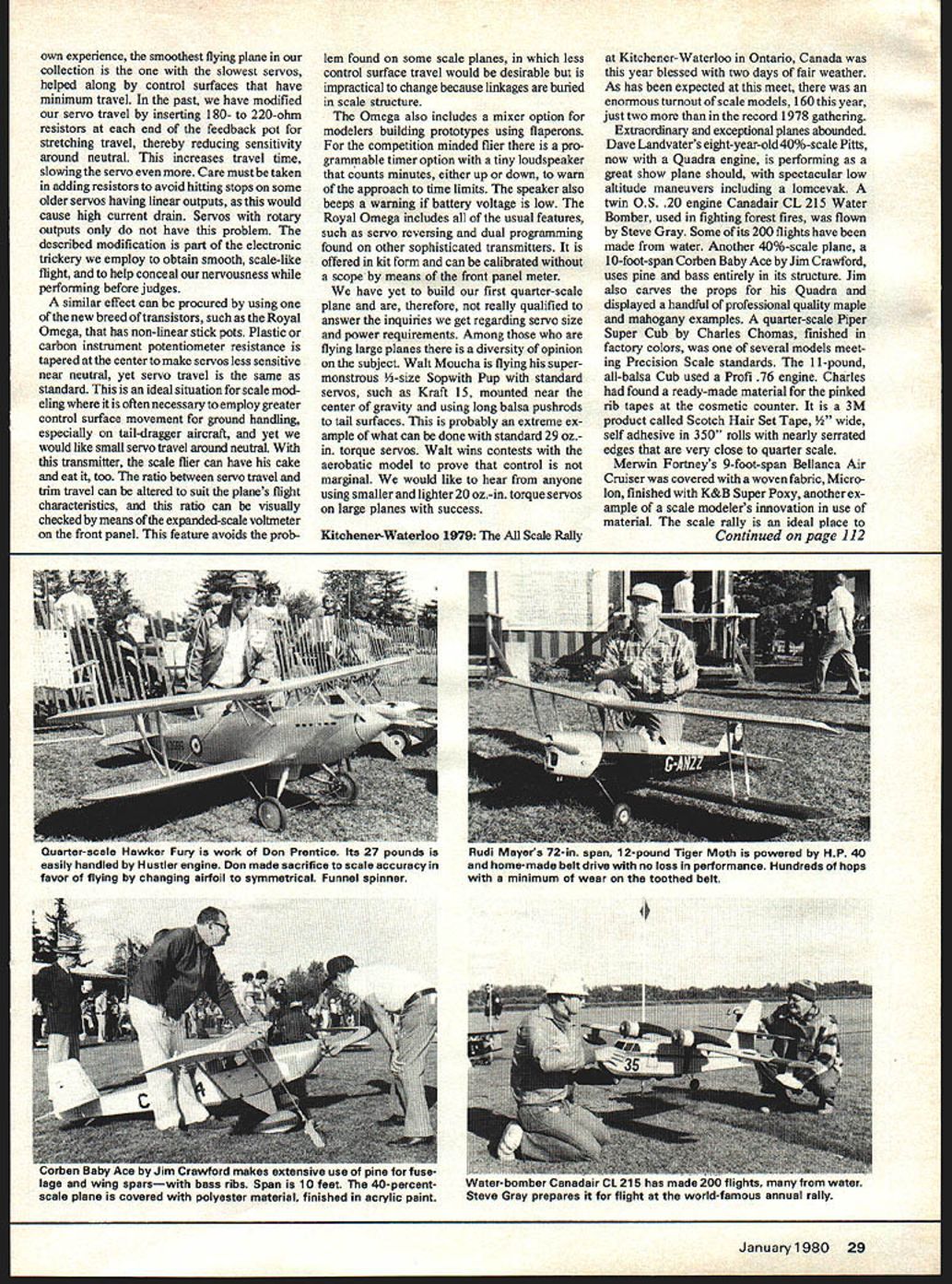
- Steve Gray: Twin O.S. .20‑engine Canadair CL‑215 water bomber; some flights were from water.
- Jim Crawford: 40%‑scale, 10‑ft‑span Corben Baby Ace built entirely of pine and bass; Jim also carves props and displayed maple and mahogany examples.
- Charles Chomas: Quarter‑scale Piper Super Cub, finished in factory colors, meeting Precision Scale standards. The 11‑lb all‑balsa Cub used a Profi .76 engine. Charles found a ready‑made material for pinked rib tapes at the cosmetic counter—3M Scotch Hair Set Tape, 1/2" wide, sold, adhesive, in 350' rolls with nearly serrated edges that are very close to quarter scale.
- Merwin Fortney: 9‑ft‑span Bellanca Air Cruiser covered with woven fabric Microlon and finished with K & B Super Poxy—another example of inventive material use.
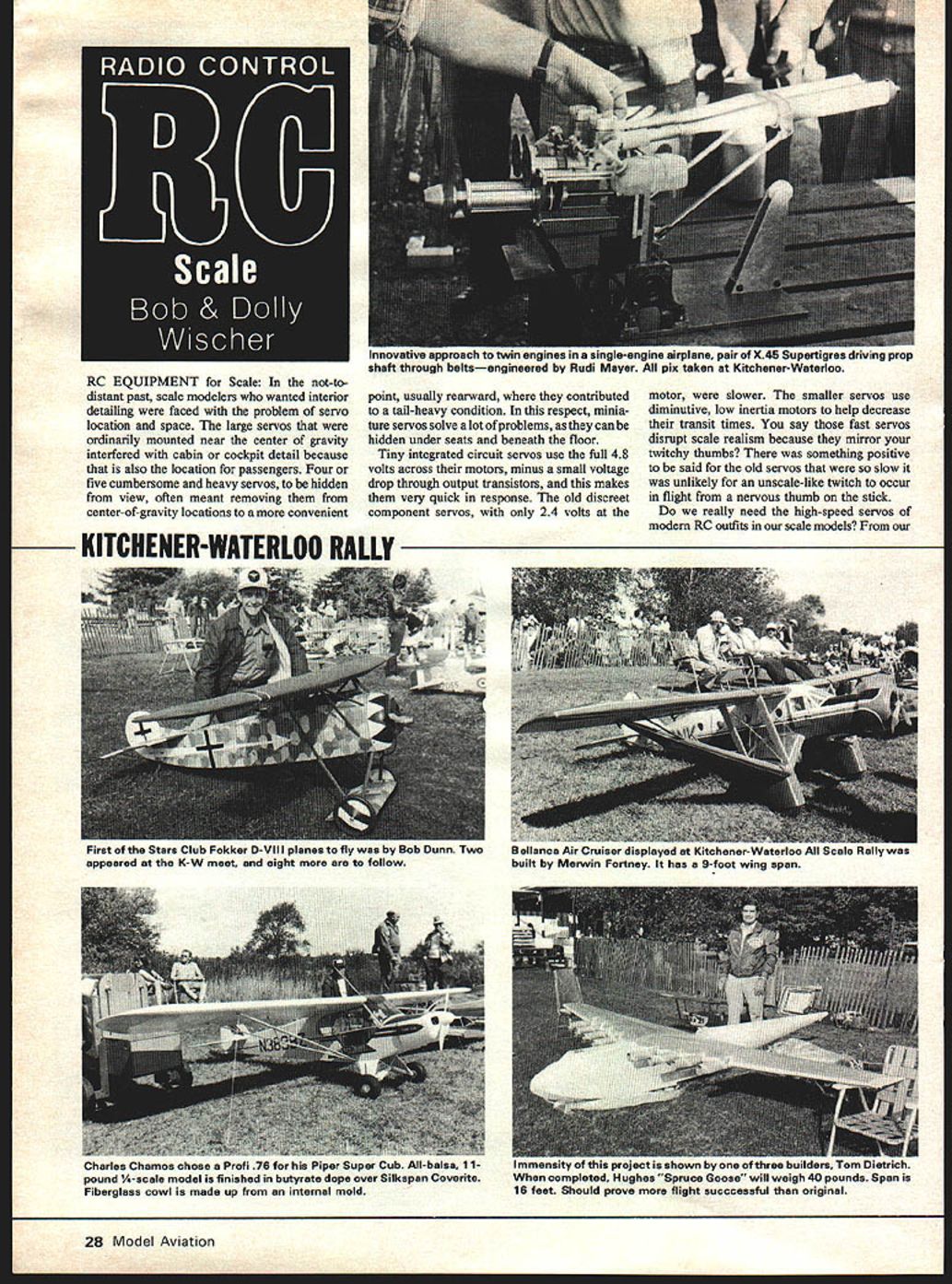
A quarter‑scale Hawker Fury by Don Prentice (foam‑float kit manufacturer) used a funnel for its spinner, a Huster engine in the 27‑lb Fury, and foam wings with cap strips beneath the covering to simulate rib locations.
The Stars Club of Olean, N.Y., was again present in force, showing the first two of a projected ten Fokker D‑VIII Quadra‑powered monsters designed by Bob Dunn. All servos are located near the CG with wires and pulleys operating control surfaces, including ailerons. Bob uses all‑wood turned wheels and tires with scale shock absorption in the cross axle and carves 20x8 maple props. Finish is latex acrylic flat paint.
Jim Messer (also of the Stars), who kits a quarter‑scale Ercoupe, found a way to keep his plane free of gas spit from the Quadra carburetor: he added a copper plumbing ell facing forward for a ram effect, held in place with cyanoacrylate. The Ercoupe was a consistent performer at the rally.
One of the more innovative modelers, Rudi Mayer (Flying Dutchmen Club), flies a 72"‑span, 12‑lb Tiger Moth with an H.P. .40 engine and a home‑made belt drive. Rudi gets phenomenal life from his belts—hundreds of flights and years of service—by proper use of flywheel mass. He is developing a twin‑engine Super Tigre X‑45 installation for a quarter‑scale de Havilland Chipmunk. The engines are mounted side‑by‑side with one slightly behind; two toothed belts with a reduction ratio of 1 3/4 to 1 drive a single prop shaft that turns in three ball bearings. The powerplant has twin tuned pipes exiting through the fuselage bottom. Vibration was very low. To achieve sufficient flywheel mass for smoothness and long belt life while reducing overall unit length, one flywheel has its outer periphery grooved so the second wheel meshes with it.
Participants were urged to bring unfinished projects; several appeared:
- An 8‑engine Hughes Spruce Goose flying boat (16‑ft span) by three Flying Dutchmen Club members—power planned to be eight O.S. .25 engines; projected weight 40 lb. Foam wings covered with 1/16" hardwood veneer; fuselage all balsa.
- Skip Mast: unfinished Lockheed Hercules C‑130 to use four K&B 3.5 engines; construction balsa and foam.
Information Source: Leo J. Kohn
Leo J. Kohn, an old‑time modeler, aviation writer, historian, and photographer, has a wealth of information and some 45,000 plane photos available to scale modelers seeking documentation. His photos are 2‑1/4" x 4‑1/4" and are sold in packs that vary from a few photos to several dozen; the average price per photo is about 24¢—less than it would cost to take your own if you can locate and photograph the prototype.
Examples:
- Douglas DC‑3 photos are available in 23 different packs arranged by airline, with an additional four packs for the C‑47 military version. Some packs have as few as four photos; the United Airlines pack contains 48. All are actual black‑and‑white photos made from negatives for maximum detail.
- His list includes military, racing, antique, airline, business, rotorcraft, homebuilt, aerobatic, sailplane, classic, foreign, and pre‑1920 WW I subjects. He maintains a large data bank and can supply information and details on almost any aircraft.
Modelers often request "actual" color photos of WW I and 1920s aircraft, but Leo points out that modelers must depend on black‑and‑white photos taken during the aircraft’s era. From those photos it is possible—if not always straightforward—to track down correct color schemes. Color photos are available for various unique and other aircraft types taken at EAA and other fly‑ins, but usually only one or two examples of a basic type exist, which can lead many modelers to model the same airplane.
Leo also offers a scale documentation service in which he will research an airplane and provide copies of whatever information, drawings, technical details, and color schemes he can find. He has a backlog of requests from modelers and full‑size aircraft restorers. He has about 500 color photos, but feels that modelers who rely only on easily available color documentation are missing the educational opportunities inherent in the hobby. His service is called Collect‑Aire Photos, P.O. Box 14234, Milwaukee, WI 53214. When asking for data or his catalog, include a stamp for reply postage.
Color photography became practical in the late 1930s, but reasonable permanence of color images did not occur until after WWII. For planes built before 1945, color documentation will likely be something other than a photograph—such as a written description, a Profile Publication, or authentic color chips. Unless color photos are carefully made they seldom agree with actual paint samples and are therefore not as useful for documentation as they might appear. AMA rules state that proof may be photographs, drawings, or written references; however, a color photo often carries a psychological advantage when authenticity is in doubt.
For contemporary subjects, irrefutable proof is a photo of the model posed with the prototype, or color patches verified by the aircraft owner. Finding documentation for finish, color, and markings is one of the more difficult tasks facing a modeler who chooses an obscure subject. Proof accounts for 10% of the static score in Precision Scale and a much larger 30% in Sport Scale. At the International Stand‑Off Scale meet in Waukegan, a surprising number of documentations were found deficient in this area. Judges are becoming more insistent that proof be furnished, and this will likely influence choice of prototype.
Bob and Dolly Fischer Rt. 1, S‑221 Lapham Peak Road Delafield, WI 53018
Transcribed from original scans by AI. Minor OCR errors may remain.

