
Radio Control: Scale
Bob & Dolly Wischer
MILWAUKEE Scale Rally
The first annual RC Hobbies Scale Rally met with only partial success due to high wind on both days, June 30 and July 1. Twenty-seven planes were on hand and most made flights in spite of the conditions. As is usual with meets of this type, a number of scale models displayed innovative ideas and construction methods, with informational exchange the basis for modelers' presence on the scene. The phenomenal growth of the rally theme is indicative of modelers' desire to congregate, examine each other's handiwork, seek ideas, and observe scale models in action.
The Milwaukee Rally had several distinctive models. Two outstanding examples are described below.
Norb Grobarchik — 1/4-scale Focke Wulf FW 190
Norb displayed and flew a 1/4-scale Focke Wulf FW 190 enlarged from Brian Taylor's plans. Some 50% of its parts were fabricated from corrugated cardboard. This construction material added little or nothing to the plane's weight of 20 pounds. A cardboard basic fuselage structure was combined with spruce stringers to support the thin 1/8" balsa skin. Wing skins of 3/32" balsa covered the cardboard ribs.
Too often the FW 190 is seen with shortened landing gear to avoid the weakness that results from true scale length, a disturbing flaw in scale effect. Norb solved the problem by using 1/4" diameter drill rod for the foot-long legs. Inside the fiberglass cowl, a Quadra engine had its flywheel balanced with the Brisighella modification. Tail-surface servos were mounted in the rear fuselage with chokes in the long leads.
Norb is understandably enthused about the flight of his plane as it is stable and realistic. While less aerobatic than smaller models, it will perform basic roll and loop maneuvers, very likely with agility comparable to that of the prototype. His rolls were aided by the use of Frise-type ailerons. The real proof of the cardboard durability came on the last flight when the engine quit unexpectedly while flying downwind near the ground. After an extremely hard landing there was some balsa damage but the cardboard components survived.
Jim Scott — 1/4-scale Bucker Jungmeister BU-133
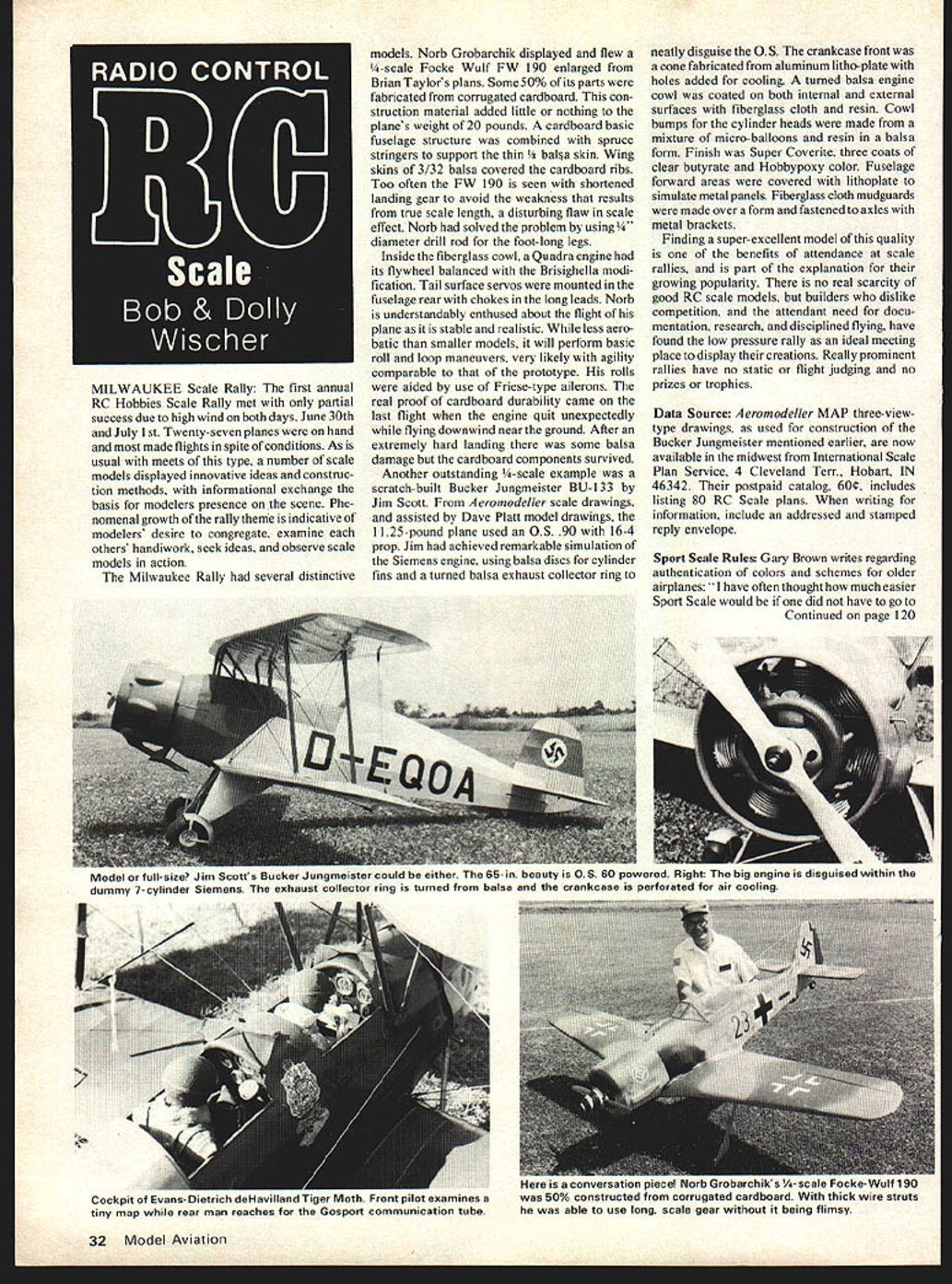
Another outstanding 1/4-scale example was a scratch-built Bucker Jungmeister BU-133 by Jim Scott. From Aeromodeller scale drawings, and assisted by Dave Platt model drawings, the 11.25-pound plane used an O.S. 90 with a 16x4 prop. Jim achieved remarkable simulation of the Siemens engine using balsa discs for cylinder fins and a turned balsa exhaust collector ring to neatly disguise the O.S. The crankcase front was a cone fabricated from aluminum litho-plate with holes added for cooling.
A turned balsa engine cowl was coated on both internal and external surfaces with fiberglass cloth and resin. Cowl bumps for the cylinder heads were made from a mixture of microballoons and resin in a balsa form. Finish was Super Coverite with three coats of clear butyrate and Hobbypoxy color. Fuselage forward areas were covered with litho-plate to simulate metal panels. Fiberglass cloth mudguards were made over a form and fastened to axles with metal brackets.
Finding a model of this quality is one of the benefits of attendance at scale rallies, and is part of the explanation for their growing popularity. There is no real scarcity of good RC scale models, but builders who dislike competition, and the attendant need for documentation, research, and disciplined flying, have found the low-pressure rally an ideal meeting place to display their creations. Really prominent rallies have no static or flight judging and no prizes or trophies.
Data Source
Aeromodeller MAP three-view-type drawings, as used for construction of the Bucker Jungmeister mentioned earlier, are now available in the Midwest from International Scale Plan Service, 4 Cleveland Terr., Hobart, IN 46342. Their postpaid catalog, 60¢, includes a listing of 80 RC scale plans. When writing for information, include an addressed and stamped reply envelope.
Sport Scale Rules
Gary Brown writes regarding authentication of colors and schemes for older airplanes: "I have often thought how much easier Sport Scale would be if one did not have to go to great lengths to prove an actual color scheme, but only shape and form via three-view drawing while employing a paint scheme typical of the aircraft. It also seems like it would open up new subjects for Sport Scale. Many aircraft have been overdone past the point of boredom, at least in my opinion."
We would tend to agree with Gary, especially after experiencing the nit-picking that takes place at contests regarding not only color schemes, but also the insistence upon agreement of model color hues with inaccurate color photos. It has been our experience that color printing processes do not render accurate hues and are generally unacceptable as proof. A photo has value only as proof of color in fine locations. Gary was referring to the building of a 1930-era biplane for which color documentation can't be found.
As Sport Scale rules are written presently, a color photo is not required, but some proof of the color scheme used on the model is needed to show that it resembles a particular prototype. A maximum of 30% of the static score is awarded for finish, color, and markings, without which the contestant's winning potential is considerably diminished. If no proof can be found, the modeller is discouraged from building the plane and we lose another interesting subject.
Flight Comparisons
How do the flight qualities of one model compare with another, and how do they compare with the prototype? We had a rare opportunity to compare our Piel Beryl to its full-scale counterpart recently when we were privileged to make several flights in Ellsworth Bentley's homebuilt Beryl. While our model was copied from the prototype built by Norm Taylor in Oregon, it was constructed from drawings borrowed from Ellsworth four years ago. His Beryl was completed last year and is kept near our home. He had offered numerous invitations to fly it and the opportunity to compare its flight with that of our model became possible.
Ellsworth's plane is a jewel among custom homebuilts with the mark of quality that has misled some into thinking it is not of humble origin, including an FAA inspection. The Beryl has the look, with its tight glass-fiberglass finish, of a finely crafted factory airplane. Canopy and flaps are electrically driven. The custom interior is finished with deep-pile material to deaden sound. Navigational and radio equipment have already been used for cross-country flights to points as distant as Alaska.
Even with two heavyweights aboard, takeoff was accomplished in several hundred feet. Using the 150-hp engine at full throttle, the rate of climb indicated 1,400 feet per minute. At this early point in the flight, similarity with our model was conspicuous. Its climb angle and the feeling of solidity were familiar. Something we were not prepared for was the closeness of the wing tips of the small plane—only 13 feet from the center.
Aileron sensitivity and roll rate were similar to the model. Steep turns could be entered and terminated with sharp abruptness, leaving the impression of flying our own little personal fighter plane.
In a steep turn we found one basic difference with the model. Less elevator was needed to keep the nose from dropping and this resulted in climbing turns, possibly because our 45°-banked turns were not as steep as those performed with the model. We sometimes tend to rack our models around the sky in a most unrealistic manner. There is nothing like flight in the real thing to open one's eyes to flaws in technique, such as turns so steep as to cause the pilot to black out.
One characteristic found very similar between prototype and model was the lack of a sharp break at the stall point. A well-rounded leading edge gives a soft stall, with no drop-off of the wing tip, even though there is no washout at the narrow, semi-elliptical tip. The model will reverse spin quite easily. Unfortunately, we wore no parachutes and could not check this feature.
Ellsworth found that his motor for lowering flaps initially had too little torque to go beyond 10° and motor size had to be increased. Similarly, our flap servo is worked harder than any other in the model. Flaps are very effective, as application can be felt by a noticeable sliding forward into the seat belt. There is also an abrupt speed change on the model when flaps are lowered. Both have a tendency to float when about to touch down, more pronounced when full flaps are not used. The oversize rudder really moves the tail around, before and after landing. Aeropiccola electric brakes on the model are used in unison, not differentially as on full size, which limits the model's turning radius. Except for this limitation, taxiing both is similar to steering a car and precise ground handling is effortless. After years of flying the model, flight in the prototype ranks as one of our most rewarding and informative experiences.
Check Those Batteries
Scale modelers are a very trusting group of people. We spend years and thousands of hours to create our masterpiece and then hope our batteries will function to keep it in one piece. Because it is common to fly a contest-type scale model only during competition, and possibly a few flights earlier, we assume that the batteries haven't had much use and should last forever. Not so—especially true if they have aged or have been improperly charged.
Our Kraft charger is intended for use with batteries that will accept a high charge rate, typically 1.75 A. The battery pack used in our Beryl, consisting of four G.E. 550 cells (½‑sub‑C), was thought to be of the high-discharge type and was purchased as such. Again, not so. The cell labels specified a charge rate of 50 mA. Kraft's charger rate is 165 mA for the airborne pack and we had been cooking our batteries. One cell shorted internally and this placed the remaining three cells at a charge rate of 240 mA, almost five times too great.
It was discovered after three flights at the recent Nats that we had flown with a three-cell battery pack—the fourth cell shorted. We wondered about the Beryl's sudden inability to snap-roll on command. Low voltage means slow servos; our reason. We were fortunate enough to survive the three Nats flights and several more afterward. The servo slowness was discernible but went unnoticed. The Kraft receiver has good range, even on a substandard 3.6 volts. Battery voltage can be checked at the charging plug. Checking voltage immediately before that first contest flight could avert a disaster. Most importantly, determine positively whether your batteries are compatible with the charger being used. We have heard it said that all nickel-cadmium batteries can be fast-charged. In view of our recent experience, we doubt it. There is no comparison between the cost of a scale model and the batteries to fly it.
Bob and Dolly Wischer R.1, S-221 Lapham Peak Road Delafield, WI 53018
Transcribed from original scans by AI. Minor OCR errors may remain.

