
Radio Control: Scale
Bud Atkinson
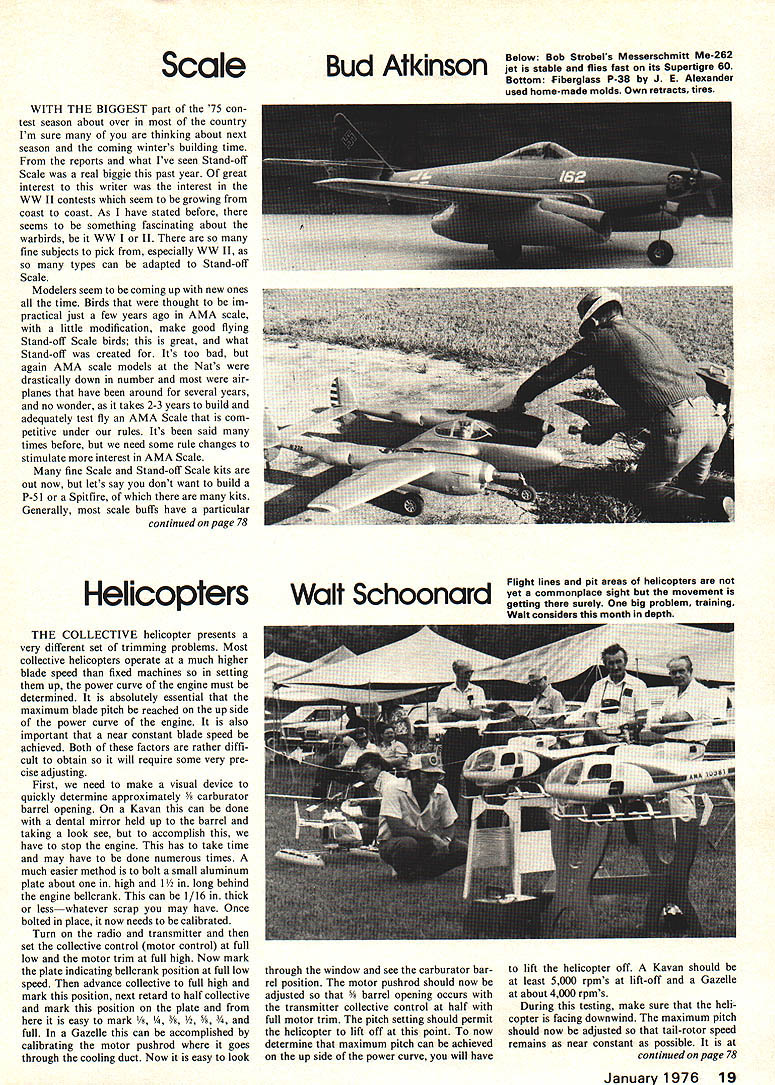
WITH THE BIGGEST part of the '75 contest season about over in most of the country I'm sure many of you are thinking about next season and the coming winter's building time. From the reports and what I've seen Stand-off Scale was a real biggie this past year. Of great interest to this writer was the interest in the WW II contests which seem to be growing from coast to coast. As I have stated before, there seems to be something fascinating about the warbirds, be it WW I or II. There are so many fine subjects to pick from, especially WW II, as so many types can be adapted to Stand-off Scale.
Modelers seem to be coming up with new ones all the time. Birds that were thought to be impractical just a few years ago in AMA scale, with a little modification, make good flying Stand-off Scale birds; this is great, and what Stand-off was created for. It's too bad, but again AMA scale models at the Nat's were drastically down in number and most were airplanes that have been around for several years, and no wonder, as it takes 2-3 years to build and adequately test fly an AMA Scale that is competitive under our rules. It's been said many times before, but we need some rule changes to stimulate more interest in AMA Scale.
Many fine Scale and Stand-off Scale kits are out now, but let's say you don't want to build a P-51 or a Spitfire, of which there are many kits. Generally, most scale buffs have a particular airplane they are attracted to; for one reason or another it has some fascination for them. Another reason for wanting to build a particular airplane is it will adapt well to an RC scale model.
The first consideration is the powerplant and just how large you want it to be, 45 or 60 power desired. Most Scale, be it AMA or Stand-off competition, should be a 60-powered bird as, of course, the extra detailing and retracts (if used) will give a much higher wing loading than, say, a pattern or sport bird. Next, of course, is to obtain as much information as possible on the subject; a good set of three views is a must to make the building plans from. If it's to be a Stand-off Scale there are some modifications that must be made to insure a better flying model without changing the outline too much.
The aerodynamics involved in scratch building a scale model would make a sizable book and we may get into it in part in later articles. One of the best ways to draw up your scale model is to use other successful models as a starting point, such as a good kit, or many of the scale plans in the magazines. Most standard airplanes are extraordinarily similar in the basic aerodynamic sense — one simply is a continuation of the other. Of course, there are exceptions. Most WWII aircraft basically are the same in configuration depending on the roles they played, such as fighters, bombers, dive-bombers, reconnaissance, etc.
If you were to overlay a Spitfire, P-51, Me 109, a Japanese Tony and a Macchi 202 you would be surprised how the moments would be comparable. This is also true of the radial-engined fighters. Probably the prime factor in a scale model is the proper airfoil. Most of the sections are about the same. Most of the symmetrical and laminar airfoils are much too fast and will not comfortably adapt to your scale model, as the wing loading is naturally going to be higher.
Probably among the best and most used airfoils on scale models are the 2400 series, 2412 to 2415, and they are good scale sections. The last two numbers refer to the thickness. In other words, a 2412 has a 12% thickness at the highest point of the chord or about 35-40% from the leading edge, so any percentage under 12% will usually be too thin to accommodate retracts. A 2412 has a 12% thickness at the highest point of the chord or about 35-40% from the leading edge, so any percentage under 12% will usually be too thin to house retracts; you will need at least 14-15% locally to take the wheels and wells.
Usually we are trying to simulate a fabric-covered wing. The stabilizer and elevator should always be symmetrical, be it a slab type or an airfoil symmetrical stab. Both will work OK on your scale models. A good safe-size stab is from 1.8 to 2% of the wing area; this is the tail volume coefficient.
Keep the stab large enough to be effective; if in doubt add a little more tail moment. A little extra tail area is easier to trim out than not enough.
Transcribed from original scans by AI. Minor OCR errors may remain.

