
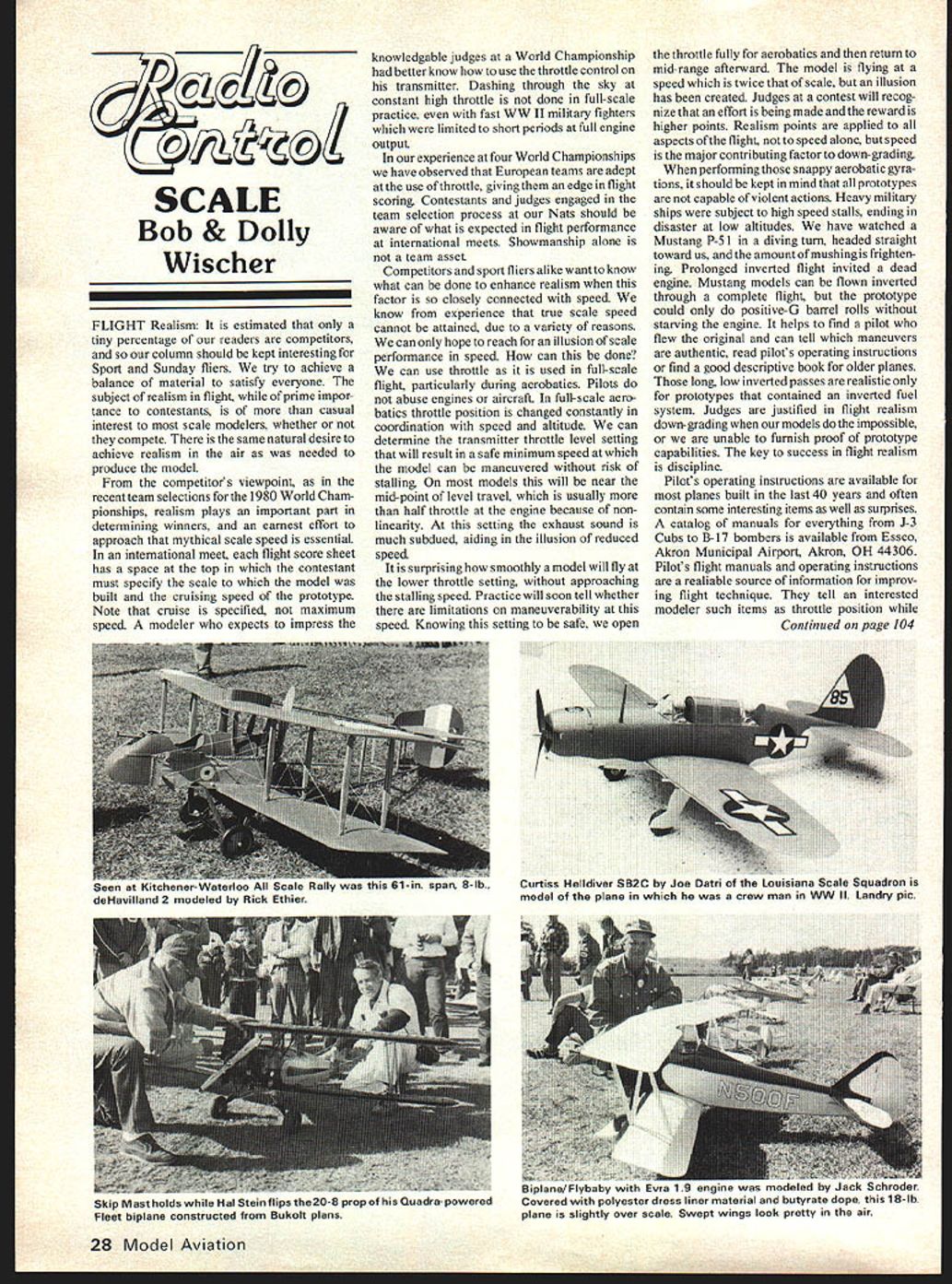
Radio Control: SCALE
Bob & Dolly Wischer
Flight Realism
It is estimated that only a tiny percentage of our readers are competitors, and so our column should be kept interesting for sport and Sunday fliers. We try to achieve a balance of material to satisfy everyone. The subject of realism in flight, while of prime importance to contestants, is of more than casual interest to most scale modelers, whether or not they compete. There is the same natural desire to achieve realism in the air as was needed to produce the model.
From the competitor's viewpoint, as in the recent team selections for the 1980 World Championships, realism plays an important part in determining winners, and an earnest effort to approach that mythical scale speed is essential. In an international meet, each flight score sheet has a space at the top in which the contestant must specify the scale to which the model was built and the cruising speed of the prototype. Note that cruise is specified, not maximum speed. A modeler who expects to impress the knowledgeable judges at a World Championship had better know how to use the throttle control on his transmitter. Dashing through the sky at constant high throttle is not done in full-scale practice, even with fast World War II fighters which were limited to short periods at full engine output.
In our experience at four World Championships we have observed that European teams are adept at the use of throttle, giving them an edge in flight scoring. Contestants and judges engaged in the team selection process at our Nats should be aware of what is expected in flight performance at international meets. Showmanship alone is not a team asset.
Competitors and sport fliers alike want to know what can be done to enhance realism when this factor is so closely connected with speed. We know from experience that true scale speed cannot be attained, due to a variety of reasons. We can only hope to reach for an illusion of scale performance in speed. How can this be done? We can use throttle as it is used in full-scale flight, particularly during aerobatics. Pilots do not abuse engines or aircraft. In full-scale aerobatics throttle position is changed constantly in coordination with speed and altitude.
We can determine the transmitter throttle level setting that will result in a safe minimum speed at which the model can be maneuvered without risk of stalling. On most models this will be near the mid-point of stick travel, which is usually more than half throttle at the engine because of non-linearity. At this setting the exhaust sound is much subdued, aiding in the illusion of reduced speed.
It is surprising how smoothly a model will fly at the lower throttle setting without approaching stalling speed. Practice will soon tell whether there are limitations on maneuverability at this speed. Knowing this setting to be safe, we open the throttle fully for aerobatics and then return to mid-range afterward. The model is flying at a speed which is twice that of scale, but an illusion has been created. Judges at a contest will recognize that an effort is being made and the reward is higher points. Realism points are applied to all aspects of the flight, not to speed alone, but speed is the major contributing factor to downgrading.
When performing those snappy aerobatic gyrations, it should be kept in mind that all prototypes are not capable of violent actions. Heavy military ships were subject to high-speed stalls, ending in disaster at low altitudes. We have watched a Mustang P-51 in a diving turn, headed straight toward us, and the amount of mushing is frightening. Prolonged inverted flight invited a dead engine. Mustang models can be flown inverted through a complete flight, but the prototype could only do positive-G barrel rolls without starving the engine. It helps to find a pilot who flew the original and can tell which maneuvers are authentic, read pilot operating instructions, or find a good descriptive book for older planes. Those long, low inverted passes are realistic only for prototypes that contained an inverted fuel system. Judges are justified in flight realism downgrading when our models do the impossible, or we are unable to furnish proof of prototype capabilities. The key to success in flight realism is discipline.
Pilot operating instructions are available for most planes built in the last 40 years and often contain some interesting items as well as surprises. A catalog of manuals for everything from J-3 Cubs to B-17 bombers is available from Essco, Akron Municipal Airport, Akron, OH 44306. Pilot flight manuals and operating instructions are a reliable source of information for improving flight technique. They can tell an interested modeler such items as throttle position while diving, speeds at which flaps can be lowered or bomb doors opened, and the maximum nose-down angle for dropping bombs. Some of the bomb-dropping exhibitions we have seen should receive low scores for their lack of authenticity because, according to the book, it wasn't safe to descend at a steep angle. On a model, if flaps are lowered at too high a speed, ballooning is the result. Prototype flaps would be torn from their hinges.
Model weight is obviously going to have an effect on low-speed performance. The Nats contestant who claimed that his 1/6-scale model would weigh 1/6 of the prototype's gross weight was mathematically incorrect. Our models do not fly at gross weight, nor do they carry fuel for a six-hour flight. Models carry ounces for a 20-minute flight. His 1/6-scale model was dimensionally reduced in length, width, and height; therefore, the prototype empty weight should be divided by 6^3 (216), the cube of the scale ratio. Models of military planes usually fly at less than half of the scale weight. We can't reach scale speed, but building light and throttling back will help in simulation.
Now we see the effect of scale speed dissidence at contests. If everyone flies through his routine at wide-open throttle, not unlikely at local or regional meets, judges find no reason for downgrading anyone and a contestant feels secure that his flight style is normal and accepted. At his first encounter with a judge or contest director who finds fault with pattern-type flying, the complaints begin to appear. He argues that his style was accepted elsewhere and should continue to be. There has been a continuous upgrading in model quality since the beginning of R/C scale. Shouldn't there also be an escalation in flight quality with respect to realism? The threatened boycott of contests where a tough stand is taken on realism may cause a loss in attendance. Will some of the multitude of rally-type fliers come over to contests when they find that they are no longer expected to compete against pattern flying? Have an opinion? Let's hear it.
Needle Valve Adjustment
Having to fly at part throttle for maximum realism means that the engine's needle valve must be easily adjusted to meet the varying conditions of altitude, temperature, and humidity. Maxey Hester once offered the admonition to never build a scale model that had no means of adjusting the carburetor. Scale modelers are reluctant to pierce an adjustment hole in the smooth cowl of a finely finished plane.
With a properly modified needle the hole need not be very large. A 1/16" diameter hole will accept a slender screwdriver. The real problem is finding the screwdriver slot hidden inside the cowl, especially while the engine is vibrating. Probing for the slot can be made less irksome if the driver can be guided. For a standard needle with a right-angle end, the bent portion is removed. A cylindrical steel or brass part is made with a screwdriver slot filed into one end and a hole to fit the needle drilled in the opposite end. This is soldered to the needle. A short piece of brass tube soldered over the slotted end forms a guide that prevents the screwdriver from slipping out of the slot. A small hole in the cowl needs to be lined up with the tube quite accurately for maximum effectiveness.
For cowls that have cooling air outlets at the rear, a flexible-shaft needle valve extension can be made with its adjustment knob just inside the opening where it can be reached. This is certainly the safest arrangement as it removes the adjustment from the vicinity of the prop. No unsightly holes blemish the smooth cowl. We tend to use an extra-long flex-shaft extension with a metal core. Salvage the knurled end from one of those old, damaged needle valves, press out the needle, and solder it to the shaft end as a knob. A short length of brass tube joined to the flexible shaft's opposite end and the needle. The outer plastic sleeve must be anchored at some convenient point near the carburetor. We use an aluminum bracket and epoxy. The flat spring detents on the carb will need to be loosened by bending so that the needle will rotate quite freely to avoid excessive twist in the flexible cable. The cable itself becomes an effective brake in place of the flat springs. It is difficult to make small adjustments when cable wind-up causes jumpy rotation.
Report From Paris
Six proposals concerning scale modeling rules were included in the plenary session agenda of the Committee for International Aeromodelling (CIAM) in Paris, November 29–30. That meeting proposed a scale rules sub-committee for aeromodeling and a sub-committee to examine the recommendations of the recent world championship. Our committee voted to send proposals and a short paragraph related to all that was needed to be considered at the meeting. Most of the proposals were accepted. Highlights:
- A Czechoslovak proposal contained a long list of sweeping changes that would have drastically affected the basis of scoring such features as multi-engines, flaps, retracts, and bomb doors. Scores would be lowered because these were not considered to be flight operations. Anyone who has noted the trim change during these operations is aware that flight is affected. The proposal was rejected because it would virtually replace the whole of our present rules system developed over years of world championships.
- A U.S. proposal to permit an increase in engine displacement from 10 cc (.61) to 15 cc (.91) for single-engine planes was rejected because increased motive power should be restricted to multi-engined models. The rule to permit 15 cc total for twins became effective in 1979. We had hoped to follow with the same displacement for single-engine models because it is reasoned that models so adjusted to active power are safer in flight.
- A Swiss proposal asked for a change in the ratio of scoring between static and flight from the present 50-50 to 57-43 in favor of flight, with the omission of craftsmanship points in static scores. The proposal was rejected as originally written and resubmitted with only a change in fidelity scoring into plane and engine views. This means that a model will be classed as if it were a three-view drawing including top and bottom views, and is applicable to Precision as well as Stand-off Scale models. Judges who see the bottom of a plane, as was done at the 1979 Nats for Sport Scale, will apply this.
The complexity flight bonus system that formerly applied to Precision (FAC) Scale models will now be applied to Stand-off Scale. In FAI competition the flight schedule will be the same. The French delegate, Jules Rege, informed us that judges in the Metz Stand-off Scale meet first viewed the models from three meters for fidelity and then close up for craftsmanship. Is this a trend for future meets? Because Precision and Stand-off are now so closely comparable in quality in the U.S. and worldwide, committee members reasoned that there may eventually be only one class with this type of judging technique.
The committee recommended that the earlier proposal for clarification of flight bonus points be accepted. This awards a 5% bonus for any biplane and 10% for a biplane with under-cambered wings (on prototype and model) rather than 10% for a two-bay biplane. No bonus points are awarded for monoplane models with or without retracts. Complexity points are to be awarded only if the contestant reproduces the feature on his model.
Bob and Dolly Wischer Rt. 1, S-221 Lapham Peak Rd., Delafield, WI 53018.
Transcribed from original scans by AI. Minor OCR errors may remain.

