
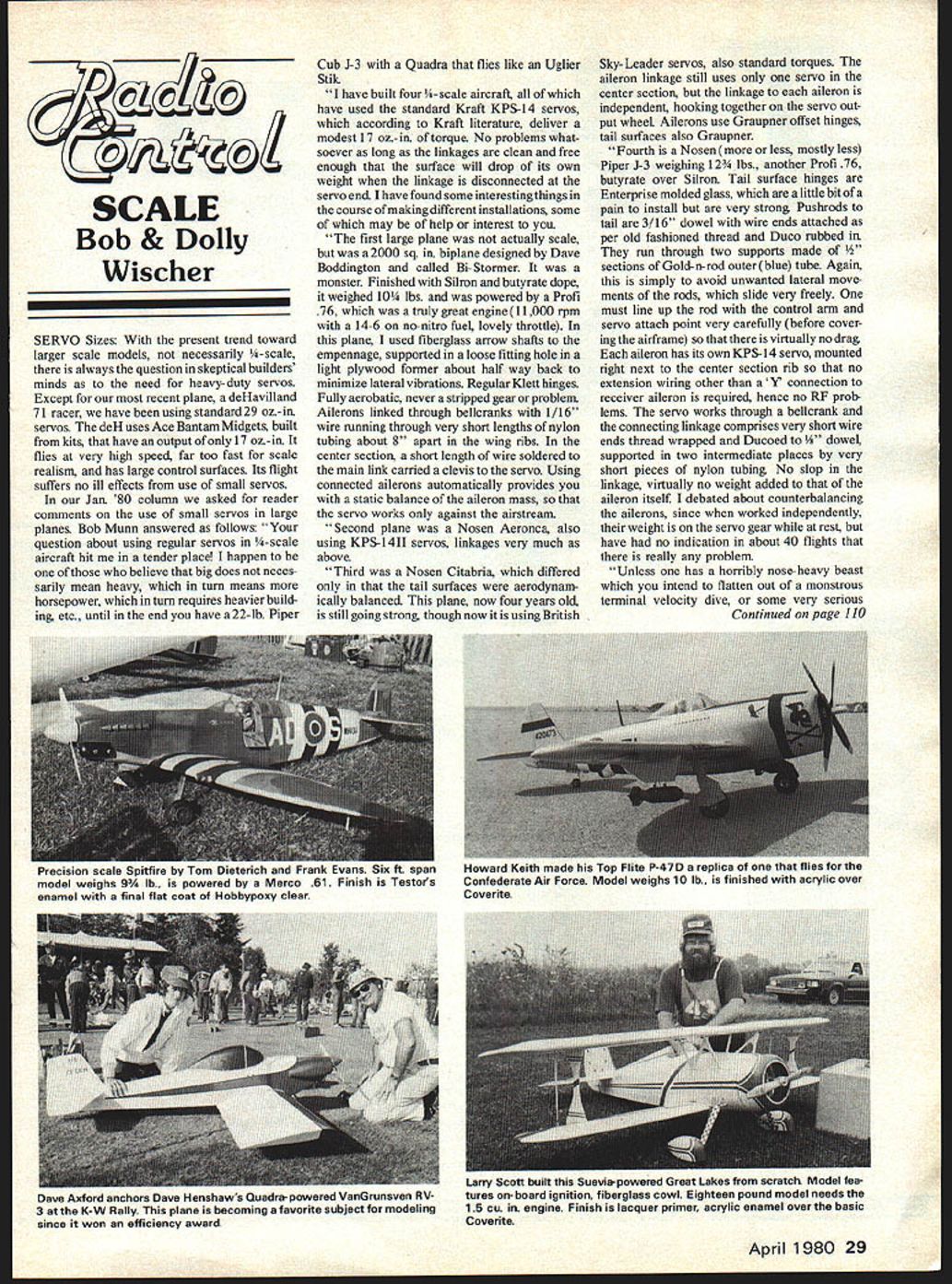
Radio Control: Scale
Bob & Dolly Wischer
Servo Sizes
With the present trend toward larger scale models, not necessarily 1/2-scale, there is always the question in skeptical builders' minds as to the need for heavy-duty servos. Except for our most recent plane, a de Havilland 71 racer, we have been using standard 29 oz.-in. servos. Our de Havilland uses Ace Bantam Midgets, built from kits, that have an output of only 17 oz.-in. It flies at very high speed, far too fast for scale realism, and has large control surfaces. Its flight suffers no ill effects from use of small servos.
In our Jan. '80 column we asked for reader comments on the use of small servos in large planes. Bob Munn answered as follows:
"Your question about using regular servos in 1/2-scale aircraft hit me in a tender place! I happen to be one of those who believe that big does not necessarily mean heavy, which in turn means more horsepower, which in turn requires heavier building, etc., until in the end you have a 22-lb. Piper Cub J-3 with a Quadra that flies like an Uglier Stik.
"I have built four 1/2-scale aircraft, all of which have used the standard Kraft KPS-14 servos, which according to Kraft literature, deliver a modest 17 oz.-in. of torque. No problems whatsoever as long as the linkages are clean and free enough that the surface will drop of its own weight when the linkage is disconnected at the servo end. I have found some interesting things in the course of making different installations, some of which may be of help or interest to you.
- First plane: Bi-Stormer (designed by Dave Boddington)
- About 2,000 sq. in., finished with Silron and butyrate dope, weighed 10 1/4 lbs., powered by a Profi .76 (11,000 rpm with a 14-6 on no-nitro fuel).
- Used fiberglass arrow shafts to the empennage, supported in a loose-fitting hole in a light plywood former about halfway back to minimize lateral vibrations.
- Regular Klett hinges. Fully acrobatic, never a stripped gear or problem.
- Ailerons linked through bellcranks with 1/16" wire running through very short lengths of nylon tubing about 8" apart in the wing ribs. In the center section, a short length of wire soldered to the main link carried a clevis to the servo.
- Using connected ailerons automatically provides a static balance of the aileron mass, so the servo works only against the airstream.
- Second plane: Nosen Aeronca
- Also used KPS-14II servos, linkages similar to those above.
- Third plane: Nosen Citabria
- Tail surfaces were aerodynamically balanced.
- Now four years old and still flying, currently using British Sky-Leader servos of standard torque.
- Aileron linkage uses only one servo in the center section; linkages to each aileron are independent and hook together on the servo output wheel.
- Ailerons use Graupner offset hinges; tail surfaces also Graupner.
- Fourth plane: Nosen (mostly less) Piper J-3
- Weighed 12 3/4 lbs., powered by another Profi .76, finished with butyrate over Silron.
- Tail surface hinges are Enterprise molded glass — strong though a bit of a pain to install.
- Pushrods to tail are 3/16" dowel with wire ends attached by old-fashioned threading and Duco, running through two supports made from 1/8" sections of Gold-n-rod outer (blue) tube to avoid lateral movement.
- Careful alignment of the rod with the control arm at the servo attach point (before covering) ensures virtually no drag.
- Each aileron has its own KPS-14 servo, mounted next to the center section rib so no extension wiring other than a Y connection to the receiver is required (hence no RF problems).
- Servo works through a bellcrank; connecting linkage comprises very short wire ends threaded, wrapped and Ducoed to 1/16" dowel, supported at two intermediate places by short pieces of nylon tubing — no slop, virtually no added weight.
"I debated counterbalancing the ailerons since, having worked independently, the aileron weight rests have shown no indication after about 40 flights that there is any problem. Unless one has a horribly nose-heavy beast which you intend to flatten out of a monstrous terminal velocity dive, or some very serious vibration problems, I cannot see that a 1/4-scale aircraft, if flown in anything resembling scale-type flight and comparative stresses, can't be controlled with normal servos delivering somewhere around 20 oz.-in.
"I believe that since 1/4" dowel is as stiff as wire but much lighter and without RF associations, it can be used quite successfully for control pushrods, provided it is supported at 8" to 10" intervals by carefully aligned nylon or comparable 'slick' guides to prevent lateral movement. This type of connection also minimizes weight in all respects and tends to dampen vibration better than using a heavier unsupported pushrod."
Bob Munn's accomplishments with friction-free lightweight pushrods provide ideas that will be helpful on all sizes of scale planes. His use of standard servos on planes up to nine-foot span would indicate that we have power to spare. The only exception may be a servo driving large-area flaps down to a 45° angle, which may require some extra energy, particularly when there are friction losses in the linkage.
Scale Details
Inquiries regarding the gathering of information needed to finish a scale kit are constantly reaching our mailbox. It isn't easy to inform someone that he should have started with a good scale drawing and a stack of sharp photos before he bought the kit; that is a more proper sequence. Questions of this nature usually arise because the kit buyer is new to scale, has purchased kits in the past for trainer-type models and found the kit box to contain all that was needed. Even though some scale kits do include a three-view drawing, additional information to build a model of a specific aircraft is more often required. Kit information may be sufficient to build a model with the general outlines and colors of the type. When a builder is dissatisfied with the ordinary—perhaps because he has seen well-finished models or photos of them—there comes an awareness of lacking information.
We have been asked for a list of purchased scale goodies from which to select parts that can be assembled with a kit, making modeling an assembly task rather than a building job. Actually, the Sig and Ace catalogs contain a large portion of the available items on the market, so a list of sorts already exists. It is regrettable that the builder who wants a top-quality model of a specific airplane will not find many items that are usable in their original, as-purchased condition. Everything depends upon the degree of authenticity that is desired, and Sport Scale modelers have a definite advantage in being willing to accept ready-made parts that are not necessarily perfect for their application.
Choosing a model subject on the basis of available data and usable purchased parts is the surest course of action. Preferred scale drawings should have sufficient detail to remove doubts about such items as control-surface hinge-point locations and landing-gear motion, if retractable. Determine whether commercial retract mechanisms can be employed. Wheels that swing through an arc greater than 90° may require machining of parts beyond the modeler's capacity, or a change in design that reduces scale accuracy. A decision must be made as to whether loss of accuracy is acceptable, as it may be to a Sport Scale builder.
A modeler searching for the ultimate in every detail will find that quality suffers when compromises must be made in shape, form, or structure to accommodate ready-made parts. Hinges, as an example, are available in a profusion of shapes and sizes. Possibly a way can be found to use them, but true scale hinges usually have pivot centers in such positions that a sacrifice in scale appearance or operation is inevitable.
Wheels and tires are an eyesore on too many otherwise excellent scale planes. Too large or too small, with the wrong proportion of hub to tire size, is a conspicuous error, and tread pattern also contributes to lack of authenticity. Reliable scale data in the form of drawings and clear photos, on hand before starting construction, will warn that wheels can be a problem, even though we have many from which to select. We have rejected some attractive prototypes because similar wheels are not available. If exact-diameter wheels can't be found, it is best to err on the large side.
Research is regarded by many as a boring ancillary to the art of scale modeling. Others dislike writing begging letters to possible data sources. Too many of us live in relative isolation from fellow modelers who may come forth with helpful information about our choice of subject. Groups and clubs that specialize in scale can assist one another. As a research aid, the National Association of Scale Modelers (NASA) has compiled a Scale Data Source List for its members. The list narrows down the number of places one would need to write for specific information. Some information can be found in columns such as ours, but the data becomes lost to future reference unless the reader clips the item. Membership dues in NASA are $5.00 annually. Address inquiries to Robert Underwood, 4109 Concord Oaks Drive, St. Louis, MO 63128. The list contains government agencies and commercial sources for drawings, photographs and some museum aircraft for personal viewing and study.
What may be the largest collection of aircraft photo negatives is in the possession of Peter Bowers. Peter has not been able to answer inquiries because of the time required to operate a photo business, but prints from his several hundred thousand negatives can be obtained through Castle Graphics, P.O. Box A, D. Greenbank, WA 98253. Prices are $2.50 for 8 x 10" or $1.75 for 5 x 7" single-weight glossy black-and-white, with $1.00 additional for first-class postage. Like most photo sources, it will be necessary to be quite specific when ordering. To be of value, photos should not be halftone magazine or book types. A magnifying glass used on a halftone photo merely enlarges the dots. A really sharp photo can be magnified to read stenciled legends on the plane and to locate panel lines. Best source of photos is the modeler's camera, if the prototype can be found. Dedicated researchers travel great distances and spend days photographing and measuring a plane.
Bob and Dolly Wischer, Rt. 1, S-221 Lapham Peak Road, Delafield, WI 53018.
Tigercat / Norman
From the Jig
As indicated by the shape of former F-12, the vertical tail is of tapered thickness. The two horizontal ribs in the fin are cut from scrap 1/20" or 1/16" sheet stock, and tapered from a width equal to that of F-12 where they join it, down to the thickness of the fin's leading edge. Also, the contour of the upper fuselage immediately behind the cockpit is somewhat rounded and it is suggested that the area between formers F-5 and F-7 be filled in with tapering pieces of 1/16" sheet, sanded and rounded to better approximate the look of the full-size aircraft. The rudder (the moveable part of the vertical tail) is built separately.
Nacelles
Using the same techniques described for constructing the fuselage, the nacelle formers and longerons are cut and then assembled on a masonite jig to hold them true while being assembled. As the nacelles "mirror" each other you will have to flip the formers shown on the plan to make the left nacelle.
Component Assembly
The wing halves are joined to the fuselage center in such a way that the leading edge of each half of the wing is joined in front of former F-5. The main spars meet just behind former F-6, and the trailing edges join at former F-8. It will be necessary to deeply notch F-8 to permit the trailing edges to pass through it. It will also be necessary to remove portions of the fuselage stringers where they block passage of the main spar. The approximate dihedral angle has been indicated on formers F-5 and F-6 and will help in aligning the wing halves. The dihedral on the full-size aircraft is substantial and the dihedral on the model is approximately 1 1/4" at each tip rib.
Once the wing halves are positioned so that the leading and trailing edges and the main spar all meet as indicated, the two halves are joined together with epoxy. Before the wing is joined to the fuselage, check that it has approximately two degrees positive incidence (use the side longeron as a reference line). The wing is then joined permanently to the fuselage using epoxy and scrap balsa to fill any gaps between the wing and nearby supporting fuselage formers.
The area between the root rib and the fuselage is filled in with 1/32" sheet, both for strength and as a base for adhering the tissue covering. Similarly, 1/32" x 3/32" strip pieces are installed following the shape of the airfoil in those portions of the fuselage adjacent to the wing root. This adds strength and also provides a suitable base for the tissue attachment.
Each of the nacelles is joined to the wing at the position shown on the plan. The angled tops of formers N-4, N-5, N-6 and N-7 are aligned with the underside of the wing. The trailing edge is epoxied to N-7, while the leading edge is joined to N-3 as shown. Once the nacelle is in place, fill in the area between the nacelle and the underside of each wing rib nearest to it with 1/32" sheet. There is no need to put 1/32" sheet fill on the top surfaces of the wing, except for that portion between N-3 and the turbulator spar.
Landing Gear
As indicated on the plan, landing gear for this model is optional. Flying Aces' Rules permit subjects with retractable gear to be flown "wheels up," thus eliminating considerable weight and drag.
If you intend to place your model on static display, the landing gear may be desirable as a realistic "base" for the model. If you decide to build landing gear, it is suggested that you make it removable for flying. My favorite technique is to use a "plug-in" type in which small receptacles of 1/16" aluminum tubing are placed at the points where the main landing gear members meet the fuselage or nacelles. Then the landing gear components are fashioned with 1/32" wire pins which slide into the aluminum-tube receptacles. If you intend to use landing gear on your model, it is suggested that you build the appropriate receptacles for it before proceeding with the covering.
Covering and Coloring
The wing and fuselage were assembled. By using 1/32" sheet fill at key points, such as the wing roots, you have strengthened stress areas and provided anchor points for the tissue covering.
Almost all Tigercats were overall dark navy blue. My prototype is this color, but the prototype of the original aircraft was all silver. One of the first F7Fs tested at Patuxent, Maryland was all yellow. The July 1978 issue of Air Classics magazine contains color photos of a civilian Tigercat in silver, red, white and black trim. I chose to mark my model with the green and white bands sported by a Marine Corps F7F at El Toro Marine Base in 1946.
In keeping with the general design philosophy, it is suggested that after shrinking the tissue, only a single coat of dope be applied.
As there is no rubber motor passing through the fuselage, you have an opportunity to install a completely detailed cockpit and full pilot figure if you wish. It is my intention to do this on my model, but the pressures of completing it for the July 15, 1978 Flying Aces' National Meet dictated that I use a conventional pilot bust (which I carved from styrofoam). I have been unable to find any good detail on the F7F cockpit interior, but a fair amount of information is contained in the Model Airplane News book Best of Nye, Vol. 3. Also, an excellent reference for scale details may be had by purchasing the 1/72 Monogram plastic kit.
Propellers
I used 8" Sterling plastic propellers cut to 7 3/4". Static three-bladed propellers were also made by using 7" Sleek Streak props epoxied at the appropriate angles. The model will probably fly on three-bladed props.
Transcribed from original scans by AI. Minor OCR errors may remain.

