
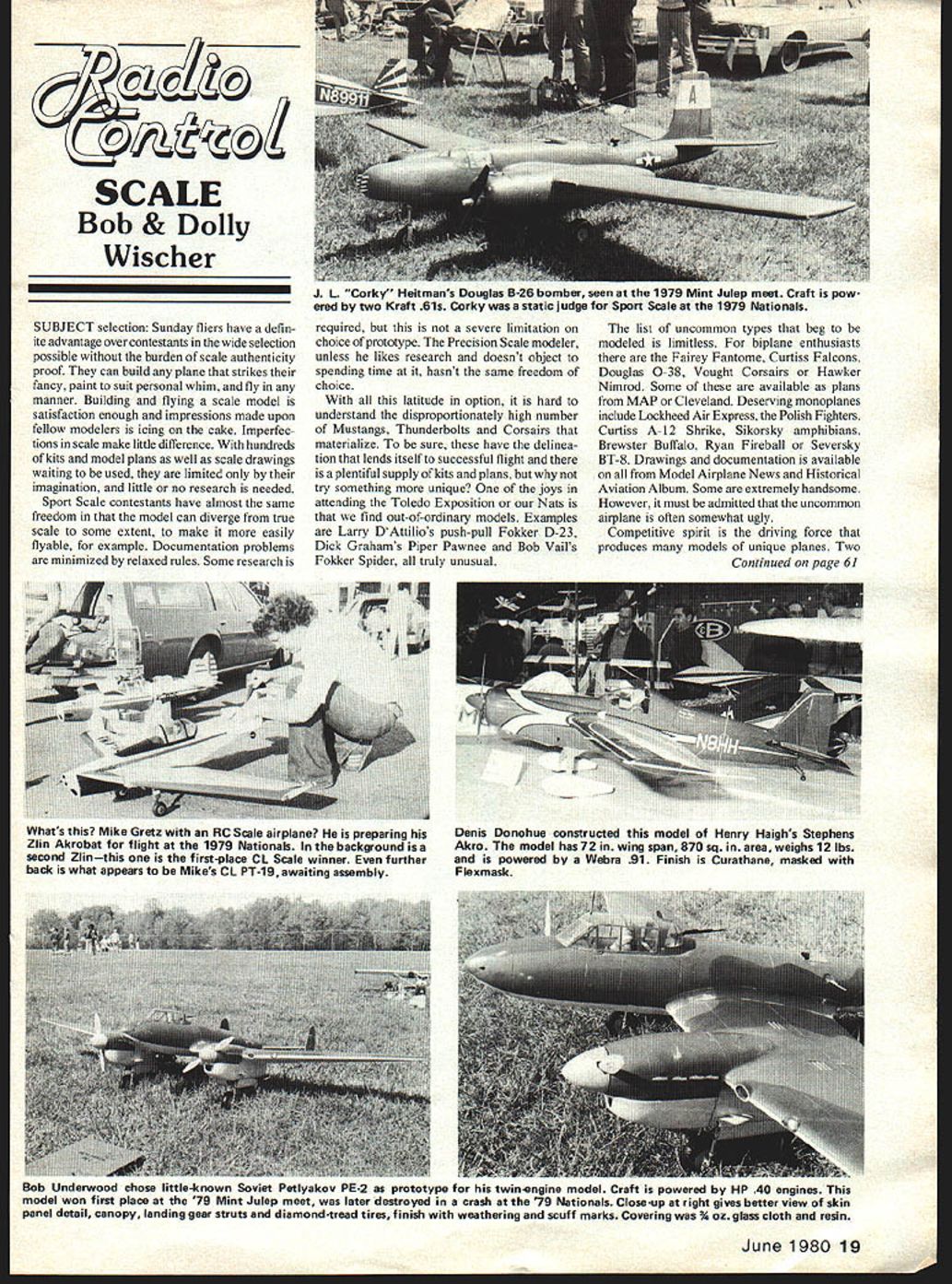
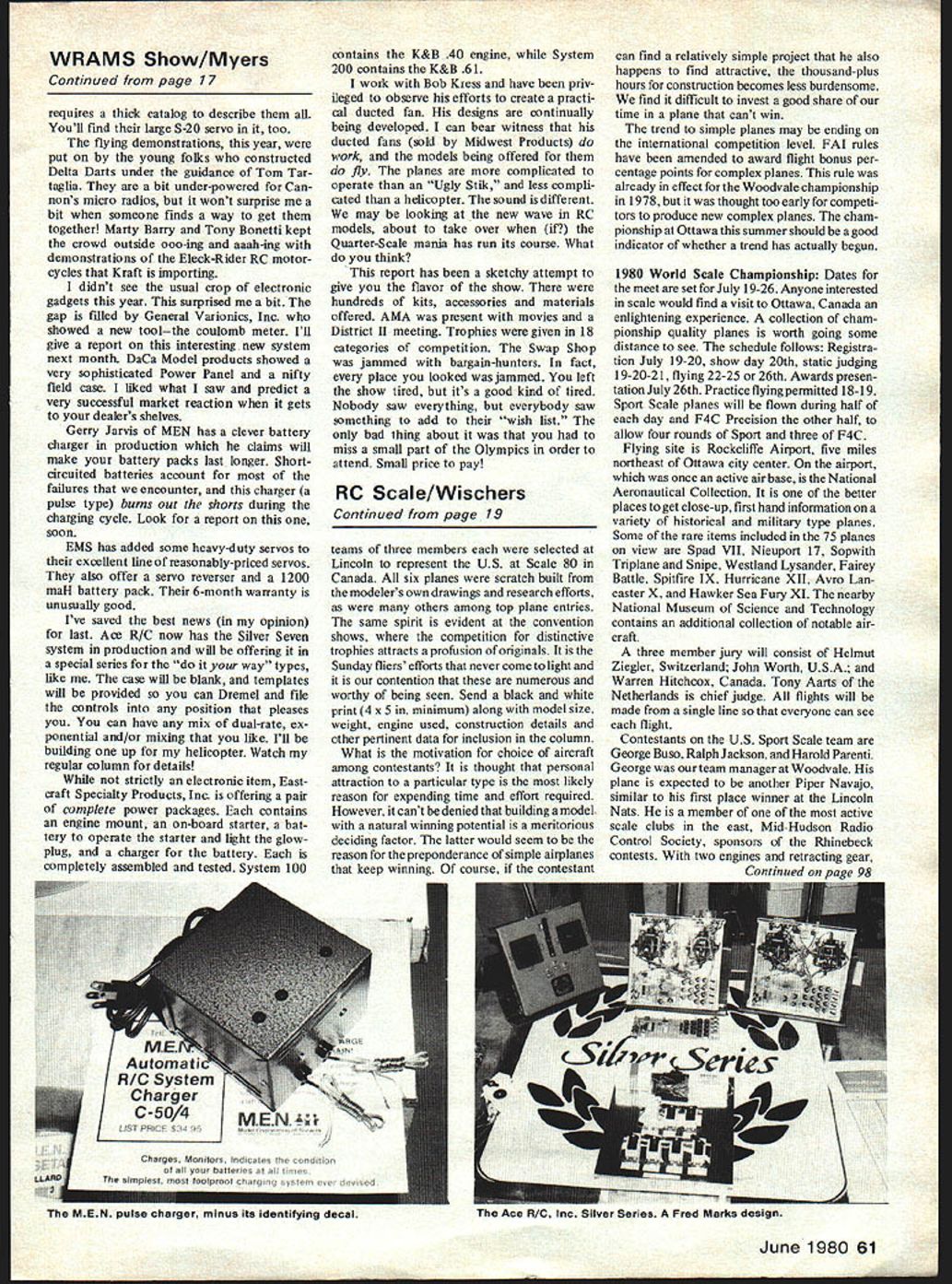
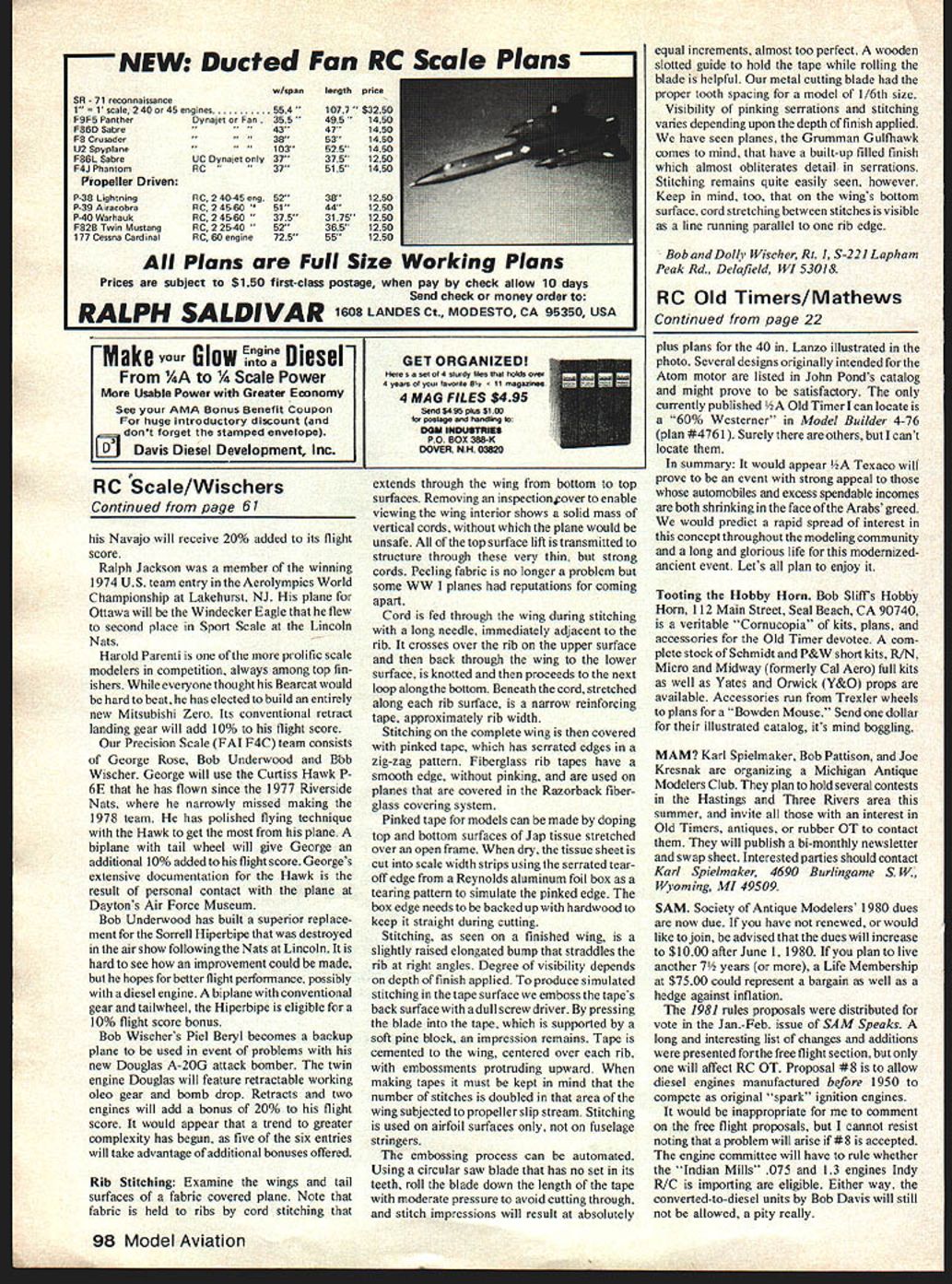
SCALE
Bob & Dolly Wischer
Subject selection
Sunday fliers have a definite advantage over contestants in the wide selection possible without the burden of scale authenticity proof. They can build any plane that strikes the fancy, paint to suit personal whim, and fly in any manner. Building and flying a scale model is satisfaction enough and impressions made upon fellow modelers are icing on the cake. Imperfections in scale make little difference. With hundreds of kits and model plans as well as scale drawings waiting to be used, Sunday fliers are limited only by their imagination, and little or no research is needed.
Sport Scale contestants have almost the same freedom in that the model can diverge from true scale to some extent to make it more easily flyable, for example. Documentation problems are minimized by relaxed rules. Some research is required, but this is not a severe limitation on choice of prototype. The Precision Scale modeler, unless he likes research and doesn't object to spending time at it, hasn't the same freedom of choice.
With all this latitude in option, it is hard to understand the disproportionately high number of Mustangs, Thunderbolts and Corsairs that materialize. To be sure, these have the delineation that lends itself to successful flight and there is a plentiful supply of kits and plans, but why not try something more unique? One of the joys in attending the Toledo Exposition or our Nats is that we find out-of-ordinary models. Examples are Larry D'Attilio's push-pull Fokker D-23, Dick Graham's Piper Pawnee and Bob Vail's Fokker Spider — all truly unusual.
The list of uncommon types that beg to be modeled is limitless. For biplane enthusiasts there are the Fairey Fantome, Curtiss Falcons, Douglas O-38, Vought Corsairs or Hawker Nimrod. Some of these are available as plans from MAP or Cleveland. Deserving monoplanes include the Lockheed Air Express, the Polish fighters, Curtiss A-12 Shrike, Sikorsky amphibians, Brewster Buffalo, Ryan Fireball or Seversky BT-8. Drawings and documentation are available on all from Model Airplane News and Historical Aviation Album. Some are extremely handsome. However, it must be admitted that the uncommon airplane is often somewhat ugly.
Competitive spirit
Competitive spirit is the driving force that produces many models of unique planes. Teams of three members each were selected at Lincoln to represent the U.S. at Scale 80 in Canada. All six planes were scratch-built from the modelers' own drawings and research efforts, as were many others among top plane entries. The same spirit is evident at the convention shows, where the competition for distinctive trophies attracts a profusion of originals. It is the Sunday fliers' efforts that never come to light, and it is our contention that these are numerous and worthy of being seen. Send a black-and-white print (4 x 5 in. minimum) along with the modeler's name, weight, engine used, construction details and other pertinent data for inclusion in the column.
Motivation for choice
What is the motivation for choice of aircraft among contestants? It is thought that personal attraction to a particular type is the most likely reason for expending the time and effort required. However, it can't be denied that building a model with a natural winning potential is a meritorious deciding factor. The latter would seem to be the reason for the preponderance of simple airplanes that keep winning. Of course, if the contestant can find a relatively simple project that he also happens to find attractive, the thousand-plus hours for construction becomes less burdensome. We find it difficult to invest a good share of our time in a plane that can't win.
The trend to simple planes may be ending on the international competition level. FAI rules have been amended to award flight bonus percentage points for complex planes. This rule was already in effect for the Woodvale championship in 1978, but it was thought too early for competitors to produce new complex planes. The championship at Ottawa this summer should be a good indicator of whether a trend has actually begun.
1980 World Scale Championship
Dates for the meet are set for July 19–26. Anyone interested in scale would find a visit to Ottawa, Canada an enlightening experience. A collection of championship-quality planes is worth going some distance to see. The schedule follows:
- Registration: July 19–20
- Show day: July 20
- Static judging: July 19–21
- Flying: July 22–25 or 26 (awards presentation July 26)
- Practice flying permitted: July 18–19
Sport Scale judging will be flown during half of each day and F4C Precision the other half, to allow four rounds of Sport and three of F4C. All flights will be made from a single line so that everyone can see each flight.
Flying site is Rockcliffe Airport, five miles northeast of Ottawa city center. On the airport, which was once an active air base, is the National Aeronautical Collection. It is one of the better places to get close-up, first-hand information on a variety of historical and military type planes. Some of the rare items included in the 75 planes on view are:
- SPAD VII
- Nieuport 17
- Sopwith Triplane and Snipe
- Westland Lysander
- Fairey Battle
- Spitfire IX
- Hurricane XII
- Avro Lancaster X
- Hawker Sea Fury XI
The nearby National Museum of Science and Technology contains an additional collection of notable aircraft.
Judges and officials
A three-member jury will consist of Helmut Ziegler (Switzerland), John Worth (U.S.A.) and Warren Hitchcock (Canada). Tony Aarts (Netherlands) is chief judge.
U.S. Sport Scale team
Contestants on the U.S. Sport Scale team are George Buso, Ralph Jackson and Harold Parenti.
- George Buso was our team manager at Woodvale. His plane is expected to be another Piper Navajo, similar to his first-place winner at the Lincoln Nats. He is a member of one of the most active scale clubs in the East, the Mid-Hudson Radio Control Society, sponsors of the Rhinebeck contests. With two engines and retractable gear, his Navajo will receive 20% added to its flight score.
- Ralph Jackson was a member of the winning 1974 U.S. team entry in the Aerolympics World Championship at Lakehurst, NJ. His plane for Ottawa will be the Windecker Eagle that he flew to second place in Sport Scale at the Lincoln Nats.
- Harold Parenti is one of the more prolific scale modelers in competition, always among top finishers. While everyone thought his Bearcat would be hard to beat, he has elected to build an entirely new Mitsubishi Zero. Its conventional retract landing gear will add 10% to his flight score.
U.S. Precision Scale (FAI F4C) team
Our Precision Scale team consists of George Rose, Bob Underwood and Bob Wischer.
- George Rose will use the Curtiss Hawk P-6E that he has flown since the 1977 Riverside Nats, where he narrowly missed making the 1978 team. He has polished flying technique with the Hawk to get the most from his plane. A biplane with tail wheel will give George an additional 10% added to his flight score. George's extensive documentation for the Hawk is the result of personal contact with the plane at the Dayton Air Force Museum.
- Bob Underwood has built a superior replica of the Sorrell Hiperbipe that was destroyed in the air show following the Nats at Lincoln. It is hard to see how an improvement could be made, but he hopes for better flight performance, possibly with a diesel engine. As a biplane with conventional gear and tailwheel, the Hiperbipe is eligible for a 10% flight score bonus.
- Bob Wischer's Piel Beryl becomes a backup plane to be used in the event of problems with his new Douglas A-20G attack bomber. The twin-engine Douglas will feature retractable working oleo gear and bomb drop. Retracts and two engines will add a bonus of 20% to his flight score.
It would appear that a trend to greater complexity has begun, as five of the six entries will take advantage of additional bonuses offered.
Rib Stitching
Examine the wings and tail surfaces of a fabric-covered plane. Note that fabric is held to ribs by cord stitching that extends through the wing from bottom to top surfaces. Removing an inspection cover to view the wing interior shows a solid mass of vertical cords, without which the plane would be unsafe. All of the top surface lift is transmitted to structure through these very thin but strong cords. Peeling fabric is no longer a problem, but some World War I planes had reputations for coming apart.
Cord is fed through the wing during stitching with a long needle, immediately adjacent to the rib. It crosses over the rib on the upper surface and then back through the wing to the lower surface, is knotted and then proceeds to the next loop along the bottom. Beneath the cord, stretched along each rib surface, is a narrow reinforcing tape approximately rib-width.
Stitching on the complete wing is then covered with pinked tape, which has serrated edges in a zig-zag pattern. Fiberglass rib tapes have a smooth edge, without pinking, and are used on planes that are covered in the Razorback fiberglass covering system.
Pinked tape for models can be made by doping over top and bottom strips of Jap tissue stretched over an open frame. When dry, the tissue sheet is clipped into scale-width strips using the serrated tear-off edge from a Reynolds aluminum foil box as a single operation to simulate the pinked edge. The box edge needs to be backed up with hardwood to keep it straight during cutting.
Stitching, as seen on a finished wing, is a slightly raised elongated bump that straddles the rib at right angles. Degree of visibility depends on depth of finish applied. To produce a simulated stitched line, the tape surface was embossed with the tape's back surface using a dull screwdriver. By pressing the blade into the tape, which is supported by a soft pine block, an impression remains. Tape is cemented to the wing, centered over each rib, with embossments protruding upward. When making tapes it must be kept in mind that the number of stitches is doubled in the area of the wing subjected to propeller slipstream. Stitching is used on airfoil surfaces only, not on fuselage stringers.
The embossing process can be automated. Using a circular saw blade that has no set in its teeth, roll the blade down the length of the tape with moderate pressure to avoid cutting through, and stitch impressions will result at equal increments, almost too perfect. A wooden slotted guide to hold the tape while rolling the blade is helpful. Our metal-cutting blade had the proper tooth spacing for a model of 1/6th size.
Visibility of pinking serrations and stitching varies depending upon the depth of finish applied. We have seen planes — the Grumman Gulfhawk comes to mind — that have a built-up filled finish which almost obliterates detail in serrations. Stitching remains quite easily seen, however. Keep in mind, too, that on the wing's bottom surface the cord stretching between stitches is visible as a line running parallel to one rib edge.
Bob and Dolly Wischer Rt. 1, S-221 Lapham Peak Rd. Delafield, WI 53018
Transcribed from original scans by AI. Minor OCR errors may remain.

