
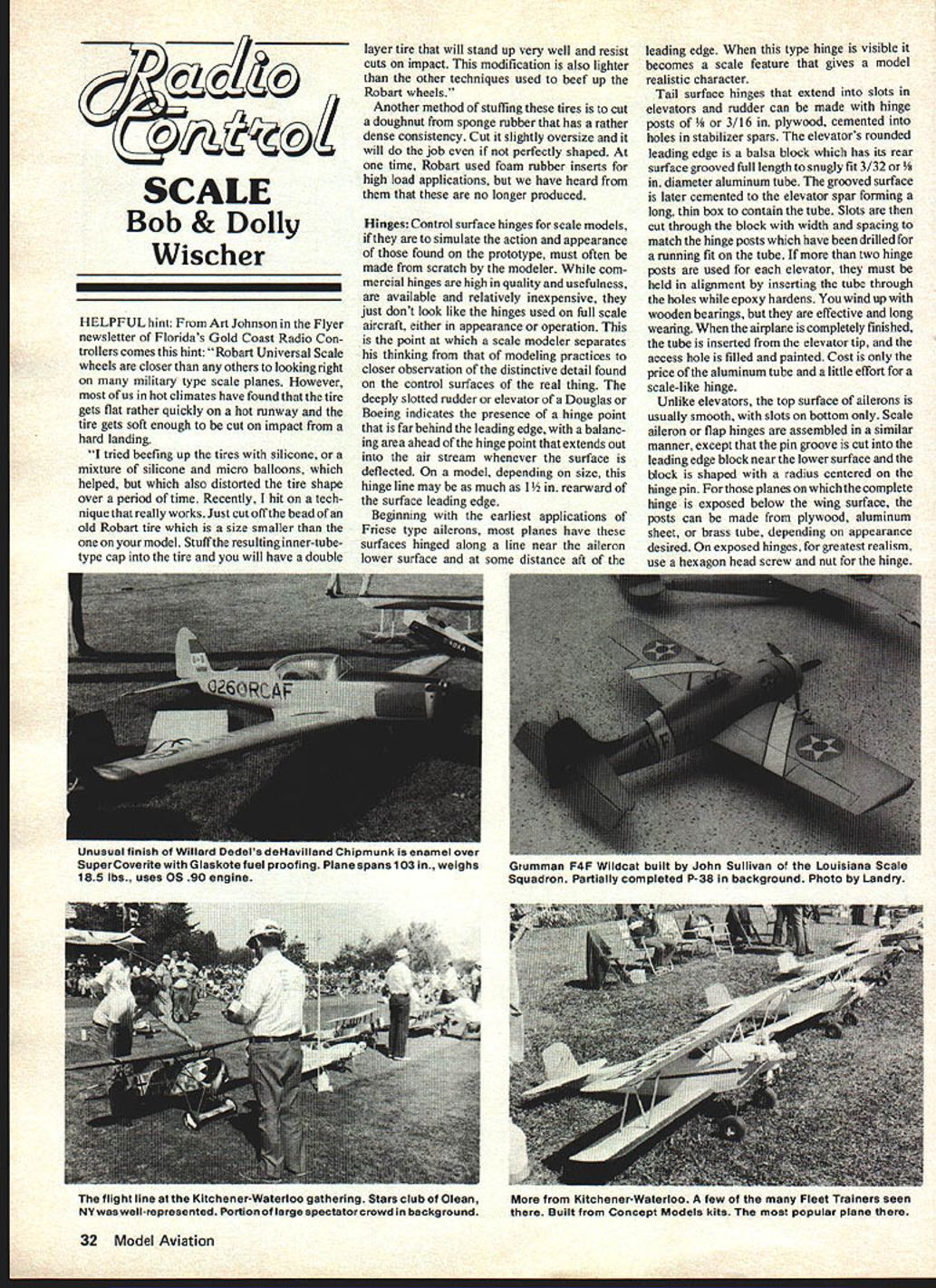
Radio Control: Scale
Bob & Dolly Wischer
Helpful hint: Wheels
From Art Johnson in the Flyer newsletter of Florida's Gold Coast Radio Controllers comes this hint: "Robart Universal Scale wheels are closer than any others to looking right on many military-type scale planes. However, most of us in hot climates have found that the tire gets flat rather quickly on a hot runway and the tire gets soft enough to be cut on impact from a hard landing."
- Common attempts: Beefing up the tires with silicone or a mixture of silicone and micro balloons helps, but often distorts the tire shape over time.
- A working technique: Cut off the bead of an old Robart tire that is one size smaller than the one on your model. Stuff the resulting inner-tube-type cap into the tire and you will have a double-layer tire that stands up well and resists cuts on impact. This modification is lighter than other beefing-up techniques.
- Another method: Cut a doughnut from relatively dense sponge rubber slightly oversize and insert it into the tire. It will work even if not perfectly shaped.
- Note: Robart once used foam rubber inserts for high-load applications, but they are no longer produced.
Hinges
Control surface hinges for scale models, if they are to simulate the action and appearance of the prototype, often must be made from scratch. Commercial hinges are high quality and useful but usually do not look like full-scale aircraft hinges in appearance or operation. Observing the prototype details separates scale modelers from standard modeling practice.
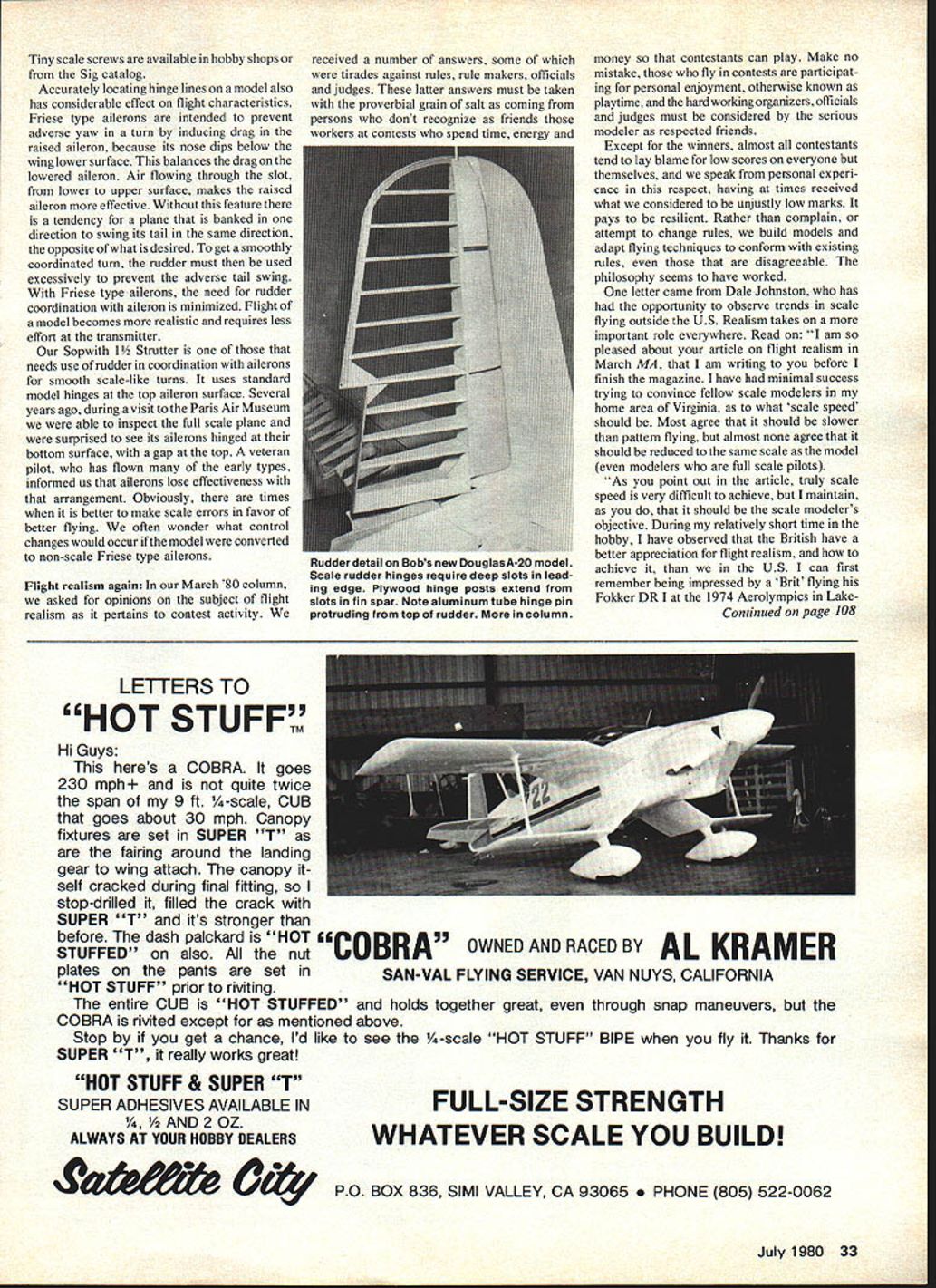
The deeply slotted rudder or elevator of a Douglas or Boeing indicates a hinge point far behind the leading edge, with a balancing area ahead of the hinge that extends into the airstream when deflected. On a model, depending on size, this hinge line may be as much as 1½ in. rearward of the surface leading edge. When visible, this type of hinge becomes a scale feature that gives a model realistic character.
Tail surface hinge construction (one effective method):
- Make hinge posts from 1/8 or 3/16 in. plywood and cement them into holes in the stabilizer spars.
- Make the elevator's rounded leading edge from a balsa block and groove its rear surface full length to snugly fit a 3/32 or 1/8 in. diameter aluminum tube.
- Cement the grooved surface to the elevator spar to form a long, thin box to contain the tube.
- Cut slots through the block with width and spacing to match the hinge posts, which have been drilled for a running fit on the tube.
- If more than two hinge posts are used, hold them in alignment by inserting the tube through the holes while epoxy hardens.
The result is wooden bearings that are effective and long-wearing. When finished, insert the tube from the elevator tip and fill and paint the access hole. Cost is only the price of the aluminum tube and a little labor for a scale-like hinge.
Ailerons and flaps:
- Unlike elevators, the top surface of ailerons is usually smooth with slots on the bottom only. Scale aileron or flap hinges are assembled similarly, except the pin groove is cut into the leading-edge block near the lower surface and the block is shaped with a radius centered on the hinge pin.
- On planes where the complete hinge is exposed below the wing surface, the posts can be made from plywood, aluminum sheet, or brass tube depending on the desired appearance. For exposed hinges, use a hexagon head screw and nut for greatest realism.
- Tiny scale screws are available in hobby shops or from catalogs such as Sig.
Hinge location and flight characteristics: Accurately locating hinge lines affects flight characteristics significantly. Frise-type ailerons are intended to prevent adverse yaw—the turn-inducing drag of a raised aileron whose nose dips below the wing lower surface—and to balance the drag of a lowered aileron. Air flowing through the slot between lower and upper surfaces makes the raised aileron effective. Without this feature, the tendency is for the plane to bank toward the raised aileron and the tail to swing the same direction (opposite of what is desired). To get a smoothly coordinated turn, rudder must be used excessively to prevent adverse tail swing. Frise-type ailerons require rudder coordination.
Example: Our Sopwith 1½ Strutter needs rudder coordination with ailerons for smooth scale-like turns. It uses standard model hinges at the top aileron surface. During a visit to the Paris Air Museum we inspected the full-scale plane and were surprised to see its ailerons hinged at the bottom surface, with a gap at the top. A veteran pilot who has flown many early types informed us that ailerons lose effectiveness with that arrangement. There are times when it is better to make scale errors in favor of better flying. We often wonder what control changes would occur if the model were converted to non-scale Frise-type ailerons.
Flight realism
In our March 1980 column we asked for opinions on flight realism as it pertains to contest activity. We received a number of answers, some of which were tirades against rules, rule makers, officials, and judges. Those latter answers must be taken with a grain of salt; contest workers spend time, energy, and money so contestants can play. Contest organizers, officials, and judges should be considered respected friends by the serious modeler.
Except for the winners, almost all contestants tend to blame low scores on everyone but themselves. We speak from personal experience, having at times received what we considered unjustly low marks. It pays to be resilient. Rather than complain or attempt to change rules, we build models and adapt flying techniques to conform to existing rules, even those that are disagreeable. That philosophy seems to have worked.
Letter from Dale Johnston
One letter came from Dale Johnston, who has observed trends in scale flying outside the U.S. He wrote:
"I am so pleased about your article on flight realism in March MA, that I am writing to you before I finish the magazine. I have had minimal success trying to convince fellow scale modelers in my home area of Virginia as to what 'scale speed' should be. Most agree that it should be slower than pattern flying, but almost none agree that it should be reduced to the same scale as the model (even modelers who are full-scale pilots).
"As you point out, truly scale speed is very difficult to achieve, but I maintain, as you do, that it should be the scale modeler's objective. During my relatively short time in the hobby, I have observed that the British have a better appreciation for flight realism and how to achieve it than we in the U.S. I remember being impressed by a Brit flying his Fokker DR 1 at the 1974 Aerolympics in Lakehurst, New Jersey. This past summer I was fascinated by the performance of a Peter French Zlin 526 at the British Nationals. So much so that I purchased a kit and have been flying it here in Saudi Arabia. It has a wingspan of 86 in. and does all aerobatics powered with a .60 engine because it only weighs 8½ lbs! There are no U.S. kits on the market that can compare. Why? The British National Sport Scale event was won by a Grumman Skyrocket with a five-foot wingspan, powered by two OS Max .20s.
"At scale speed, a model should move across the sky at the same speed its real counterpart appears to be moving, when it is far enough away to appear the same size. Said another way, when a model and its real counterpart are at the correct distances from the viewer to appear the same size, they should also be covering the same angular distance in the same amount of time."
Johnston added: "Why should we wait until national-level competition to impose flight realism? We would have it all the time if standards for it were established and explained in the AMA rule book. I don't see how increasing the permissible engine size for competition will encourage modelers to build it light."
As discussed previously in this column, planes with low wing loadings can be made to operate at scale speeds. It is questionable, however, whether we would find it desirable, since we can't control wind velocity, air density, or Reynolds numbers. The best we can hope to achieve is an illusion of scale speed. This argument has been going on since we started writing the column. The 1980 AMA rule book will contain a judge's guide which should be helpful in establishing that realism and speed are related.
Bob and Dolly Wischer Rt. 1, S-221 Lapham Peak Road Delafield, WI 53018
Transcribed from original scans by AI. Minor OCR errors may remain.

