
Radio Control: SCALE
Bob & Dolly Wischer
TWENTY-sixth annual Toledo show: Our annual pilgrimage to Toledo always reinforces the firm belief that scale activity is constantly increasing. Display scale models in manufacturers' booths were not only numerically equal to those shown by competing modelers, but had quality of sufficient excellence to make any of them serious contenders had they been entered in the competition. It seemed that half of the commercial displays had something related to scale modeling, either in actual kits for models or items useful in our category. Scale models displayed out-numbered those in any other class. Commercial exhibitors specializing in scale, once rare, have become numerous.
- Dave Platt
- Byron Originals
- Flyline Models
- Brooke Model Products
- Model Merchants
- Dave & Al's Scale Products
- Bob Dively
- Robart (with their new flat hinge pockets and gear struts)
Toledo has become the scale modeler's world.
Each year we depart from Toledo with the firm impression that we have seen the ultimate and that the following year's show could never surpass its quality. Each year new models appear in the competitive displays that are superior to anything shown previously, leaving us wondering where it will end. Improving on perfection must have its limitations. We find ourselves nitpicking to detect minor imperfections and are certain that the competition judges are faced with doing the same in order to determine winners.
Toledo winners are a special breed of airplanes. Some are built to be flown, and our personal satisfaction is to see these given awards. Others are pure glitter, entered with the hope of winning the most coveted trophies in exposition shows, with flight only a minor consideration. For many years the number of entries kept increasing, but due to the high quality of models, plus the fact that flight is not a requirement, there now seems to be an element of self-limitation of quantity. Many modelers assume that they have no chance against the museum-quality offerings at Toledo.
Highlights and Winners
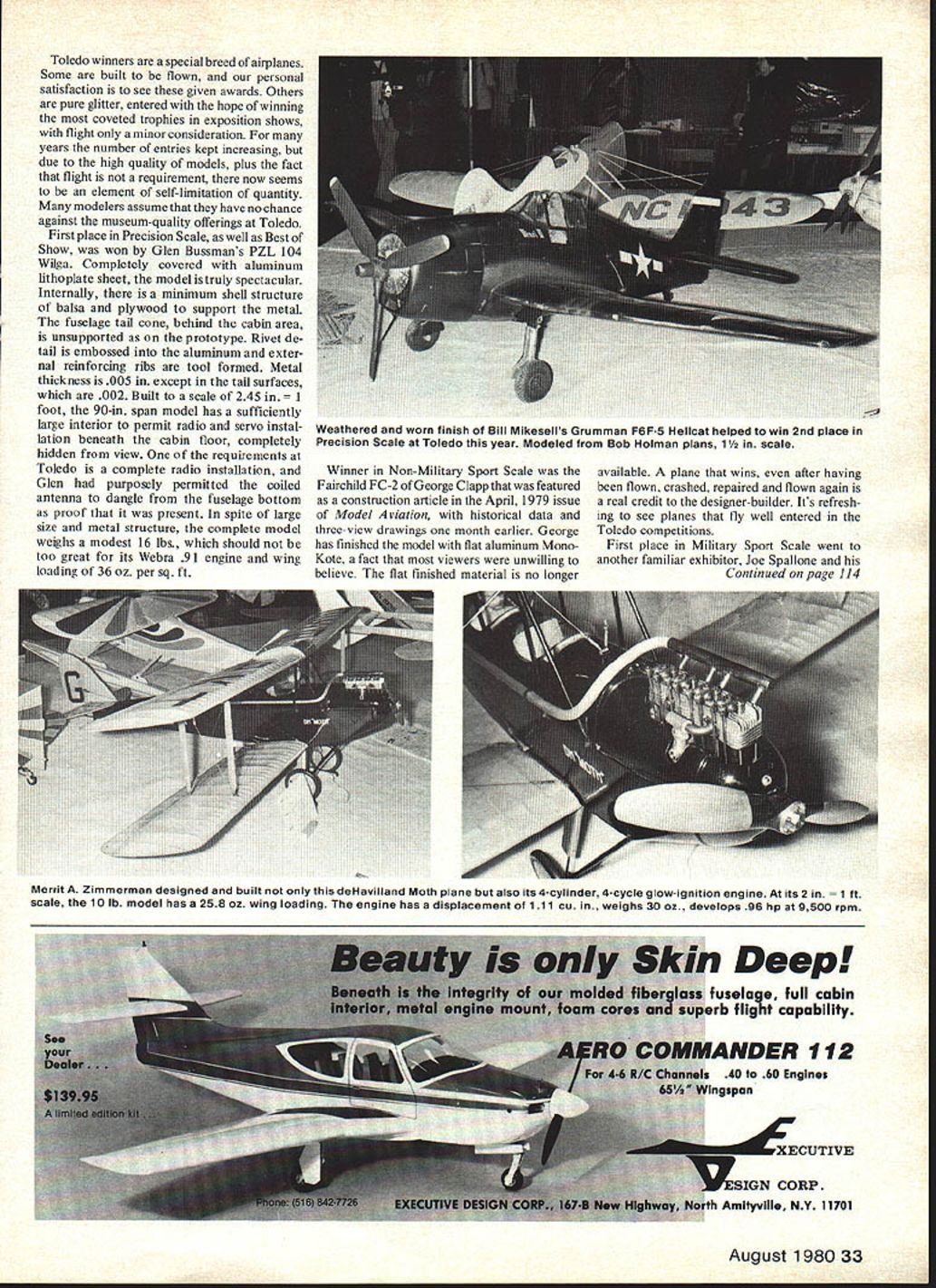
First place in Precision Scale, as well as Best of Show, was won by Glen Bussman's PZL 104 Wilga. Completely covered with aluminum lithoplate sheet, the model is truly spectacular. Internally, there is a minimum shell structure of balsa and plywood to support the metal. The fuselage tail cone, behind the cabin area, is unsupported as on the prototype. Rivet detail is embossed into the aluminum and external reinforcing ribs are tool formed. Metal thickness is .005 in., except in the tail surfaces, which are .002 in. Built to a scale of 2.45 in. = 1 foot, the 90-in. span model has a sufficiently large interior to permit radio and servo installation beneath the cabin floor, completely hidden from view. One of the requirements at Toledo is a complete radio installation, and Glen had purposely permitted the coiled antenna to dangle from the fuselage bottom as proof that it was present. In spite of large size and metal structure, the complete model weighs a modest 16 lbs., which should not be too great for its Webra .91 engine and wing loading of 36 oz. per sq. ft.
Winner in Non-Military Sport Scale was the Fairchild FC-2 of George Clapp that was featured as a construction article in the April 1979 issue of Model Aviation, with historical data and three-view drawings one month earlier. George has finished the model with flat aluminum MonoKote, a fact that most viewers were unwilling to believe. The flat finished material is no longer available. A plane that wins, even after having been flown, crashed, repaired and flown again is a real credit to the designer-builder. It's refreshing to see planes that fly well entered in the Toledo competitions.
First place in Military Sport Scale went to another familiar exhibitor, Joe Spallone, and his Corsair F4U-1A. Except for the fiberglass fuselage, the model was covered with 1/2 oz. fiberglass cloth and Super Coverite, given a base coat of Hobbypoxy silver followed by Aero Gloss dope. Robart retract gear was used to obtain rotation of the legs, with Sonic Systems air actuators. Joe had also entered a Mitsubishi Ki-51 Sonia in the Precision Scale class. This model was finished in a similar manner with panel lines hand-drawn and etched to the silver base.
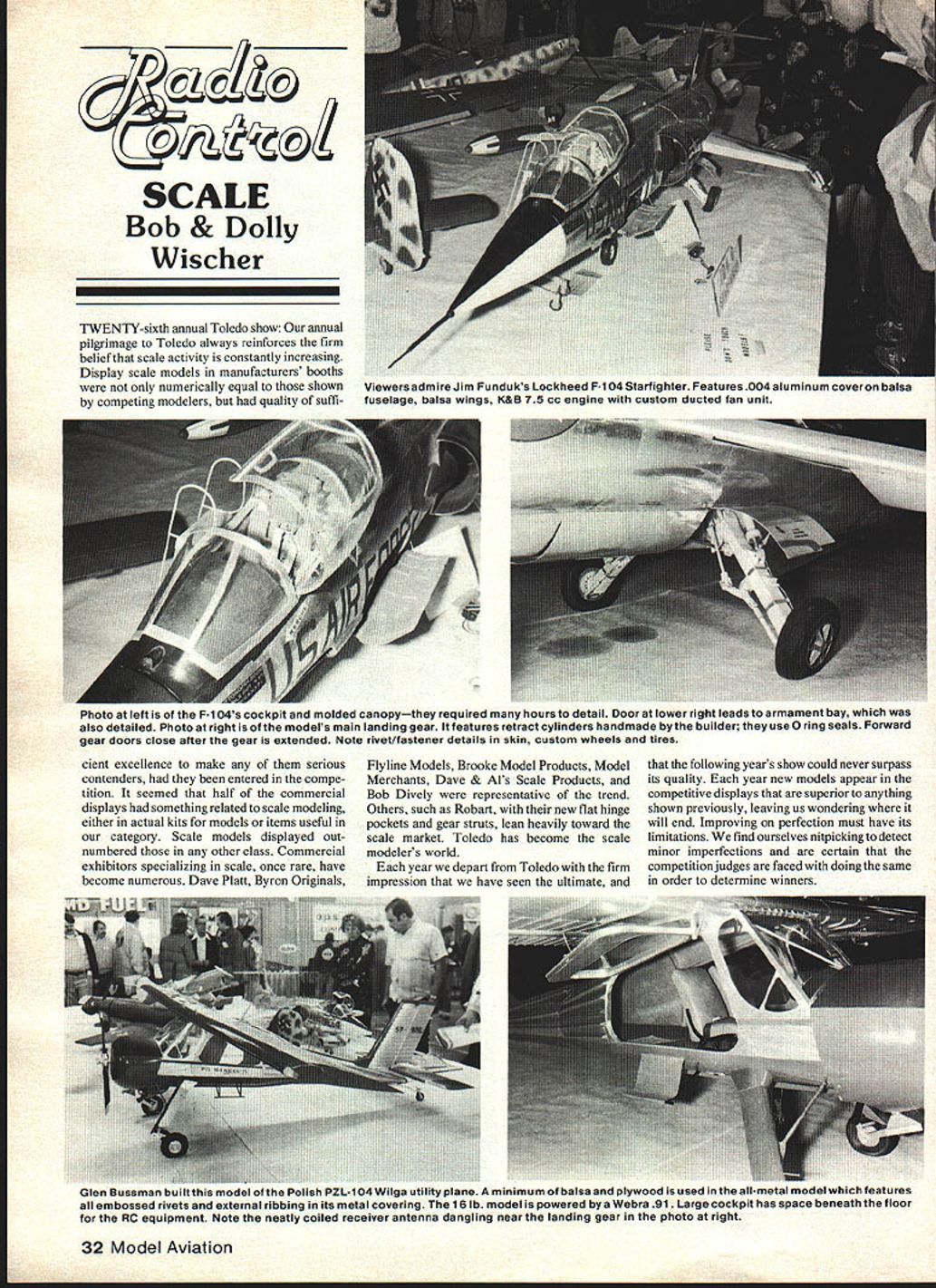
No Toledo show would be complete without one of the masterworks by Jim Funduk. His crowd-pleasing plane this year was a Lockheed F-104G Starfighter using a 7 in. diameter custom ducted fan and 7.5 cc K&B engine. Built to a scale of 1 1/2 in. = 1 ft., the model has a span of only 38 5/8 in., but a length of 96 in. Like his P-38 Lightning of last year, the fuselage is covered with .004 aluminum. Handmade retracts have cylinders sealed with O-rings that leaked hydraulic fluid realistically. The four-spar wing is sheeted with 1/16 balsa. Judging from the amount of attention it received, the F-104 was a favorite among viewers. It was certainly the most talked-about plane on display, with most of the comments dealing with the 11-pound plane's ability to fly on such tiny wing area. Wing loading would be in the range of 50 to 60 oz. per sq. ft. It will need a lot of runway. Previous efforts with high wing loadings have indicated a need for runways 1,000 ft. long and 100 ft. wide. One visitor was heard to say that he would be anxious to try its first flight and was quite confident of success. Surprisingly, with all its dazzling good looks and glamor, it placed only third in Precision Scale.
As in past Toledo shows, there is always one plane that doesn't really stand out, but upon closer scrutiny is a bit overwhelming. This year that honor went to Merrit Zimmerman and his de Havilland Gypsy Moth with its clear-doped 60 in. span wings. What made it outstanding was the hand-made scale model, operating Gypsy engine that occupied its nose. Plane and engine were completely scratch-built. The four-stroke, four-cylinder glow engine has single-ring aluminum pistons, chromed steel cylinders, .687 in. bore, .75 in. stroke, 1.11 cu. in. displacement, weighs 3 ounces and develops .96 bhp with a 12-8 prop at 9,500 rpm. The plane placed third in Non-Military Scale class, another example of a well-tried model with many flights before being brought to Toledo.
Quarter scale and larger models were plentiful. Walt Mouchar's half-size Fly Baby had to be hung from the ceiling to make room on the display tables, as did several others, including a 3/4 scale Buhl Bull Pup by Hubert Lacey and a 1/4 scale Stinson SR-9F by Fred Nielsen. There was a swarm of 1/4 and 3/8 size Pitts and Steen Skybolts.
Several years ago we first met Steve Sagert at Toledo when he displayed his Stinson Station Wagon. He seemed to be convinced that he should try to win at the Nats and also to be a member of the U.S. team for world championship competition. Steve has since been to Sweden and England as a team member. Each year, at Toledo, we meet more prospective Nats winners and team members. Joe Spallone, mentioned earlier, and Bill Rafferty, who entered a Focke Wulf TA-152 in Precision Scale (fourth place), are both to be regarded as competitive types who could become future team members. Winning at Toledo is not necessarily the ultimate end, but rather a good beginning.
Scale speed again
A letter from George Wilson says: "Your comment (assumption) that scale speed is an impossibility aroused my pen. My good friend Milenko Mitrovich (full-size aeronautical engineer par excellence!) finally made me aware that for comparable performance between the real thing and its scale cousin, the speed is the square root of the scale factor multiplied by the speed of the full-size plane. For example, a quarter scale with a scale ratio of 0.25 to 1: the square root of 0.25 is 0.5, or 1/2 the full-size speed. This assumes weight, power, etc., all follow the proper scaling factors."
George also asks: "What happens when you stray from the physics and build a lighter-than-scale model that requires less lift and less power? This is what currently has my curiosity. Is the compromise the modeler would like for visual similarity? But what happens to other performance characteristics? Can these be compensated by changing angular differences, dihedral, etc.?"
We tried this formula on some of our existing scale models and it appeared to work out to approximately the speed that we hoped to attain. For example, with the Pober Pixie at 1/5 scale (0.2 to 1 ratio), the square root of 0.2 (0.447) multiplied by a cruising speed of 85 mph yielded an easily attainable speed of 38 mph. This is approximately the Pixie's cruising speed at half throttle. Assuming that its weight is 1,000 lbs divided by 125 (cube of the scale ratio) = 8 lbs for the model, the 1/5 scale plane would need to fly at 17 mph to be true scale speed (derived from 85 divided by 5) as we had always thought it should be calculated. Seventeen mph is close to stall speed for the model — the stalling speed for an 8 lb. plane.
We then calculated the speed of a quarter-scale P-51 Mustang with a prototype speed of 300 mph and found that the model should be cruising at 150 mph (300 × 0.5, the square root of 0.25). This seems unreasonably fast for a 1/4-size P-51. Those that we have observed appear to be flying at about half that speed, near 75 mph. The calculations for small planes with slow prototype speeds or for large planes reduced to a small model size seem to align with typical model speeds as we know them. Hot military and racing planes in large model sizes wouldn't have sufficient power to reach the speeds that this formula indicates they should. The scale-speed controversy continues. Have an opinion? Let's hear it.
A light model can be flown at slower speeds than the heavier one, but its top speed could be even faster because of drag reduction. Reducing the angular difference between wing and stabilizer would make it easier to control at higher speeds. To use down trim at the transmitter would result in tab effect; that is, there would be trim changes between high- and low-speed flight. Changing dihedral on a scale model has too great an effect on appearance and would not be done by most scale modelers.
Bob and Dolly Wischer Rt. 1, S-221 Lapham Peak Road Delafield, WI 53018
Transcribed from original scans by AI. Minor OCR errors may remain.

