
Radio Control: Scale
Bob & Dolly Wischer
Equipment installations
With the current trend toward larger scale models, the problems of hiding receiver, batteries and servos become less acute. However, most kits being built are not large planes, and scale modelers who attempt cockpit and cabin detailing of smaller planes face the very real problem of satisfactorily installing RC equipment. Finding space in a tight interior is not always easy, since the heavier components should preferably be near the center of gravity — the space normally occupied on the prototype by human cargo.
There was a time when sport-scale builders ignored cockpit and cabin interiors. Anyone who peers inside some of the better examples of this class today will not be surprised to find detailing to match what is normally found in precision scale. This constant improvement has always been with us in all categories of aeromodeling. Satisfaction in accomplishment and a competitive attitude are reasons for progress in this direction. A few modelers have said the trend is counter-productive and will doom sport scale as a contest event, but this does not seem to be happening, as the event continues to grow.
Does it seem impossible to squeeze a receiver and servos into a cockpit along with seats, instrument panels, controls and pilots? Don't give up too quickly. Newer small servos will fit into tiny spaces — for example, a seat could cover two or three servos. The pilot's body could be hollow to contain the receiver. Joe McCollum fitted servos inside the pilot to move arms and legs that actually operated cockpit controls on his Volksplane. Concealing the wiring can be the only real problem area; wires can be bundled into the space under servos, with extension cords passing beneath the floor.
World War II military planes are blessed with small cockpit volume compared with total fuselage interior. The space normally occupied by fuel tanks and armament can be used for equipment. Civil types need more careful planning to squeeze equipment into interiors that are easily visible through large cockpit openings, canopies, windows and doors.
The throttle pushrod, made from heavy flexible cable, needs to be concealed in one of the cockpit sidewalls. For a narrow fuselage, this rod can be connected directly to the engine throttle. On wide fuselages, such as side-by-side seating arrangements, a bellcrank or lever may be needed forward of the firewall to bring the linear motion into alignment with the engine throttle. An alternative places the throttle servo in the engine compartment with an extension cord back to the receiver; a servo mounted close to this vibration source requires careful shock mounting and protection from engine oil.
We do not use the engine carburetor throttle-stop for idling. Instead, the transmitter's throttle-lever rearmost travel position is used for idle, and we move the transmitter throttle trim toward idle for a realistic engine stop at the end of a flight.
Many modelers ask about receiver antenna location on scale models. A visible antenna is an eyesore. We prefer to run the antenna internally down the fuselage bottom and extend it out through a small hole at the rear, where a knot prevents retraction. The tiny knot is almost invisible.
Many of our models use stainless-steel control line cable to operate tail surfaces in place of pushrods, to save weight and preserve scale appearance. These wires are fastened at their ends to plywood operating levers and control horns. Even though our antenna is in close proximity to these wires and may touch them, there has been no radio interference or loss of range with our Royal and Kraft equipment. This is likely due to the wires being anchored to wood levers rather than metal. Where steel wires cross or are in close proximity, we slip a piece of insulating tube over one of them, held in place with a drop of adhesive, to prevent rubbing wires from becoming an RF noise source.
To mount servos in a concealed manner (beneath a seat or in a baggage compartment), a standard servo tray is often too difficult to hide, so we use plywood servo rails. For maximum strength with minimum size, laminate two 1/16-in. ply strips with white glue under pressure to form a rail.
Very rare is the scale plane that doesn't need some additional weight in the nose for balance. Usually this means batteries must be located under the fuel tank, even when a long extension cord is required. We have run long extension cords through models for batteries and remote servos with no ill effects.
Another trick to help balance is to use an extra-large fuel tank, if nose space permits. The plane will carry much more fuel than needed. In contests, the model is weighed without fuel, and using fuel for ballast can help keep within weight limits. The risk is the temptation to use all the fuel on a long flight and encounter a tail-heavy landing. An alternate approach uses two tanks: a rear tank feeding a ballast tank located near the engine. Always land with the ballast tank full.
Aileron and flap servos on a low-wing model are usually the least troublesome and can be hidden beneath the floor. The least desirable method of concealment is raising the floor. We have seen contest models where the floor was raised, and the effect is objectionable: the pilot sits with legs stretched straight forward and the cockpit looks cramped and unreal. It is better to have the aileron pushrod above the floor, painted flat black for minimum visibility.
Team selection
Scale team members for international competition are chosen at the Nats. Contestants who want eligibility for the following year's World Championship team must enter models at the Nats that comply with FAI rules (beginning in 1981 and on odd-numbered years thereafter). The plane used at the Nats need not be the plane used at the World Championships, but the entrant must have at least one FAI model.
For the 1982 World Championship team selection (based on the 1981 Nats), models must meet the following specifications:
- Weight: 6 kg (13.22 lb) without fuel.
- Wing loading: 100 grams per square decimeter (32.77 oz. per square foot) for the area of wing and horizontal tail surfaces combined.
- Maximum area: 150 sq. decimeters (2,325 sq. in.).
The foregoing applies to both F4C (Precision) and Standoff (Sport) scale airplanes.
Precision Scale entrants in the 1981 Nats who seek eligibility for the 1982 World Championship will be limited to a total engine displacement, regardless of the number of cylinders, of 10 cc (0.61 cu. in.). For 1983, the engine size limit becomes the same as Sport Scale:
- Single engines: 10 cc
- Twins: 15 cc
- Three or more cylinders: 20 cc
Contestants not seeking a place on an international team will have their models judged in both static and flight by AMA rules.
Kitchener–Waterloo revisited
The All Scale Rally at Kitchener, Ontario, organized by the Flying Dutchmen RC Model Club, continues growing in size even though the organizers do no advertising. The 1980 Rally attracted 208 airplanes, 53 of which were giant scale, and heavy rains dampened activity on Saturday. The organized flight line was so efficient that we made four flights on Sunday and could have had more. Popular frequencies were crowded, and six planes in the air at one time was common.
The previous year’s unfinished models reappeared completed and in good condition. Spectacular and impressive was an eight-engine Hughes Spruce Goose built by Steve Gray, Frank Evans and Tom Dietrich. The four .25 engines on each half of the 16-ft wing are controlled by one servo for each side, and this system proved effective for steering. A water rudder is not needed. The auxiliary levers of the transmitter are ganged together by a tie-bar for throttle control; either side of the bar can be advanced individually, or the whole bar moved for control of all eight engines. Movies shown at Waterloo University demonstrated the very large scale of the Goose, which has had many more flights than the prototype.
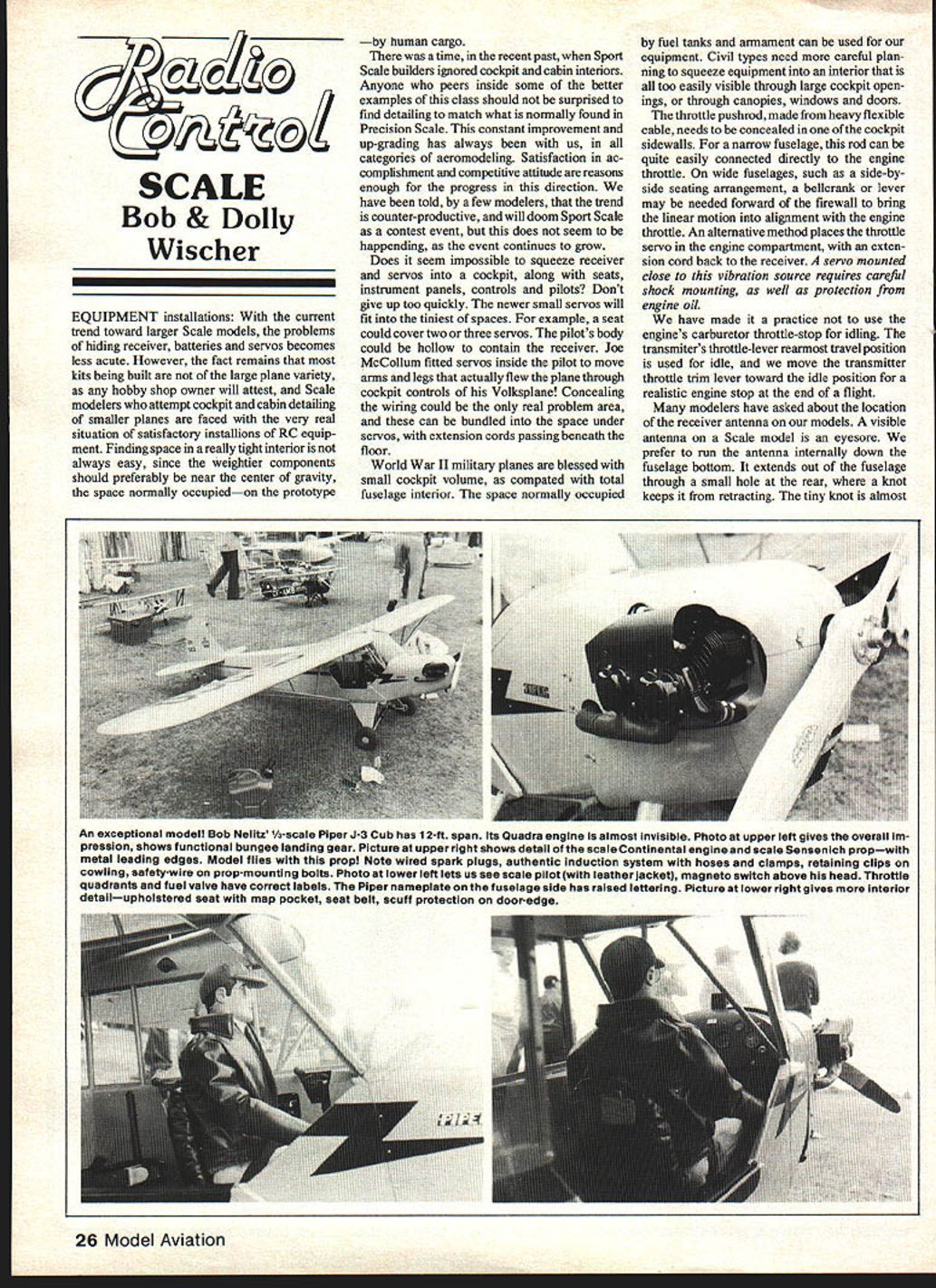
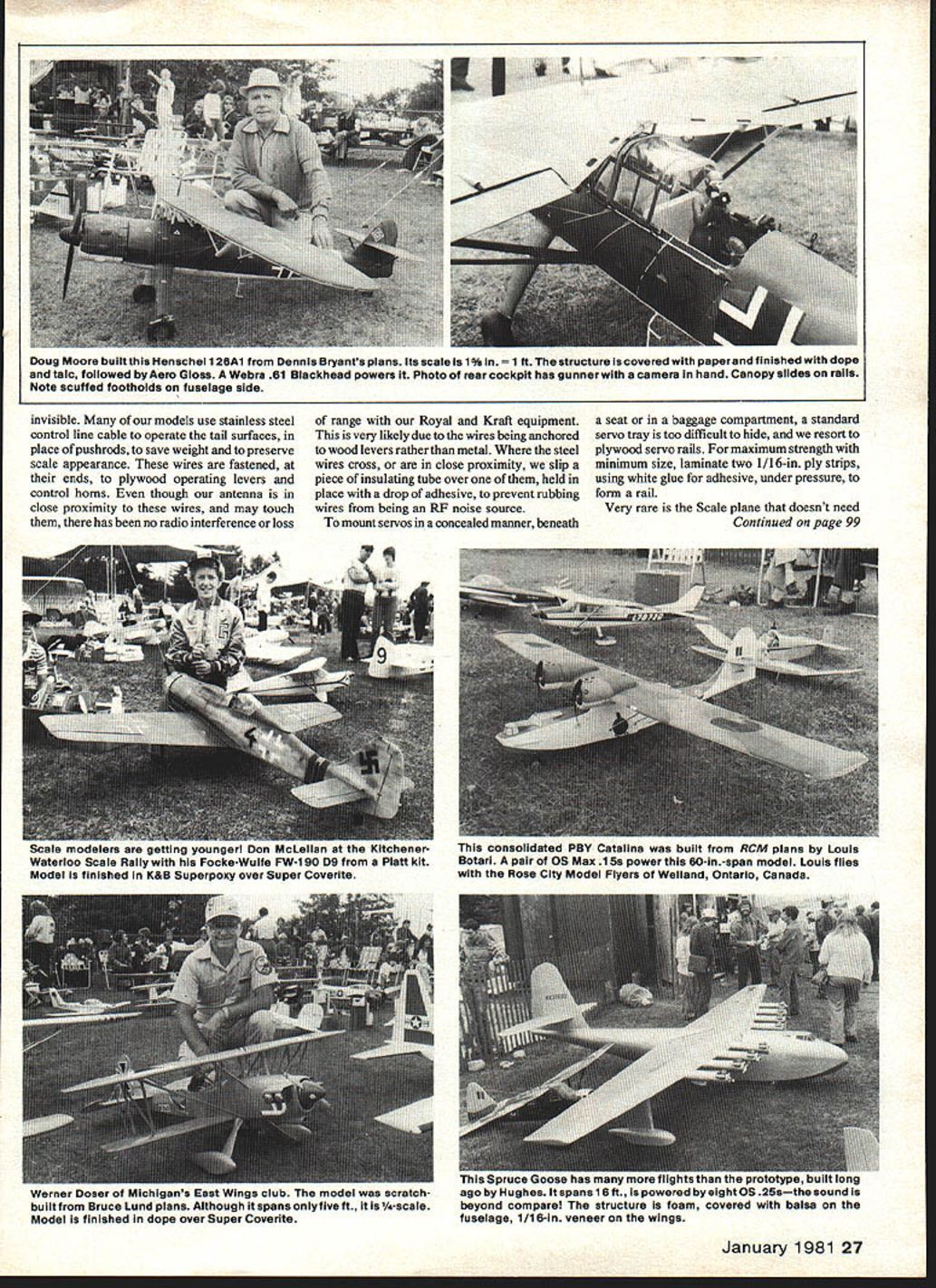
We always attend the KW Rally to see out-of-the-ordinary models. This year we were rewarded with several. It may be hard to imagine a more perfect Piper Cub, but the 1/6-scale J-3 of former World Champion Bob Nelitz is truly outstanding. Precision scale quality is not often found in giant or mammoth scale planes, yet Bob's Cub is precise in every respect. The quadra was almost completely hidden. A detailed four-cylinder dummy Continental engine has wired spark plugs and accurately formed cylinders with heads and cooling baffles properly shaped. The fuel tank is filled at the correct location, after removing a tank cap that has the typical wire and float gas gauge. By flying low and close, the exposed wire gives an indication of fuel remaining. Every tiny detail is faithfully reproduced, including the characteristic brace wire terminations on the tail surfaces. Ailerons are operated by cables that extend along the lift struts. In the air, there is no question Bob has achieved the ultimate in realism.
The East Wings Club of Memphis, MI accounted for 14 high-quality planes at the rally, including a Henschel 126A1 by Doug Moore and four by Carl Skiba: Westland Lysander, Fiesler Storch, Curtiss Hawk P-6E and Gee Bee R-1. The group also included a Lockheed Hercules by Skip Mast, Lockheed Orion by Steve Sauger, and Der Jaeger homebuilt by Werner Doser. This represents a portion of the output of a single scale-oriented club. As usual, the giant scale class was dominated by the Stars Club of Olean, NY, and this year the number of Fokker D-VIII models increased to four, in addition to the usual squadrons of Bristol Scouts. One revealing fact of the rally was that 25% of participants had brought giant airplanes — a good indication of the trend to large models.
NASA membership
Bob Underwood, president of the National Association of Scale Aeromodellers (NASA), has requested that anyone who has paid dues and has not received a membership card or newsletters write to:
- Bob Underwood, 4109 Concord Oaks, St. Louis, MO 63128
- John Preston, 7012 Elvira Court, Falls Church, VA 22042
NASA needs to know if anyone has been inadvertently forgotten in the past.
R. 1, S-221 Lapham Peak Road, Delafield, WI 53018
Bob and Dolly Wischer
Transcribed from original scans by AI. Minor OCR errors may remain.

