

Radio Control: Scale
By Bob & Dolly Wischer
Oshkosh visit
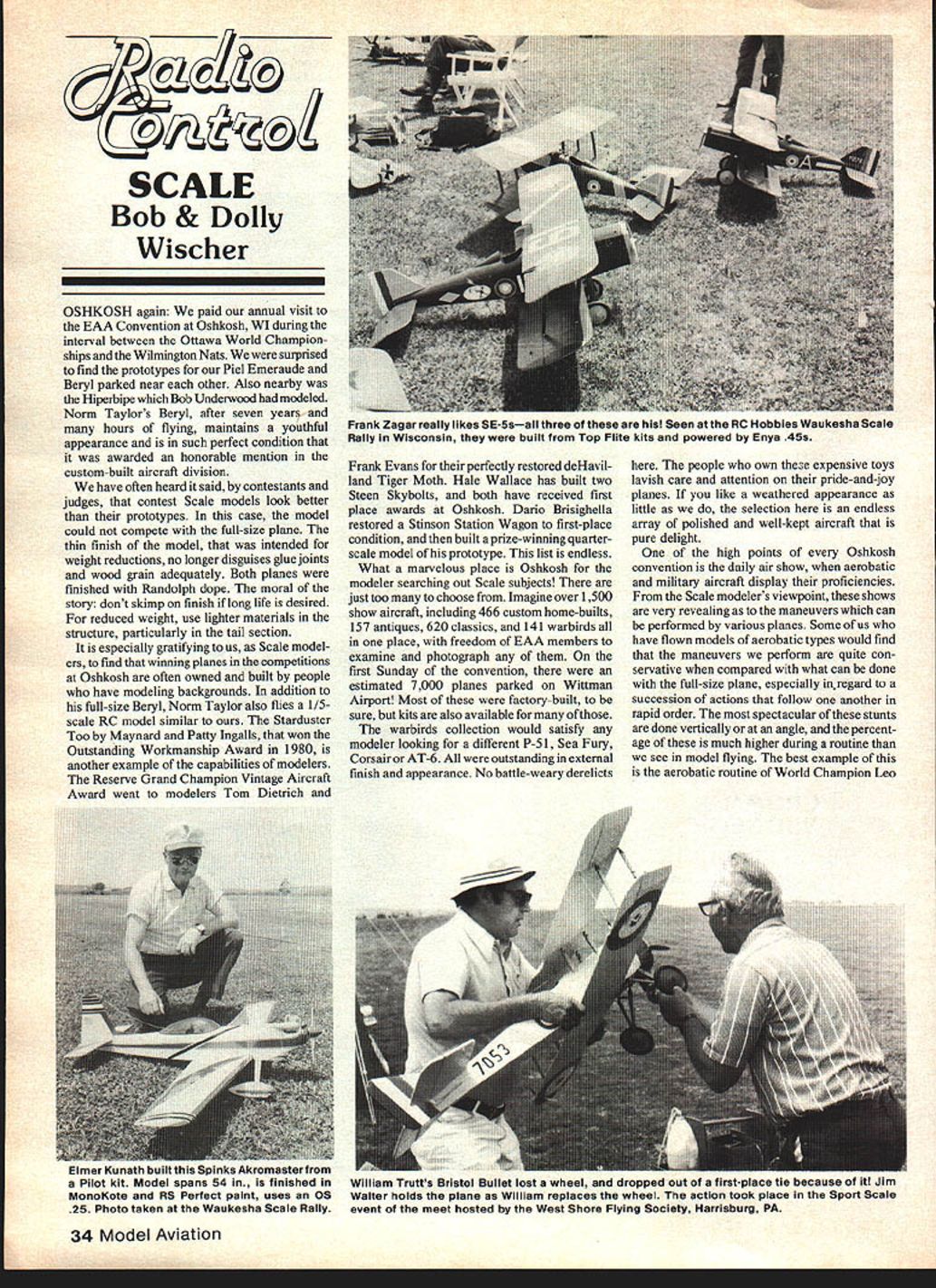
We paid our annual visit to the EAA Convention at Oshkosh, WI during the interval between the Ottawa World Championships and the Wilmington Nats. We were surprised to find the prototypes for our Piel Emeraude and Beryl parked near each other. Also nearby was the Hiperbipe which Bob Underwood had modeled. Norm Taylor's Beryl, after seven years and many hours of flying, maintains a youthful appearance and is in such perfect condition that it was awarded an honorable mention in the custom-built aircraft division.
We have often heard it said, by contestants and judges, that contest Scale models look better than their prototypes. In this case, the model could not compete with the full-size plane. The thin finish of the model, intended for weight reduction, no longer disguises glue joints and wood grain adequately. Both planes were finished with Randolph dope. The moral of the story: don't skimp on finish if long life is desired. For reduced weight, use lighter materials in the structure, particularly in the tail section.
Modelers and full-size owners
It is especially gratifying to us, as Scale modelers, to find that winning planes in the competitions at Oshkosh are often owned and built by people who have modeling backgrounds. In addition to his full-size Beryl, Norm Taylor also flies a 1/5-scale RC model similar to ours. Other examples include:
- The Starduster Too by Maynard and Patty Ingalls, which won the Outstanding Workmanship Award in 1980.
- Tom Dietrich and Frank Evans, who restored a de Havilland Tiger Moth and won the Reserve Grand Champion Vintage Aircraft Award.
- Hale Wallace, who built two Steen Skybolts; both received first-place awards at Oshkosh.
- Dario Brisighella, who restored a Stinson Station Wagon to first-place condition and then built a prize-winning quarter-scale model of the prototype.
This list is endless and encouraging to modelers looking for subjects.
Scope and subjects at Oshkosh
What a marvelous place Oshkosh is for the modeler searching for Scale subjects! There are just too many to choose from. Imagine over 1,500 show aircraft, including:
- 466 custom home-builts
- 157 antiques
- 620 classics
- 141 warbirds
All in one place, with freedom for EAA members to examine and photograph any of them. On the first Sunday of the convention, there were an estimated 7,000 planes parked on Wittman Airport! Most were factory-built, but kits are available for many of those.
The warbirds collection would satisfy any modeler looking for a different P-51, Sea Fury, Corsair, or AT-6. All were outstanding in external finish and appearance — no battle-weary derelicts here. The people who own these expensive toys lavish care and attention on their pride-and-joy planes. If you like a weathered appearance as little as we do, the selection here is an endless array of polished and well-kept aircraft that is pure delight.
Air show and aerobatics — what models can learn
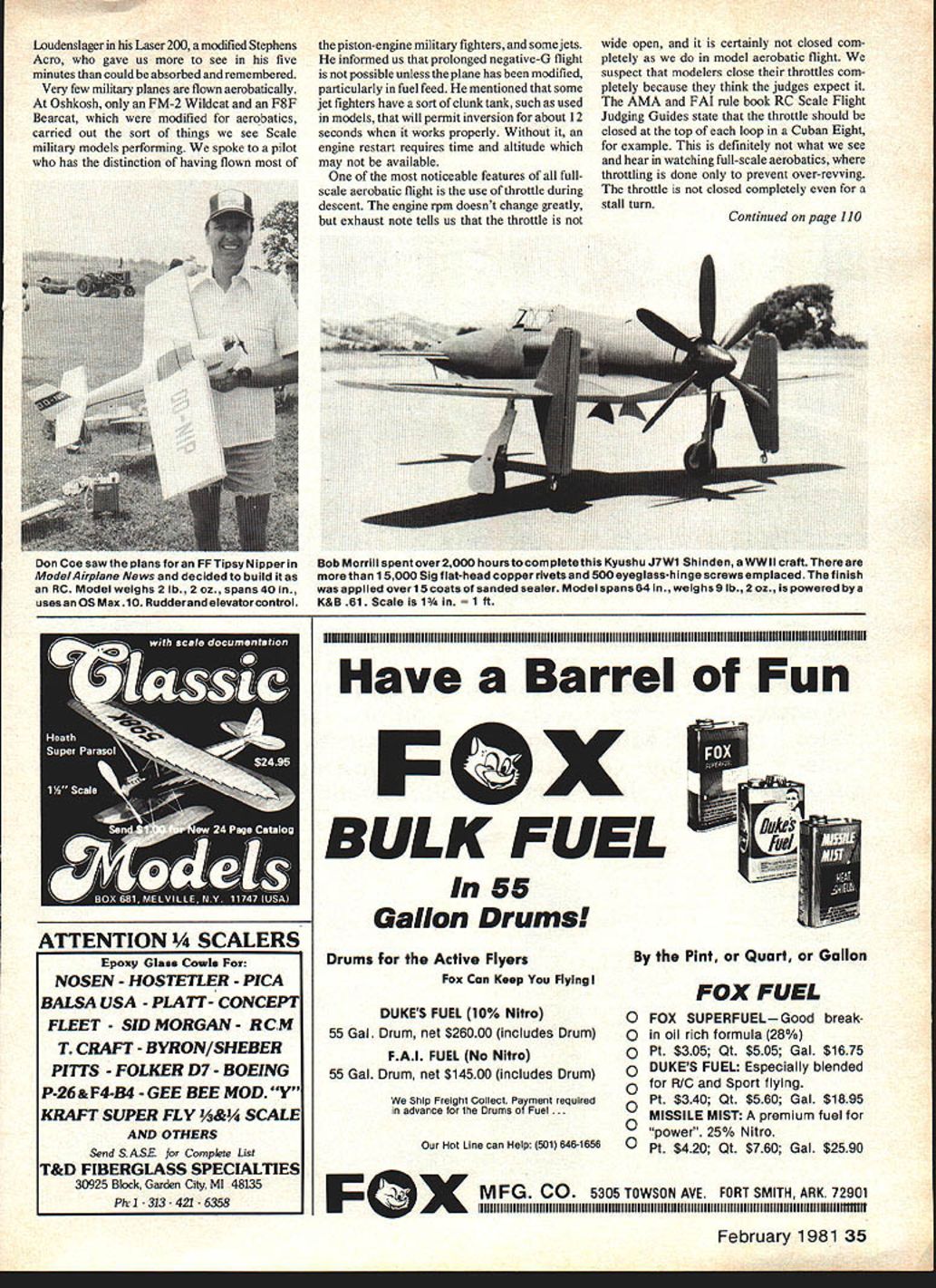
One of the high points of every Oshkosh convention is the daily air show, when aerobatic and military aircraft display their proficiencies. From the Scale modeler's viewpoint, these shows are very revealing as to the maneuvers that can be performed by various planes. Some of us who have flown models of aerobatic types find that the maneuvers we perform are quite conservative when compared with what can be done with the full-size plane, especially in regard to a succession of actions that follow one another in rapid order. The most spectacular stunts are done vertically or at an angle, and the percentage of these is much higher during a routine than we see in model flying.
The best example is the aerobatic routine of World Champion Leo Loudenslager in his Laser 200, a modified Stephens Acro. He gave us more to see in his five minutes than could be absorbed and remembered.
Very few military planes are flown aerobatically. At Oshkosh, only an FM-2 Wildcat and an F8F Bearcat — both modified for aerobatics — carried out the sort of things we see Scale military models performing. We spoke to a pilot who has the distinction of having flown most of the piston-engine military fighters, and some jets. He informed us that prolonged negative-G flight is not possible unless the plane has been modified, particularly in fuel feed. He mentioned that some jet fighters have a sort of clunk tank, similar to those used in models, that will permit inversion for about 12 seconds when it works properly. Without such modification, an engine restart requires time and altitude which may not be available.
One of the most noticeable features of all full-scale aerobatic flight is the use of throttle during descent. Engine rpm doesn't change greatly, but the exhaust note tells us the throttle is not wide open, and it is certainly not closed completely as we often do in model aerobatic flight. We suspect modelers close their throttles completely because they think the judges expect it. The AMA and FAI rule book RC Scale Flight Judging Guides state that the throttle should be closed at the top of each loop in a Cuban Eight, for example. This is definitely not what we see and hear in full-scale aerobatics, where throttling is done only to prevent over-revving. The throttle is not closed completely even for a stall turn.
Early one morning, when the wind was light, Brian Allen flew the Gossamer Albatross. It was our misfortune not to be at Wittman Airport that day, but we had the pleasure of an introduction. We also met Brian's parents, and the source of his modesty and equanimity became apparent.
For the Scale race-plane buffs, there were full-size reproductions of the Gee Bee Z, Travelair Mystery Ship, and Laird Super Solution, along with Jimmy Doolittle who flew the original Laird in the Bendix and Thompson Trophy races.
World Aerobatic Championships
Two weeks after the convention, and again at Wittman Field, we attended three days of the World Aerobatic Championships. Forty-two men and nine women from 10 countries were included in the competition, but there were only about 20 planes in use, with several pilots taking turns flying some of the planes. Pitts S-1s and S-2s were the most common U.S. designs, along with one Christen Eagle and Leo Loudenslager's winning Laser 200. The German team used a Zlin 50L. From France there were three CAP 20s, one CAP 21, and an ASA 200 (a CAP 20 fuselage with a tapered wing in place of the usual semi-elliptical planform). All of these aerobatic types are ideal Scale projects, and some are already available in kit form. The CAP 20 was featured as a construction article in the March 1980 issue of Model Aviation. The United States swept the first three places in both men's and women's divisions.
From a reader: 1/5-scale as an alternative to Giant Scale
The trend toward 1/5-scale as a practical alternative to Giant Scale seems to be gaining a foothold. We thought this letter from Louie Scribner would be of general interest:
"While at the Nats, I had a chance to visit the Springfield MAC field at Donnelsville, OH, and watched several fellows flying (new) Old-Timers. They were all in the seven-foot-span range and were powered by OS .60 4-cycle engines. I was impressed with the quiet engines, low rpm and floating ability of these planes. It occurred to me (I build Sport Scale) that one might build a Piper J-3 along the same lines that would fly slowly and smoothly, in calm air, using the same OS .60 engine. I might add that I'm not interested in the belt drives that are used on 1/3-scale aircraft.
"I've already built one Sig J-3, which turned out rather nicely, and I'm considering scaling the Sig plans up (1.17 times to 1/6-scale) to handle the OS .60. This engine seems to have about the same power as a good .40 (14-6 at 7,000 rpm). Obviously, .4-scale is too much, but 1/5-scale might be right, which would produce the following numbers: span 84.5 in., chord 12.5 in., wing thickness 1-5/16 in., overall length 52 in., area 990 sq. in. (6.88 sq. ft.).
"The weight would have to be in the 5½- to 7½-lb. range (12 to 17 oz. per sq. ft.), so it would be built-up and light, in order to fly slowly. I would much prefer to use a one-piece wing, being transportable at seven feet, than to have all the attachment mess of two panels. Other things would include inverted engine with glow plug battery, dummy cylinders, dual aileron servos, etc.
"Questions: 1) Do you think the size is right for this engine? 2) What weight and wing loading range is best for this type of scale? 3) Do you have any other suggestions about this project?"
Our response and suggestions
Some of the early four-stroke engines had problems with keeping valve clearances adjusted. As a result, they were not always equal to the task of carrying aloft a 7- or 8-lb. model. It is our understanding that the materials used today have been changed to avoid this problem, which, if memory serves, had to do with soft rocker arms. We have seen these engines recently being used to fly models in the 8-lb. range with consistently good results and without the need for frequent valve adjustments.
For the type of flight indicated (little or no wind), a 7½-lb. weight and 17 oz. per sq. ft. loading would be acceptable. The real problem is keeping the weight down to that figure. It can be done with careful selection of materials and by using lightweight finish and covering. A heavy paint job can really add pounds. The on-board glow plug battery may be a weighty luxury that could be omitted.
We have never seen a Piper Cub model with a one-piece wing that could be considered scale-like in appearance because of the prominent windshield. If a full windshield is used with a one-piece wing, it becomes vulnerable to damage. A one-piece wing may be desirable in a small model because of the difficulty of getting your hands inside the fuselage for fastening, as would be required in two-piece construction. The only real advantage of a one-piece wing is the use of a single servo in the center section with pushrods extending to the ailerons.
In the size suggested, we think a two-piece wing is preferable, especially since you mentioned dual servos. We assume that means one servo in each wing. Our suggestion would be two wing halves and functional struts, as on the prototype, with wings plugged into slots in the fuselage and a single machine screw fastening each half. We have seen this done on Pipers in the past and know it to be a successful method that preserves scale appearance.
If at all possible, consider tipping the engine away from a vertical inverted mounting — 10° would be sufficient — to avoid problems with starting due to a drowned glow plug. It is a common sight at model meets to see a two-man team holding a model inverted to get the engine started. Flipping the model over with the engine running always seems hazardous. A slight angle tends to place the wet fuel away from the plug in a flooded engine. Very likely you will not be using a muffler, because the four-stroke engines are inherently quiet. Should a muffler be needed, the angled mounting helps in concealing it inside the cowl. Another solution is to model the Super Cub rather than the J-3. The Super Cub has a full cowl and the engine can be side-mounted. The cowl weighs a bit more, but this is compensated by omission of the dummy cylinders. See our January '80 column for a photo of a Super Cub model.
Bob and Dolly Wischer Rt. 1, S-221 Lapham Peak Road Delafield, WI 53018
Transcribed from original scans by AI. Minor OCR errors may remain.

