
Scale
Bud Atkinson
IN THE LAST column we got into the aerodynamics of how to scratch-build your next Stand-off Scale bird. We have chosen the powerplant (a good .60, and there are many to choose from) and the airfoil (we will use, say, a 2414 in this case). The next consideration is the size of the wing. It's usually best to start with the wing and to determine the size and wing area needed.
I'm what you would call a "heavy" builder in that I like to beef up my scale models to stand the rigors of contest flying as a lot of our midwestern flying sites are grass or out on pasture flying fields. On an average, I build around 9-10 lbs., so 660 to 700 sq. in. of wing area is best for that weight. For a very light model you may go as low as 600 sq. in., but most scale models get a little squirrely below 600 sq. in., and usually don't fly too scale-like. Most popular kits today are in the 600 to 700 sq. in. category. Again, the biplane is the exception, usually having a higher wing area of 700 to 760 sq. in. So you turn to your past building experience as to how heavy or light you can build your scale model. Remember, too, foam wings are usually about 10-15% heavier than built-up wings, but in many ways are well worth it.
Now we come to a problem that's a little sticky. Aileron size! In most WW II single-engine fighter types the true scale ailerons are rather small for their models to be able to roll properly. In most cases leave the span of the aileron scale and increase the chord, say 3/16" to 1/2" to give more movable area without deviating in appearance from scale. I know there are exceptions here, so use your discretion. It's easy to cut down the throw on your ailerons, but a problem to make them more effective if they are
Radio Control: Scale
too small.
I have described flaps in previous columns. In most cases, scale-size flaps are O.K. Should you find the subject you want to model is lacking in wing area — in the case of a stand-off model — you may increase the wing chord, let's say by 1", and in most cases without it being noticed too much in static judging. To increase the span very much is not advisable, as it may show up somewhat out of proportion and look too much out of scale. A wider chord, on say a 60" wing, adds 60 more sq. in. to your wing.
The next consideration is the landing gear, and since a large percentage of our scale models are low-wingers and we are discussing the wing layout, the gear is the next step. Here, our old enemy scale effect rears its head. In a majority of cases a scale landing gear is much too long and is gangly, and not only looks out of place, but also gives ground handling problems. So shorten the gear length to the point where it looks good and is proportionate to the rest of the model; this is exceptionally true on most low-draggers. Usually, scale-size wheels can be retained in Stand-off Scale; nothing is measured, so whatever looks good to the eye at 10 ft. is what we want. Scale dihedral, or lack of it, seems to be no problem on our model so it may be duplicated; in some cases there is too much dihedral, so it may be reduced somewhat to look better. This is true on a lot of the civilian light aircraft.
Now that we have established the wing and stab sizes the remaining problem is the fuselage. In 95% of the cases on fuselages they will be rather long when scaled to the wing — mostly too wide to look realistic. Also, areas such as spinners on in-line-engine airplanes and scale cowlings are often out of proportion. In most cases, the fuselage may be scaled down to 4" to 4.5" and still retain realism. Also, the nose or spinner may be reduced to around 3-1/4". Nose moments may be a problem on some aircraft, such as radial-engine airplanes, as the nose is usually very short, which in turn will make many models tail heavy. The nose moment may be lengthened maybe 1" to 1-1/2", but not much more, because it's easy to distort a scale model by lengthening the nose too much. Seldom is it necessary to change tail moment. It is seldom necessary to change the rudder and fin area as they seem to scale out about right.
It appears that, in some parts of the country, there seems to be some misgivings on Stand-off Scale rules concerning static judging, and I understand many of the Stand-off entries should have been entered in AMA Scale at the Nats since many models are being judged with large detailed cockpits and detailing meant for AMA scale. The intent of Sport Scale was to keep the airplane simple from a static standpoint. One possible answer would be to enlarge its judging circle from 20 ft. to 40 ft. It would be very difficult to see small details at 20 ft., and some entries may seem fine from 20 ft. that would not stand up at 40 ft.
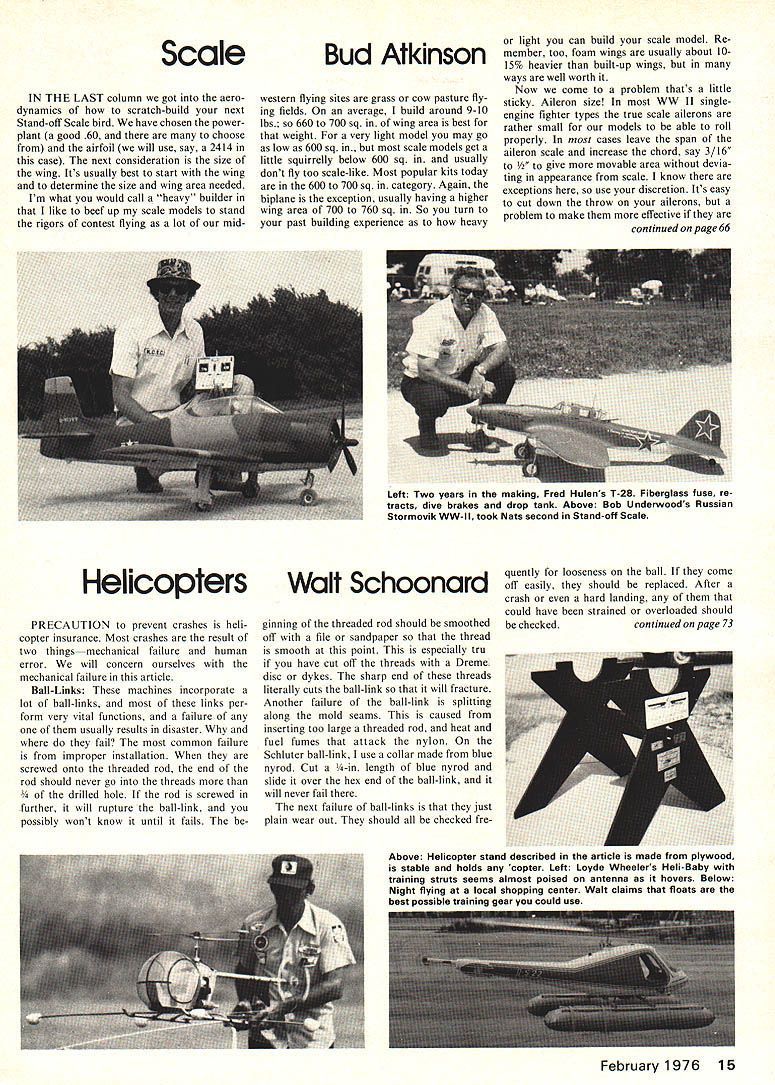
In the pictures are two excellent scale models. The T-28 is by Fred Hulens of Kansas City. Fred spent almost two years in building it. He has a fiberglass fuselage and the model has retracts, dive brakes and a drop tank. The final product shows why that much time went into it. He used Dave Platt's original plans, the one with which Platt won the British Nats in '66 or '67. It is built very scale and more scale than Platt's kit on the T-28. Fred did a fine job with retracts, dive brakes and drop tank. It flies as good as it looks and has been on top in contests around the midwest.
The other shot is of Bob Underwood's of St. Louis unusual Stormovik Russian attack fighter. Bob went on to the Nats to take second in Stand-off with this excellent flying model. A rather unusual feature of the Stormovik was the steel gear which retracted straight back. It does present some problems with scale models. The wing is almost flat with little or no dihedral, which makes the model stable.
My address is: 734 N. 6th St. Ter., Blue Springs, Mo. 64015.
Transcribed from original scans by AI. Minor OCR errors may remain.

