
Radio Control: Scale
Bob & Dolly Wischer
Instrument Faces
When commercially produced instrument faces don't meet your needs, here's an idea that should be revived. Attractive faces can be reproduced with a material called scraper board, made by Essdee in England and sold at artist's supply houses. It is a hard, white, cardboard-like material, .025 in. thick, that has a very thin and dense black semi-gloss coating on one side. The coating can be removed with a sharp instrument to expose the white substrate.
Exceedingly fine lines are made with a very sharply pointed tool, such as a scriber for straight lines or a draftsman's divider for circles. For broader lines, use a wider scraper. Numerals are engraved into the black surface by a steady hand, using a draftsman's lead-holder pencil with a compass point inserted in place of the lead. We use an Optivisor binocular magnifier headband to obtain uniform numerals and letters.
Instrument faces as small as 1/4 in. diameter, and up to 1 in. or larger, are quite easily reproduced. The work goes quickly enough so that an unsatisfactory dial can be discarded and done over at small cost in time and material. A simple face can be cut in a few minutes. Relatively complex instruments, such as an artificial horizon, may require a half hour.
To remove a circular face from the board, use a cutting blade inserted into a draftsman's compass in place of the lead. These blades are also obtainable from art supply stores. When properly adjusted for depth, a sharp blade will cut through scraper board in three or four revolutions.
The circular face can then be inserted into a ring-type bezel. An alternate method is to cut a square of board, centered around the scribed face, and cement it to the back of a prepared instrument panel having pre-cut holes. The ring bezel can be made from soft wire, copper, or iron, wrapped around the proper-size dowel for a uniform diameter. The ring is cemented into the periphery of the hole and painted flat black using thinned auto primer or model-railroad paint.
Clear plastic sheet, cellulose acetate or butyrate, covers the instrument face. This can be a sheet of plastic sandwiched between the panel and the individual faces, or individual discs for each face. We have found that cyanoacrylate cements tend to cause cloudiness in clear plastic in the area of contact. The cement for clear plastics that seems to hold best is Wilhold R/C 56, which dries clear.
Whether instruments are made by the modeler or purchased ready-made, there is a need for good data on the prototype panel — preferably a sharp photograph or two that show sufficient detail to permit recognition of individual instruments. Best source, of course, is having access to the plane being modeled. If this is possible, we sit in the cockpit with our camera and photograph the complete panel as well as each individual instrument. A wide-angle lens is a great help, particularly if it permits an extremely close focusing distance (down to 9 or 10 in.). Prints from the photos can be used directly for instruments in the model, or they can be copied to the correct diameter on scraper board.
A magazine or book photo can also be copied. We have found that screened halftone photos sometimes leave doubt in identification due to unsharpness, and it helps to be somewhat familiar with instrumentation. Really most helpful are the cockpit sketches that accompany good three-view drawings, such as those from Britain's Aero Modeller magazine. For old and obscure prototypes, we can only guess at instruments and their locations. Advertisements in modern aviation magazines, for contemporary planes, often show instrument panels in color and great detail. Almost invariably these are the wrong scale and will need to be enlarged or reduced.
The Sport Scale builder may feel that an instrument panel is not a necessity, and we have a number of models that are deficient in this respect. In our attendance at contests and exhibitions recently, we see many more with panels. Even for contest models, where judges should not be influenced by interior detail, many builders use a panel to avoid that empty look, especially when it is easily visible from a distance. There is also a certain amount of personal satisfaction in a well-finished model.
Doping techniques
In reply to our Sept. '80 column, Doug Dahlke offered this information on dope-and-silk covering:
Would like to mention two things on the off-chance there remains anyone who is weight conscious, not depending on more horsepower and nitro to fly his overloaded Scale plane.
Hot dope flows better for a smoother finish, brush or spray. I use 120°–130°. A local wood factory shoots their lacquer at 160°! You do have to prepare better and move faster. Hot dope doesn't sink into the surface as far; therefore, lighter weight. Use a light bulb, hot water, or other handy and safe heat source.
Once silk is applied and you are getting set for the critical first coat, water can be used directly on the silk to fill the weave, then hit it with the hot dope. Perhaps water can be used even during the second coat. Use of water prevents dope build-up, to reduce weight.
Heating dope, as done in industry, will speed production and give a smooth finish. Warm dope, as done with epoxy, probably is mostly to speed production, to shorten cure time. Warming the dope, as done by modelers, is mainly to smooth out flow so poor flow, like I used to have, could get rid of brush marks. Reduced penetration is a useful side effect that results in less weight. Naturally, the effect of percentage of solids in the dope is significant. Further, there should be a difference between nitro and butyrate dopes.
The first coat is critical. To release water vapor trapped in a wing, reverse the usual covering methods. Do the wing tips a day later. This doesn't seem to be any problem.
My covering techniques use bamboo paper, smooth side out, rough side in. Very little dope needed to seal and build a finish. Of course, it isn't a scale fabric, but it sure is light! I predict that the future may see a measure of sanity return to scale covering.
Many thanks, Doug, for the ideas on weight reduction by the use of hot dope. We have never tried heating dope, although we have heard of heating epoxies. To reduce weight, we use thinner to spread the dope. This is probably quite wasteful because the thinner evaporates and does nothing to build a finish. At $7.00 a gallon for thinner, our money evaporates. It would be interesting to make some test panels using heated and cold dope to get comparative data, especially with the water treatment.
The subject of scale speed has been largely beaten to death in this and other columns. We find it hard to understand the relationship between prop pitch, rpm, and the effect on scale speed. It boils down to the simple fact that we know what scale speed should be, but don't know how to attain it on well-detailed models which tend toward weightiness. Without the detail, is it really Scale?
Sailplane Photography
The trim lever in the "high speed" position is pushed forward. By moving the throttle lever forward and back twice, the advance-timing cycle is accomplished.
The shutter-release cycle is accomplished by moving the trim lever down and then back up. This allows the servo to travel from Position #1 to Position #3, causing the rocker arm to trip the shutter.
After a little practice (with no film in the camera), I finally got the wind and release cycles down pat. The main thing to remember is that after you release the shutter, you must return the trim lever back to its original position. Otherwise, it locks out the trim advance.
Having mastered this little exercise, I took my glider back to the Malibu slope. Within a 15-minute period, and with the blessing of nice lift, I took 24 fantastic pictures.
The camera pod is interchangeable with the regular canopy. The plane balanced out with weights normally, so that I had to remove weight to compensate for the camera pod. By adding weight to the standard canopy, I could interchange them in the field without rebalancing.
As you can see from the pictures, the camera is looking to the port side. Aiming it is a matter of flying so that the port wing is pointing at the subject. This takes a little practice.
There are other cameras that can be used. One is the Vivitar Motorized 110. It is a little larger in size and weighs 9 oz. It costs between $50 and $70, depending on whether it has the telephoto option. The winding is no problem, since it winds itself automatically, and a smaller servo can be used to trigger the shutter release. This will make up part of the extra weight.
The telephoto feature is good, as it doubles the focal length and enables you to get a pretty good view of yourself from way up.
The Instamatic-type camera has only two shutter speeds. To obtain 1/250, you have to use ASA 400 film, or settle for a slight underexposure with ASA 100. Some cameras automatically index the shutter speed depending on the film. The Ansco shutter speed is set manually.
The windable camera pod and servo are easily accommodated on any 100-in. glider. Experimenting with a 72-in. glider revealed that it takes a pretty heavy wind, and the camera and servo needed to be at the center-of-gravity location instead of on the nose. It is my recommendation to use at least a 100-in. wingspan if you are going to succeed in sailplane photography.
For those of you who want to try this out, I hope you will find it rewarding. It helps get the message across that a lightly built Scale model can actually be fun to fly! Expect a lot fewer victims for the Ground Monster.
There are other related issues. Has anyone, besides me, called the local Piper, Cessna, and Beech dealers, got a "book" reading on the prop pitch, say at 75% or whatever, matched it with its rated rpm, run the figures through a calculator, and found out it doesn't work? Try it. Now, about scale speed, HA!
Hobby tools
One tool to delight a modeler: a fortunate purchase, 16 years ago, of an Atlas 6-in. swing lathe with milling attachment, has been the one factor that has given us the capability to build scale reproductions of complex aircraft parts. Turned metal and wood parts are occasionally made, but we find that 75% or more of our machining is by the milling process. We have had no training in the use of machine tools. Using the lathe and its attachments has been a continuing educational process, where imagination plays a part. Scale modelers seem to be particularly blessed with the necessary desire, imagination and inquisitiveness to produce quality miniatures. A machine tool is the ultimate step in equipping ourselves to create.
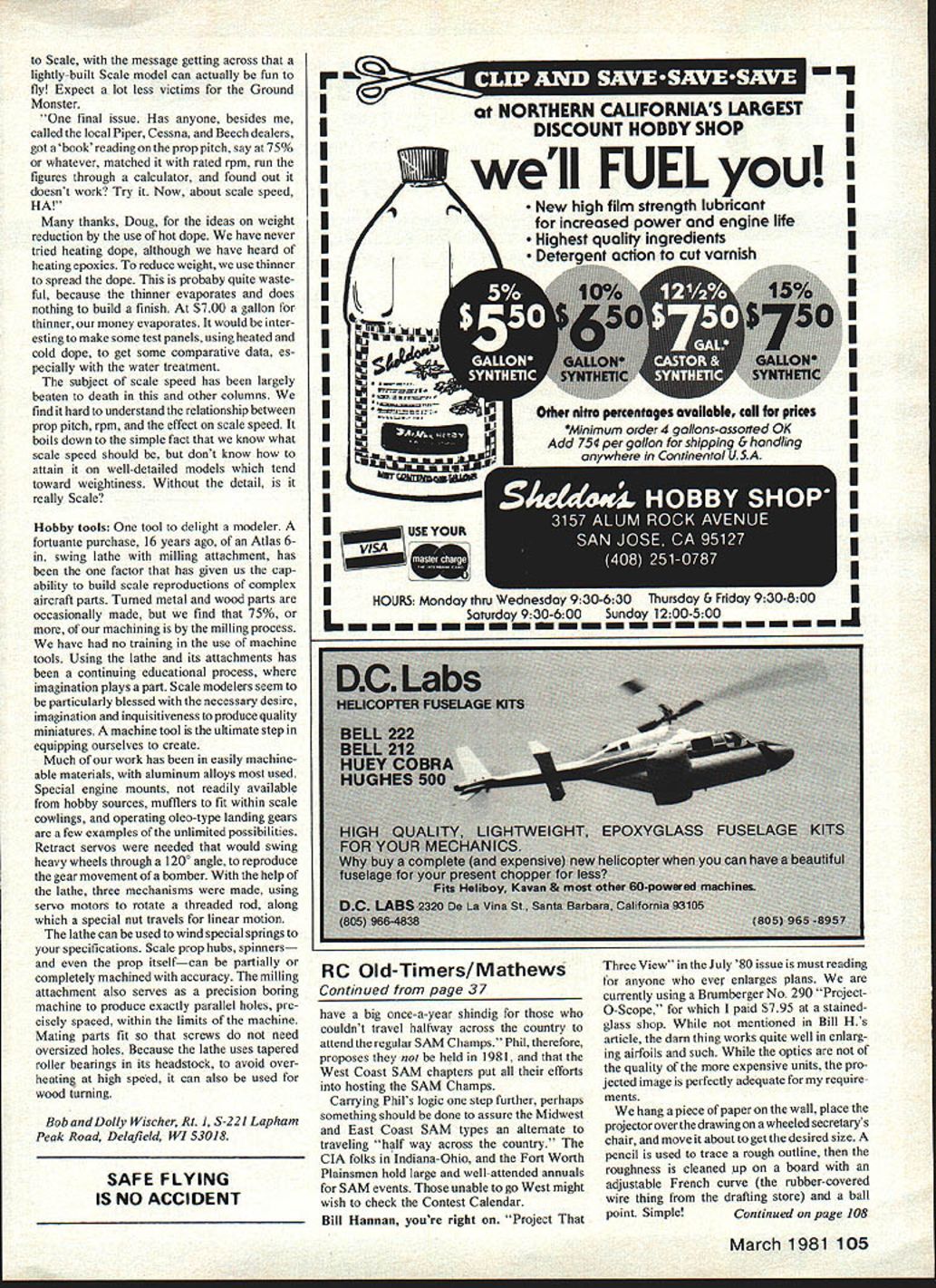
Much of our work has been in easily machinable materials, with aluminum alloys most used. Special engine mounts not readily available from hobby sources, mufflers to fit within scale cowlings, and operating oleo-type landing gears are a few examples of the unlimited possibilities. Retract servos were needed that would swing heavy wheels through a 120° angle, to reproduce the gear movement of a bomber. With the help of the lathe, three mechanisms were made, using servo motors to rotate a threaded rod, along which a special nut travels for linear motion.
The lathe can be used to wind special springs to your specifications. Scale prop hubs, spinners—and even the prop itself—can be partially or completely machined with accuracy. The milling attachment also serves as a precision boring machine to produce exactly parallel holes, precisely spaced, within the limits of the machine, making parts fit so that screws do not need oversized holes. Because the lathe uses tapered roller bearings in its headstock, to avoid overheating at high speed, it can also be used for wood turning.
Bob and Dolly Wischer Rt. 1, S-221 Lapham Peak Road Delafield, WI 53018
SAFE FLYING IS NO ACCIDENT
Transcribed from original scans by AI. Minor OCR errors may remain.

