
Radio Control: Scale
By Bob & Dolly Wischer
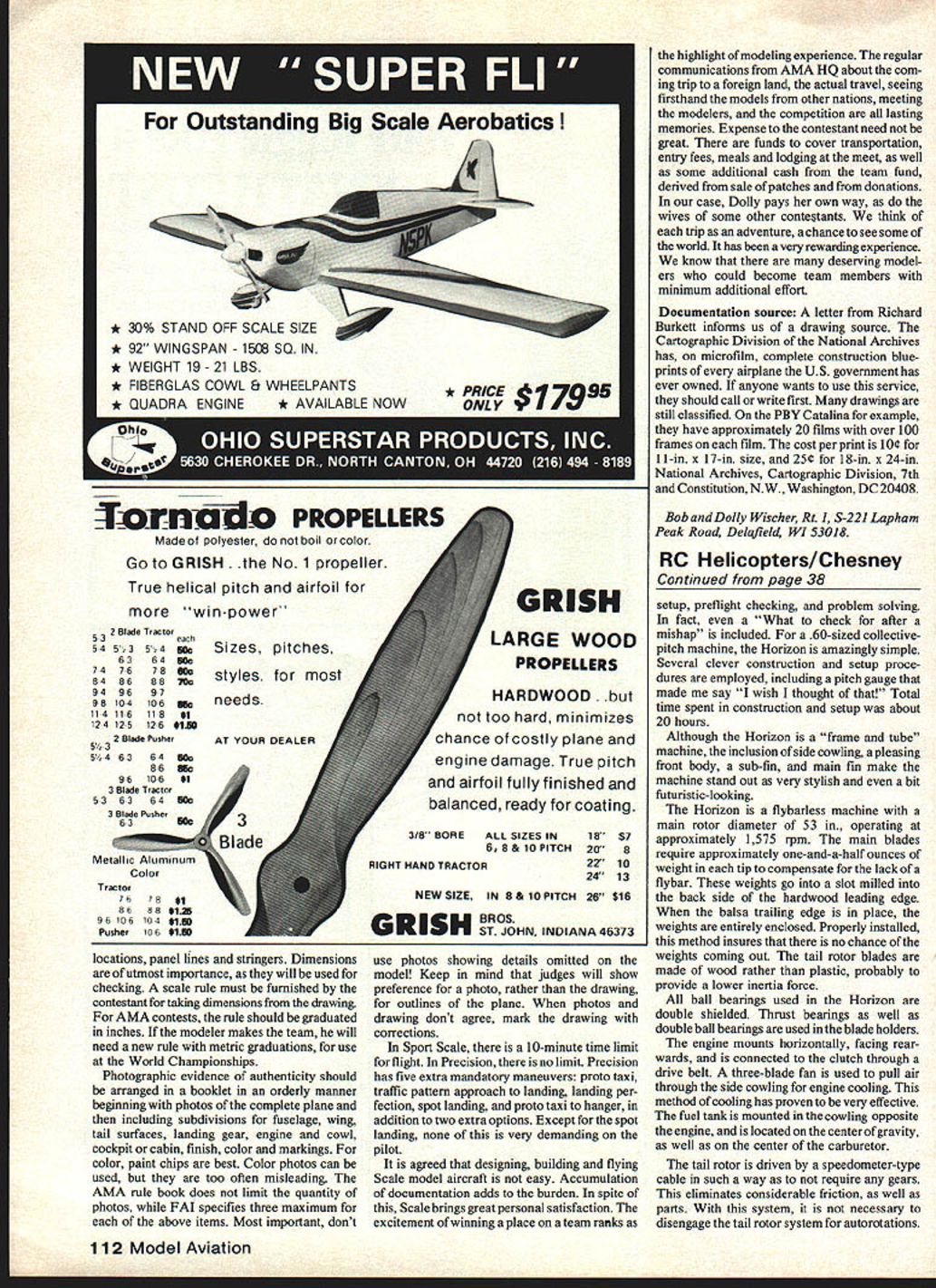
Heath Baby Bullet — Dan Santich
Photos of a Heath Baby Bullet arrived from Dan Santich, a long-time modeler. His letter follows in part:
"A match made in heaven? The O.S. 1.20 four-cycle engine and a 1/2-scale Baby Bullet! Seems so. Except for FAI Scale, it meets the qualifications of Precision, Sport and Giant Scale. Dimensions are 74 in. span, 58.9 in. length, 1,036 sq. in. wing area, 12 lbs. dry weight. Flies very sweet on a 16-6 prop. To qualify for FAI, I will have to bury a .60 on an inverted prop drive and make dummy cylinders. What a shame! That Gemini engine is such a beautiful piece of work. But that's the precarious position we are in with FAI and AMA Scale.
"Having flown Sport Scale for so long, it was quite a different sensation to see a tape measure put to my model! I recently won first place in Precision Scale at the Tangerine Internats at Orlando with it, and also had high static score. There were a lot of models entered in Sport Scale which would have done quite well in Precision. What does it take to cross the line? As far as models, not much. I think it is more of a mental decision."
Dan is making full-size drawings of the Baby Bullet available. Contact: Dan B. Santich, Rt. 1 Box 12, King, NC 27021.
International Competition and Team Selection
With another Nats approaching and team selection for the 1982 World Championships, many Sport Scale modelers have asked about converting to Precision (FAI) Scale. At the time of writing, it appears only a Precision RC Scale team and a Control Line Scale team will be selected, since the host Soviet Union model aero club has elected not to include Stand-off Scale in 1982.
To be eligible for the team, a model must conform to FAI rules. The main differences between FAI and AMA are:
- Engine displacement:
- FAI: total limited to .61 cu. in., regardless of number of engines.
- AMA: up to 1.25 cu. in.
- Weight (model without fuel):
- FAI: maximum 6 kg (13.2 lb.).
- AMA: maximum 15 lb.
- Maximum surface area (wing + stabilizer combined):
- FAI: 2,325 sq. in.
- AMA: 2,976 sq. in.
- Maximum loading (wing + stabilizer combined):
- FAI: 100 g/dm² (32.76 oz/sq ft).
- AMA: no specified limit.
A heavy twin such as a pair of .60s would not be eligible under FAI. Weight would need to be reduced and engines changed (for example, to a pair of .30s).
Many Sport Scale models we see at competitions could be used in Precision Scale and already meet FAI specifications. Add a few external details—cockpit, dummy engine if needed—and the plane may be ready. Panel lines for an all-metal plane, rib tapes and stitching, working canopy, and working shock struts are all plus items. Rivet detail should not be overdone: too large is worse than none, and a prototype with flush riveting is better without exaggerated simulated rivets.
Be aware: modifications such as increased fuselage length, changed wing or tail area, modified airfoil, thicker wingtips, or decreased fuselage cross section will reduce static points, because these features are measured.
Documentation and Drawings
Documentation for AMA Precision Scale and FAI F4C is essentially similar. Unlike Sport Scale, there is no six-page limit. Drawings can be elaborate, with as many views as needed—the more views and detail, the better as proof of authenticity.
Emphasis should be on visible structural features:
- rib lines, formers, spars and stringers,
- panel lines and stringers,
- dimensions and reference numbers where possible.
Include original manufacturer's drawings or factory photos of component parts when feasible. Dimensions are of utmost importance; they will be used for checking. Contestants must furnish a scale rule for taking dimensions from the drawing:
- For AMA contests, the rule should be graduated in inches.
- If selected for the team and attending the World Championships, a metric rule will be needed.
Photographic evidence should be arranged in a booklet in an orderly manner:
- Photos of the complete airplane.
- Subsections for fuselage, wing, tail surfaces, landing gear, engine and cowl, cockpit/cabin, finish, color and markings.
- For color, paint chips are best; color photos can be misleading.
- AMA does not limit the number of photos; FAI specifies maximums for each item.
- Do not include photos showing details that are omitted on the model.
- Judges tend to prefer a photo for outlines; when photos and drawings disagree, mark the drawing with corrections.
Flight and Competition Differences
- Sport Scale: 10-minute time limit for flight.
- Precision: no flight time limit.
Precision has five extra mandatory maneuvers in addition to those in Sport Scale:
- Proto taxi,
- Traffic pattern approach to landing,
- Landing perfection,
- Spot landing,
- Proto taxi to hangar,
plus two extra optional maneuvers. Except for spot landing, these are not especially demanding on the pilot.
Rewards and Experience
Designing, building and flying Scale model aircraft is not easy, and assembling documentation adds to the workload. Despite this, Scale brings great personal satisfaction. Winning a place on a team ranks as a highlight of modeling experience. Team membership often includes regular communications from AMA HQ about the trip, travel arrangements, seeing models from other nations, meeting foreign modelers, and the competition itself—lasting memories.
Expense to the contestant need not be great. There are funds to cover transportation, entry fees, meals and lodging at the meet, and some additional cash from the team fund (derived from sale of patches and donations). Some spouses pay their own way; the trip is often treated as an adventure and a chance to see the world.
We believe many deserving modelers could become team members with minimal additional effort.
Documentation Source — National Archives
A letter from Richard Burkett noted a drawing source: the Cartographic Division of the National Archives holds, on microfilm, complete construction blueprints of every airplane the U.S. government has owned. Call or write first—many drawings are still classified. Example: on the PBY Catalina they have approximately 20 films with over 1,000 frames each.
Costs per print:
- 11 in. x 17 in.: 10¢
- 18 in. x 24 in.: 25¢
Contact: National Archives, Cartographic Division 7th and Constitution, N.W. Washington, DC 20408
Bob and Dolly Wischer Rt. 1, S-221 Lapham Peak Road Delafield, WI 53018
Transcribed from original scans by AI. Minor OCR errors may remain.

