
Radio Control: Scale
Bob & Dolly Wischer
Flying Technique
Our Wisconsin winters usually shorten the flying season to six or seven months. The long idle period in the frigid months gives us plenty of time for model building, but also results in some loss of proficiency during first flights in the spring. Using a trainer-type plane helps to re-establish confidence in the early going, rather than risk a newly finished scale model.
A trainer may introduce a false sense of assurance, however. Its forgiving nature may permit us to forget the devastating results of high-angle-of-attack flying. Scale models have higher wing loading, especially during periods of reduced speed such as climbing or gliding. A light trainer with a larger-than-necessary engine may lead us to believe altitude can be acquired by touch-up elevator. A surprising number of pilots, both full-size and modelers, have the mistaken notion that the throttle controls altitude and the elevator controls speed. The transmitter moves the controls mechanically regardless of the facts of flight.
The first step in the learning — or unlearning — process is to stop flying wide-open throttle. Follow practice used in full-size planes: use throttle position to give a comfortable cruise speed; set elevator trim to permit level flight. The wing angle-of-attack at that speed will produce lift equal to the model’s weight. Changing throttle position results in climb or descent. An important observation: notice speed does change as the model climbs or descends.
Without changing throttle position, move the elevator trim control up (elevator up) and speed will be reduced. Move trim down and speed will increase. These observations in the air determine that throttle is for altitude control and elevator is for speed control. Using the two controls in the opposite manner can lead to stalls, spins, and crashes.
Resist the temptation to pull the nose up with elevator to stretch the glide. Judging a model’s attitude during a glide and its distance is a matter of experience. When flying slowly its apparent size doesn’t change rapidly; as it approaches head-on the model may appear to be losing altitude. Too rapidly touching the throttle will slow the descent and gather speed; adding too much throttle can cause the model to overshoot the landing. Added down elevator trim will result in a speed increase with much the same effect. An indication the model is about to stall is loss of directional control.
The classic example of a scale-model accident is a snap roll on takeoff. Best insurance against this often-fatal mishap is to control the angle of attack by using a bit of down elevator trim, and let the model gather adequate speed before lifting it off with just a touch of up elevator. Be prepared to release that elevator the instant the model breaks from the surface. If it lifts off too early, two ingredients for a snap roll are present: low airspeed and up elevator. As in landing, experience is needed in judging airspeed. To keep the takeoff in a straight line, we prefer to stand behind the model; from this point it is not easy to judge speed. A nosewheel model, with a more predictable takeoff run, permits the pilot to stand to one side for better observation of acceleration.
The third element in the surprise snap roll on takeoff is tail heaviness. Check the center-of-gravity location carefully, and follow the example of most other scale modelers: use as much weight as necessary to place that center in the proper location. An error on the nose-heavy side is preferred.
Tips to avoid snap roll on takeoff:
- Use a bit of DOWN elevator trim to control angle of attack.
- Let the model gather adequate speed before lifting off with a small UP elevator input.
- Be ready to release elevator the instant the model lifts.
- Ensure the center of gravity is correct; prefer slight nose heaviness.
Planes at Toledo
As in past years, one of the centers of attention at Toledo was the exhibit of Jim Funduk. This year his F4U Corsair, a three-year project, had air-operated folding wings that attracted constant interest. The plane had numerous other features, some hidden. Jim had combined two Dooling .61 engines connected in-line using a Webra carburetor. The basic fuselage was fiberglass with .006-in. aluminum covering. Rudder and elevator were silk covered. Trim tabs and flaps were operational, and hatches in the wings opened to expose machine guns.
Best-of-show and first place in Precision Scale were won by George Rose and his well-known Curtiss Hawk P-6E, the same plane that has been doing so well on the contest circuit, including a second place in the recent World Championship at Ottawa. This was George's first attendance at Toledo. The prototype for the Hawk is located in Dayton's Air Force Museum. The five-year-old model looks better than ever. It is refreshing to see the well-known model lineup at Toledo Expo, where non-flying types with radios installed have too often taken top prizes.
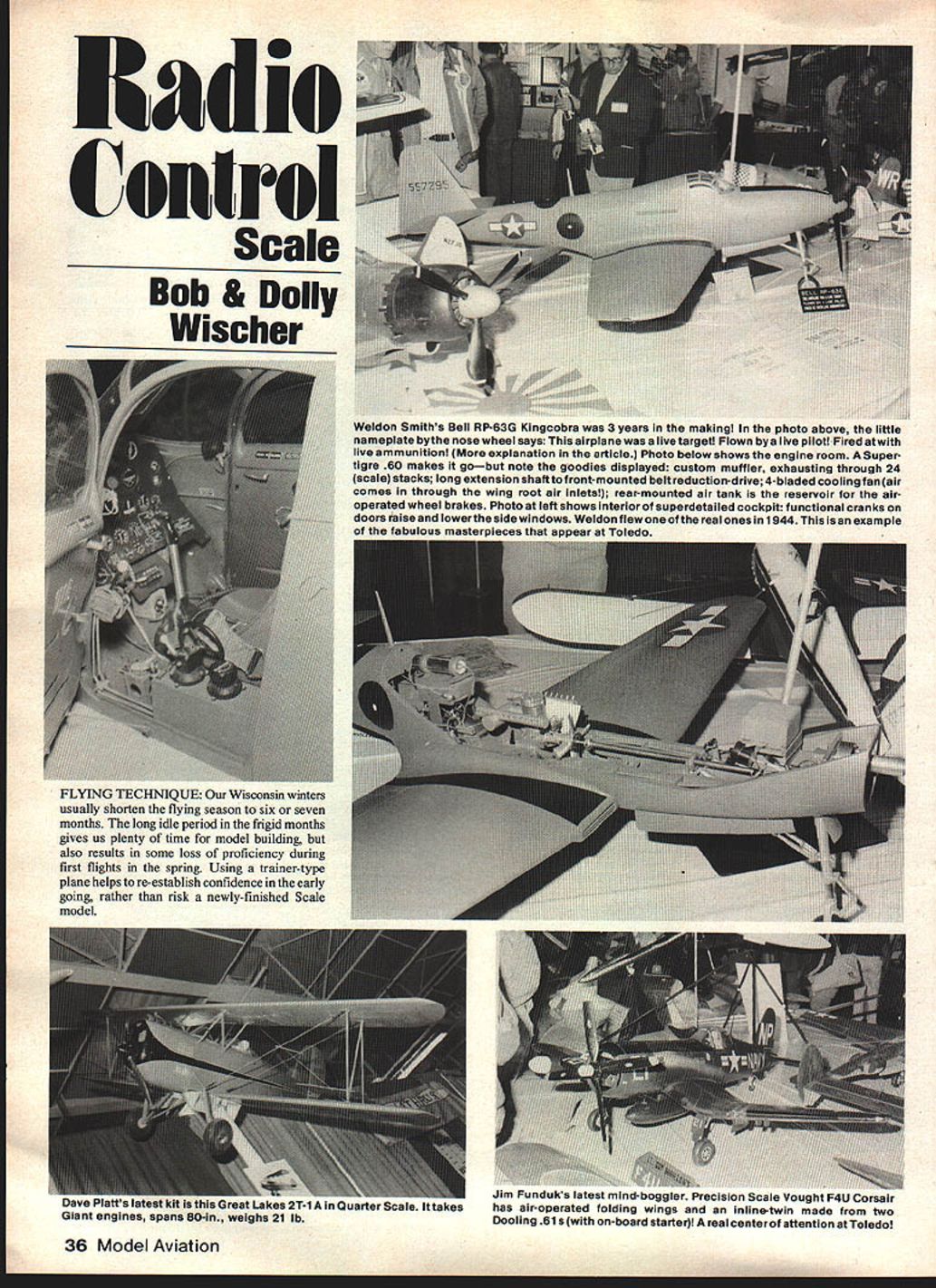
Second place in Precision Scale was won by Weldon Smith's Bell RP-63G Kingcobra target plane. Now a retired airline captain, Weldon had flown the prototype as a ferry pilot in 1944, from the Buffalo, N.Y. factory to Texas. Several hundred of the target planes had been built, with guns omitted and a ton of armor added to protect against fire from gunners in simulated attacks in air combat. That's right — live ammunition fired at a plane with a live pilot! A visitor at the show, Art Johnson, had been one of the pilots on these missions. (Art will be remembered as the modeler who flies the P-38, P-40, and P-82 at the Nats and other events.) Weldon and Art were introduced, and we spent a happy half-hour listening to stories about the plane. Art had been told that the RP-63G could withstand .30-caliber fire, and so he tried it with his rifle, denting the surface and finding a soft spot by penetrating through the windshield. He remembers bullets that hit the engine and some that rattled around inside the wing root. The plane had lights that would flash when the target had been hit.
Weldon's model is quite large at an 84-in. wingspan. It has a Super Tigre .60 engine mounted in the scale location at the nose, with exhausts routed to scale stacks. Long extension shafts lead to a front-mounted belt reduction drive. A four-bladed cooling fan is used; air enters through wing-root air inlets. The model has a rear-mounted air tank reservoir and air-operated wheel brakes. The interior is super-detailed with a functional cockpit; doors raise and lower, and the side windows operate. Weldon flew one real RP-63G in 1944 and used that knowledge in building the model. He has the model set up for initial flying with the .60; a Rossi .90 is ready for installation if the .60 proves insufficient.
Finish is international orange butyrate dope, with flattener added, over silkspan. The complete fuselage top, with cockpit, is removable for access to engine and drive train. Weldon has made electric retract mechanisms and operational, sprung landing gear legs. A reservoir supplies the air bladder wheel brakes. The cockpit is well detailed, including operating hand cranks for lowering the side windows. Unquestionably a fine example of Precision Scale, it is in the Giant Scale class at 18 lb.
Vito Tomeo's scratch-built, 1/6-scale Hawker Sea Fury was the first-place winner in Military Stand-off class. We had seen the 18-lb., 77-in. span model in flight at last year's Nats. Dennis Bryll placed second with a P-47 Thunderbolt. Third place Stand-off winner was another familiar plane, having won first place at the '77 and '80 Nats, the P-61 Black Widow by Roger Brennon. The 19.5-lb. plane is scratch-built from Wylam drawings, with foam and balsa construction and Hobbycraft finish. Three hand-made, non-retractable gear legs have two springs in each. Roger has recently installed new OS .60 engines. It seems that more of the well-tried flying planes are making their appearance at Toledo. In Non-military Stand-off Scale, the Starduster Too of Terry Williams was awarded first place.
Team Selection
A proposal has been made to select three scale teams at the Seguin Nats: F4C Radio Control, F4B Control-line, and Stand-off Radio Control, even though the only nation making a bid for the 1982 World Championship has been the U.S.S.R., who have elected to omit Stand-off RC. This is being proposed on the basis that another nation may make a more attractive bid for 1982 that would include Stand-off RC, and preparations must be made to send a team in that eventuality.
Modelers who wish to have their entries considered in any of the three classes must meet these requirements:
- Have an FAI stamp on their AMA license.
- Pay the FAI entry fee in addition to the Nats entry fee.
- Enter a model that complies with FAI rules.
It should be noted that the FAI designation for the event is "Stand-off RC Scale," while in the U.S. it is called RC Sport Scale.
If no other nation makes a successful bid for the 1982 World Championship at the FAI plenary session in December, and the U.S.S.R. bid is accepted, refunds of the FAI program entry fee will be made by AMA headquarters, upon application, to Sport Scale RC Nats contestants. A serious effort is being made, by at least one other nation, to outbid the U.S.S.R. so that Stand-off RC can be included. At present it is by far the most popular scale event in all nations except the U.S.S.R. It certainly deserves World Championship status.
Bob and Dolly Wischer R1, S-221 Lapham Peak Road, Delafield, WI 53018.
Transcribed from original scans by AI. Minor OCR errors may remain.

