
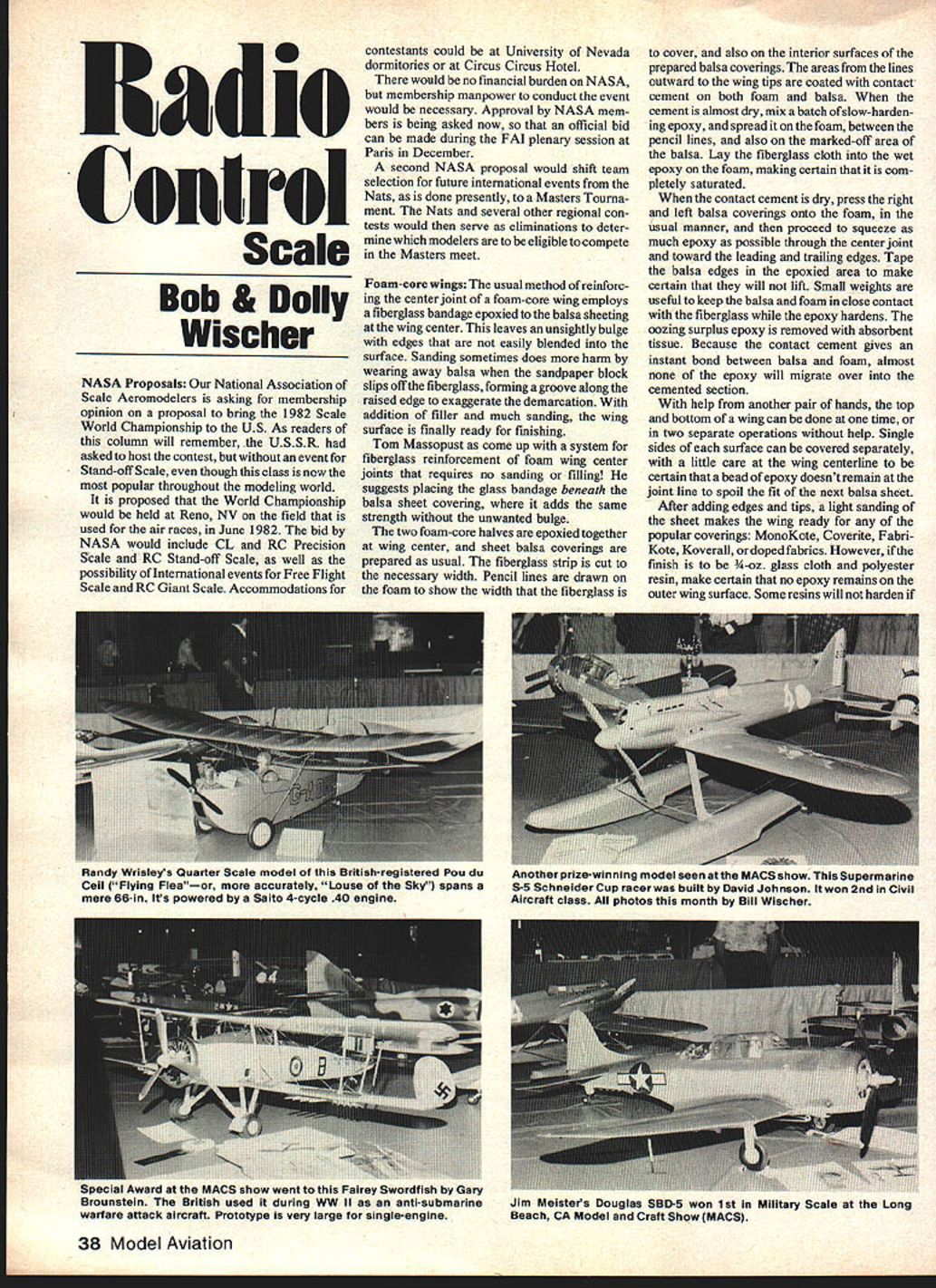
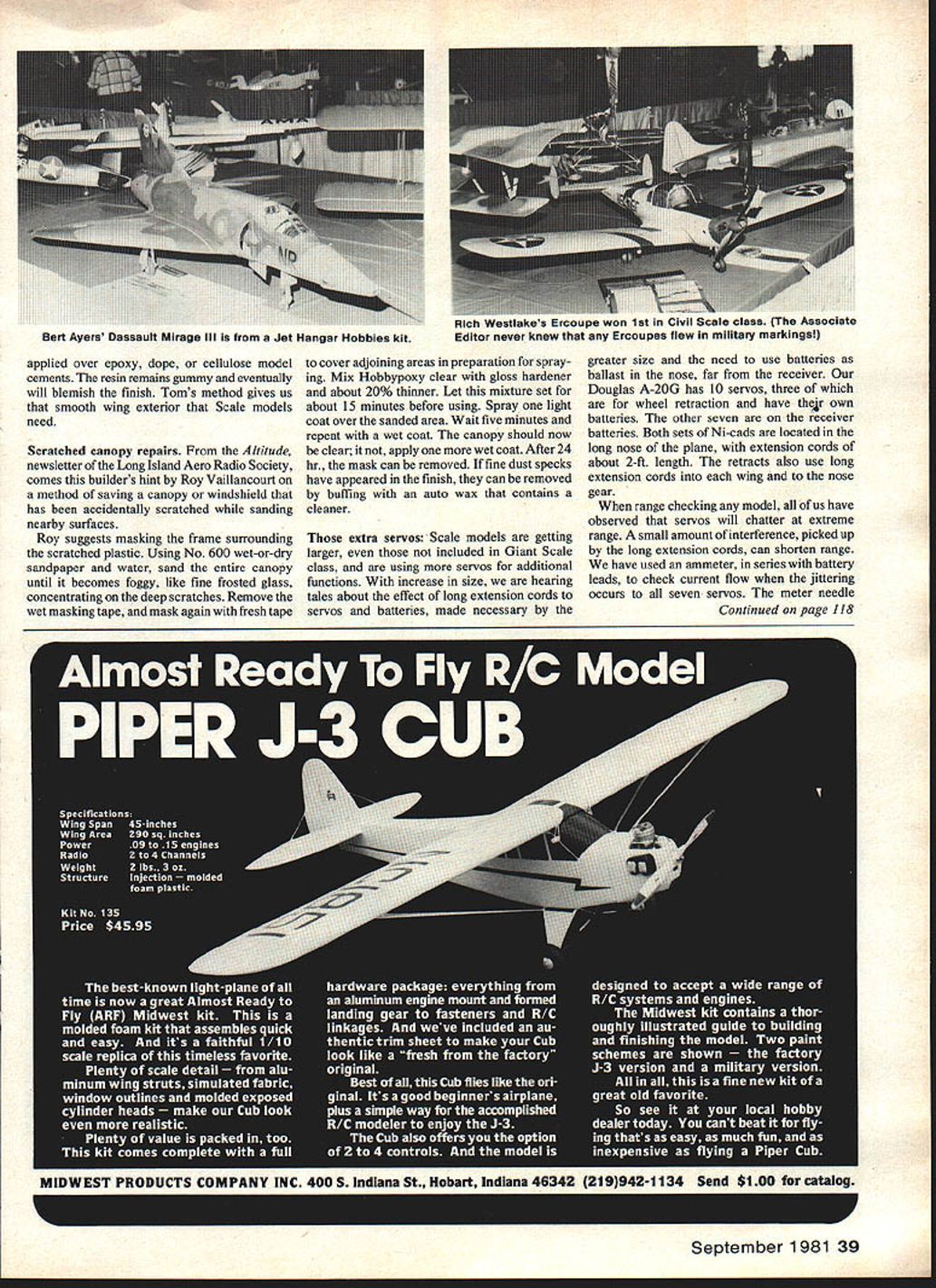
Radio Control: Scale
Bob & Dolly Wischer
NASA proposals
Our National Association of Scale Aeromodelers (NASA) is asking for membership opinion on a proposal to bring the 1982 Scale World Championship to the U.S. As readers of this column will remember, the U.S.S.R. had asked to host the contest but without an event for Stand-Off Scale, even though this class is now the most popular throughout the modeling world.
It is proposed that the World Championship be held at Reno, NV on the field used for the air races, in June 1982. The bid by NASA would include:
- CL and RC Precision Scale
- RC Stand-Off Scale
- Possible international events for Free Flight Scale and RC Giant Scale
Accommodations for contestants could be at University of Nevada dormitories or at Circus Circus Hotel.
There would be no financial burden on NASA, but membership manpower to conduct the event would be necessary. Approval by NASA members is being requested now so that an official bid can be made during the FAI plenary session in Paris in December.
A second NASA proposal would shift team selection for future international events from the Nats (as is done presently) to a Masters Tournament. The Nats and several other regional contests would then serve as eliminations to determine which modelers are to be eligible to compete in the Masters meet.
Foam-core wings
The usual method of reinforcing the center joint of a foam-core wing employs a fiberglass bandage epoxied to the balsa sheeting at the wing center. This leaves an unsightly bulge with edges that are not easily blended into the surface. Sanding sometimes does more harm by wearing away balsa when the sandpaper block slips off the fiberglass, forming a groove along the raised edge that exaggerates the demarcation. With addition of filler and much sanding, the wing surface is finally ready for finishing.
Tom Massopust has come up with a system for fiberglass reinforcement of foam wing center joints that requires no sanding or filling. He suggests placing the glass bandage beneath the balsa sheet covering, where it adds the same strength without the unwanted bulge.
Procedure:
- Epoxy the two foam-core halves together at the wing center and prepare the sheet balsa coverings as usual.
- Cut the fiberglass strip to the necessary width. Draw pencil lines on the foam to show the width the fiberglass is to cover, and on the interior surfaces of the prepared balsa coverings.
- Coat the areas from the lines outward to the wing tips with contact cement on both foam and balsa. When the cement is almost dry, mix a batch of slow-hardening epoxy and spread it on the foam between the pencil lines and on the marked areas of the balsa.
- Lay the fiberglass cloth into the wet epoxy on the foam, ensuring it is completely saturated.
- When the contact cement is dry, press the right and left balsa coverings onto the foam and squeeze as much epoxy as possible through the center joint and toward the leading and trailing edges. Tape the balsa edges in the epoxied area to prevent lifting. Use small weights to keep the balsa and foam in close contact with the fiberglass while the epoxy hardens. Remove surplus epoxy with absorbent tissue.
Because the contact cement gives an instant bond between balsa and foam, almost none of the epoxy will migrate into the cemented section. With help from another pair of hands, the top and bottom of a wing can be done at one time, or in two separate operations without help. Single sides of each surface can be covered separately, with care at the wing centerline so a bead of epoxy doesn't remain at the joint line and spoil the fit of the next balsa sheet.
After adding edges and tips, a light sanding of the sheeting makes the wing ready for any of the popular coverings: MonoKote, Coverite, Fabri-Kote, Koverall, or doped fabrics. However, if the finish is to be 3/4-oz. glass cloth and polyester resin, make certain that no epoxy remains on the outer wing surface. Some polyester resins will not harden if epoxy remains on the outer surface.
Tom's method produces a smooth wing exterior.
Canopy scratch repairs
Altitude, the newsletter of the Long Island Aero Radio Society, offers a builder's hint from Roy Vaillancourt for saving a canopy or windshield that has been scratched while sanding nearby surfaces.
- Mask the frame surrounding the scratched plastic.
- Using No. 600 wet-or-dry sandpaper and water, sand the entire canopy until it becomes foggy, like fine frosted glass, concentrating on the deep scratches.
- Remove the wet masking tape and re-mask with fresh tape to cover adjoining areas in preparation for spraying.
- Mix Hobbyoxy clear with gloss hardener and about 20% thinner. Let the mixture set for about 15 minutes before using.
- Spray one light coat over the sanded area. Wait five minutes and repeat with a wet coat. If necessary, apply one more wet coat.
- After 24 hours, remove the mask. If fine dust specks have appeared in the finish, remove them by buffing with an auto wax that contains a cleaner.
Those extra servos
Scale models are getting larger and using more servos for additional functions. With increased size we hear about the effects of long extension cords to servos and batteries, made necessary by the greater size and the need to use batteries as ballast in the nose, far from the receiver.
Our Douglas A-20G has 10 servos, three of which are for wheel retraction and have their own batteries. The other seven are on the receiver batteries. Both sets of Ni-Cads are located in the long nose of the plane, with extension cords of about 2 ft. The retracts also use long extension cords into each wing and to the nose gear.
When range-checking any model, servos will chatter at extreme range. A small amount of interference, picked up by the long extension cords, can shorten range. We used an ammeter in series with battery leads to check current flow when jittering occurs to all seven servos. The meter needle fluctuated rapidly, but indicated well over one ampere, which is quite a load on our 500 mAh battery pack. Air loads on the control surfaces would increase current draw further. After a number of flights, when batteries are low, a bit of interference could result in a suddenly-dead receiver.
Recommendations:
- Avoid very long extension cords and too many servos on a single receiver battery if possible.
- Use larger batteries (1.0 Ah or 1.2 Ah) if additional nose weight is needed.
- Use ferrite beads on long extension cords, strung on the red and black wires and spaced about every 10 inches, to reduce interference risk.
- Keep the receiver antenna away from extension cords.
- Inspect all wiring for broken strands at solder joints.
- Check plugs and sockets that are frequently separated, as they can be additional noise sources.
Forming small parts
We have vacuum-formed small parts with a Mattel Vac-U-Form toy. These have become scarce and are very difficult to find. Anyone having a MonoKote heat gun can get similar results by stretch-molding parts made from ABS plastic or styrene.
Make the mold by carving from balsa, sanding and giving several coats of polyester resin to harden the surface, then sanding smooth. Fasten the mold on the end of a hardwood dowel or square strip so it can be mounted in a vise or otherwise held vertically with the molding surface facing upward.
The plastic sheet to be formed is fastened with masking tape to a piece of plywood which has a hole near its center larger than the mold. Warm the plastic with the heat gun until it begins to sag. With the plastic side down, press the plywood holder down over the mold and hold it while the plastic cools. After trimming edges, the part is complete.
For best results:
- The plywood holder should have a hole similar in outline to the mold shape and somewhat larger. It need not be exact but should not be greatly oversize.
- Warm the mold with the heat gun so the plastic does not cool too quickly upon contact. This permits more time for stretching and reduces the pressure required.
Likely candidates for this method are parts needed in quantity, for example, 14 or 18 rocker-arm bumps on a radial-engine cowl.
Bob and Dolly Wischer R1, S-221 Lapham Peak Rd. Delafield, WI 53018
Transcribed from original scans by AI. Minor OCR errors may remain.

