
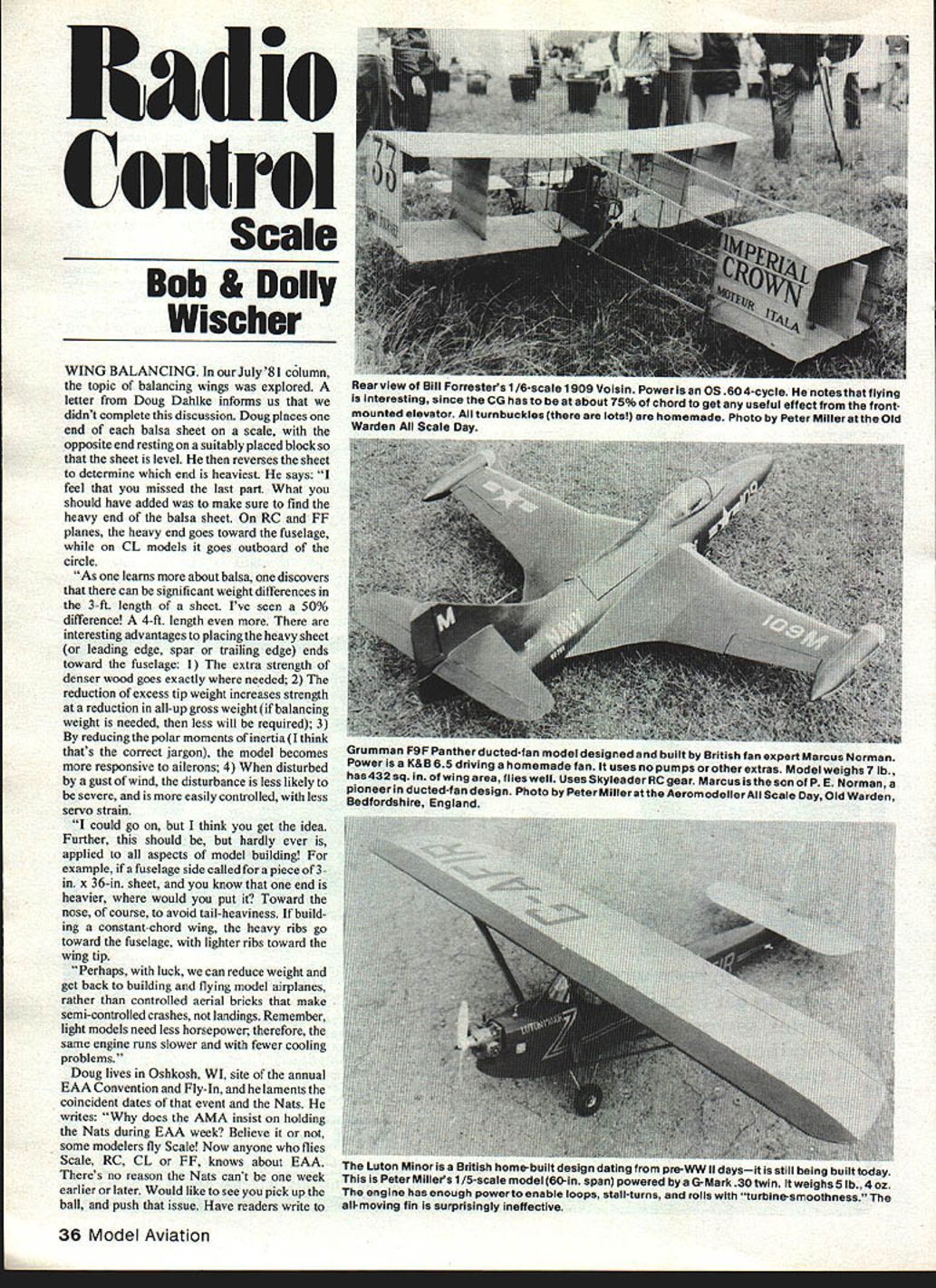
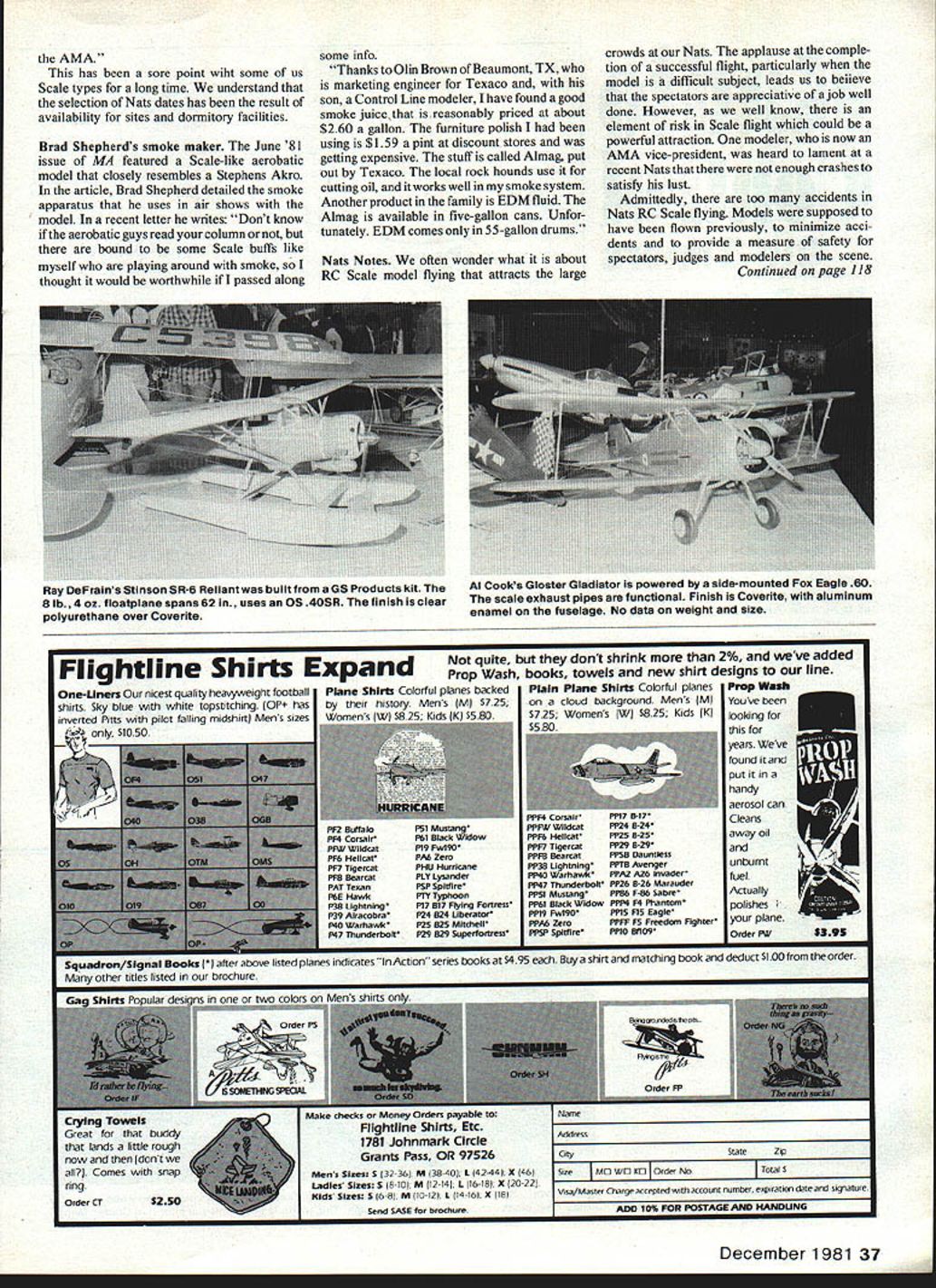
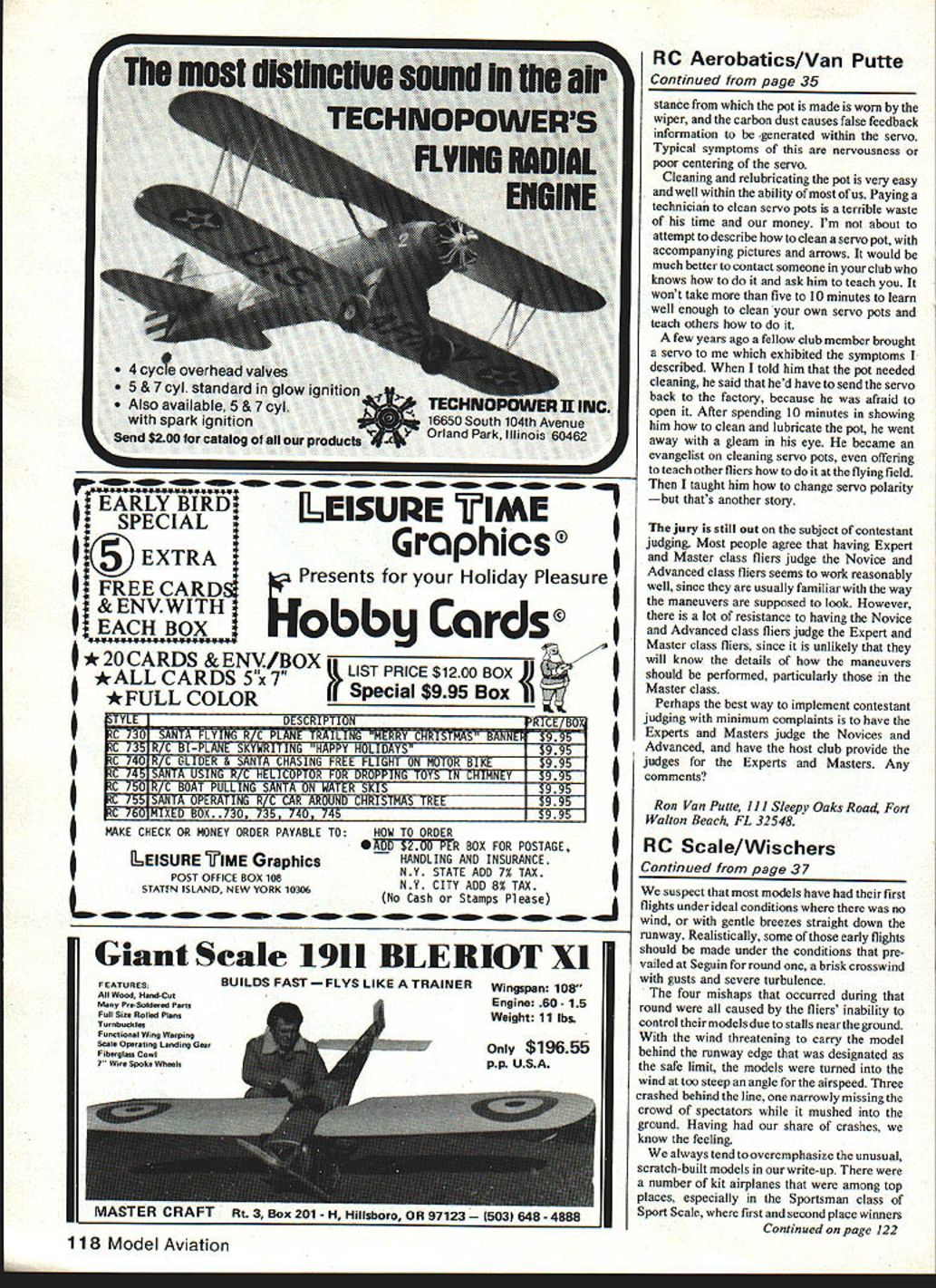
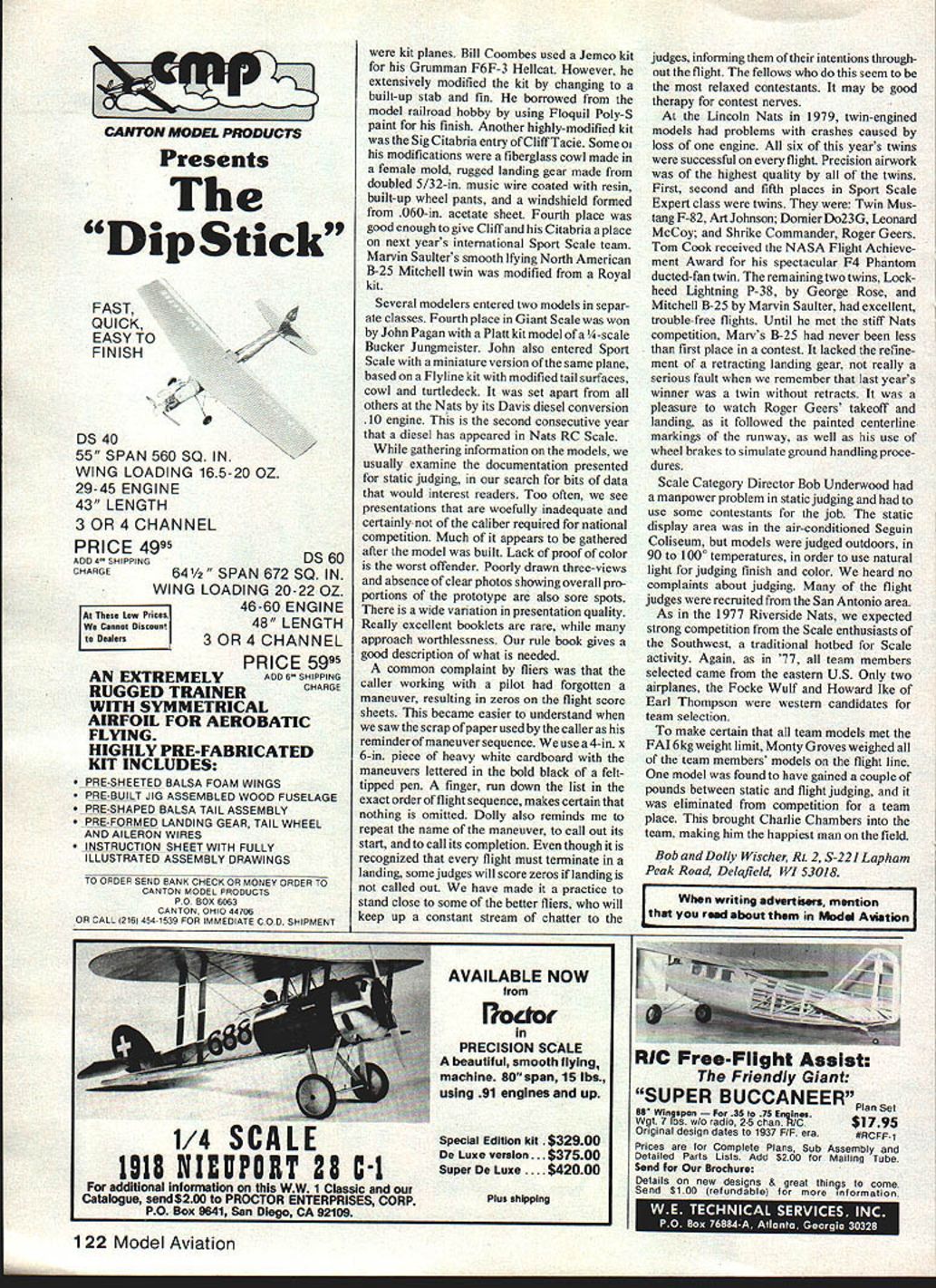
Radio Control: Scale
Bob & Dolly Wischer
Wing Balancing
In our July '81 column, the topic of balancing wings was explored. A letter from Doug Dahlke informs us that we didn't complete that discussion. Doug places one end of each balsa sheet on a scale, with the opposite end resting on a suitably placed block so that the sheet is level. He then reverses the sheet to determine which end is heaviest. He says that you should make sure to find the heavy end of the balsa sheet. On RC and FF planes, the heavy end goes toward the fuselage, while on CL models it goes outboard of the circle.
As one learns more about balsa, one discovers that there can be significant weight differences in the 3-ft length of a sheet — I've seen a 50% difference! A 4-ft length can show even more. There are interesting advantages to placing the heavy sheet (or leading edge, spar, or trailing edge) ends toward the fuselage:
- The extra strength of denser wood goes exactly where needed.
- The reduction of excess tip weight increases strength and reduces all-up gross weight (if balancing weight is needed, then less will be required).
- By reducing the polar moments of inertia, the model becomes more responsive to ailerons.
- When disturbed by a gust of wind, the disturbance is less likely to be severe and is more easily controlled, with less servo strain.
This principle should be applied to all aspects of model building. For example, if a fuselage side called for a piece of 3-in. x 36-in. sheet and you know one end is heavier, put the heavy end toward the nose to avoid tail-heaviness. If building a constant-chord wing, the heavy ribs go toward the fuselage, with lighter ribs toward the wing tip.
Perhaps, with luck, we can reduce weight and get back to building and flying model airplanes, rather than controlled aerial bricks that make semi-controlled crashes instead of landings. Remember: light models need less horsepower; therefore, the same engine runs slower and with fewer cooling problems.
Doug lives in Oshkosh, WI, site of the annual EAA Convention and Fly-In, and he laments the coincident dates of that event and the Nats. He writes: "Why does the AMA insist on holding the Nats during EAA week? Believe it or not, some modelers fly Scale! Now anyone who flies Scale, RC, CL or FF, knows about EAA. There's no reason the Nats can't be one week earlier or later. Have readers write to the AMA."
This has been a sore point with some of us Scale types for a long time. We understand that the selection of Nats dates has been the result of availability for sites and dormitory facilities.
Brad Shepherd's smoke maker
The June '81 issue of MA featured a Scale-like aerobatic model that closely resembles a Stephens Akro. In the article, Brad Shepherd detailed the smoke apparatus that he uses in air shows with the model. In a recent letter he writes that, thanks to Olin Brown of Beaumont, TX (marketing engineer for Texaco and, with his son, a Control Line modeler), he has found a good smoke juice that is reasonably priced at about $2.60 a gallon. The furniture polish he had been using was $1.59 a pint at discount stores and was getting expensive.
The product is called Almag, put out by Texaco. Local rock hounds use it for cutting oil, and it works well in his smoke system. Another product in the family is EDM fluid. The Almag is available in five-gallon cans; unfortunately, EDM comes only in 55-gallon drums.
Nats Notes
We often wonder what it is about RC Scale model flying that attracts the large crowds at our Nats. The applause at the completion of a successful flight, particularly when the model is a difficult subject, leads us to believe that spectators are appreciative of a job well done. However, there is also an element of risk in Scale flight which can be a powerful attraction. One modeler, now an AMA vice-president, was heard to lament at a recent Nats that there were not enough crashes to satisfy his lust.
Admittedly, there are too many accidents in Nats RC Scale flying. Models were supposed to have been flown previously to minimize accidents and to provide a measure of safety for spectators, judges, and modelers on the scene. We suspect that most models have had their first flights under ideal conditions — no wind, or gentle breezes straight down the runway. Realistically, some of those early flights should be made under the conditions that prevail at Seguin for round one: a brisk crosswind with gusts and severe turbulence.
The four mishaps that occurred during that round were all caused by the fliers' inability to control their models due to stalls near the ground. With the wind threatening to carry the model behind the runway edge designated as the safe limit, the models were turned into the wind at too steep an angle for the airspeed. Three crashed behind the line; one narrowly missed the crowd of spectators while it mushed into the ground. Having had our share of crashes, we know the feeling.
We always tend to overemphasize the unusual, scratch-built models in our write-up. However, several kit airplanes were among the top places, especially in the Sportsman class of Sport Scale, where the first and second place winners were kit planes. Bill Coombes used a Jemco kit for his Grumman F6F-3 Hellcat, but he extensively modified the kit by changing to a built-up stab and fin and borrowing from the model-railroad hobby by using Floquil Poly-S paint for his finish.
Another highly modified kit was Cliff Tacie's Sig Citabria. Some of his modifications were a fiberglass cowl made in a female mold, rugged landing gear made from doubled 5/32-in. music wire coated with resin, built-up wheel pants, and a windshield formed from .060-in. acetate sheet. Fourth place was good enough to give Cliff and his Citabria a place on next year's international Sport Scale team. Marvin Sautler's smooth-flying North American B-25 Mitchell twin was modified from a Royal kit.
Several modelers entered two models in separate classes. Fourth place in Giant Scale was won by John Pagan with a Platt kit model of a 1/4-scale Bucker Jungmeister. John also entered Sport Scale with a miniature version of the same plane, based on a Flyline kit with modified tail surfaces, cowl, and turtledeck. It was set apart from all others at the Nats by its Davis diesel-conversion .10 engine. This is the second consecutive year that a diesel has appeared in Nats RC Scale.
While gathering information on the models, we usually examine the documentation presented for static judging in search of data that would interest readers. Too often, we see presentations that are woefully inadequate and certainly not the caliber required for national competition. Much of it appears to be gathered after the model was built. Lack of proof of color is the worst offender. Poorly drawn three-views and absence of clear photos showing overall proportions of the prototype are also sore spots. There is a wide variation in presentation quality. Really excellent booklets are rare, while many approach worthlessness. Our rule book gives a good description of what is needed.
A common complaint by fliers was that the caller working with a pilot had forgotten a maneuver, resulting in zeros on the flight score sheets. This became easier to understand when we saw the scrap of paper used by the caller as his reminder of maneuver sequence. We use a 4-in. x 6-in. piece of heavy white cardboard with the maneuvers lettered in bold black of a felt-tipped pen. A finger, run down the list in the exact order of flight sequence, makes certain that nothing is omitted. Dolly also reminds me to repeat the name of the maneuver, to call out its start, and to call its completion. Even though it is recognized that every flight must terminate in a landing, some judges will score zeros if landing is not called out.
We have made it a practice to stand close to some of the better fliers, who will keep up a constant stream of chatter to the judges, informing them of their intentions throughout the flight. The fellows who do this seem to be the most relaxed contestants. It may be good therapy for contest nerves.
At the Lincoln Nats in 1979, twin-engined models had problems with crashes caused by the loss of one engine. All six of this year's twins were successful on every flight. Precision airwork was of the highest quality by all of the twins. First, second, and fifth places in Sport Scale Expert class were twins: Twin Mustang F-82 (Art Johnson); Dornier Do 23G (Leonard McCoy); and Shrike Commander (Roger Geers).
Tom Cook received the NASA Flight Achievement Award for his spectacular F4 Phantom ducted-fan twin. The remaining two twins, Lockheed Lightning P-38 by George Rose and Mitchell B-25 by Marvin Sautler, had excellent, trouble-free flights. Until he met the stiff Nats competition, Marvin's B-25 had never been less than first place in a contest. It lacked the refinement of a retracting landing gear — not really a serious fault when we remember that last year's winner was a twin without retracts. It was a pleasure to watch Roger Geers' takeoff and landing as they followed the painted centerline markings of the runway, and to see his use of wheel brakes to simulate ground handling procedures.
Scale Category Director Bob Underwood had a manpower problem in static judging and had to use some contestants for the job. The static display area was in the air-conditioned Seguin Coliseum, but models were judged outdoors in 90 to 100°F temperatures in order to use natural light for judging finish and color. We heard no complaints about judging. Many of the flight judges were recruited from the San Antonio area.
As in the 1977 Riverside Nats, we expected some competition from the Scale enthusiasts of the Southwest, a traditional hotbed for Scale activity. Again, as in '77, all team members selected came from the eastern U.S. Only two airplanes — the Focke Wulf and Howard Ike of Earl Thompson — were western candidates for team selection.
To make certain that all team models met the FAI 6 kg weight limit, Monty Groves weighed all of the team members' models on the flight line. One model was found to have gained a couple of pounds between static and flight judging, and it was eliminated from competition for a team place. This brought Charlie Chambers into the team, making him the happiest man on the field.
Bob and Dolly Wischer, R.R. 2, S-221 Lapham Peak Road, Delafield, WI 53018.
Transcribed from original scans by AI. Minor OCR errors may remain.

