
Radio Control: Scale
Bob & Dolly Wischer
Good News: Profile Publications Reprinted
Profile Publications are being reprinted by Zenith Aviation Books, North Branch, MN 55056. After an absence of six years they are again becoming available at $2.50 each. First titles to be released are:
- No. 3 — Focke Wulf FW 190A
- No. 7 — P-47D Thunderbolt
- No. 8 — P-51D Mustang
- No. 19 — B-24J Liberator
- No. 20 — F-86A Sabre
- No. 24 — Hurricane Mk. II C
- No. 29 — Junkers Ju 88A
- No. 30 — F-100 Super Sabre
The entire 300+ volume series is being reprinted as originally published, with center-folds, photos and text. These Profiles have been considered sufficiently authentic to serve as color documentation for Scale static scoring in contests; AMA and FAI rules specifically mention the Profiles for this purpose. Their return should be welcome to Scale modelers.
Ten years ago many models tended to look alike because modelers copied the Profiles’ color information. When the Profiles became scarce, modelers searched elsewhere and greater variety resulted. Some Profiles included alternate schemes, but builders often copied the most attractive option.
Non-contestants will find the Profiles convenient for photos, color schemes and historical data. Sport Scale contestants will appreciate the color documentation — 30% of a static score is based on proof of finish, color and markings, while 40% is awarded for accuracy of outline, also well supported by the Profiles. Scale enthusiasts interested in prototype variants and history will find the series invaluable.
Kitchener–Waterloo All-Scale Rally
The Flying Dutchmen Club of Kitchener, Ontario, hosts an annual All-Scale Rally that has grown steadily. After a high of 208 registered planes one year, the 1981 count was 165 — a comfortable size for a two-day event. It was common to see six or seven planes airborne at once.
There has been a clear trend toward large (Giant) models. In 1980 they made up about 25% of registrations; in 1981 that rose to 52%. Giant-scale modelers are among the most active and tend to gather and fly together, often producing more than their registration percentage of actual flying time.
#### Meet highlights and notable participants
- Bob Nelitz — His 1/3-scale Piper J-3 Cub (recently rebuilt after a mishap) was considered Best of Show. The model is a faithful, slightly reduced Cub; Bob’s leather-jacketed dummy pilot now occupies the rear seat (previously the front) after complaints. The Quadra-powered Cub towed a banner “Piper J-3 Plans Available” and all plans were sold before the banner was lifted. Contact: Bob Nelitz, RR #4, Creemore, Ontario L0M 1G0, Canada.
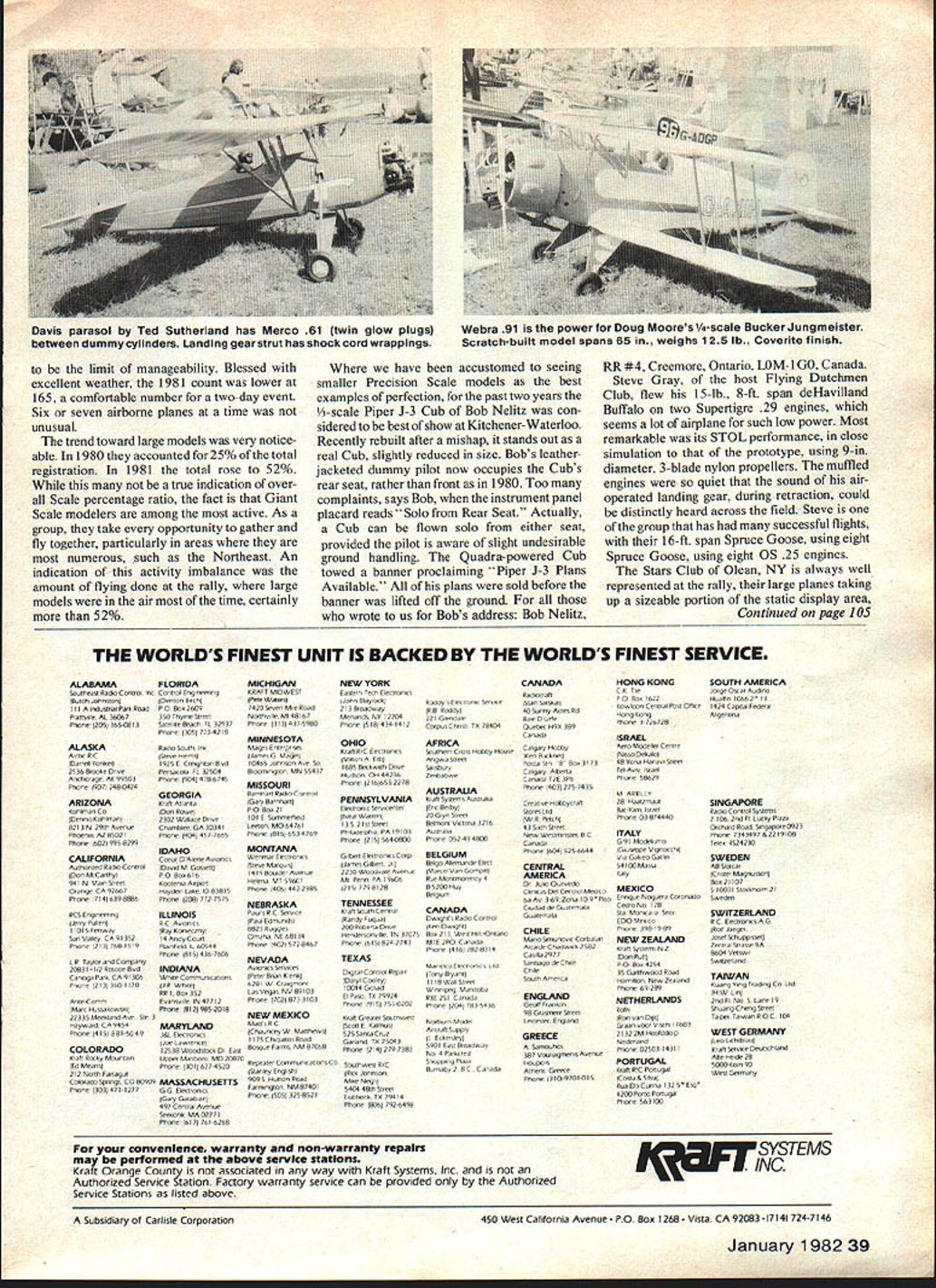
- Steve Gray (Flying Dutchmen Club) — Flew an 8 ft span, 15 lb de Havilland Buffalo powered by two Super Tigre .29 engines. Despite modest power it demonstrated remarkable STOL performance closely simulating the prototype, using 9 in diameter, 3-blade nylon propellers. The muffled engines were very quiet; the air-operated landing gear retraction could be heard across the field. Steve’s group has also achieved many flights with a 16 ft span “Spruce Goose” model powered by eight OS .25 engines.
- Stars Club of Olean, N.Y. — Well represented at the rally; their large planes occupied a sizeable portion of the static display area. Their dedication and workmanship were notable.
- Bob Dunn — Displayed a 1/5-scale Curtiss A-3 Falcon (numerous flights) and a Boeing P-26 Peashooter.
- Other large models — The meet included two 1/4-scale Curtiss Hawk P-6E models and two 1/4-scale Miles Hawks.
- Jack Swift — One of the few Precision Scale entrants at the rally. Jack, a Canadian team member in the last two Scale World Championships and slated to represent Canada again in 1982, displayed a scratch-built Zlin 526AS (7 ft span) powered by a Fisher Redshift .60 engine. Jack is among a growing number of builders using homemade retract mechanisms that provide scale-like operation, reasonably slow retraction times, and the strength required for heavier models.
#### Club field and facilities
- Location: Flying Dutchmen club field, Kiwanis Park — a large mowed area with a triangle of three paved runways.
- Operations: Club members manage frequency control and monitor take-offs and landings to avoid interference. A meet of this size requires constant supervision to run smoothly.
- Amenities: An adjacent campground a few yards from the flying field is popular and usually well filled. A Saturday night bonfire in the campground is a favored place to swap stories and enjoy a communal meal.
Forming fillets
The method for producing fillets depends on size and the desired finish. Below are workable techniques and tips.
#### Very small fillets
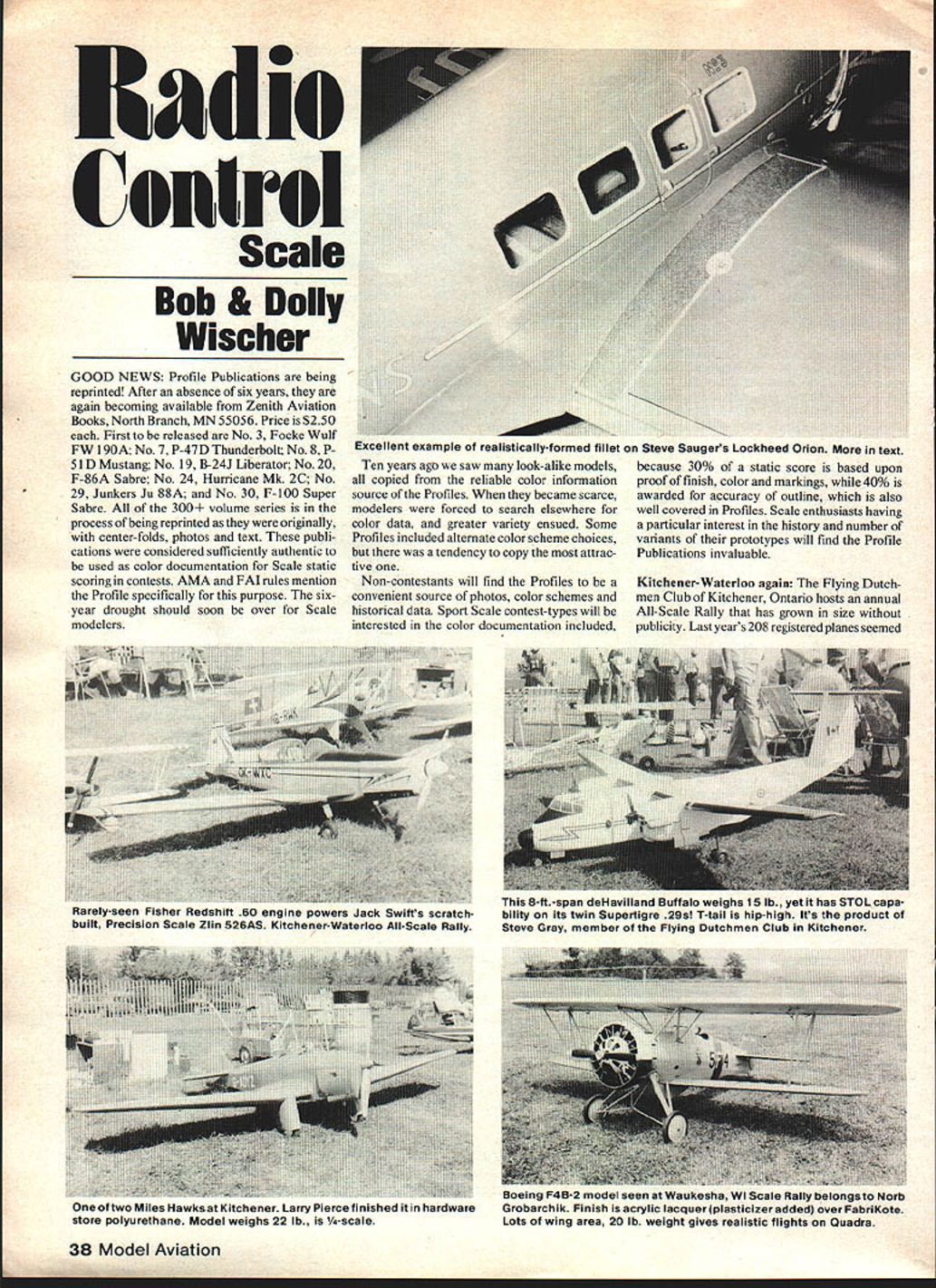
- Vinyl spackling compound (from a hardware or paint store) is simple and easy to apply. Use an artist’s paint-mixing spatula or a small rounded-tip knife. Apply heavily, shape while wet (you can smooth with a rounded object or a finger, using water to soften the surface), then allow to dry and sand lightly. Because balsa absorbs moisture, expect some shrinkage and possibly a second application. Spackling sands easily but its edges are soft; avoid making very thick edges or they may crumble.
#### Small to medium fillets
- Sig Epoxolite: Apply and shape while still pliable; it is difficult to work after curing. Sand after full cure to blend into adjacent surfaces. When sanding is expected, outline the fillet edges with masking tape to protect adjacent balsa; sand to the tape edge and remove the tape for a sharp boundary. For thicker edges, use multiple layers of tape.
- Polyester finishing resin (K&B or Sig) thickened with microballoons can also be used in the same manner.
#### Large fillets (wing–fuselage or separation joints)
- Plywood base method:
- Make two paper patterns of the area to be covered — one shaped to the wing and one to the fuselage. Fit them by a cut-and-try method.
- Duplicate the patterns in 1/64 in plywood.
- If the fillet belongs to the wing (separation between fillet and fuselage), permanently cement the plywood to the wing. Tack-glue the fuselage plywood shape in a few spots so it can be removed later.
- Fit small soft balsa blocks with grain running chord-wise, beginning at the leading edge, so each block covers the plywood edge. Carve and sand the balsa to the concave fillet shape; leave the plywood edges visible for a sharp outline.
- Cut the tack-glued spots through with a razor blade so the fuselage detaches. When reassembled, the fuselage fits snugly into the permanently shaped plywood saddle (or vice versa).
This method yields very prototype-like fillets; ply edges give a definite outline and can be sanded thin if desired.
- Foam alternative: Use styrene foam over the plywood base instead of balsa blocks. Shape the foam and then give it a hard surface with epoxy and glass cloth.
#### Light-weight and quick methods
- Use balsa formers with short sections of soft sheet balsa, or start with blocks at the leading edge and transition to sheet as the fillet widens. Preform balsa sheet by soaking in water or household ammonia and wrapping around a cylinder until dry; it will retain the curve with little spring-back.
- Cyanoacrylate (CA) with wet balsa: CA cures quickly and can be used with wet balsa to hold shapes in place on the model. Expect some shrinkage as the balsa dries; gaps may need filling later.
#### Off-model fillets and finishing
- Build small fillets directly on the model with polyester resin and glass cloth. Protect the balsa with Saran Wrap so the hardened fillet can be lifted off as one piece. Several layers may be needed for rigidity. Sand and trim edges to exact shape. The advantage is you can finish the model and add fillets in final assembly, a technique used in full-size custom aircraft when unique fillet shapes are required.
General tips:
- Allow plenty of time for curing before final sanding and finishing.
- When sanding near balsa, use minimal pressure to avoid removing adjacent material.
- Masking tape is a useful protective aid when shaping and sanding fillet edges.
Transcribed from original scans by AI. Minor OCR errors may remain.

