
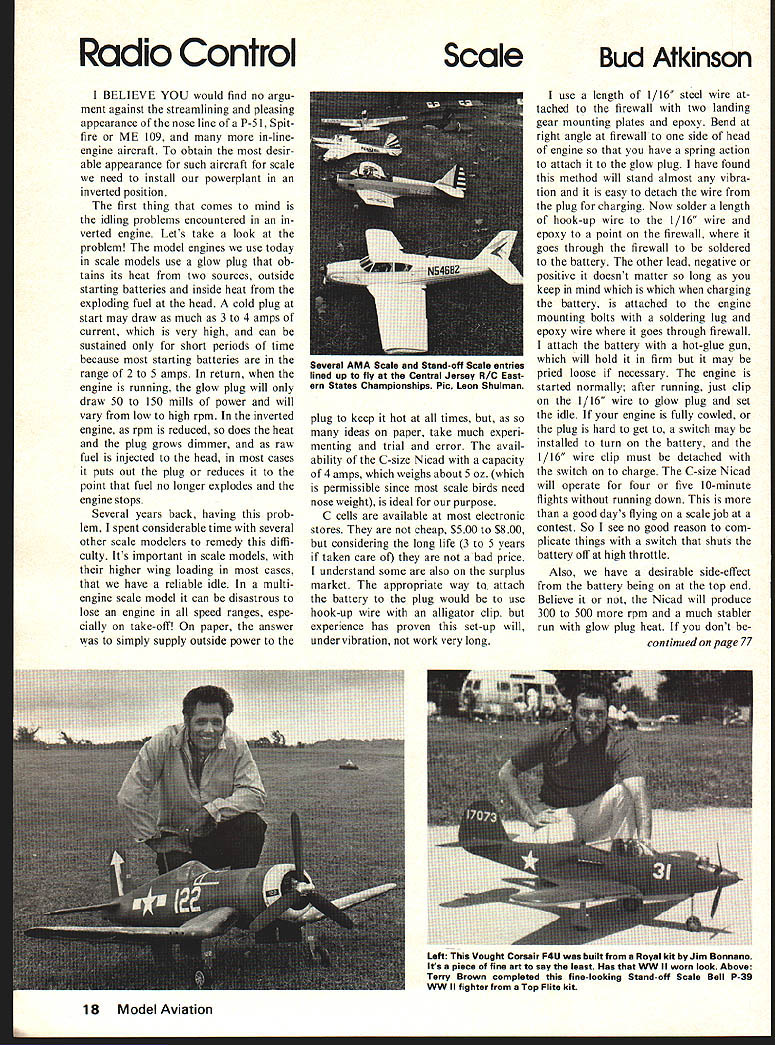
Radio Control: Scale
I believe you would find no argument against the streamlining and pleasing appearance of the nose line of a P-51, Spitfire or ME 109, and many more in-line-engine aircraft. To obtain the most desirable appearance for such aircraft for scale we need to install our powerplant in an inverted position.
The first thing that comes to mind is the idling problems encountered in an inverted engine. Let's take a look at the problem! The model engines we use today in scale models use a glow plug that obtains its heat from two sources, outside starting batteries and inside heat from the exploding fuel at the head. A cold plug at start may draw as much as 3 to 4 amps of current, which is very high, and can be sustained only for short periods of time because most starting batteries are in the range of 2 to 5 amps. In return, when the engine is running, the glow plug will only draw 50 to 150 milliamps of power and will vary from low to high rpm. In the inverted engine, as rpm is reduced, so does the heat and the plug grows dimmer, and as raw fuel is injected to the head, in most cases it puts out the plug or reduces it to the point that fuel no longer explodes and the engine stops.
Several years back, having this problem, I spent considerable time with several other scale modelers to remedy this difficulty. It's important in scale models, with their higher wing loading in most cases, that we have a reliable idle. In a multi-engine scale model it can be disastrous to lose an engine in all speed ranges, especially on take-off! On paper, the answer was to simply supply outside power to the plug to keep it hot at all times, but, as so many ideas on paper, take much experimenting and trial and error. The availability of the C-size Nicad with a capacity of 4 amps, which weighs about 5 oz. (which is permissible since most scale birds need nose weight), is ideal for our purpose.
C cells are available at most electronic stores. They are not cheap, $5.00 to $8.00, but considering the long life (3 to 5 years if taken care of) they are not a bad price. I understand some are also on the surplus market. The appropriate way to attach the battery to the plug would be to use hook-up wire with an alligator clip. In my experience this set-up will, under vibration, not work very long.
I use a length of 1/16" steel wire attached to the firewall with two landing gear mounting plates and epoxy. Bend at right angle at firewall to one side of the head of engine so that you have a spring action to attach it to the glow plug. I have found this method will stand almost any vibration and it is easy to detach the wire from the plug for charging. Now solder a length of hook-up wire to the 1/16" wire and epoxy to a point on the firewall, where it goes through the firewall to be soldered to the battery. The other lead, negative or positive, it doesn't matter so long as you keep in mind which is which when charging the battery, is attached to the engine mounting bolts with a soldering lug and epoxy where it goes through firewall. I attach the battery with a hot-glue gun, which will hold it in firm but it may be pried loose if necessary. The engine is started normally; after running, just clip on the 1/16" wire to the glow plug and set the idle. If your engine is fully cowled, or the plug is hard to get to, a switch may be installed to turn on the battery, and the 1/16" wire clip must be detached with the switch on to charge. The C-size Nicad will operate for four or five 10-minute flights without running down. This is more than a good day's flying on a scale job at a contest. So I see no good reason to complicate things with a switch that cuts the battery off at high throttle.
Also, we have a desirable side-effect from the battery being on at the top end. Believe it or not, the Nicad will produce 300 to 500 more rpm and a much stabler run with glow plug heat. Believe me, just run up your engine to top end and then attach your starting battery. Even without a tack, you can hear your engine pick up rpm; also, the rpm at the low end will be higher so a throttle adjustment will be necessary. You will notice a much smoother response to throttle with the battery attached. With a good strong battery and an engine rather hard to get a starter battery to, you may, by throwing a switch, start your engine with the in-flight C cell. I did this many times on my T-34. It was something to see the surprised look on the flight judge's face to see the engine bark off with seemingly no battery attached! But remember, the plug draws up to 4 amps when cold, so have your engine preprimed and ready to go, and preferably started with an electric starter. Always remember to disconnect the clip as soon after landing as possible with the engine running to preserve your battery. This method is well worth the trouble to install in your scale model and practically a must to assure a good reliable idle on an inverted engine or engines.
The name of Sid Morgan goes back many years in RC scale. He is noted for his excellent large scale planes—and I mean large! How about a 9-ft. Cub and a 9-ft. PBY Catalina? Sid also has many hi-impact plastic cowlings and wheel pants for many scale models, as well as plastic canopies. So if you like your scale models big, as well as normal size, drop Sid a card and ask for his catalog of many fine plans. Write to Vintage RC Plans by Sid Morgan, 13157 Ormond Drive, Belleville, Mich. 48111.
Another very interesting item for scale or RC models is a neat little antenna connector very professionally made in which you may install your antenna inside of your model and still be able to disconnect the antenna safely. It consists of a gold-plated connector that is very small and easy to connect and disconnect; with this item you can completely hide your antenna in your scale model with complete safety. If your local hobby shop doesn't have them, drop a line to Sukarta Hobrines, 51 Hawthorne Ave., Park Ridge, N.J. 07656 and ask for their "Shore It" antenna connector for only $1.29.
Keep me posted on your 1976 scale contests and I will see to it your meet is listed in the column. Till next time, "Let's build more scale."
(My address is 734 N. 6th St., Terrace, Blue Springs, Mo. 64015.)
Transcribed from original scans by AI. Minor OCR errors may remain.

