
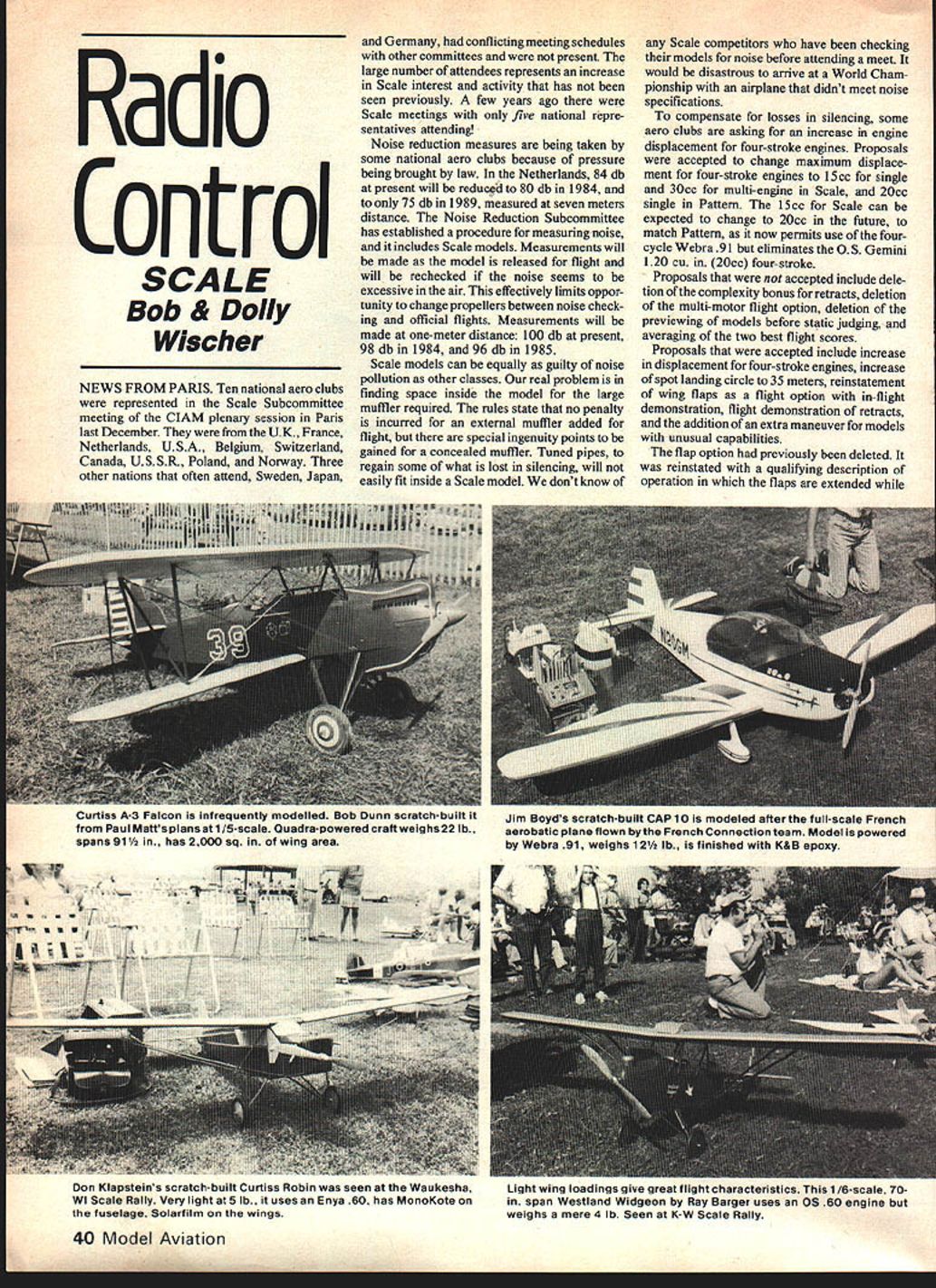



Radio Control: Scale
Bob & Dolly Wischer
CIAM Scale Subcommittee meeting — Paris
News from Paris. Ten national aero clubs were represented at the Scale Subcommittee meeting of the CIAM plenary session in Paris last December: United Kingdom, France, Netherlands, U.S.A., Belgium, Switzerland, Canada, U.S.S.R., Poland, and Norway. Three other nations that often attend — Sweden, Japan, and Germany — were unable to be present because of conflicting meeting schedules with other committees. The large number of attendees represents an increase in Scale interest and activity not seen for a few years; a few years ago Scale meetings had only five national representatives attending.
Noise and measurement procedures
Noise-reduction measures are being taken by some national aero clubs because of legal pressure. For example, in the Netherlands the limit is 84 dB at present, to be reduced to 80 dB in 1984 and to 75 dB in 1989 (measured at seven meters). The Noise Reduction Subcommittee has established procedures for measuring noise that include Scale models. Measurements will be made with the model released for flight and rechecked if the noise seems excessive in the air. Airfield conditions will effectively limit the opportunity to change propellers between noise checking and official flights. Measurements will also be made at one-meter distance: 100 dB at present, 98 dB in 1984, and 96 dB in 1985.
Scale models can be as guilty of noise pollution as other classes. The real problem is finding space inside the model for the large muffler required. Rules state there is no penalty if an external muffler is added for flight, but special ingenuity points are awarded for a concealed muffler. Tuned pipes, which can help regain some performance lost to silencing, do not easily fit inside many Scale models. We do not know of Scale competitors routinely checking their models for noise before attending meets — it would be disastrous to arrive at a World Championship and find your airplane did not meet noise specifications.
Engine displacement for four-stroke engines
To compensate for performance losses due to silencing, some aero clubs requested increases in allowable engine displacement for four-stroke engines. Proposals accepted include changes in maximum displacement: for four-stroke engines, 15 cc single and 30 cc multi-engine in Scale, and 20 cc single in Pattern. The 15 cc limit for Scale can be expected to change to 20 cc in the future to match Pattern; the change affects which commercial four-cycle engines may be used.
Proposals — accepted and not accepted
Proposals not accepted:
- Deletion of the complexity bonus for retractable landing gear.
- Deletion of the multi-motor flight option.
- Deletion of previewing models before static judging.
- Averaging of the two best flight scores.
Proposals accepted:
- Increase in displacement for four-stroke engines (see above).
- Increase of the spot-landing circle to 35 meters.
- Reinstatement of the wing-flaps flight option with an in-flight demonstration requirement.
- Flight demonstration of retractable landing gear.
- Addition of an extra maneuver option for models with unusual capabilities.
Flaps demonstration — description and concerns
The flap option, previously deleted, was reinstated with a qualifying description of the required operation:
- The model approaches heading into the wind at a maximum height of 10 meters and, directly in front of the judges, extends the flaps.
- The model then flies a 360° circle and, when again directly in front of the judges, retracts the flaps.
- Judges will assess specified error conditions.
Specified error conditions include:
- Model approaches too high with flaps extended.
- Flaps retracted not in full view of the judges.
- Incorrect speed on extension or retraction.
- Model unstable with flaps extended.
- Speed not reduced before flaps are extended.
- No change in flight attitude when flaps are extended.
Comments and safety concerns:
- The flap-operation description clearly derives from full-scale practice, but simulating the operation for contest judging is different. Judges are not qualified to know the real extension/retraction speeds for every aircraft or model, whether manual, electric, or hydraulic; documentation of speed by the modeler would be difficult.
- Expected attitude changes during flap cycling will be hard to detect from a judge’s position.
- Extending flaps at low altitude increases drag and often requires additional throttle; suddenly applied engine torque can induce a snap roll if the model is near a stall. Demonstration will require considerable practice and, realistically, performance may need to occur higher than the 10-meter maximum to be safe and visible.
Landing gear retraction demonstration — description and concerns
The landing gear demonstration requires:
- The model approach into wind in straight and level flight at a height not exceeding 10 meters.
- At a point directly in front of the judges, the model extends the landing gear.
- The model executes a 360° turn away from the judges.
- When again directly in front of the judges, the model retracts the landing gear and climbs away in straight flight.
Specified error conditions include:
- Model approaches too high.
- Gear not extended and retracted in full view of the judges.
- Speed of operation incorrect.
- Action incorrect.
- Model speed not reduced before retraction.
Comments:
- Our comments regarding flaps apply equally to the landing-gear demonstration. After watching Bob Karlsson’s Grumman FM-2 Wildcat at last year’s Nats, with its 20-second retraction and extension times, we question the requirement that the action occur directly in front of the judges — some models will need more than one 360° turn to complete the sequence.
Spot landing circle changes
- The spot-landing circle has been increased from 25 m (82 ft) to 35 m (115 ft).
- The K-factor for landing within the circle remains K = 9.
- The K-factor for landing outside the circle changes from K = 4 to K = 6.
This change effectively de-emphasizes the spot circle as a landing feature. Pilots of full-size aircraft are not obligated to hit a precise spot on every landing; the circle has primarily been used in model competition to encourage competitors to land where judges can properly observe. In the past, attempts to hit the spot have frequently spoiled otherwise good landings.
Observations on model size and economics
Our annual trip to Paris provides an opportunity to exchange ideas about the direction of modeling in other nations. The notion that bigger is better, so prevalent in the U.S., is being seen differently abroad. Gasoline prices are high and rising, and cars are becoming smaller. Modelers in other countries are limiting model size to what will fit in their cars. Competition modelers, in particular, are concerned because models need to be transported longer distances to contests. We can expect resistance to any effort to establish rules favoring large airplanes or to increase weight and engine displacement: economics dictate model size. The average modeler doesn’t haul a large model in a motor-home.
We were once told by a World Champion that a serious modeler would spend whatever was necessary to be competitive. That concept runs contrary to our philosophy that anyone willing to develop skill in building and flying can be a potential winner regardless of his ability to spend. The economic pinch and high cost of transportation may lead to greater alignment between FAI rules and AMA rules.
Reno in 1982 — RC Scale World Championship (Aeroscale '82)
Reno Stead Airport (site of the Reno Air Races), about 10 miles north of Reno, will host the RC Scale World Championship — Aeroscale '82 — June 13–19, 1982, including F4C (Precision) and Stand-off Scale. The Control-Line Scale portion of the championship is scheduled for Kiev, U.S.S.R., August 24–31.
Interest shown:
- Sixteen national aero clubs have shown interest in sending teams for Stand-off class.
- Ten clubs have shown interest in F4C.
If all arrive with full teams, the total could be as many as 78 airplanes; realistically, turnout will likely be smaller (there were 35 planes at Ottawa in 1980).
Accommodations and fees:
- Contestants and supporters will be accommodated at Circus-Circus Hotel.
- Fees for supporters: $270 double occupancy or $320 single.
- Included: seven breakfasts, six lunches, six dinners, banquet, and lodging for seven nights.
U.S. team selections (expected):
- Stand-off Scale: Phil Sibille, Charlie Chambers, Cliff Tacie.
- F4C (Precision): Steve Sauger, George Rose, Bob Wischer.
- Contest Director: Monty Groves, assisted by Pat Groves.
- Chief judge: Johnny Carroll (Ireland).
Judging from Paris meeting enthusiasm, this promises to be a very successful World Championship.
Future of RC Scale — F4C, Stand-off, Sport Scale, and Precision
Scale flying has undergone the same transition seen in Sport Scale: models have become more complex and sophisticated, with more external detail, dummy engines, and complete cockpits. At standard viewing distances (15 ft for AMA, 11 ft for FAI) the detail is visible and can influence judges despite rules. Upgrading was inevitable from the event’s inception, and the contest has lost some of the simplicity that made it popular.
We have reached the point where Sport and Precision models almost look alike. Under AMA rules the difference is primarily in the flight schedule; under FAI rules the difference disappears because both F4C and Stand-off use identical flight procedures. This raises the question: why maintain two events?
French innovation: in France, a blending approach is used. Models are static-judged from a distance, then given a quick close inspection for scale detail. The value placed on detail is minimal in scoring. A similar blend of F4C and Stand-off under FAI rules may or may not happen; if it does, team selection becomes problematic. Our teams would be disadvantaged if selected under AMA rules rather than FAI rules.
Current participation concerns:
- Diminished interest in Precision Scale: at the Nats there were only four entries from which to select a team of three.
- The expected influx of Sport Scale modelers into Precision did not occur.
- If modelers can be given credit for detail and special technical features (even if of minimal value in scoring), they may be encouraged to produce higher-quality models. Upgrading of Sport Scale could continue at a pace comparable to other countries if static scoring rewarded close-up detail.
Conclusion: Precision Scale may not inevitably die, but it may need to be maintained as a team-selection tool if the FAI blends classes — as insurance that U.S. models meet championship quality. At the Ottawa World Championship, Precision entries outnumbered Stand-off; it will be interesting to see the class ratios at Reno. The future of Precision Scale may be determined there.
Bob and Dolly Wischer Rt. 1, S-221 Lapham Peak Road, Delafield, WI 53018.
Transcribed from original scans by AI. Minor OCR errors may remain.

