
Radio Control: Scale
Bob & Dolly Wischer
Aeroscale '82 at Reno
Where would you go to see the world's greatest collection of RC scale models in operation? Go to Reno, NV, June 13–19 for the Seventh Radio Control Scale World Championships and Stand-off Scale International Competition. Supporters are welcome, and a very attractive package has been arranged. The fee is $270 per person (double occupancy) or $320 single. It includes site pass, program book, pin, patch, banquet ticket, seven nights' lodging at Circus-Circus Hotel, plus seven breakfasts, six lunches, and five dinners. Extra nights at the hotel are $35.00, single or double. There are unlimited possibilities for entertainment near Reno.
Static judging begins on Monday, June 14, with Stand-off Scale flights on Tuesday and Wednesday while the F4C models are being judged. Stand-off awards will be made at the field after the final flights. F4C Precision Scale models will be flown on Thursday and Friday, continuing into Saturday if required, with awards in the afternoon. The banquet, a Western-style barbecue, is planned at the field on Saturday evening.
The flying site is at Reno-Stead Airport, 10 miles north of the hotel. Models will be displayed and judged in the hangar used by racing planes during the famous Reno Air Races in September. The airport will remain active during the competition. Members of the Northern California Antique Airplane Association are planning to fly their antique and experimental home-built aircraft into Stead on Saturday morning, June 19, weather permitting. They will make their planes available for photo sessions.
Past World Championship highlights
World Championships bring out the best in scale modeling that each national group has to offer. Those who have attended five or six previous meets say the excitement of seeing world-class airplanes fresh from the experience is hard to describe. Some champion aircraft from past events give an idea of what Reno visitors can expect.
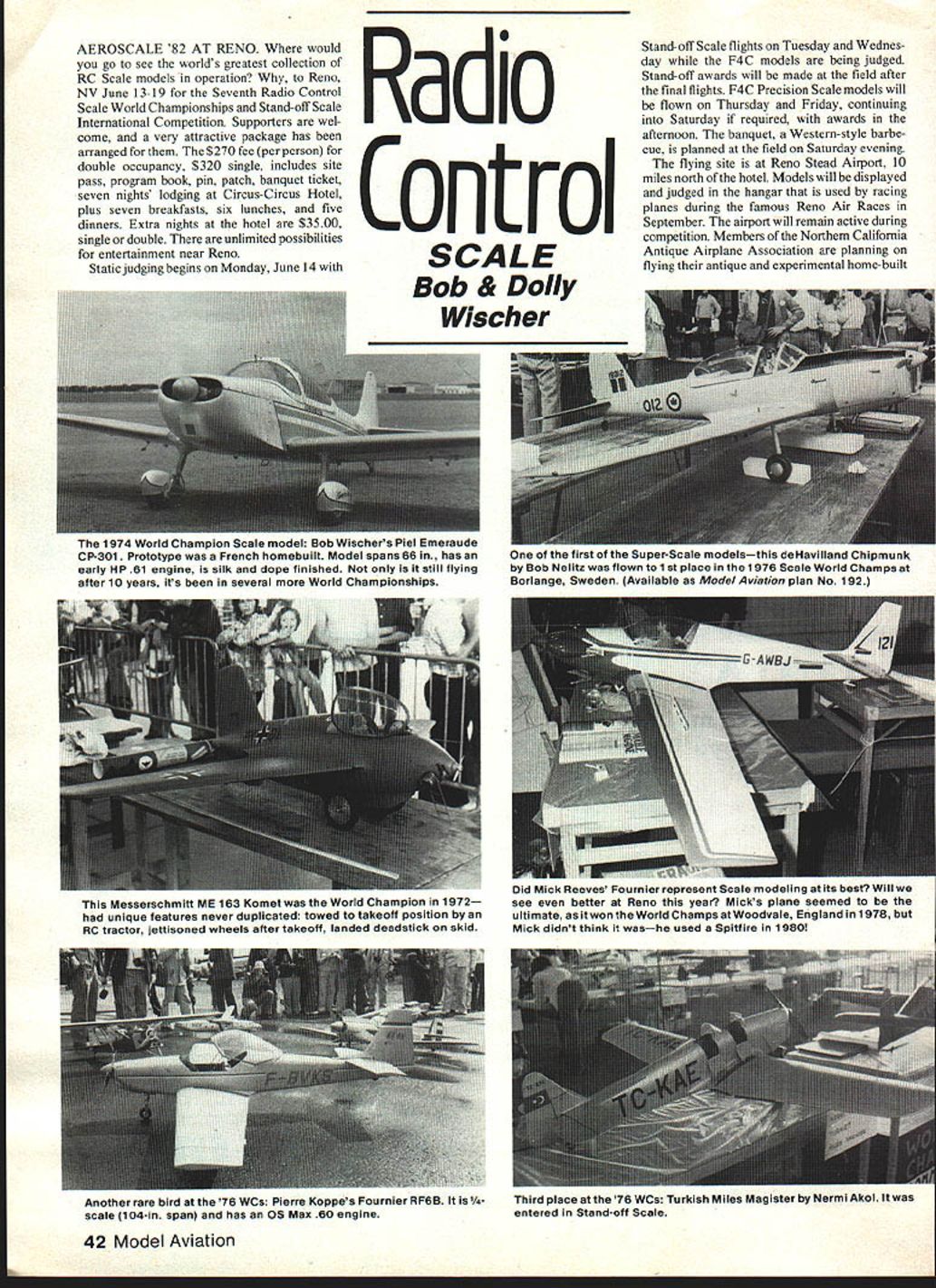
- 1970: The classic home-built Jurco Sirocco, built by England's Mick Charles, took top honors, followed by Maxey Hester's famous Ryan ST from Toulouse, France.
- 1972: Heinz Simons won first place with his Messerschmitt Me 163 Komet. It had unique features never duplicated: towed to takeoff position by an RC tractor, jettisoned wheels after takeoff, and landed deadstick on a skid. The prototype's flight speed equaled the fastest pattern planes of the day. The Komet's slightly swept wing had no stabilizer; its CG position had to be exactly right because there was no evidence of instability. Second place was won by Terry Melleney with a de Havilland Moth Minor, a sharp contrast in type and presentation.
- Stand-off Scale has also featured unusual subjects, such as a Saab MFI 9B that taxied and took off under control for Sweden's John Lyrsell.
- 1976: The Komet and Moth flew at a much slower pace than in earlier years, showing the evolution toward very close scale speed. Even experienced modelers like the Wischers didn't make the team by those newer standards; Terry's Moth would have placed in previous years but a last-minute accident affected high static and flight scores.
- 1976 Stand-off Scale (Sweden): Military aerobatic planes swept the top three places. Fred Coulson of England won with a Curtiss Hawk P-36A. A Bücker Bestmann entry from Sweden placed Kjell-Åke Elofsson second, and Nermi Akol (competing for Turkey but residing in Sweden) placed third with a Miles Magister. This marked the first time Stand-off Scale had been flown as an international competition.
- 1978 (Woodvale, England): Notable for rain, mud, and cold winds off the Irish Sea. Mick Reeves' Fournier RF4 won with exceptional static scoring and flying; his model had extraordinary detail (operational cockpit instruments, a pilot figure carved to resemble the builder, real clipped hair for the pilot, and a radio-connected headphone). Bob Underwood's Hyperbipe took second, Jean Rousseau's CAP-20 (France) placed third.
- 1978 Stand-off: Fred Coulson won again, this time with a Republic P-47 Thunderbolt; biplanes remained competitive (Graham Smith's Pomilio PE-2 bomber placed second).
- 1980 (Ottawa, Canada): Jean Rousseau returned with a CAP-20 that earned the highest static score and won on his final flight by a narrow margin. George Rose's exquisite Curtiss Hawk P-6E took second and had been awarded best-of-show at Toledo the previous year. Ottawa was a turning point for Stand-off Scale—Sweden's team arrived with well-practiced, finely detailed models having light wing loadings that permitted true scale flight speeds with precise throttle control. Lars Helmbro won flying a North American AT-6, followed by Mikael Carlsson with a Pfalz D.XII.
If this brief description of planes, pilots, and flights sounds interesting enough to induce a visit to Reno in June, keep in mind that reservations for the supporter package (described above) have a May 15 deadline.
Reservations
To make room reservations before May 15, write to: Academy of Model Aeronautics Attention: Micheline Madison 815 15th St., N.W. Washington, D.C. 20005
Phone: (202) 347-2751
Or fill in the reservation application on page 37 of the April issue of Model Aviation (page 53 of the May issue).
Servo extension cords — letter from Art Johnson
In our September 1981 column we mentioned the effects resulting from multiple servos and long extension cords used in larger models. A letter from Art Johnson—who flew the Curtiss P-40 and North American F-82 Twin Mustang in last year's Nats—relates similar problems:
- Art checked servo current drain in his F-82 and was horrified to find the meter pegged at its maximum of 1.2 amperes when he worked the controls. He was using a 1,000 mAh Kraft battery pack, but the battery was in one fuselage and the receiver in the other for balance. The Kraft extension wire was too light to carry the load without a large voltage drop to the nine servos. Making up a larger-diameter wire cable to the pack solved the problem and eliminated glitches.
- Art also reported a mechanical failure on his P-40: on the last flight an engine stopped because it kicked and sheared the Woodruff key lengthwise. That key drives the prop thrust washer from the shaft. He now uses a sandpaper washer between the spinner backplate and the thrust washer, which allows a little "give" but still keeps the prop from spinning loose. So far it has worked OK.
Many thanks to Art for reminding us of what happens when a backfire occurs while using a heavy prop and spinner. We have used an emery cloth disc between the thrust washer and our aluminum shaft extensions to avoid the nuisance of the prop spinning off while using the electric starter. The grit side of the emery is used against the smooth-surfaced shaft extension; a second emery disc is used between prop and extension. These discs are necessary when we cannot knurl the faces of our homemade shaft extensions. Anyone who has had the prop spin off while starting an engine at a contest will know the value of Art's suggestion (time spent replacing prop and spinner is deducted from your flight time). Spinners with smooth metal backplates need the abrasive discs.
Bob and Dolly Wischer Rt. 1, S-221 Lapham Peak Road Delafield, WI 53018
RC Old-Timers/Mathews
Berkeley Courier Sportster and Snow White
The Berkeley Courier Sportster was considered for kitting as a larger design, but with the advent of new limited-engine-run events and declining interest in large models, that idea was not pursued. The Berkeley Courier Sportster was developed and kitted as a smaller, less complex model. Bill described it as a "dog" in looks with an uncomplicated fuselage. It flew pretty well, but sales were disappointing, and the kit was dropped after a few years.
We chose to feature the Snow White this month as another example of the non-competition-type Old-Timer. It would be delightful to build and fly in the original 90-inch size, but it wouldn't have a prayer in competition with a Dallaire or similar contest ships. The 3/4-scale version should give many of us an opportunity to build and fly a Snow White after waiting all these years.
Berkeley Cavalier — 45 years and still flying
Responses to our two columns on the Berkeley Cavalier series were unexpected and gratifying. Mel Mattson of Antioch, CA, sent photos of his Cavalier built from the first-run kits of the 1936 version.
Built in San Diego and first flown at Camp Kearny Mesa on February 21, 1937, Mel's Cavalier is now 45 years old and still flying! Mel reports it has taken color slides and movies, dropped soft drinks, beer, and champagne, and even towed 300-foot banners.
The plane was in the fleet of the Night Hawks, the first model club in San Diego. Other members of that club included Bob Holland (the engine man and several-times National Champ) and Elbert "Joe" Weathers (Wescorner, Mystery Man, Tubby, etc.). Mel says he still has his IGMA pin (International Gas Modelers Assoc. of America), a predecessor of the AMA.
Several modifications have been made over the years, but the basic shell remains Cavalier. While 45 years of continuous service may not be the record for model aircraft longevity, Mel Mattson's Cavalier certainly belongs among the longest-serving models.
International Old-Timer interest
An excellent model magazine is being printed in Australia called Airborne (no "u" in the title). Its pages include a monthly column titled "For Old-Timers."
Transcribed from original scans by AI. Minor OCR errors may remain.

