
Radio Control SCALE
Bob & Dolly Wischer
Toledo
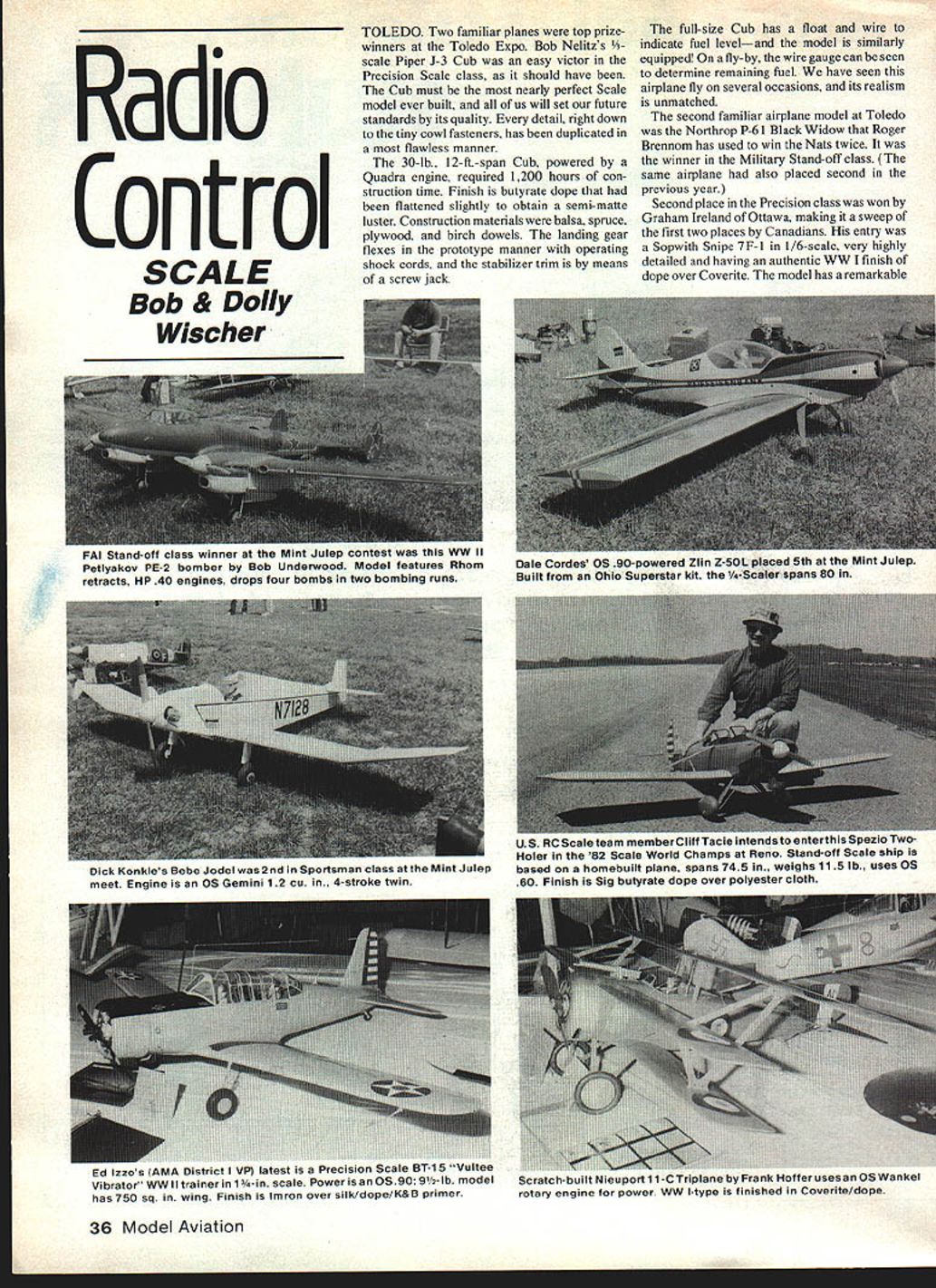
Two familiar planes were top prizewinners at the Toledo Expo. Bob Nelitz's 1/2-scale Piper J-3 Cub was an easy victor in the Precision Scale class, as it should have been. The Cub must be the most nearly perfect scale model ever built, and all of us will set our future standards by its quality. Every detail, right down to the tiny cowl fasteners, has been duplicated in a most flawless manner.
The 30-lb., 12-ft span Cub, powered by a Quadra engine, required 1,200 hours of construction time. Finish is butyrate dope that had been flattened slightly to obtain a semi-matte luster. Construction materials were balsa, spruce, plywood, and birch dowels. The landing gear flexes in the prototype manner with operating shock cords, and the stabilizer trim is by means of a screw jack.
The full-size Cub has a float and wire to indicate fuel level — and the model is similarly equipped. On a fly-by, the wire gauge can be seen to determine remaining fuel. We have seen this airplane fly on several occasions, and its realism is unmatched.
The second familiar airplane model at Toledo was the Northrop P-61 Black Widow that Roger Brennom has used to win the Nats twice. It was the winner in the Military Stand-off class. (The same airplane had also placed second in the previous year.)
Other top finishers in Precision Scale included:
- 2nd place: Graham Ireland of Ottawa, Sopwith Snipe 7F-1 in 1/6-scale — very highly detailed with an authentic WW I finish of dope over Coverite. The model features a remarkable dummy rotary engine that was scratch-built. The plane had been flown and damaged, but there was no visible evidence of repairs.
- 3rd place: Vito Tomeo, Focke Wulf FW 190A-8.
An important point is that the four airplanes previously described had all been flown. Toledo visitors are often heard to lament that winners are non-flying-type planes, and there is a sense of injustice in awarding prizes to radio-control models whose controls merely move surfaces rather than air. The unflyable types seem to be nearing extinction at Toledo, although there are occasional lapses where a top prize goes to a plane with a very un-scale-like gloss finish, on a tiny model that weighs over 11 lb. It isn't easy for judges to draw the line and determine which are flyable.
Toledo brings out the truly unusual in modeling. One of these was Frank Hoffer's 2-in-scale, scratch-built Nieuport 11-C Triplane. It was probably the original staggerwing airplane, as it has its top wing aft of the other two by a considerable amount. A Wankel engine powered the 11-C, which originated in Model Airplane News three-view drawings and Cleveland drawings.
About 25 years ago, Ed Izzo introduced foam wing construction for Pattern planes with a demonstration of foam cutting at Toledo. Ed has also been flying Sport Scale models, and this year he entered the Toledo competition with a Precision Scale plane, a Vultee BT-15, which he modeled after a restored airplane that was conveniently close at hand for documentation. The model is completely detailed, including cockpits. Ed demonstrated his flap operation, which is tied to a hand crank in the cockpit, with the pilot's hand and arm going round and round. Seats are adjustable as on the prototype. Construction is silk and dope over balsa with talc and dope filler. K&B primer was followed by application of many thousands of rivets, finished with Imron paint.
Mint Julep Scale Meet
Hosted by the Kentucky Department of Parks and the Southern Indiana RC Modelers, the Tenth Annual Mint Julep Scale Meet was one of the largest in the club's history. Shortened by rain on Sunday afternoon, most contestants were able to fly all four rounds in each of seven classes. To help prepare the FAI team for the upcoming World Championships at Reno, there were divisions for FAI Stand-off and F4C classes.
As would be expected in an early-season meet, a swarm of new airplanes appeared along with some that had been on the contest circuit for more than 10 years. One of Underwood's latest Hiperbipe for Sport Scale weighed 2 lb. less than his older Precision Scale model, and the difference was evident in its flight. Both planes now use HP .61 engines. Both Hiperbipes placed second in their divisions, while Bob's campaign favorite, the Petlyakov PE-2 WW II bomber, was again a winner, this time in the FAI Stand-off Scale class, where its retractable landing gear and twin engines gave it a 20% bonus.
Notable winners and entries at Mint Julep included:
- Giant Scale: Bud Atkinson, de Havilland Chipmunk.
- Expert Division One: Hal Parent, Bell P-39 Airacobra. His Grumman F8F Bearcat finished third in the FAI Stand-off class. Hal is an alternate for the Reno FAI team.
- FAI Stand-off: Phil Sillibe (Reno team), Spitfire — 2nd place.
- Expert Division Two: Don Srull, Royal Aircraft Factory BE-2 — winner.
- Sportsman Division One: Doral Drew, Percival Mew Gull (OS 90-powered) — built from three-views published in Model Aviation (February 1981) — winner in Sportsman class.
Other unusual scratch-built airplanes dominated the scene at the Mint Julep:
- Dick Konkle flew a Bebe Jodel to second place; its four-stroke OS Gemini 1.20 was almost inaudible. His second airplane, a 5/8-scale Emeraude with Quadra power, was almost the Jodel's equal.
- Bill Kleinhans flew an Aeronca C-3, modified from a Balsa U.S.A. kit, powered by an OS .60 four-stroke.
- Bill Kinsey's Dornier Do 335 push-pull fighter had two OS .60 engines with the rear unit water-cooled. The radiator was located at the front with long tubes carrying coolant to the rear engine, which was mounted just behind the rear cockpit. He found the three-view drawings at the National Air and Space Museum in Washington, D.C.
- Cliff Tacie (Reno team member) brought a new Spezio Two-Holer to the Mint Julep for team practice. The Spezio's first flights went well except for a minor elevator trim adjustment. The model has abundant wing area and light weight — attributes useful at Reno's 5,000-ft-high Stead Airport. Although intended to compete in the Stand-off Scale class, it is detailed enough for FAI F4C (Precision) competition. Cliff has access to the prototype and ample documentation material. All servos are mounted in the wing trailing edge so they are not visible in the large, open cockpits.
- Larry Scott presented a white and red Waco Taperwing CPO in Giant Scale, modeled as a copy of the air-show Waco used by Bob Lyjak, including an elaborate Polish eagle painted on the upper wing center section. Larry used a Kawasaki 31.5 cu. in. engine for aerobatic capability in the 28-lb. Waco.
- Steve Gray (from Canada) brought a twin-engined de Havilland Buffalo troop transport. Using drawings obtained from de Havilland of Canada, Steve powered the model with a pair of OS .40 engines to give STOL performance similar to the prototype.
The Mint Julep Meet is convincing evidence that there is no lack of interest in scale activity, either in quality or quantity. The Southern Indiana RC Modelers are to be commended for the effort spent on a meet with seven classes, providing trophies and prizes down to fifth place. The location at Rough River State Park (with its paved runway, the lake, lodge, and cottages) made it an ideal springtime destination for winter-weary modelers. Some attendees from the far North had not yet had practice flights by Mint Julep time.
Bob and Dolly Wischer Rt. 1, S-221 Lapham Peak Rd., Delafield, WI 53018.
Transcribed from original scans by AI. Minor OCR errors may remain.

