
Radio Control: Scale
Bob & Dolly Wischer
Kitchener-Waterloo All-Scale Rally
The Kitchener-Waterloo All-Scale Rally at the Flying Dutchmen Club drew 163 registered airplanes. Attendance was lower than in previous years, but model parking was again completely filled. More than 80% of the models were in the Giant Scale class, a percentage that has been increasing rapidly. Kit manufacturers report that small-scale models remain the mainstay of their business, but Giant Scale dominates rallies. Many small models were likely present but kept in modelers' cars because they are visually overshadowed when the two classes meet. Giant Scalers are attracted to rallies and few attend contests—only six Giants appeared at the Lincoln Nats, but those were contest-quality airplanes compared with most seen at rallies.
Howard Hughes Spruce Goose (flying boat)
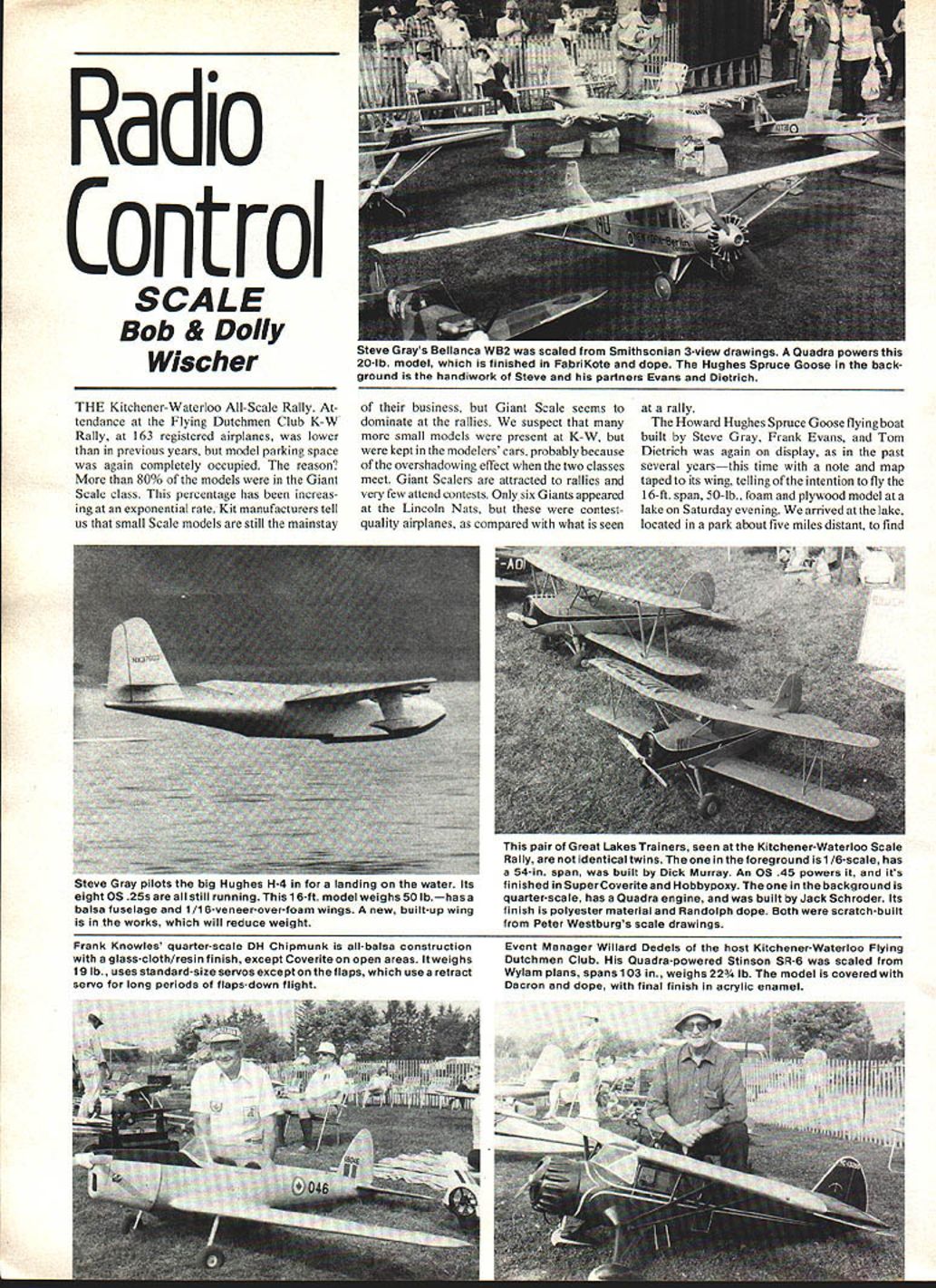
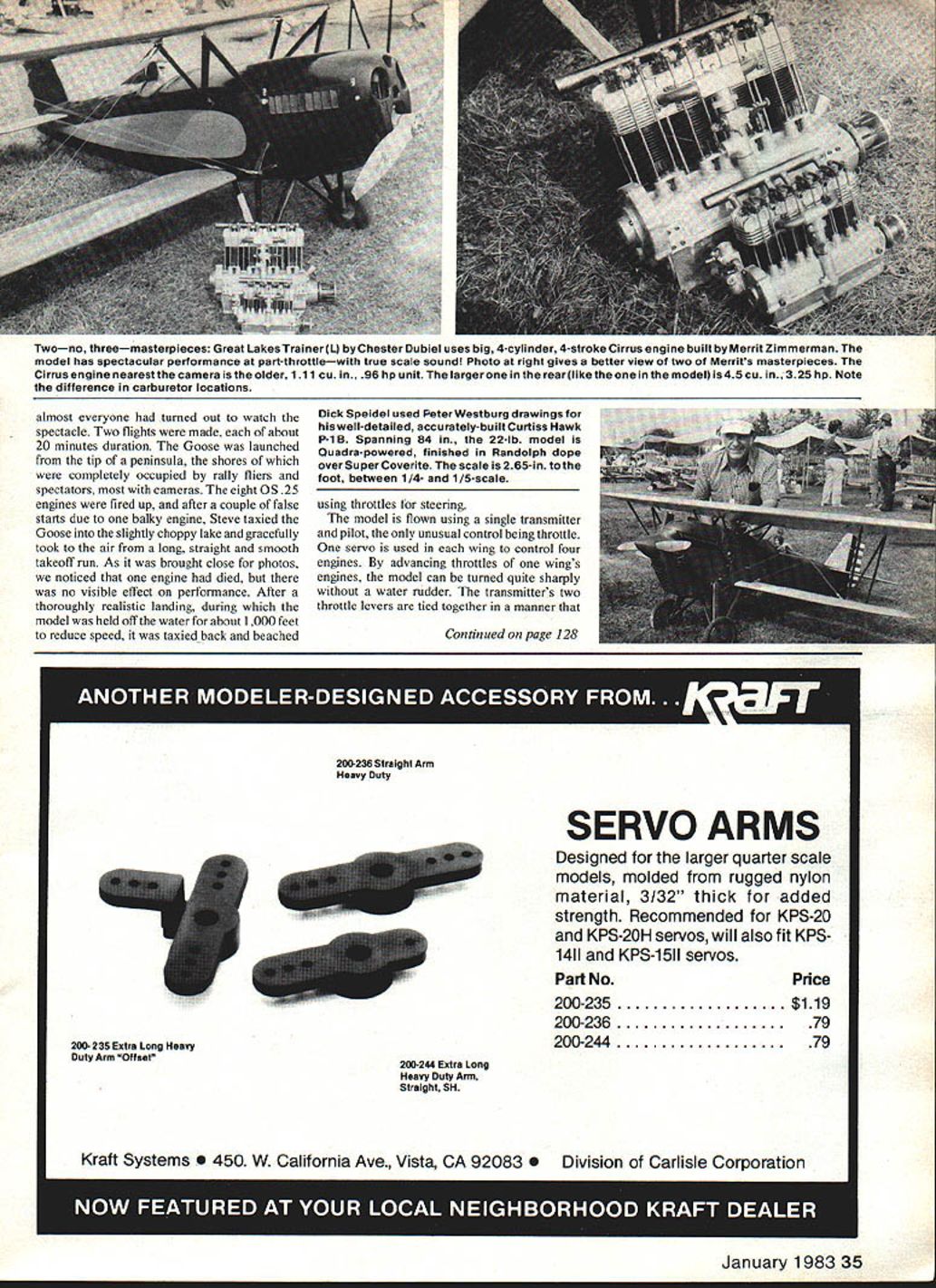
The Howard Hughes "Spruce Goose" flying boat, built by Steve Gray, Frank Evans, and Tom Dietrich, was on display as in past years. This 16-ft span, 50-lb foam-and-plywood model has a balsa fuselage and 1/16-inch veneer-over-foam wings; a new built-up wing is in the works to reduce weight. It is powered by eight OS .25 engines.
Two flights of about 20 minutes each were made. The Goose launched from the tip of a peninsula with shores lined by rally fliers, spectators, and cameras. After a couple of false starts due to balky engines, Steve taxied the Goose across the slightly choppy lake and made a long, smooth takeoff. One engine died during a close photo pass with no visible effect on performance. After a realistic landing, the model held off the water about 1,000 feet to reduce speed, then taxied back and was beached. Steve later demonstrated climb performance, rising from a cruising altitude of 100 feet to about 400 feet in less than a minute. There is considerable spray during takeoff and landing, but the engines are high above the water and unaffected.
Using throttles for steering (on the Goose)
The Goose was flown using a single transmitter and pilot. The only unusual control was throttle: one servo in each wing controlled four engines. By advancing throttles on one wing, the model could be turned sharply without a water rudder. The transmitter's two throttle levers were tied together so either could be moved independently or both together.
Steve's participation was worth the 1,200-mile round trip to K-W; the enthusiastic crowd saw and heard many flights.
Other large seaplanes and floatplanes
- Rudi Mayer (Flying Dutchmen Club) flew a 1/6-scale clipped-wing Piper Cub on floats. Powered by a Webra .91 and swinging a large prop, it showed outstanding STOL performance with very short takeoff and landing runs.
- Steve Gray also flew a Bellanca WB-2 Skyrocket built from Smithsonian three-view drawings.
- Dick Speidel's venerable Fairchild FC-2 and Steve Gray's Bellanca, of the same era and similar size, were both Quadra-powered; their formation takeoffs and touch-and-go landings drew attention.
Engines and powerplants
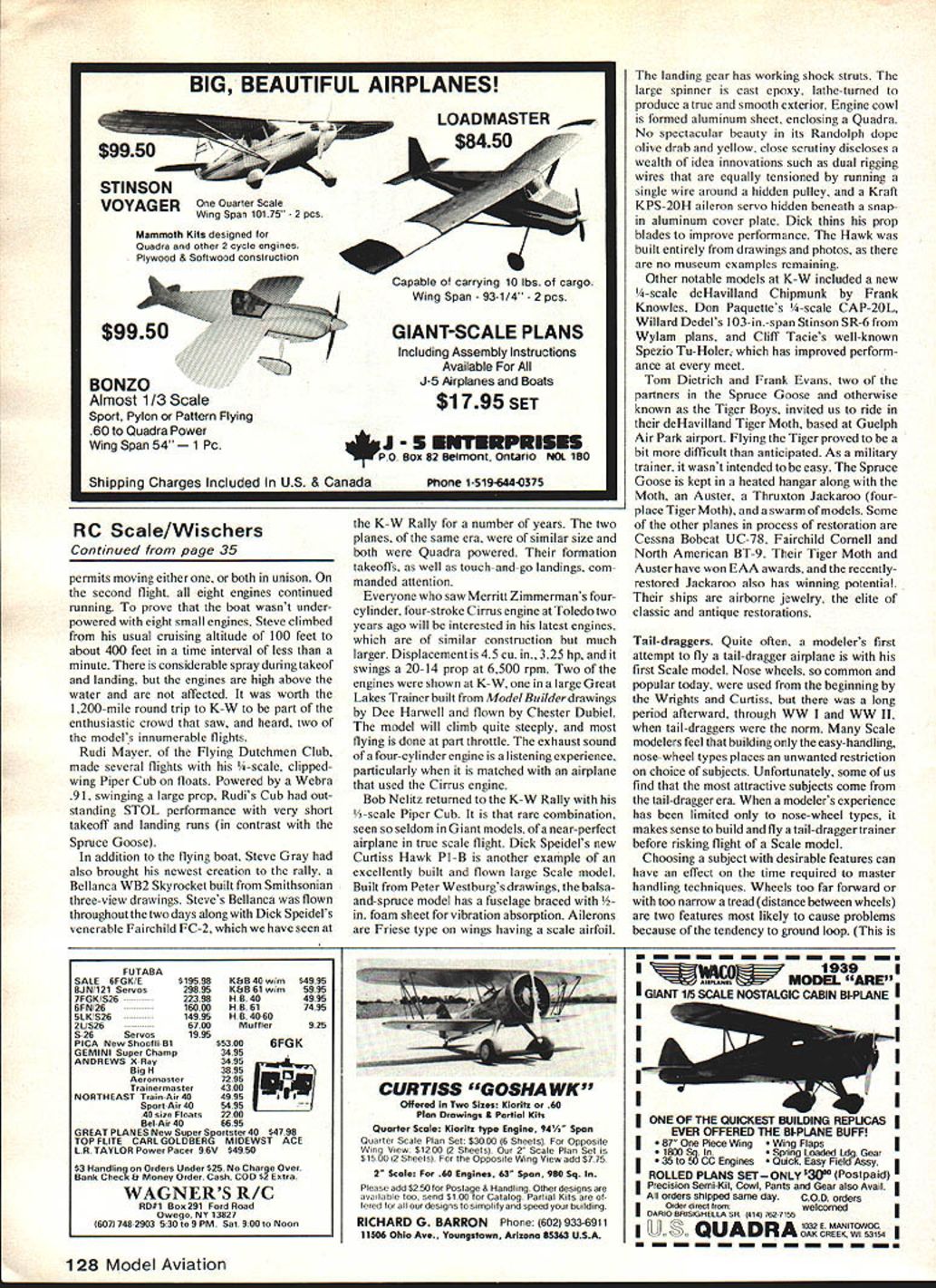
Merritt Zimmerman's latest engines were displayed—larger versions of his earlier four-cylinder, four-stroke Cirrus design. Displacement is 4.5 cu in, 3.25 hp, swinging a 20-1/4-inch prop at 6,500 rpm. Two of these engines were shown at K-W; one powered a large Great Lakes Trainer built from Model Builder drawings by Dee Harwell and flown by Chester Dubiel. The exhaust sound of a four-cylinder engine is particularly notable when matched with an airplane that originally used the Cirrus.
Curtiss Hawk P-1B (Dick Speidel)
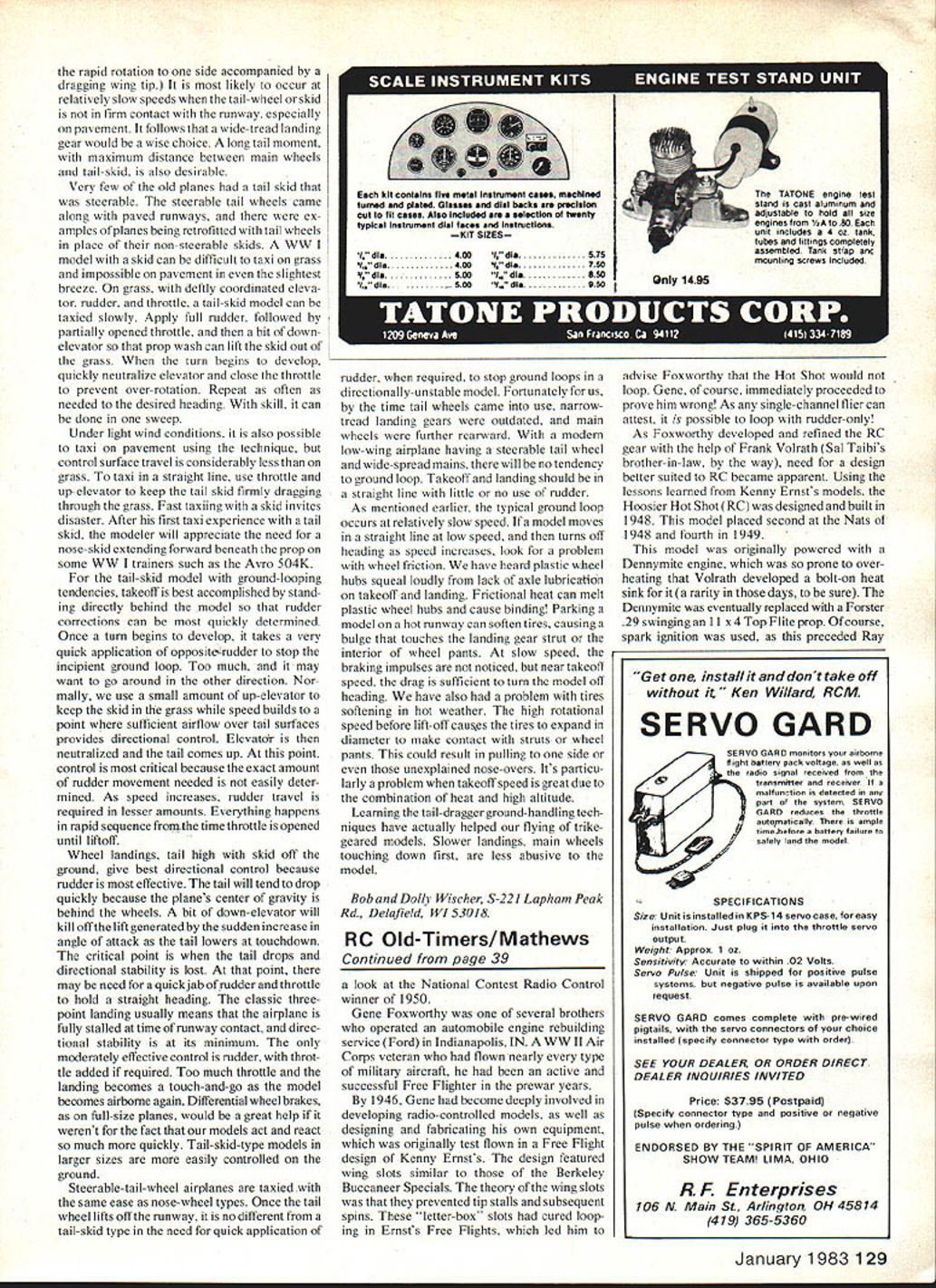
Dick Speidel built a well-detailed, accurately finished Curtiss Hawk P-1B from Peter Westburg drawings. The model spans 84 in and weighs 22 lb; it is Quadra-powered and finished in Randolph dope over Super Coverite. Scale is about 2.65 inches to the foot (between 1/4- and 1/5-scale).
Construction and features:
- Balsa-and-spruce structure with fuselage braced using 1/8-inch foam sheet for vibration absorption.
- Frise-type ailerons on wings with a scale airfoil.
- Landing gear with working shock struts.
- Large spinner cast from epoxy and lathe-turned for a smooth exterior.
- Engine cowl formed from aluminum sheet enclosing a Quadra engine.
- Innovative details include dual rigging wires equally tensioned by running a single wire around a hidden pulley, and a Kraft KPS-20H aileron servo hidden beneath a snap-in aluminum cover plate.
- Dick hones his prop blades to improve performance.
The Hawk was built entirely from drawings and photos, as no museum examples remain. Its finish is conservative olive drab and yellow, but close inspection reveals numerous clever solutions and craftsmanship.
Other notable models at K-W
- Frank Knowles: new 1/4-scale de Havilland Chipmunk.
- Don Paquette: 1/4-scale CAP-20L.
- Willard Dedel: 103-inch span Stinson SR-6 built from Wylam plans.
- Cliff Tacie: the well-known Spezio Tu-Holer, continually improved and showing better performance at every meet.
- Bob Neitz: 1/6-scale Piper Cub noted for near-perfect, true-scale flight.
Tiger Moth and restorations
Tom Dietrich and Frank Evans (partners in the Spruce Goose and known as the Tiger Boys) invited the authors to ride in their de Havilland Tiger Moth, based at Guelph Air Park airport. Flying the Tiger Moth proved more difficult than anticipated; as a military trainer it was not intended to be easy. The Spruce Goose is kept in a heated hangar along with the Moth, an Auster, a Thruxton Jackaroo (a four-place Tiger Moth), and many models. Other restoration projects include a Cessna Bobcat UC-78, Fairchild Cornell, and North American BT-9. The Tiger Moth and Auster have won EAA awards, and the recently restored Jackaroo also has winning potential. These restorations are described as airborne jewelry—elite examples of classic and antique restorations.
Tail-draggers
Many modelers' first attempt at flying a tail-dragger is with their first scale model. Nose-wheel gear is common today, but there was a long period through WWI and WWII when tail-draggers were the norm. Many scale modelers find tail-draggers more challenging and more fun, but they can also be unforgiving. The first touchdown after a long flight is the most critical; a model that is too tail-heavy will often bounce, nose over, or ground loop.
Design features that affect ground handling
Problems that increase the tendency to ground loop:
- Wheels too far forward or too far back.
- Too narrow a tread (distance between wheels).
- Excessive dihedral or wing stagger.
A wide-tread landing gear and a long tail moment (maximum distance between main wheels and tail-skid) are desirable for better ground handling.
Taxiing a tail-skid model
Very few old planes had steerable skids; steerable tail wheels came with paved runways. A WWI model with a skid can be difficult to taxi on grass and impossible on pavement in even a slight breeze. On grass, with coordinated elevator, rudder, and throttle, a tail-skid model can be taxied slowly:
- Apply full rudder.
- Partially open throttle.
- Use a bit of down elevator so prop wash lifts the skid out of the grass.
- When the turn begins, quickly neutralize elevator and close the throttle to prevent over-rotation.
- Repeat as needed to reach the desired heading.
Under light wind conditions it is sometimes possible to taxi on pavement using the same technique, but control surface travel is reduced. To taxi in a straight line on grass, use throttle and up elevator to keep the tail skid dragging. Fast taxiing with a skid invites disaster. After a first skid-taxi experience, modelers will appreciate the need for a nose-skid extending forward beneath the prop on some WWI trainers (e.g., Avro 504K).
Takeoff technique for tail-skid models
Stand directly behind the model so rudder corrections can be applied quickly. Use a small amount of up elevator to keep the skid in the grass while speed builds, then neutralize elevator as the tail comes up. Rudder corrections are most critical during the transition to liftoff; as speed increases, less rudder movement is required. Everything happens rapidly from throttle opening to liftoff.
Landing technique and control
- Wheel landings (tail high with skid off the ground) give the best directional control because rudder is most effective.
- The tail will tend to drop quickly as the center of gravity is behind the wheels; a bit of down elevator will kill lift generated by the sudden increase in angle of attack as the tail lowers.
- The critical moment is when the tail drops and directional stability is lost—quick rudder and perhaps throttle may be required to hold a straight heading.
- Three-point landings usually mean the airplane is fully stalled at runway contact and directional stability is at a minimum; rudder and throttle are the primary effective controls.
- Too much throttle can turn the landing into a touch-and-go.
Differential wheel brakes would help, but models react much more quickly than full-size aircraft. Larger tail-skid-type models are generally easier to control on the ground.
Steerable tail-wheel models
Steerable-tail-wheel airplanes taxi as easily as nose-wheel types. Once the tail wheel lifts off, handling is similar to tail-skid types in the need for quick rudder application when required. Fortunately, when tail wheels became common, narrow-tracked gears had already been phased out and main wheels were moved further aft, reducing ground-loop tendencies. With a modern low-wing airplane having a steerable tail wheel and wide-spread mains, takeoff and landing should be in a straight line with little or no rudder input.
Other ground-handling causes of heading changes
- Binding from dry or unlubricated axles (plastic wheel hubs can squeal and then bind).
- Tires softening and bulging in the heat or from being parked on a hot runway, causing contact with struts or wheel pants.
- Expansion of tires at high rotational speed before lift-off can contact struts or wheel pants, causing pull to one side or nose-overs.
These issues are particularly problematic at high-altitude fields or in hot weather when takeoff speed is high.
Learning tail-dragger ground-handling techniques can improve flying of trike-geared (nose-wheel) models: slower landings and making the main wheels touch down first are less abusive to the model.
Bob and Dolly Wischer S-221 Lappian Peak Rd. Delafield, WI 53018
Transcribed from original scans by AI. Minor OCR errors may remain.

