
Radio Control: Scale
Bob & Dolly Wischer — Report from Paris
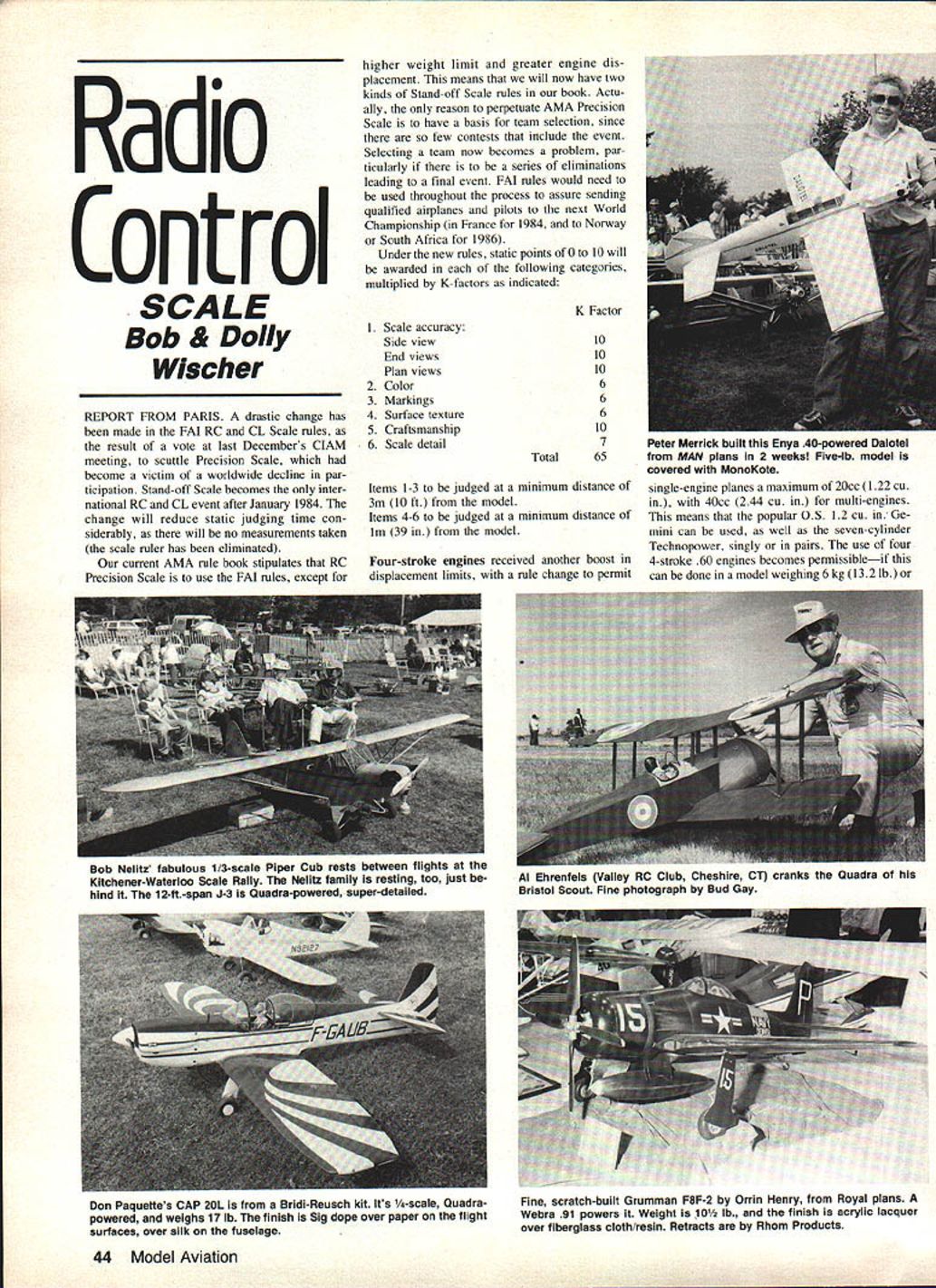
A drastic change has been made in the FAI RC and CL Scale rules as a result of a vote at the CIAM meeting last December. The change will eliminate Precision Scale, which has suffered a worldwide decline in participation. Stand-off Scale becomes the sole international RC/CL Scale event after January 1984. This change will reduce static-judging time considerably: no measurements will be taken and the scale ruler has been eliminated.
Our current AMA rule book stipulates that RC Precision Scale follow the FAI rules except for a higher weight limit and larger engine displacement. That means the AMA book will now contain two kinds of Stand-off Scale rules. The primary practical reason to keep an AMA Precision Scale rule is for team selection, since so few contests include the event. Selecting a team is now more complicated, particularly if a series of eliminations leads to a final event. FAI rules would need to be used throughout the selection process to ensure qualified airplanes and pilots are sent to the World Championships (France 1984; Norway or South Africa 1986).
Static judging and scoring
Under the new rules, static points (0–10) will be awarded in each category and multiplied by the K-factors as indicated:
- Scale accuracy (K-factor 1)
- Side view: 10
- End views: 10
- Plan view: 10
- Color (K-factor 2): 6
- Markings (K-factor 3): 6
- Surface texture (K-factor 4): 6
- Craftsmanship (K-factor 5): 10
- Scale detail (K-factor 6): 7
Total static points: 65
- Items 1–3 are to be judged at a minimum distance of 3 m (10 ft) from the model.
- Items 4–6 are to be judged at a minimum distance of 1 m (39 in) from the model.
Engine displacement and four-strokes
Four-stroke engines received a boost in permitted displacement. Under the new limits:
- Single four-stroke engine: maximum 20 cc (1.22 cu. in.)
- Multi-engine four-stroke (example): maximum 40 cc (2.44 cu. in.) total for some multi-engine configurations
Additional two-stroke limits (previously adopted and effective January 1983):
- Two engines (two-stroke): maximum total 15 cc (0.91 cu. in.)
- Three engines (two-stroke): maximum total 20 cc (1.22 cu. in.)
- Single-engine two-stroke limit remains 10 cc (0.61 cu. in.)
The higher four-stroke limits mean popular large four-stroke engines—such as the O.S. 1.2 cu. in. Ge-mini and the seven-cylinder Technopower—can be used singly or in pairs. Using multiple large four-strokes (for example, four .60 four-strokes) becomes permissible provided the model remains within the maximum weight limit of 6 kg (13.2 lb). Note that a very small four-engined model could easily surpass the wing-loading limit of 32.76 oz per sq. ft.
Large four-stroke engines should see increased use because gains in propeller efficiency come with greater diameter, higher pitch and lower noise. Enya announced a new four-stroke "90" weighing 29 oz and producing about 1.3 hp, adding another option in the large-engine field.
Effective date for the main changes is tentatively January 1984.
Ducted-fan rule change
Ducted-fan enthusiasts requested permission to modify the air-entry duct to provide additional area for greater scale size. The new rule allows additional air entries provided they are covered by movable hatches during static judging. Hatches may be moved or opened manually prior to flight. "Flight" is defined as radio control operation; the model's appearance in flight must not be affected.
This follows the precedent that allows a flying propeller to replace the scale prop after static judging has been accepted.
Observations on CIAM
Having attended six FAI/CIAM meetings, the authors have found the group somewhat inflexible in certain respects. However, the willingness shown in Paris to accept changes for the betterment of international Scale competition was notable. Two national delegates (29 percent) voted against acceptance of the rule changes—one of the larger negative votes in recent memory—yet the changes were adopted.
Side trips and museums
Side trips (at our own expense) are highlights of the annual trek to Paris. Recent visits and observations include:
- Yeovilton Royal Naval Air Station (southwest England)
- The Fleet Air Arm Museum featured a new exhibit on the Falklands War, including captured aircraft such as a Bell Jet Ranger helicopter in Argentine markings and a captured FMA Pucara twin turbo-prop ground-attack airplane.
- The museum also features enlargements of action photos, captions, a Westland Wessex helicopter noted for its role in the conflict, and regular flight activity at the airfield (Harriers, Hunters, Canberras and various helicopters).
- Royal Air Force Museum, Hendon (north of London)
- The museum is expanding with a new bomber display, and a separate Battle of Britain hall contains Allied and Axis warplanes.
- The bookshop is rich in material for modellers; the authors found a 1978 RAF Yearbook with many photos and profiles.
- Notable exhibits include a recovered Sopwith 1½ Strutter (recovered finish replacing nitrate dope), a Harrier pursuit exhibit, and an American-made Fokker D-VII reproduction.
- Brussels Air Museum and Cinquantenaire Park Museum
- The Brussels museum is large (surpassed in Europe only by Hendon and Paris), housed in a former World's Fair building with extensive glass for photography. Initially photography was restricted for commercial reasons, but permission was granted when the authors explained their modelling interest.
- The Cinquantenaire Park Museum prides itself on originals (WWI and earlier aircraft), many in original fabric coverings—valuable references for scale modellers.
- Notable WWI types: LVG C.V, Halberstadt C.V (both with original 200 hp Benz engines), Sopwith Camel F.1, Spad 13 C.1, Nieuport 17 C.1, Hanriot HD.1.
- A recently restored 1934 Kreit KL.2 with a 3-cylinder Anzani engine was hand-cranked and briefly started—a rare working display.
- The collection ranges from a tiny Tipsy S-2 to a Fairchild C-119 Packet, with good WWII representation and rarities such as the Farman F.11-A2, de Havilland Mosquito NF.30, and Royal Aircraft Factory R.E.8.
- The museums are acquiring aircraft faster than they can be restored and cleaned; dust removal is an ongoing need.
Visits with modellers and inventors
- Mike Whitnall (Nympsfield, Cotswolds)
- Works in a very small workshop yet builds Giant Scale models. His latest is a 10-ft-span Westland Widgeon parasol powered by a Magnum .91S four-stroke, suitable for the ~20 lb plane.
- Uses UHF radio equipment above 400 MHz with a tiny 4-in stub transmitter antenna that can be removed in flight without loss of signal. Other large models include a CAP 20 and a Gee Bee.
- Group Captain James Pelly-Fry (Fivehead, near Taunton, Somerset)
- Builder of a Douglas A-20 Boston model similar to the authors' model. James flew the prototype in WWII as commander of 88 Squadron and has an impressive wartime record.
- He lives a quiet life, enjoys sailplanes, and maintains a well-equipped shop. The authors hope he will write about his modelling experiences and wartime flying.
- David Parker
- Inventive engineer who demonstrated a successfully flown steam engine for model planes: a one-cylinder engine with an alcohol-fuelled flash boiler that uses propeller slipstream to augment boiler draft. Mostly lightweight stainless-steel construction.
- Also builds completely scratch-built four-stroke twin engines.
Royal Air Force colors for modelling
Petit Paint Co. (makers of Hobbycolor) provided formulas for RAF finishes used during early WWII (1940–41), including the Battle of Britain period. Typical finishes:
- Upper surfaces: dark earth and dark green
- Lower surfaces: sky type "S"
These color formulas match finishes used on most Hurricanes and early Spitfire models of that period.
Transcribed from original scans by AI. Minor OCR errors may remain.

