
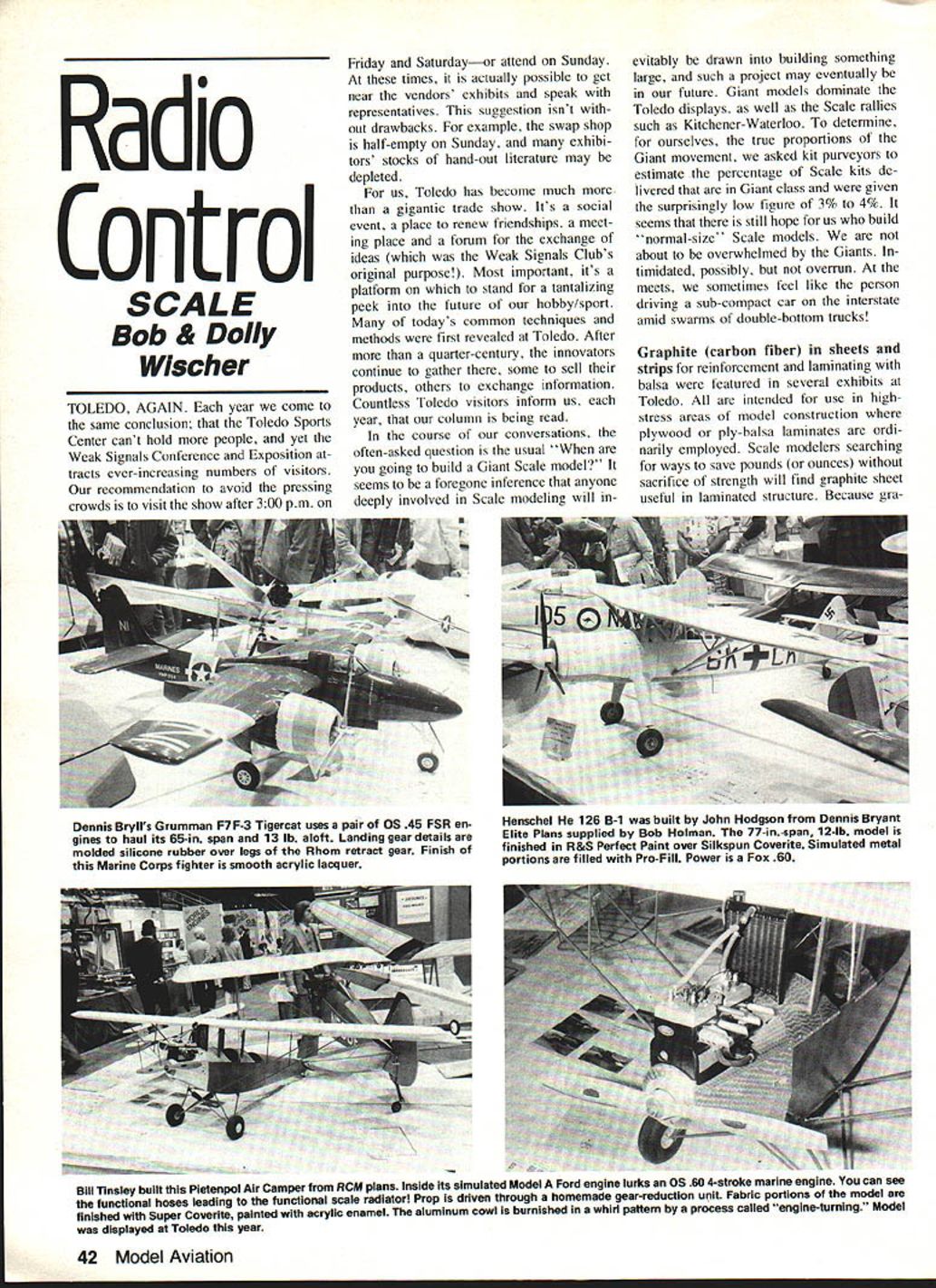
Radio Control: SCALE
Bob & Dolly Wischer
TOLEDO, AGAIN. Each year we come to the same conclusion: the Toledo Sports Center can't hold more people, and yet the Weak Signals Conference and Exposition attracts ever-increasing numbers of visitors. Our recommendation to avoid the pressing crowds is to visit the show after 3:00 p.m. on Friday and Saturday—or attend on Sunday. At these times it is actually possible to get near the vendors' exhibits and speak with representatives. This suggestion isn't without drawbacks: for example, the swap shop is half-empty on Sunday, and many exhibitors' stocks of hand-out literature may be depleted.
For us, Toledo has become much more than a gigantic trade show. It's a social event, a place to renew friendships, a meeting place and a forum for the exchange of ideas (which was the Weak Signals Club's original purpose!). Most important, it's a platform on which to stand for a tantalizing peek into the future of our hobby/sport. Many of today's common techniques and methods were first revealed at Toledo. After more than a quarter-century, the innovators continue to gather there—some to sell their products, others to exchange information. Countless Toledo visitors inform us each year that our column is being read.
In the course of our conversations, the often-asked question is the usual "When are you going to build a Giant Scale model?" It seems to be a foregone inference that anyone deeply involved in Scale modeling will inevitably be drawn into building something large, and such a project may eventually be in our future. Giant models dominate the Toledo displays, as well as Scale rallies such as Kitchener-Waterloo. To determine, for ourselves, the true proportions of the Giant movement, we asked kit purveyors to estimate the percentage of Scale kits delivered that are in Giant class and were given the surprisingly low figure of 3% to 4%. It seems that there is still hope for those of us who build "normal-size" Scale models. We are not about to be overwhelmed by the Giants. Intimidated, possibly, but not overrun. At the meets, we sometimes feel like the person driving a sub-compact car on the interstate amid swarms of double-bottom trucks!
Graphite (carbon fiber) reinforcement
Graphite (carbon fiber) in sheets and strips for reinforcement and laminating with balsa were featured in several exhibits at Toledo. All are intended for use in high-stress areas of model construction where plywood or ply-balsa laminates are ordinarily employed. Scale modelers searching for ways to save pounds (or ounces) without sacrifice of strength will find graphite sheet useful in laminated structure.
Because graphite (carbon fiber) will not stretch, a laminated part does not bend easily, is highly durable and is impervious to moisture. The tools needed are an X-Acto knife and scissors. Advantages over plywood-balsa laminations are lighter weight and greater strength. Cost is comparatively high.
Products and vendors noted at Toledo:
- Central Florida Hobbies / Bob Violett Models: Magnalite products in a number of forms. Sheet dimensions vary from 2 in. x 12 in. to 6 in. x 48 in., in two thicknesses, .007 and .014. For bracing foam-core wings, .014 material is available. 1/2-in.-wide strips with adhesive backing can be used beneath wing sheathing (it's best to depress the foam slightly). Magnalite also manufactures 1/8-in.-thick sheets and end-grain balsa laminated between double layers of graphite sheet. An epoxy-base product is lighter and stronger than five-ply birch plywood.
- Twinn-K and GloBee: Graphite .007 sheets ranging from 4 x 24 to 4 x 48.
- Dave Brown: Carbon-fiber tape in 12-ft. lengths for strengthening foam wings and balsa fuselages.
For ultimate strength, multi-layered lamination—three graphite sheets with two balsa interleaved layers—results in considerable strength and rigidity at minimum weight (useful for center-section wing spars). Graphite has about three times the strength of fiberglass of the same cross section at slightly less weight.
Adhesives can be cyanoacrylate (CA) or epoxy. The graphite sheet should be roughened to provide maximum bond. In most respects it can be used to replace plywood in composite construction, with hardwood inserted in place of balsa in areas where bolts pass through. Because of the expense, applications should be chosen where stress is concentrated; it is not a material to be used indiscriminately throughout an airplane.
Engines — Four-stroke and two-stroke developments
New four-stroke engines aimed at the Scale market appeared at Toledo in quantity.
- World Engines introduced an OS 1.20 cu. in. four-cycle single-cylinder engine with enclosed rocker arms similar to the familiar .40. The 1.20 fits the new FAI rule that permits four-stroke engines of up to 1.22 cu. in. displacement in single-engine models, or in pairs on a twin. This also applies to the older OS Gemini 1.20 four-stroke two-cylinder engine, now reduced in price with well over 20,000 produced. The new single-cylinder engine is expected to have a lower price tag and may offer greater output.
- World Engines also displayed the OS FS-75 four-stroke, which has almost the same weight and dimensions as the older .60, and a similar appearance (with exposed rocker arms).
- Magnum (imported from England) offers the Magnum .91S, a four-stroke that meets FAI specification limits; it will handle a 16-6 prop on 5% nitro fuel with 8% lubricant. Magnum has also produced a V-twin and a three-cylinder radial of 1.82 and 2.73 cu. in. displacement, respectively, using the same basic cylinder from the single. All three have exposed rocker arms, with pushrods at the rear.
- Enya displayed its complete line of four-stroke engines, from .35 through .90. The largest displacement commanded the most attention—its output approaches that of some two-stroke .60 engines. The four-stroke era has definitely arrived.
New two-stroke and large-model engines:
- World Engines introduced the Supertrige S2000, a new two-stroke 1.20 cu. in. engine for large models that will turn an 18-6 prop at 8,500 rpm on 5% nitro fuel. Conversion to ignition is expected soon.
- Lou Ross showed a complete line of new two-stroke engines intended for large models. They are two-, four-, and six-cylinder horizontally-opposed types with displacements of 1.22, 2.44, and 3.67 cu. in., all having a .90 in. bore and stroke. They can be direct-drive or geared 2.055:1 (with internal gears so that the prop shaft and engine crankshaft rotate in the same direction). These are reed-valve engines that will run in either direction—an important feature for models with pusher props. Lou is also offering a 90° V four-cylinder of 2.66 cu. in. (with a .90-in. bore and 1.00-in. stroke). He also displayed a few remaining two-, four- and six-cylinder engines made up from parts of his original .60, 1.20, and 1.80 production runs of the early 1970s.
Bob and Dolly Wischer S-221 Lapham Peak Rd., Delafield, WI 53018.
Transcribed from original scans by AI. Minor OCR errors may remain.

