
Radio Control: SCALE
Bob & Dolly Wischer
Maneuverability
We have been asked whether our semi-aerobatic Scale models will do a Lomcevak. The answer is no. To perform such violent maneuvers, a model requires an excessive amount of control-surface travel. While the controls could be set up for extreme aerobatics, doing so would inevitably result in a super-sensitive airplane in which tiny transmitter movements noticeably alter the flight path, destroying the scale-flight illusion even under expert control.
Newer transmitters with exponential and dual rates permit the pilot to perform more active aerobatics if he remembers to switch rates before and after the maneuver. It is also vital to keep track of which control mode is in use during flight—low-level aerobatics in Low rate can lead to disaster. The greatest number of scale enthusiasts still use older transmitters without these exotic features.
Simply stated: to achieve scalelike flight, minimize control-surface travel. Because ailerons are the first control to lose effectiveness at reduced speed, some argue they should have greater travel. Practice doesn't support this. Over-controlling cruising speed becomes a nightmare—rocking wings and an endless search for neutral to achieve straight, level flight. At very slow speed, approaching stall, sudden large aileron deflection can precipitate a tip stall due to increased drag; the subsequent snap roll can occur near the ground on landing approach. Takeoff typically does not provide sufficient altitude to recover. For normal aerobatics, aileron travel that produces a complete roll in about three seconds at cruising speed is sufficient. Aileron differential (up travel vs. down) is of doubtful value; movement must be small enough to provide smooth, scalelike flight. Excessive aileron travel is usually the culprit in unsteady flight.
Excessive elevator movement can also contribute to problems. A heavy dose of up-elevator can precipitate a sudden stall whenever a model is approaching stalled condition, especially if the model uses a flat-bottomed airfoil. As a rule of thumb, use enough up-elevator travel to permit lowering the tail for a three-point landing on tail-dragger models and to permit landing on the main wheels for trike models. For models intended to be aerobatic, modify this rule: use sufficient up-elevator to permit a clean, reliable entry to a tailspin. With small, incremental changes in elevator travel it is possible to arrive at a point where the model can be placed into an intentional spin yet will refuse a snap-roll command. That is the ideal set-up condition for safe flight.
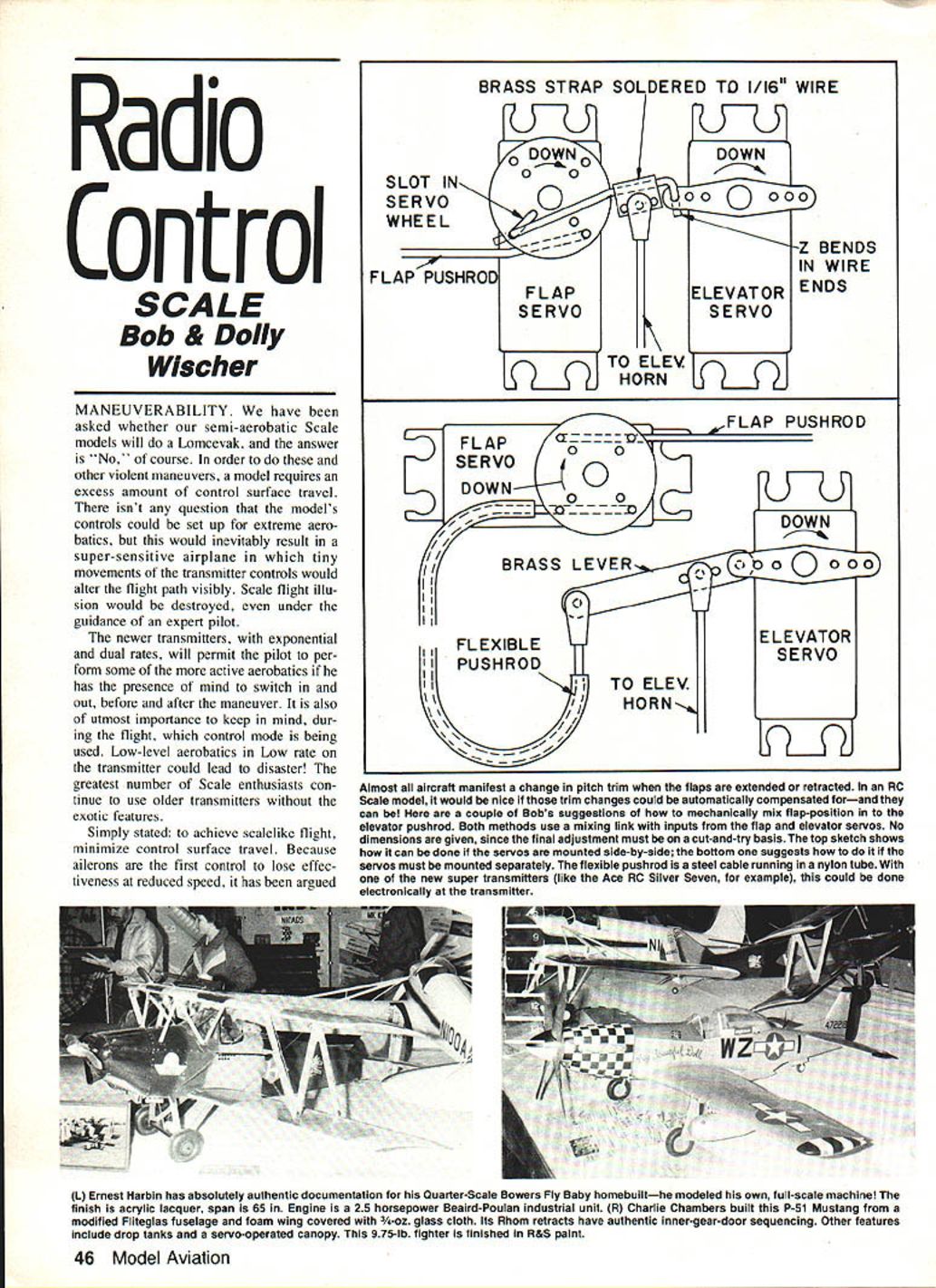
Almost all aircraft manifest a change in pitch trim when flaps are extended or retracted. A radio-control scale model can have these trim changes automatically compensated for by mechanically mixing flap position to elevator movement. One method uses mixing links between the flap and elevator servos; another uses a flexible pushrod (steel cable running in a nylon tube) when the servos cannot be mounted side-by-side. With modern transmitters (for example, the Ace R/C Silver Seven), this mixing can also be done electronically in the transmitter. This produces smooth attitude changes in the manner of a full-size aircraft, without the need for exponential or dual-rate functions.
The exception to the minimum-travel rule is the rudder, where we take as much travel as possible. Simple acrobatic maneuvers such as the barrel roll require ample rudder for successful execution. Ailerons help, but the rudder really does the job. This is also true of wing-overs and stall turns. Large rudder travel is also helpful in taxiing. A sensitive rudder seldom detracts from realism in flight.
RC Scale / Wischers
(Continued material and notes)
Paris — 1984
An official invitation has come to the AMA from the Fédération Française d'Aéromodélisme to participate by sending teams of Scale modelers to the 8th Scale World Championships to be held at historic Le Bourget Airport, north of Paris, July 2–8, 1984. The Championship will include events for RC and CL in the FAI class, as well as an additional RC International Contest for models of 7 to 10 kg (15.4 to 22 lb.). Cost for competitors, team managers, and supporters will be about 800 Swiss francs, which includes seven nights in an international-class hotel, meals, and a banquet.
Le Bourget Airport, Lindbergh's landing place on his famous flight, has fallen into disuse due to its small size and surrounding urban development. It is presently the site of the Paris Air Museum with one of the continent's largest collections of historic aircraft, numbering more than 150. Among them is the Breguet XIX Super TR sesquiplane Question Mark, which made the first east-west nonstop crossing of the Atlantic from Paris to New York in 1930, flown by Costes and Bellonte. After touring the U.S., it was flown back to Paris. Many other record flights began or terminated at Le Bourget. The museum exhibits include numerous pre-WWI aircraft—Farman, Demoiselle, and Antoinette originals—as well as military craft from both world wars. The setting for a model meet rivals that of Ottawa in 1980, which was adjacent to the Canadian Museum.
WW II Interior Colors
Pettit Paint Co., makers of Hobbypoxy products, have released formulas for interior colors used on American aircraft of WWII. These are two shades of zinc chromate primer—anti-corrosion coatings applied to bare metal surfaces before final painting. On combat aircraft, the primer was often left unpainted on interior surfaces to save weight and speed production. Standard zinc chromate primer is a greenish-yellow color. Cockpits were a more olive-green shade, designated "Interior Green No. 611." Quite often, the unmodified yellow shade was used on all surfaces except the cockpit and would therefore be found inside wheel wells, cowlings, hatches, and so forth.
Formulas (for Hobbypoxy paints only):
- Interior Green No. 611: 5 parts H49 Cub Yellow, 3 parts H47 Bright Yellow, 2 parts H33 Stinson Green, 1 part H81 Black.
- Zinc Chromate Primer (Yellow): 3 parts H47 Bright Yellow, 3 parts H49 Cub Yellow, 2 parts H70 Gray.
After blending, add an equal amount of Part B Flat Hardener for the proper matte finish.
Elevator trim for flaps
Most often, when a model exhibits a marked change in pitch as flaps are extended, it happens because the airspeed was too high at the time. On full-size planes there is a "never exceed" speed for flap lowering that must be observed. Watching models from the ground, speed is not easily judged. The pitch change may be either nose-up (most common) or nose-down. If it occurs even after speed has been reduced, the problem can be a real nuisance. The nose-up type is most awkward because it requires that down-elevator be held on the transmitter stick while the other hand fumbles for elevator trim control, which must be applied in the proper amount to regain stability. Even full-down trim may not be enough to overcome the pitch-up. What is needed is an automatic application, in the correct amount, of down-elevator to compensate when flaps are extended.
Fifteen to twenty years ago, reed radio-control pilots used an extra servo in the model to adjust elevator trim in flight, which was one reason 10-channel radios were popular. Two channels were used for each of the basic four functions, and the additional two were for elevator trim. The elevator (self-neutralizing) and trim (non-neutralizing) servos were mounted side-by-side with a connecting bar between their output arms.
A similar mechanical trim bar, connected between elevator and flap servos, provides a positive amount of trim change for any model in which those two servos can be mounted side-by-side. The elevator pushrod is then connected to the bar instead of directly to the servo. By drilling a row of holes along the bar, the amount of trim can be changed by selecting the proper hole for attaching the elevator pushrod.
When adjacent mounting isn't possible—because the elevator servo is in the fuselage and the flap servo is remotely mounted in the wing—the servos can be interconnected with a flexible pushrod in a nylon tube, or a Nyrod. A clevis is required somewhere in the system to permit disconnecting the flexible pushrod from the servo for quick wing removal. It may not be easy to set up, but the trim bar takes the pain out of trying to use flaps on an obstinate aircraft that would otherwise be unmanageable. Without some sort of system, scale flap operation may not be possible.
Using decals
Applying accurate license numbers and military markings can be tedious if correct-size decals aren't available. Exact-size decals can be made by cutting them from blank decal paper.
- Materials: blank decal paper (coated with glue and ready for paint), available in 12 x 18 in. sheets from Sig or art-supply stores; paints such as butyrate dope, acrylic lacquer, or epoxy; an X-Acto knife for cutting.
- Method: Paint the decal sheet, allow the paint to dry, and mark the sheet on the back with pencil guide lines for cutting with an X-Acto blade.
- Applying over irregular details: When applying decals over rivets or rib stitching the decal film may bridge humps and trap air underneath. Use Hobscot Solvaset (found in hobby shops that carry model-railroad supplies) to soften the decal film so it will conform to raised detail and crevices. Work while the decal is wet:
- Slip the decal off its paper base onto the model and position it precisely.
- Brush Solvaset on the decal, especially along the edges, so it flows underneath.
- The decal will soften; work trapped air toward the edge or pierce bubbles with a needle or very sharp pin.
- Be cautious handling the decal while softened; it is easily damaged until completely dry.
- The decal surface may look rough while wet but will smooth out when dry—several hours to overnight.
- After drying, the decal may be overcoated with clear epoxy or lightly sprayed with dope.
There is great satisfaction in taming a difficult model surface—use of Solvaset and mechanical trim systems can make scale features and flap operation practical and realistic.
Bob and Dolly Wischer S-221 Lapham Peak Rd., Delafield, WI 53018.
Transcribed from original scans by AI. Minor OCR errors may remain.

