
Radio Control: Scale
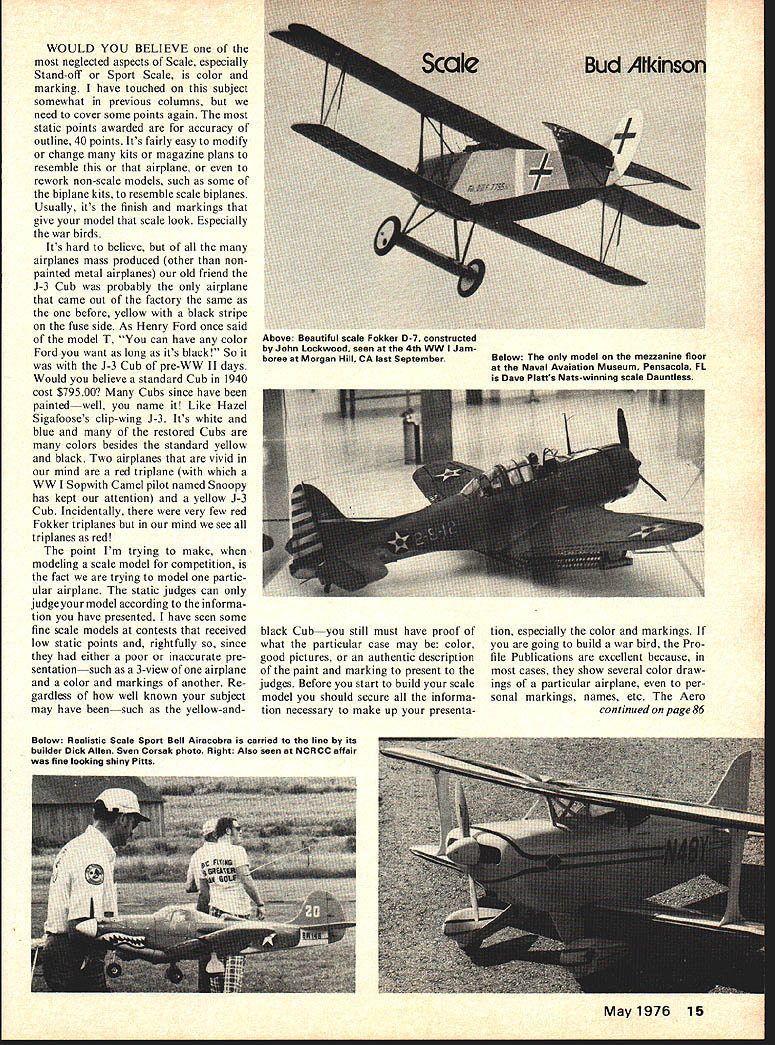
WOULD YOU BELIEVE one of the most neglected aspects of Scale, especially Stand-off or Sport Scale, is color and marking. I have touched on this subject somewhat in previous columns, but we need to cover some points again. The most static points awarded are for accuracy of outline, 40 points. It's fairly easy to modify or change many kits or magazine plans to resemble this or that airplane, or even to rework non-scale models, such as some of the biplane kits, to resemble scale biplanes. Usually, it's the finish and markings that give your model that scale look. Especially the war birds.
It's hard to believe, but of all the many airplanes mass produced (other than non-painted metal airplanes) our old friend the J-3 Cub was probably the only airplane that came out of the factory the same as the one before, yellow with a black stripe on the fuse side. As Henry Ford once said of the Model T, "You can have any color as long as it's black." So it was with the J-3 Cub of pre-WW II days. Would you believe a standard Cub in 1940 cost $795.00? Many Cubs since have been painted—well, you name it! Like Hazel Sigafoose's clip-wing J-3. It's white and blue and many of the restored Cubs are many colors besides the standard yellow and black. Two airplanes that are vivid in our mind are a red triplane (with which a WW I Sopwith Camel pilot named Snoopy has kept our attention) and a yellow J-3 Cub. Incidentally, there were very few red Fokker triplanes. In our mind we see all triplanes as red!
The point I'm trying to make, when modeling a scale model for competition, is the fact we are trying to model one particular airplane. The static judges can only judge your model according to the information you have presented. I have seen some fine scale models at contests that received low static points and, rightfully so, since they had either a poor or inaccurate presentation—such as a 3-view of one airplane and a color and markings of another. Regardless of how well known your subject may have been—such as the yellow-and-black Cub—you still must have proof of what the particular case may be: color, good pictures, or an authentic description of the paint and marking to present to the judges. Before you start to build your scale model you should secure all the information necessary to make up your presentation, especially the color and markings. If you are going to build a war bird, the Profile Publications are excellent because, in most cases, they show several color drawings of a particular airplane, even to personal markings, names, etc.
Radio Control: Scale
A series of books are excellent, and have many WW II aircraft illustrated with color drawings. There are many magazines today with good material, such as Air Progress, Wing, Flying, and many more. So, if you have in mind a very rare bird, with a little digging you should find the information you need. There is a large interest in this type of bygone years now, especially WW-II era with much being written about it, so do a little digging for your presentation!
WW II and I had some interesting color schemes to copy, especially German aircraft. The African campaign, for instance, saw many unusual camouflage patterns, both the German and Italian air arms. The Regia Aeronautica has more or less been neglected somewhat, compared to Allied and German aircraft. Owing somewhat to the fact that Italy was in the war a much shorter time, and was not active in many different sectors of the war, it never really produced a large number of aircraft and these are not well known. Many of their aircraft had unusual and colorful camouflage with many squadron markings, lettering and personal names and other markings. The camouflage patterns changed between the wars, as did markings and kills and sortie markings. The Luftwaffe, at the time of the Battle of Britain, had an elaborate system of lettering and markings. But the Russian front saw little in the way of color and markings of German aircraft, mainly because the fear of the pilot being shot by the Russians if a German ace or prominent flier was captured. So all markings and kills were deleted.
Russian aircraft were rarely decorated and most used the standard olive drab with only the red star. With the exception of the African campaign, the U.S. aircraft were rather plain compared to German and British aircraft. The majority of Air Corps aircraft were painted the old standard olive drab with Navy aircraft in the standard of the times, blue with off-white underbellies. We have all seen pictured the 8th Air Force B-17s and B-24s in England with their crews' personal markings, but this was not general practice. I'm sure we all can recall many highly decorated P-40s, P-51s etc.; but with the thousands of U.S. aircraft produced in WW II a small percentage had other than the standard olive drab with the national insignia, and a small inventory number in the fin and rudder. Japanese aircraft were more or less in the same, with a more-or-less standard camouflage pattern with fuselage markings. Again there were some exceptions. Japanese aircraft showed kill markings of individual pilots. The Japanese did not honor their ace pilots or aircrews.
While modeling one of our favorite warbirds it's to our advantage to pick exceptional ones that will have paint jobs and many markings. They naturally are more impressive and eye-catching and in most cases are more publicized. It stands to reason a yellow-nosed ME-109 with all the squadron markings and an elaborate camouflage scheme will attract more attention with the modeling public and the judges than, say, a plain old-drab standard P-39 will. So let's roll up that next scale bird.
Received notice from Eric Clapp, San Jose, Cal., of the 2nd annual World War II Scramble to be held May 15-16 at Hill County Air Museum, Morgan Hill, Cal. Events will be AMA scale, sport scale (Bom Rule) and sport scale (No Bom Rule). Contact Eric Clapp, 6116 Satellite Dr., San Jose, Ca. 95120; Phone 408-987-2298.
(My address is 734 N. 6th Street Terrace, Blue Springs, Mo. 64015.)
Transcribed from original scans by AI. Minor OCR errors may remain.

