
Radio Control SCALE
Bob & Dolly Wischer
Static Judging Method
A letter from David Andersen describes an accelerated procedure for static judging that is faster and fairer than the static circle method and is within AMA rules.
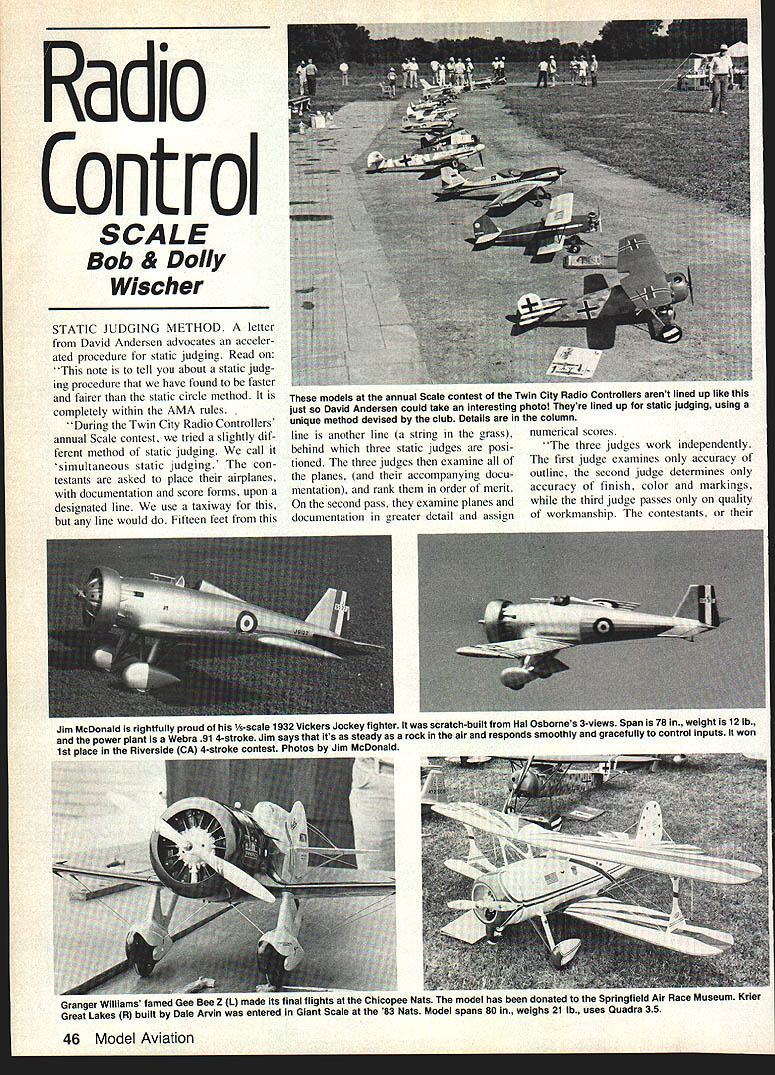
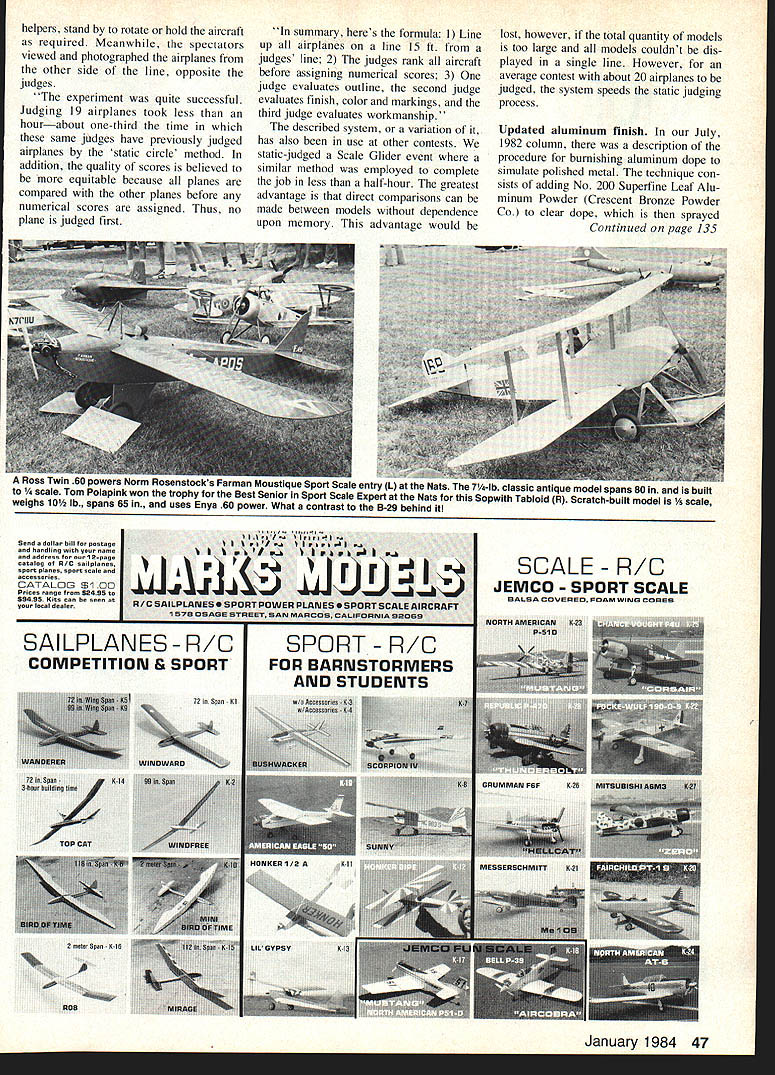
During the Twin City Radio Controllers' annual Scale contest the contestants were asked to place their airplanes, with documentation and score forms, upon a designated line (a taxiway was used). Fifteen feet from this line was another line (a string in the grass), behind which three static judges were positioned. The three judges then examined all of the planes (and their accompanying documentation) and ranked them in order of merit. On a second pass they examined planes and documentation in greater detail and assigned numerical scores.
The three judges worked independently and each had a single area of responsibility:
- Judge 1: accuracy of outline
- Judge 2: accuracy of finish, color, and markings
- Judge 3: quality of workmanship
Contestants or helpers stood behind the display line, rotated models as required, held aircraft steady while the judges inspected them, and answered questions. Each judge listed the airplanes in rank order from 1 to N (No. 1 plane listed first). The forms were collected and the average of the three ranks was used to order the airplanes from 1 to N. After ordering, the judges assigned numerical scores in the usual AMA scale categories, with the judge who examined that category doing the scoring.
Advantages:
- Faster: dozens of comparisons are made simultaneously as each judge views the same airplanes at the same time, rather than sequentially as in the static circle method.
- Fairer: direct side-by-side comparisons are possible, and no plane is judged first.
- Practical example: 19 airplanes were judged in less than an hour — about one-third the time required by the static circle method.
Disadvantages:
- The method requires that all models be displayed in a single line; it becomes impractical if too many entries prevent a single-line display.
Summary procedure:
- Line up all airplanes on a display line about 15 ft. from the judges' line.
- Judges rank all aircraft before assigning numerical scores.
- Assign judges by category (outline; finish, color and markings; workmanship).
This or similar methods have been used successfully at other contests (for example, a Scale Glider event was completed in less than half an hour).
Updated aluminum finish
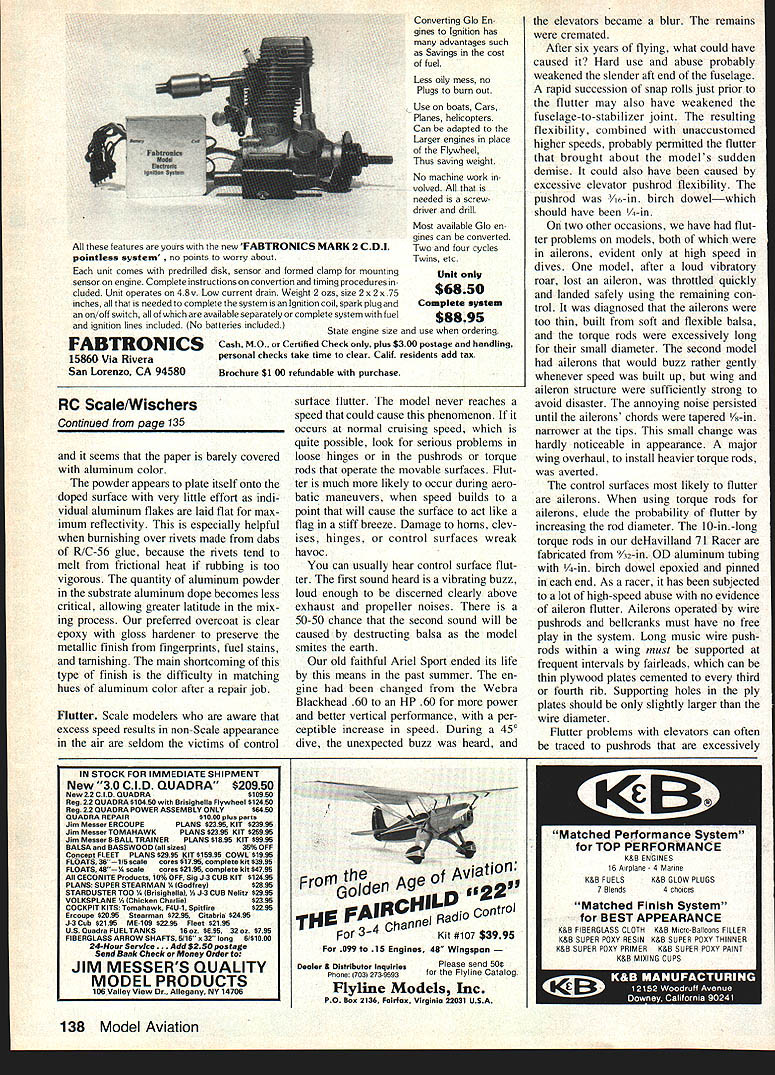
A technique for simulating polished metal on models uses No. 200 Superfine Leaf Aluminum Powder (Crescent Bronze Powder Co.) mixed into clear dope, which is then sprayed over a dope, epoxy, or polyester-resin base on the model. After thorough drying the surface is burnished using a paper wad (facial tissue or kitchen towel) to obtain a metallic sheen.
An improved method reduces effort and improves uniformity: dip the paper wad into raw No. 200 powder and use it to burnish the dried doped surface. Only a very small amount of powder is picked up; the aluminum flakes lay flat and produce strong reflectivity. This is especially helpful over rivets made from dabs of R/C-56 glue because vigorous rubbing can melt the rivets with frictional heat.
Because the powder plates itself onto the surface, the amount of powder mixed into the substrate aluminum dope is less critical. The preferred overcoat is clear epoxy with gloss hardener to preserve the metallic finish from fingerprints, fuel stains, and tarnishing. The main shortcoming of this finish is difficulty in matching the aluminum hue after repairs.
Flutter
Excessive speed and control system flexibility are common causes of control-surface flutter. Scale modelers who fly slowly may avoid flutter by never reaching the speeds that induce it; however, flutter can still occur at normal cruising speed if there are serious problems with loose hinges, flexible pushrods, torque rods, or weakened structure. Flutter is much more likely during aerobatic maneuvers where high speeds are reached.
Symptoms and consequences:
- You can usually hear control-surface flutter — first a vibrating buzz, loud enough to be heard above exhaust and prop noise.
- If not corrected quickly, structural failure often follows.
Examples and lessons learned:
- One model (an Ariel Sport) suffered flutter after the engine was changed to a more powerful .60 engine. A rapid succession of snap rolls just prior to the flutter likely weakened the fuselage-to-stabilizer joint; combined with higher speeds and resulting flexibility, flutter occurred and destroyed the model. The elevator pushrod (a 5/16-in. birch dowel) was too flexible; a stiffer pushrod should have been used.
- Another model lost an aileron after a loud vibratory roar. The ailerons were thin, made of soft balsa, and the torque rods were excessively long for their small diameter.
- A third model had ailerons that buzzed gently at high speed; the problem was cured by tapering the aileron chords 7/8 in. narrower at the tips, a small cosmetic change that avoided a major wing overhaul.
Prevention and recommendations:
- Ailerons are most likely to flutter. When using torque rods for ailerons, reduce the probability of flutter by increasing the rod diameter.
- Example successful installation: the deHavilland 71 Racer uses 10-in. long torque rods of 5/32-in. OD aluminum tubing with a 1/16-in. balsa core, epoxied and pinned with 1/16-in. dowels at each end; this has resisted aileron flutter despite high-speed use.
- Ailerons operated by wire pushrods and bellcranks must have no free play. Long music-wire pushrods within a wing must be supported at frequent intervals by fairleads — thin plywood plates cemented to every third or fourth rib. Supporting holes should be only slightly larger than the wire diameter.
- Elevator flutter is often traced to excessively flexible pushrods. A straight pushrod is more rigid; any bend introduces flex and the risk of flutter. Check by forcing the elevator trailing edge through its natural arc: if it moves without rotating the servo output wheel, look for unwanted deflection in the pushrod system.
- Enclosed nylon tubular rods should be tied down at intervals to prevent deflection. Balsa or wood pushrods should be stiff enough to resist bending under air loads at high speed. Bends in wire ends where the wire exits the fuselage often cause flexibility that can lead to flutter.
- Covering: tightly stretched covering prevents flutter in open-framework wings. Sagging covering in hot, humid weather can reduce wing rigidity enough to permit flutter. Wings with full or partial sheet-balsa covering are immune to the problem.
- Note: slow-flying, lightweight Scale models with minimal power may never encounter flutter, but fast, high-powered, or heavy types are the most likely victims. Flutter can occur in any Scale model and is usually initiated by speed, most often while diving.
Documentation sources
- Scale Plans and Photo Service, 3029 Madison Ave., Greensboro, N.C. 27403. Offers three-view drawings, photo packs, enlargements, and can enlarge drawings up to eight feet long. Catalog $3.
- Gleason Enterprises, Rt. 2, Box 125, Austin, MN 55912. A plan-finding service that locates publications with the desired drawings from the last 50 years; three-view and model drawings are listed. The service also has a limited number of model drawings.
- Ken P. Kalynuk, 369 Moorgate St., Winnipeg, Manitoba, Canada R3J 2L6. Offers a photo service listing over 130 aircraft types, color photo packs, and enlargements. Catalog 50¢.
Bob and Dolly Wischer S-221 Lapham Peak Rd., Delafield, WI 53018
Transcribed from original scans by AI. Minor OCR errors may remain.

