

Radio Control
SCALE — Bob & Dolly Wischer
Paris FAI meeting
An important development at the December FAI plenary session in Paris: the rules were frozen for four years. The present FAI scoring system — in which aircraft complexity bonuses are applied to flight scores — will remain unchanged for the 1984, 1986 and 1988 World Championships. AMA rules are tied to the FAI rules for Precision Scale class, so U.S. Scale modelers can expect no changes for those contests.
The complexity factor (multi-engined models with retracting landing gear can earn up to a 35% bonus) was introduced to give complex models a relative advantage over simpler designs that had previously dominated competition. Adoption of the bonus system produced a delayed change in entrants: simpler models continued to win initially, largely because engine displacement limits restricted multi-engine designs. With the doubling of displacement limits for four-engine models to 1.22 cu. in., complex craft have begun to appear; the current limiting factor is now the 6 kg (13.2 lb) weight limit.
At present the winning formula appears to be a multi-engine model with retracting gear and minimal exterior/cockpit detail to save weight. In other words, a relatively clean multi-engine airplane exploits the complexity bonus while compensating for lower static scores by maximizing flight points. Expecting heavy surface detail on a small, four-engine 13-lb model is unrealistic — the weight limit forces minimal detailing.
There had been concern among modelers that the bonus values might be reduced or eliminated, and proposals to remove bonuses (for gear retraction, for example) were discussed in earlier meetings. This year no national aero club proposed rule changes, so any move to de-emphasize complexity as a scoring factor will now be postponed until 1988. Meanwhile, most modelers spoken with at Paris plan to take full advantage of the complexity bonus factor, and the upcoming World Championships at Le Bourget (Paris), July 2–8, should see a proliferation of high-bonus models. This will be a marked change from Reno '82, where only one airplane (Nilsson's DH Tiger Moth) received a 15% bonus; other entrants carried 5% or 10% bonuses.
At Reno and other contests recent notable entries and examples include:
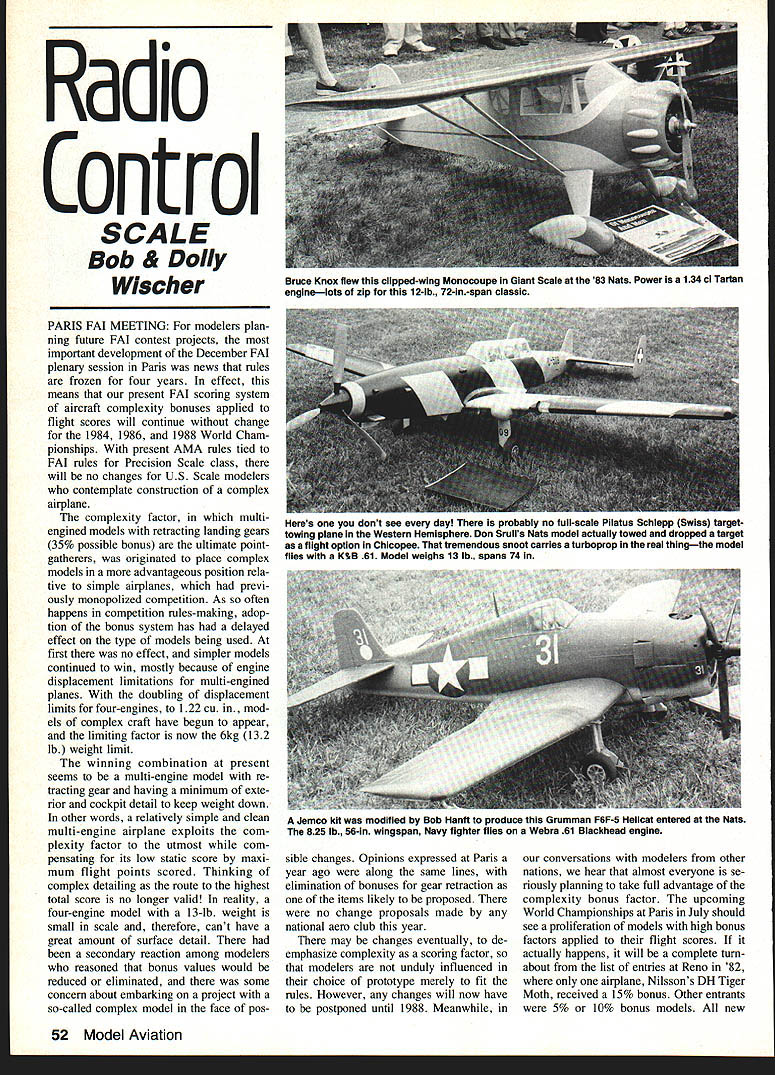
- Bruce Knox: clipped-wing Monocoupe at the Giant Scale '83 Nats, powered by a 134 ci Tartan engine (12 lb, 72 in span).
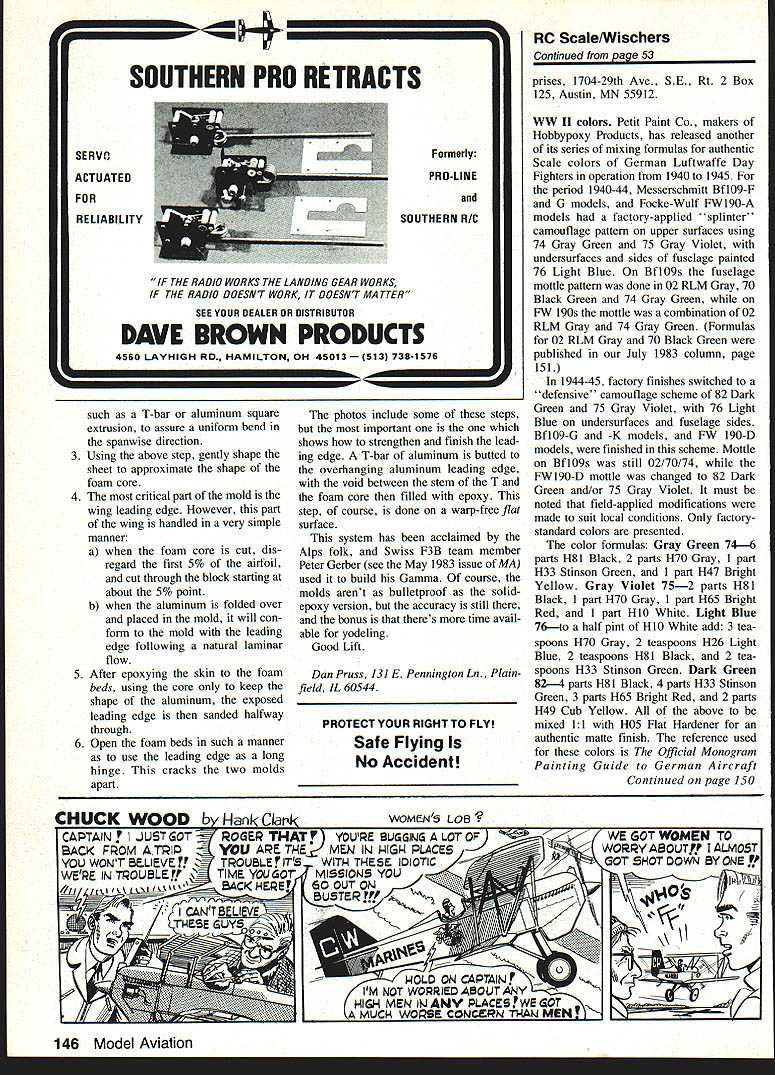
- Don Srull: Nats model that actually towed and dropped a target in a flight option.
- Chicopee: a large model carrying a turboprop (KB-61), 13 lb, 74 in span.
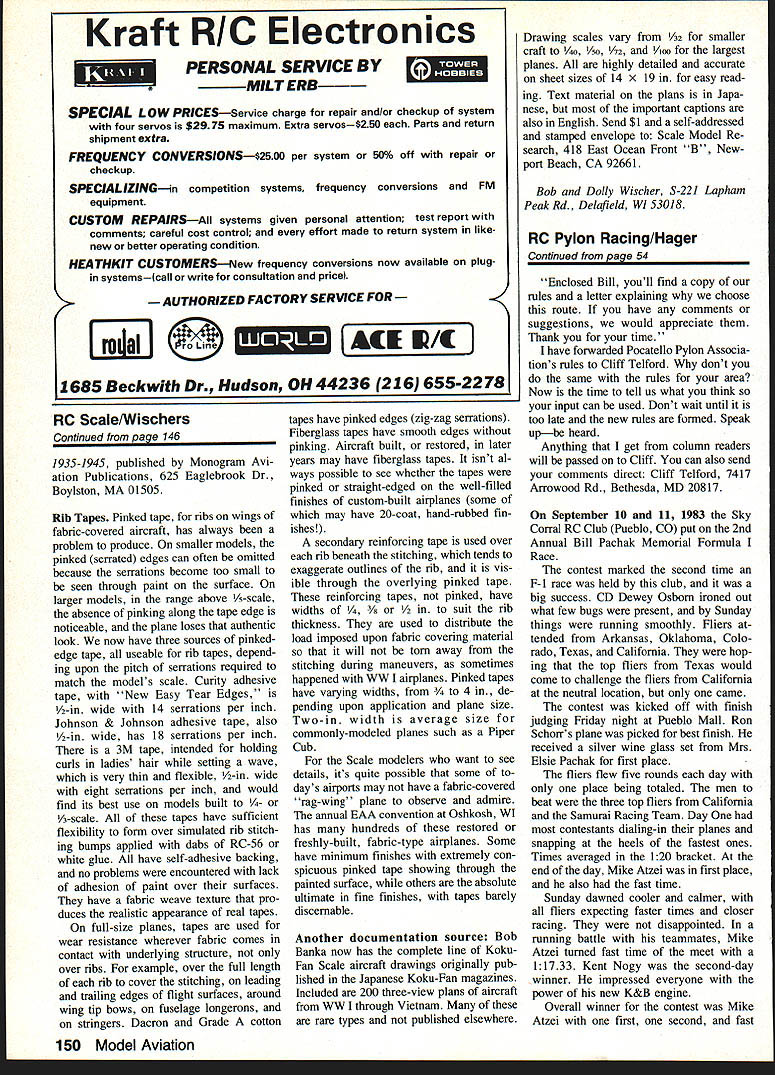
- Bob Hanft (modified Jemco kit): Grumman F6F-5 Hellcat entered at the Nats, 8.25 lb, 58 in span; Webra 61 engine.
Le Bourget (Paris) site and contest notes
France is expected to host the 1984 RC/CL Scale World Championships at Le Bourget airport, July 2–8. Event details:
- Giant Scale models: 6–10 kg, three engines maximum.
- Fourteen nations offered RC teams (same number as Reno); nine nations for CL Scale.
Le Bourget is no longer a primary airline field; it sees some civil activity (small planes, trainers, light twins) and occasional military traffic (a row of Lockheed Hercules was noted). The model contest area lies in front of hangars that now house the Paris Air Museum; the model flying area is about 1/2 mile from the museum. The museum contains primarily post–WWII aircraft (including an early test Concorde) housed indoors in hangars adjacent to the old terminal, which is under restoration. Upper stories of the terminal contain apartments for museum employees. While visiting we met René Fouquereau, a frequent Scale World Championships contestant who lives and works at the museum; his documentation sources are readily available there.
Documentation sources
- Dick Gleason (Gleason Enterprises): Expanded catalog of Scale drawings (more than 20 pages). Contains lists of 1,300+ three-view drawings, detailed engine drawings, and some model construction drawings. Gleason offers a plan-finder service listing publication sources for 3-views, construction drawings and photos of scale models. He has tabulated roughly 2,500 listings covering 1,900 models of 615 makes (most Scale plans published in the model press over the past 60 years). Catalog $1.00.
- Bob Banka: Complete line of Koku-Fan scale aircraft drawings originally published in the Japanese Koku-Fan magazines. Includes 200 three-view plans of aircraft from WWII through Vietnam; many rare types not published elsewhere.
Rib tapes
Pinked (serrated-edge) tape for ribs on fabric-covered wings has always been an issue for scale modelers. On small models the serrations can be too fine to see after painting; on larger models (above about 1/2-scale) the absence of pinking is noticeable and detracts from authenticity. Three useful sources of pinked-edge tape have been identified; choose by serration pitch required for your model's scale:
- Curity adhesive tape: 1/2 in. wide, 14 serrations per inch.
- Johnson & Johnson adhesive tape: 1/2 in. wide, 18 serrations per inch.
- 3M hair-setting tape (for holding curls): very thin and flexible, 1/2 in. wide, 8 serrations per inch — best for 1/2- or 1/4-scale models.
All three tapes are flexible enough to form over simulated rib-to-spar joints when applied with small dabs of RC-56 or white glue. They have self-adhesive backing, accept paint without adhesion problems, and the fabric-weave texture gives a realistic appearance.
On full-size aircraft, tapes are used for wear resistance wherever fabric meets structure, not just over ribs: over the full length of each rib (to cover stitching), along leading and trailing edges, around wingtips, over hinges on fuselage longerons, and on stringers. Dacron and Grade A cotton tapes typically have pinked edges; fiberglass tapes are smooth-edged. Later restorations or modern builds may use fiberglass tape, so pinked edges are not universal.
A secondary reinforcing tape is often applied beneath rib stitching to distribute loads; these reinforcing tapes are not pinked and come in widths of 1/4, 3/8 or 1/2 in. Pinked tapes vary from about 3/4 to 4 in. in width depending on application; 2 in. is an average for commonly modeled planes such as the Piper Cub.
For scale modelers seeking real-world reference, the annual EAA convention at Oshkosh, Wis., displays many restored and newly built fabric-covered airplanes, from minimally finished to ultra-fine hand-rubbed finishes where tapes are barely discernible.
Transcribed from original scans by AI. Minor OCR errors may remain.

