
Radio Control: Scale
Bob & Dolly Wischer
Reno Nats
High altitude and hot weather in August will influence flights at Reno Stead Field, site of the Nats outdoor activity. The field is about one mile above sea level. Combined with expected temperatures in the 80s, this will place density altitude in the range of roughly 8,000 to 9,000 feet. Combined high temperature and altitude will affect models as though the field elevation were over 1½ miles.
Modelers who regularly fly at Reno, and those in Colorado and New Mexico, often say altitude has little effect. Having witnessed a few problems at the Reno Scale World Championships in 1982, we know there is an effect. Modelers accustomed to those conditions make compensations for reduced air density with longer takeoff runs and faster landings as routine practice. Higher nitro content in fuel can replace some of the energy lost by engines because of reduced oxygen.
Anyone with full-size airplane experience who has flown into high-altitude fields knows the airspeed indicator reads the same at touchdown regardless of altitude. The difference is that the sensing head must move at a greater true airspeed in less dense air to register the same indicated airspeed as at lower altitude. Stall speeds (as shown on the airspeed indicator) are therefore the same at different altitudes and temperatures — only the ground speed varies. Propellers and wings must be moving faster to get the same "bite" in thinner air.
Here in Delafield, WI (about 600 feet above sea level), we see density effects mainly as performance differences with temperature changes. Our 400-foot club field is barely long enough when tall corn is at the critical end during hot, humid summer weather. First flights in the chill of autumn are always a revelation due to short takeoff runs and steeper climbs — a change of only about 8% in air weight.
A heavy scale model with marginal performance at low altitude can become unmanageable when flown from a surface 1½ miles high. After a successful takeoff, the first time the wing is heavily loaded by a high-G maneuver it may refuse to carry the model’s weight. Modelers who live at high altitudes learn the importance of building light and using sufficient power. Most modelers over-power their planes to get a climb angle typically about ten times more abrupt than that of a full-size prototype.
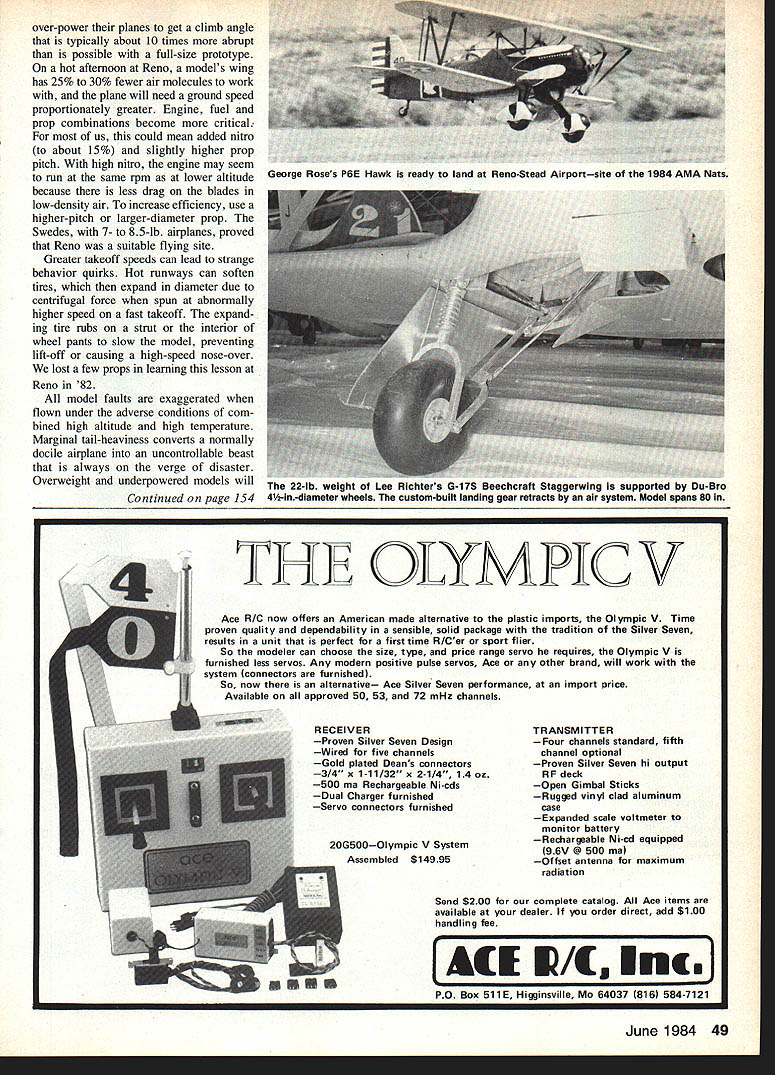
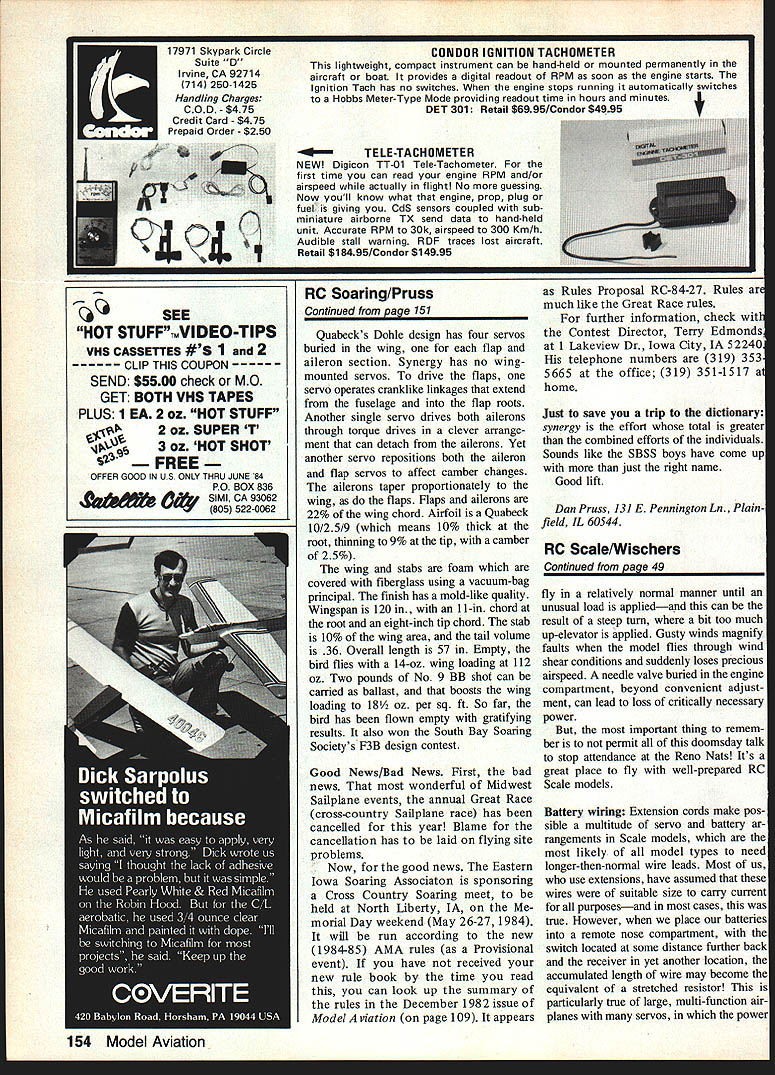
On a hot afternoon at Reno, a model's wing may have 25%–30% fewer air molecules to work with, and the plane will need a proportionately greater ground speed. Engine, fuel and prop combinations become more critical. For many, this means adding nitro (to about 15%) and using a slightly higher prop pitch. With high nitro, the engine may seem to run at the same rpm as at lower altitude because there is less drag on the blades in low-density air. To increase efficiency, use a higher-pitch or larger-diameter prop. The Swedes, flying 7–8.5 lb airplanes, proved Reno is a suitable flying site when properly prepared.
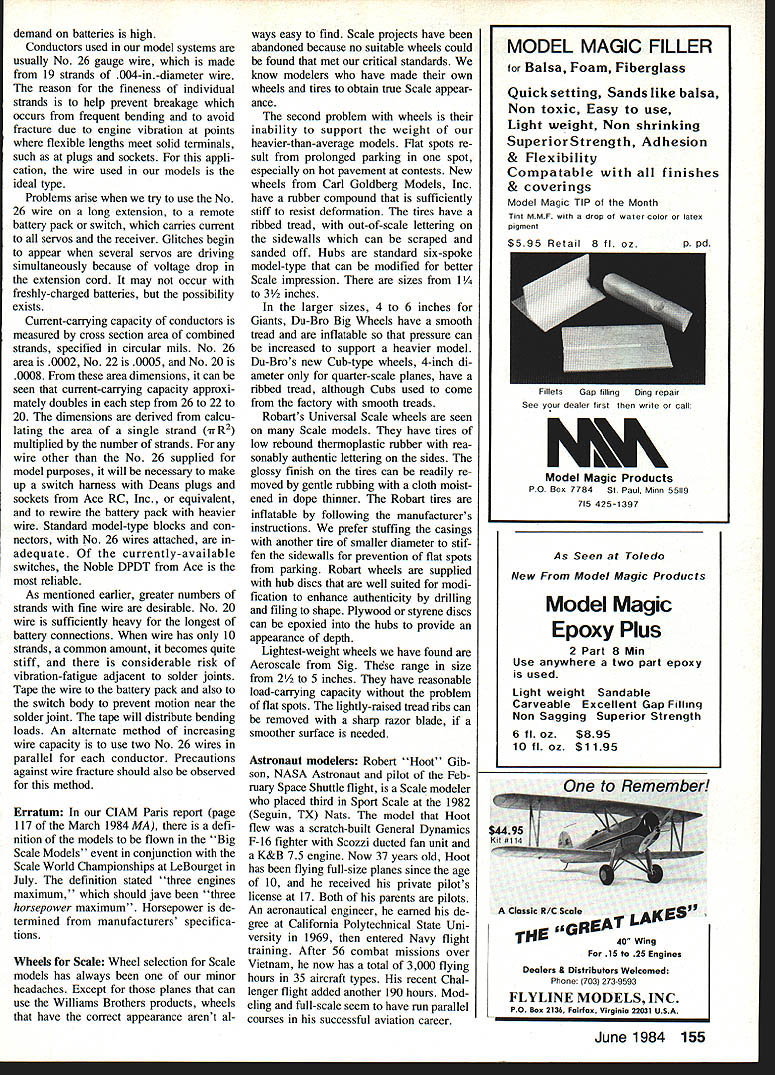
Greater takeoff speeds can lead to odd behavior. Hot runways can soften tires, which then expand in diameter due to centrifugal force when spun at unusually high speed during a fast takeoff. An expanding tire can rub on a strut or the inside of wheel pants, slowing the model, preventing lift-off, or causing a high-speed nose-over. We lost a few props learning this lesson at Reno in 1982.
All faults are exaggerated under the combined adverse conditions of high altitude and high temperature. Marginal tail-heaviness can convert a normally docile airplane into an uncontrollable beast on the verge of disaster. Overweight, underpowered models will fly relatively normally until an unusual load is applied — for example, a steep turn with a bit too much up-elevator. Gusts will magnify faults when the model flies through wind shear and loading changes suddenly. A needle valve buried in the engine compartment beyond convenient adjustment can lead to loss of critically necessary power.
But — do not let this doomsday talk deter attendance at the Reno Nats! It’s a great place to fly with well-prepared RC scale models.
Battery wiring
Extension leads often make it possible to balance servo and battery arrangements in scale models, which more than other types are likely to need longer-than-normal wire lengths. Many users assume the supplied extension wire is adequate for all purposes — and in most cases it is. However, when batteries are placed in a remote nose compartment, with the switch further back and the receiver in another location, the total wire length can become the electrical equivalent of a stretched resistor. This is especially true in large, multi-function airplanes with many servos, where the demand on batteries is high.
Conductors used in models are usually No. 26 gauge wire, made from fine strands to resist breakage from bending and to reduce vibration-induced fracture where flexible lengths meet solid terminals. For short runs this is ideal. Problems arise when No. 26 is used for long extensions carrying current to all servos and the receiver: glitches begin when several servos operate simultaneously because of voltage drop in the extension. It may not occur with freshly charged batteries, but the risk exists.
Current-carrying capacity is proportional to conductor cross-sectional area. The area — and thus capacity — increases roughly twofold going from No. 26 to No. 22 to No. 20. For long battery connections, use heavier wire (No. 20 is a suitable choice) and remake switch harnesses with heavy wire and reliable plugs (for example, Deans plugs and sockets). Standard model-type blocks and connectors with No. 26 attached are inadequate for high current long runs. Of the currently available switches, the Noble DPDT from Ace is noted for reliability.
When using heavier wire, beware of vibration-fatigue at solder joints: wire with only a few thick strands becomes stiff and transfers bending loads to the solder points. Tape the wire to the battery pack and to the switch body to prevent motion near solder joints; the tape helps distribute bending stresses. An alternative to heavier single conductors is to use two No. 26 wires in parallel for each conductor, but take precautions against wire fracture if you use this method.
Erratum
In our CIAM Paris report (page 117 of the March 1984 MA) there is a definition of the models to be flown in the "Big Scale Models" event in conjunction with the Scale World Championships at Le Bourget in July. The definition stated "three engines maximum," which should have read "three horsepower maximum." Horsepower is determined from manufacturers' specifications.
Wheels for Scale
Wheel selection has long been a headache. Except for planes that can use Williams Brothers products, appropriately scaled wheels are not always easy to find. Some scale projects have been abandoned because no suitable wheels met critical standards. Some modelers make their own wheels and tires to obtain true scale appearance.
A second problem is load-carrying capacity. Heavy models parked for long periods, especially on hot pavement at contests, can develop flat spots. Recent wheel options include:
- Carl Goldberg Models, Inc.
- New wheels with a rubber compound stiff enough to resist deformation.
- Ribbed tread with out-of-scale sidewall lettering (lettering can be scraped/sanded off).
- Standard six-spoke hubs that can be modified for better scale appearance.
- Sizes: 1¼ to 3½ inches.
- Du-Bro
- Big Wheels (4 to 6 inches) for giants: smooth tread and inflatable so pressure can be increased to support heavier models.
- New Cub-type wheels (4-inch diameter, for quarter-scale planes) have a ribbed tread (historically, Cubs came from the factory with smooth treads).
- Robart Universal Scale wheels
- Tires of low-rebound thermoplastic rubber with reasonably authentic sidewall lettering.
- Glossy finish on tires can be removed by gentle rubbing with a cloth moistened in dope thinner.
- Robart tires are inflated per the manufacturer's instructions.
- We prefer stuffing the casings with another, smaller tire to stiffen sidewalls and prevent flat spots from parking.
- Hubs include discs suited for modification; plywood or styrene discs can be epoxied into hubs to provide an appearance of depth.
- Aeroscale (Sig)
- Lightest-weight wheels found by us, sizes from 2½ to 5 inches.
- Reasonable load-carrying capacity without pronounced flat-spot problems.
- Lightly raised tread ribs can be removed with a sharp razor if a smoother surface is desired.
Astronaut modelers
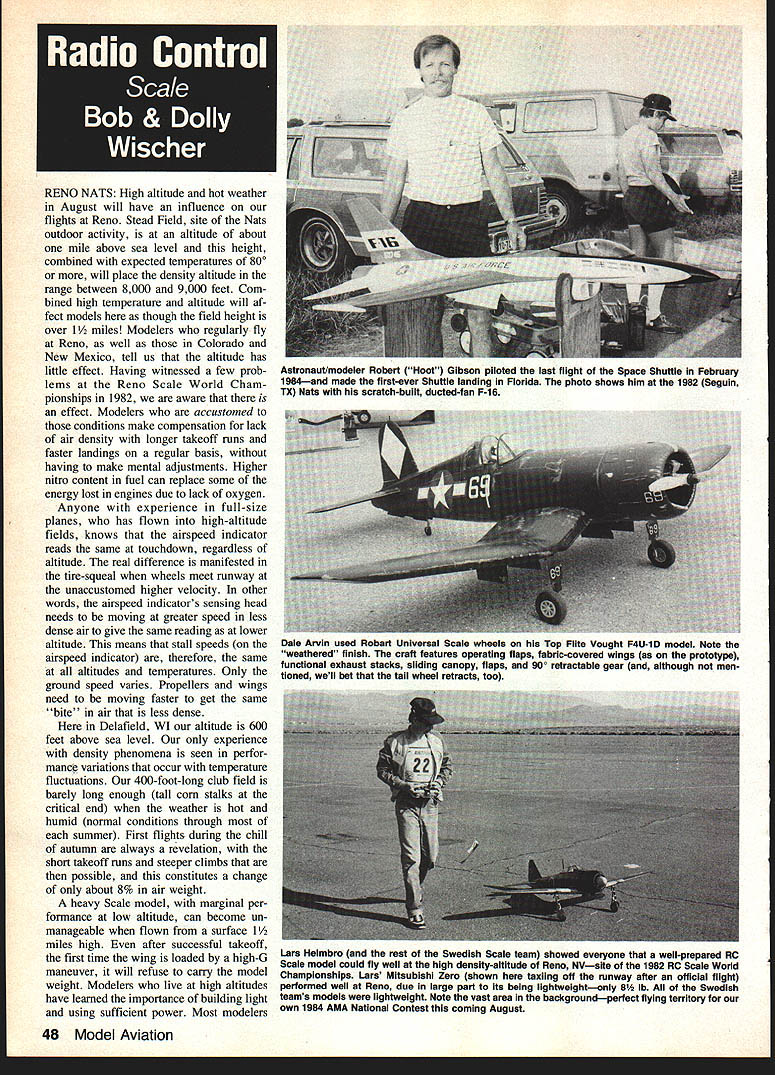
Robert "Hoot" Gibson, NASA astronaut and pilot on a February Space Shuttle flight, is a scale modeler who placed third in Sport Scale at the 1982 Nats (Seguin, TX). His model was a scratch-built General Dynamics F-16 fighter with a Scozzi ducted-fan unit and a K&B 7.5 engine.
Now 37 years old at the time of reporting, Hoot has been flying full-size planes since age 10 and received his private pilot's license at 17. Both parents are pilots. An aeronautical engineer, he earned his degree at California Polytechnic State University in 1969, then entered Navy flight training. After 56 combat missions over Vietnam, he had accumulated 3,000 flying hours in 35 aircraft types; his recent Challenger flight added another 190 hours. Modeling and full-size aviation have run parallel courses in his successful career.
Transcribed from original scans by AI. Minor OCR errors may remain.

