
Radio Control: Scale
Bob & Dolly Wischer
As usual, the throng of enthusiasts filled the aisles at the Toledo Expo, and the single most tightly packed area surrounded Dave Brown's exhibit. His radio-control flight simulator for the Apple II computer was in constant use for the full three days. A large percentage of pilots who attempted to control the flight of the model image on the picture tube had their joy abruptly interrupted by a shattering crash, followed by the bad news of the cost for damage repairs. We saw one demonstration, by Dave himself, of a difficult Rolling Circle maneuver which was completed successfully, to prove that the model image could be flown.
Centerpiece in the Sig exhibit was Claude McCullough's latest masterpiece in Scale, the Morrisey Bravo. The plane's name may not be familiar at present, but it will become better-known as more of the home-built aircraft appear at Oshkosh and other fly-in conventions. The full-size Bravo is offered in kit form by Bill Morrisey, who was also the designer of Claude's famous Shinn 2150A (now called the Varga Kachina), which he flew in past Nats for many years. Look for the Bravo model kit from Sig in autumn of 1984. The aircraft has the appearance of a design that was intended for modeling, with all of the correct proportions. A large airplane with an 84-in. wingspan, it is intended to be powered with an engine of 2.0–3.5 cu. in. to carry its 19-lb. weight. One of its attractive features is that the stabilizer and landing gear are removable for transporting in a small car.
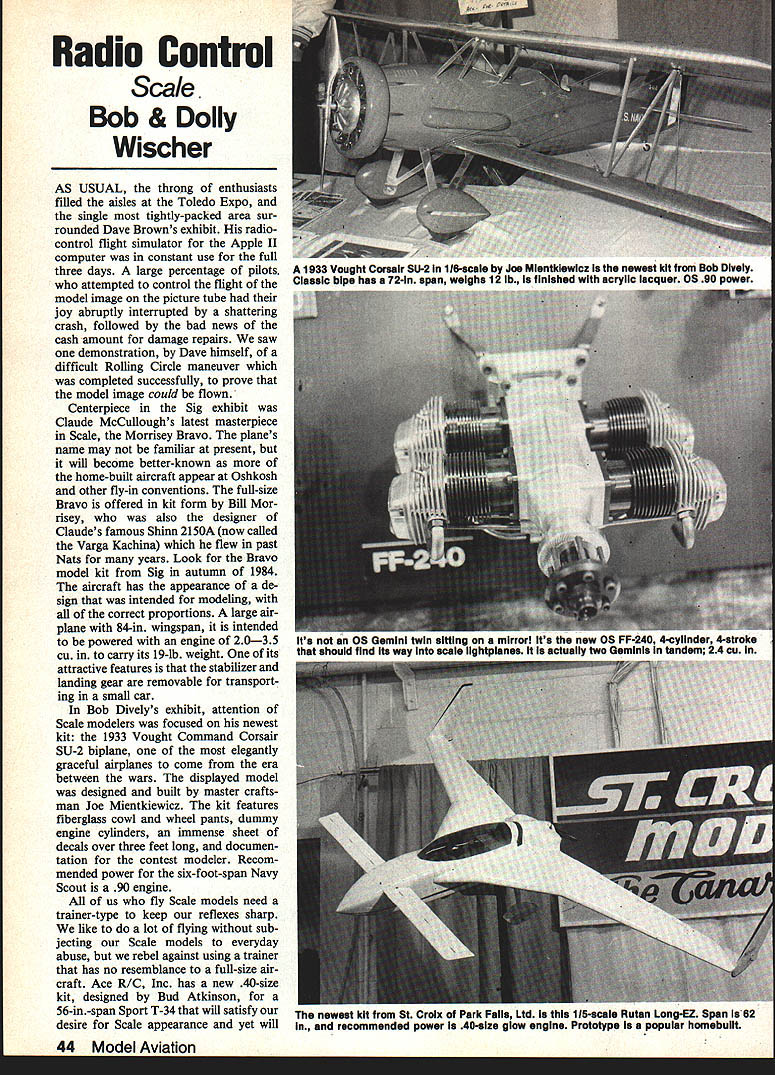
In Bob Dively's exhibit, attention of Scale modelers was focused on his newest kit: the 1933 Vought Command Corsair SU-2 biplane, one of the most elegantly graceful airplanes to come from the era between the wars. The displayed model was designed and built by master craftsman Joe Mientkiewicz. The kit features a fiberglass cowl and wheel pants, dummy engine cylinders, an immense sheet of decals over three feet long, and documentation for the contest modeler. Recommended power for the six-foot-span Navy Scout is a .90 engine.
All of us who fly Scale models need a trainer-type to keep our reflexes sharp. We'd like to do a lot of flying without subjecting our Scale models to everyday abuse, but we rebel against using a trainer that has no resemblance to a full-size aircraft. Ace R/C, Inc. has a new .40-size kit, designed by Bud Atkinson, for a 56-in. span Sport T-34 that will satisfy our desire for Scale appearance and yet will absorb the abuse of constant flying. The kit features a foam-core wing with balsa sheeting, balsa tail and fuselage, and vacuum-bagged construction.
Ace also has another item aimed at the Scale modeling group that uses large servos or long wire leads to remotely located servos. With the large, 150 in.-oz. servos, sometimes the small 26-gauge wire furnished in radio systems isn't adequate to carry the current loads, particularly in the battery pack and switch harness. Ace is now offering larger, 20-gauge, 19-strand wire in three colors and eight-foot lengths, so the R/C system can be re-wired as needed. They also offer a heavy-duty switch harness, ready-made, with Noble switch and Deans connectors.
The 20-gauge wire is available from other sources, but most have fewer strands and are, therefore, subject to vibration breakage unless precautions are taken to prevent the wire from bending near solder joints.
From Bob Violett Models come new carbon-fiber shapes to strengthen the weak spots in Scale models without adding unnecessary weight. Magnalite shapes now include strips, sheets, rods, and thin cord for wrapping joints. In addition, there are laminates of carbon fiber and end-grain balsa. Bob also is producing landing gears for 1/4-in. and 1/8-in. scale Lasers, made from carbon fiber laminated with a core of fiberglass. These gears have less than half the weight of aluminum and will return to their original shape after stressing from unusual landing loads.
Super-Scale models that are a year or two in building and weekend-special trainers are equally vulnerable to damage or loss due to battery failures. Jomar Products is marketing a Solid State Battery Backer that can be used on any model that will carry the additional load of an extra battery pack. It switches over to the extra pack whenever voltage of the first pack is reduced below 4.4 volts. A good share of our Scale jobs need the extra nose weight anyway; just substitute batteries for lead weights. Jomar also has an Accessory Controller that provides two actions from a single transmitter control when the lever is moved to either side of center. For example, internal and external bomb loads can be dropped separately using the same transmitter control moved to either side of center.
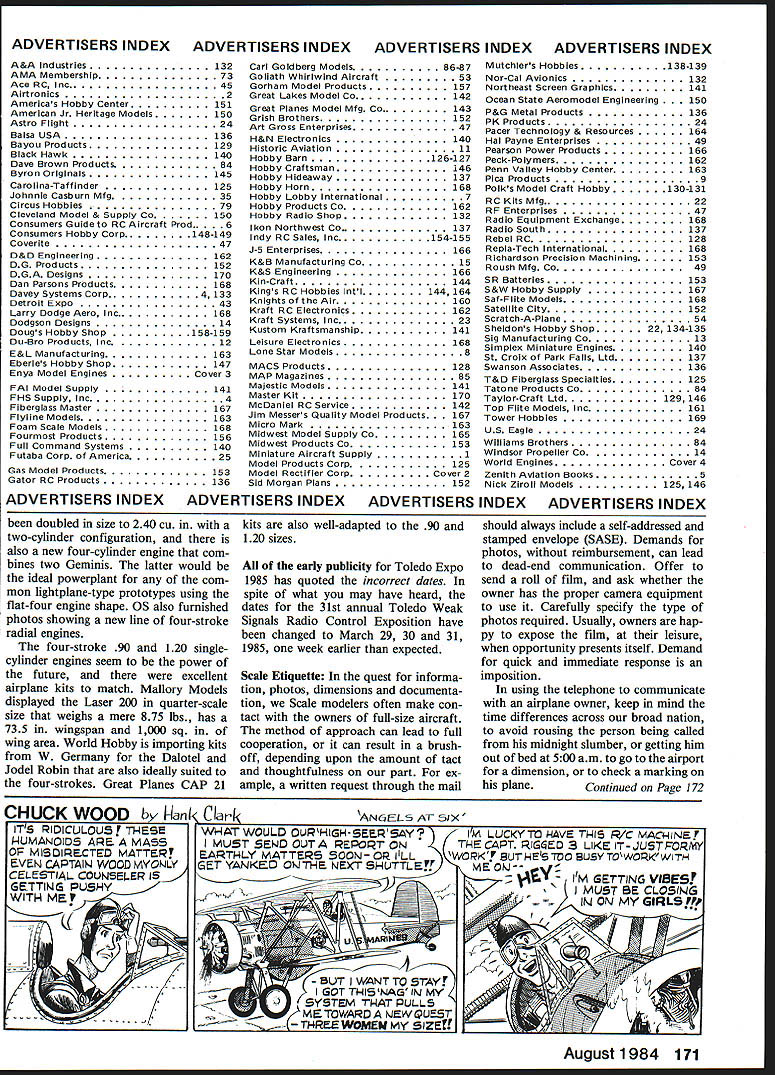
A truly outstanding model in the static display was Merritt Zimmerman's de Havilland 60 Moth biplane with another of his handmade, four-cylinder, 4.5 cu. in., four-stroke 1924 Cirrus engines, this one with ignition. Scale construction was followed as closely as possible. Tons of pressure were used to form the streamlined brace wires, using homemade dies, from Du-Bro pushrod wire. The streamlined steel wing struts were formed to shape from 1018 steel tubing. True-scale pinked tape on the Moth surfaces was produced from a hand-cranked tool that nearly serrated the edges in exact spacing. Tires were made from solid rubber that had been ground to a true clincher shape on a lathe. Wings and tail surfaces were semi-transparent (clear doped over Antique Coverite) to simulate the uncolored fabric of the original. Totally unglamorous at first glance, the model's many unique features gradually unfolded on closer examination. Many viewers passed it by without really seeing a near-perfect Scale rendition of the 60 Moth.
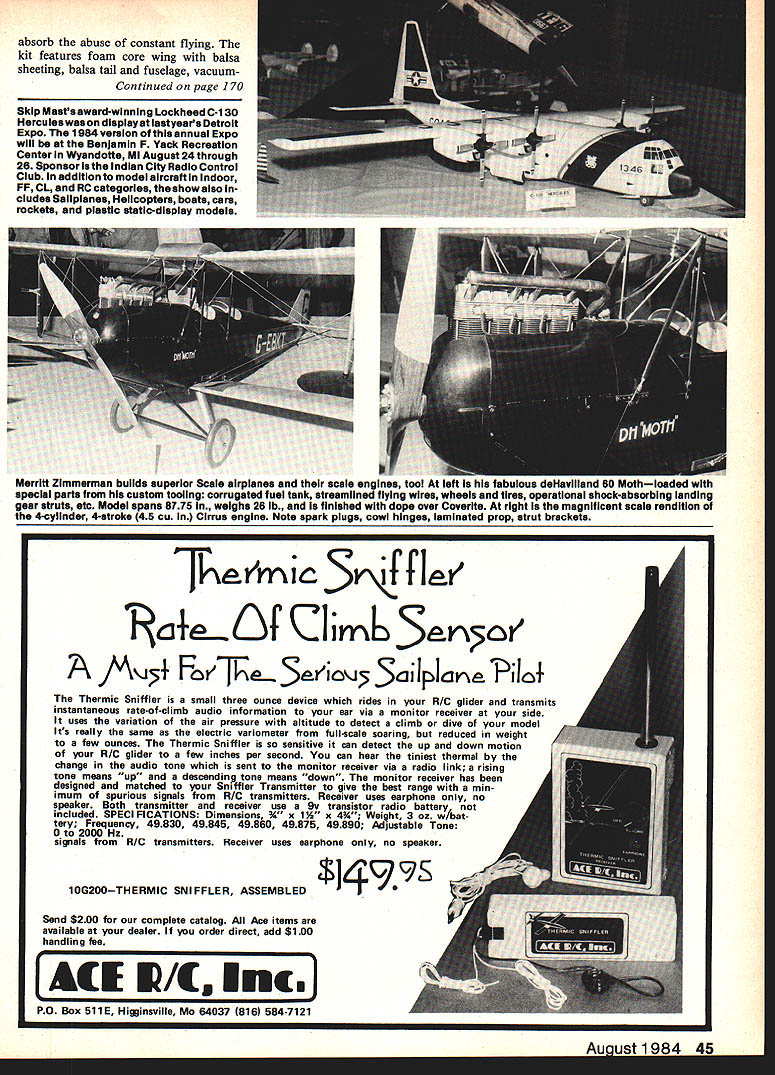
The World Engines exhibit displayed new engines to delight avid Scale modelers. The OS 1.20 Gemini twin has now been doubled in size to 2.40 cu. in. with a two-cylinder configuration, and there is also a new four-cylinder engine that combines two Geminis. The latter would be the ideal powerplant for any of the common lightplane-type prototypes using the flat-four engine shape. OS also furnished photos showing a new line of four-stroke radial engines.
The four-stroke .90 and 1.20 single-cylinder engines seem to be the power of the future, and there were excellent airplane kits to match. Mallory Models displayed the Laser 200 in quarter-scale size that weighs a mere 8.75 lbs., has a 73.5 in. wingspan and 1,000 sq. in. of wing area. World Hobby is importing kits from W. Germany for the Dalotel and Jodel Robin that are also ideally suited to the four-strokes. Great Planes CAP 21 kits are also well-adapted to the .90 and 1.20 sizes.
All of the early publicity for Toledo Expo 1985 has quoted the incorrect dates. In spite of what you may have heard, the dates for this 31st annual Toledo Weak Signals Radio Control Exposition have been changed to March 29, 30 and 31, 1985 — one week earlier than expected.
Scale Etiquette
In the quest for information, photos, dimensions and documentation, Scale modelers often make contact with the owners of full-size aircraft. The method of approach can lead to full cooperation, or it can result in a brushoff, depending upon the amount of tact and thoughtfulness on our part.
- Written requests: Always include a self-addressed stamped envelope (SASE). Demands for photos without reimbursement can lead to dead-end communication. Offer to send a roll of film, and ask whether the owner has the proper camera equipment to use it. Carefully specify the type of photos required. Usually, owners are happy to expose the film, at their leisure, when opportunity presents itself. Demand for quick and immediate response is an imposition.
- Telephone calls: Keep in mind time differences across our broad nation. Avoid rousing the person being called from midnight slumber or getting him out of bed at 5:00 a.m. to go to the airport for a dimension or to check a marking on his plane.
- On-site visits: When the airplane being modeled is within driving distance, offer to take the photos yourself at a time when the owner can best accommodate the task. Don't expect him to remove the plane from the hangar in foul weather, during a snowstorm, or at sub-freezing temperatures, particularly if the plane is parked in the back corner and a dozen other planes must be removed first. It has happened on several occasions that we have had to take our photos, with flash or time exposures if necessary, inside hangars rather than inconvenience someone with the toil and trouble of moving planes and opening larger hangar doors in cold weather. The cost to re-heat a chilled hangar can be considerable.
After the model is completed, be certain to show appreciation for the owner's cooperation by sending color photos. Even better, make arrangements to meet the owner to give him an opportunity for close examination of the model. His reaction may be surprising, especially when he realizes that the model duplicates the airplane with all of its markings.
Photo Source
Scale Model Research, the documentation source for color photos and Koku-Fan three-view drawings, is now operated by Bob Banka at a new address. Bob has color photo packs covering more than 600 aircraft types. For a catalog, send $1 and SASE to Scale Model Research, 418 E. Oceanfront "B", Newport Beach, CA 92661. Dale Willoughby, originator of the photo service, continues as photographer.
Rules omission error
Our new 1984–85 AMA rule book, on page 120, contains an error of omission in the FAI Radio Control Scale Model section that lists maximum engine displacements. The specification for two-stroke displacements on multi-engine airplanes was omitted. The complete specification should be as follows:
- Piston motors:
- 2-stroke, max. displacement:
- Single engine — 10 cm3
- Two or more engines — 20 cm3
- 4-stroke, max. displacement:
- Single engine — 20 cm3
- Two or more engines — 40 cm3
- Neither jet nor rocket motors may be used.
- Electric motors:
- Maximum voltage of power source — 42 volts (30 Ni-Cd cells in a row).
Bob and Dolly Wischer, S-221 Lapham Peak Rd., Delafield, WI 53018.
Transcribed from original scans by AI. Minor OCR errors may remain.

