
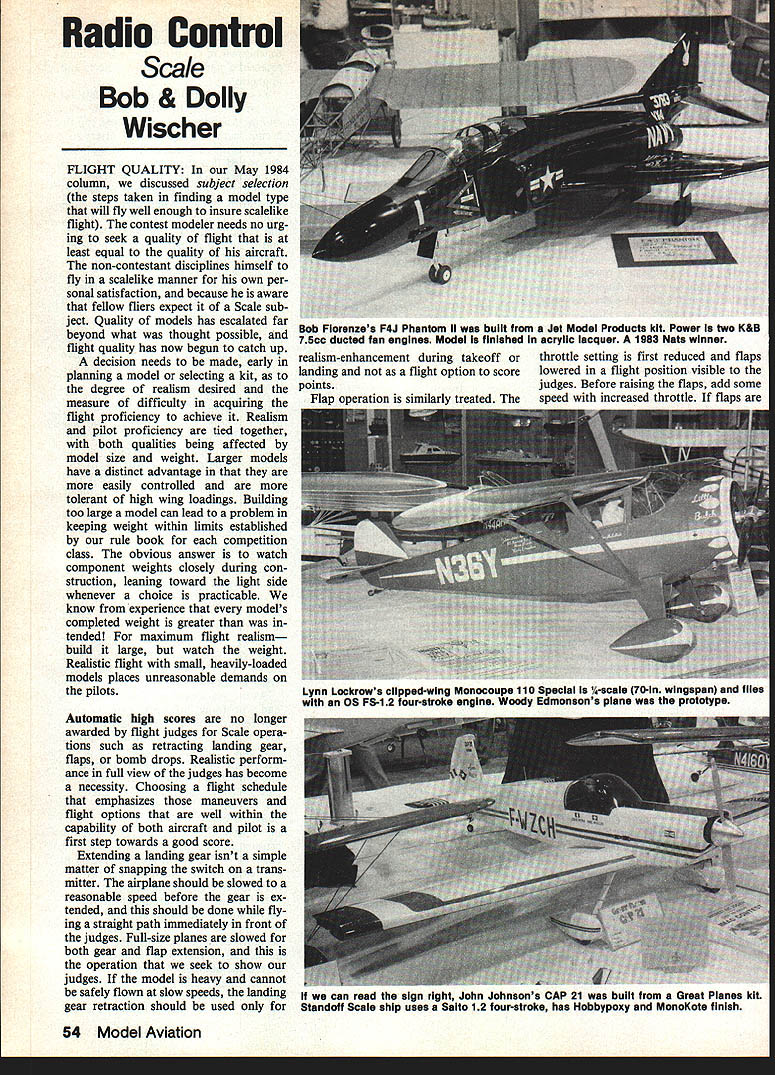
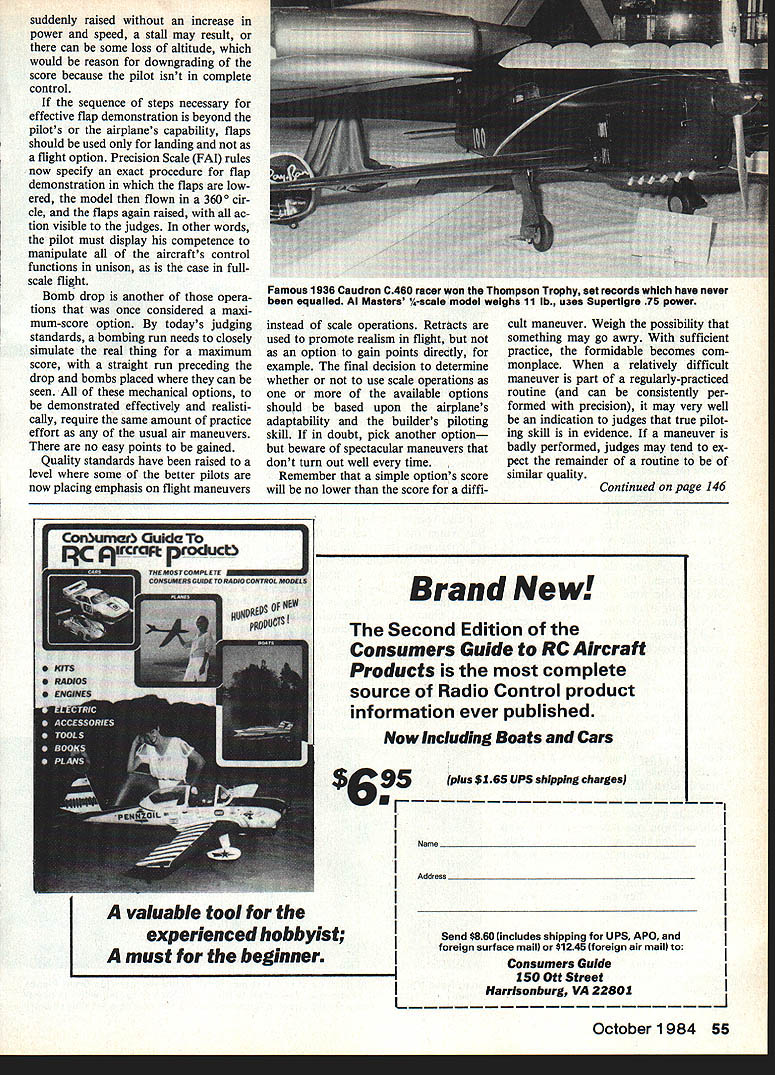
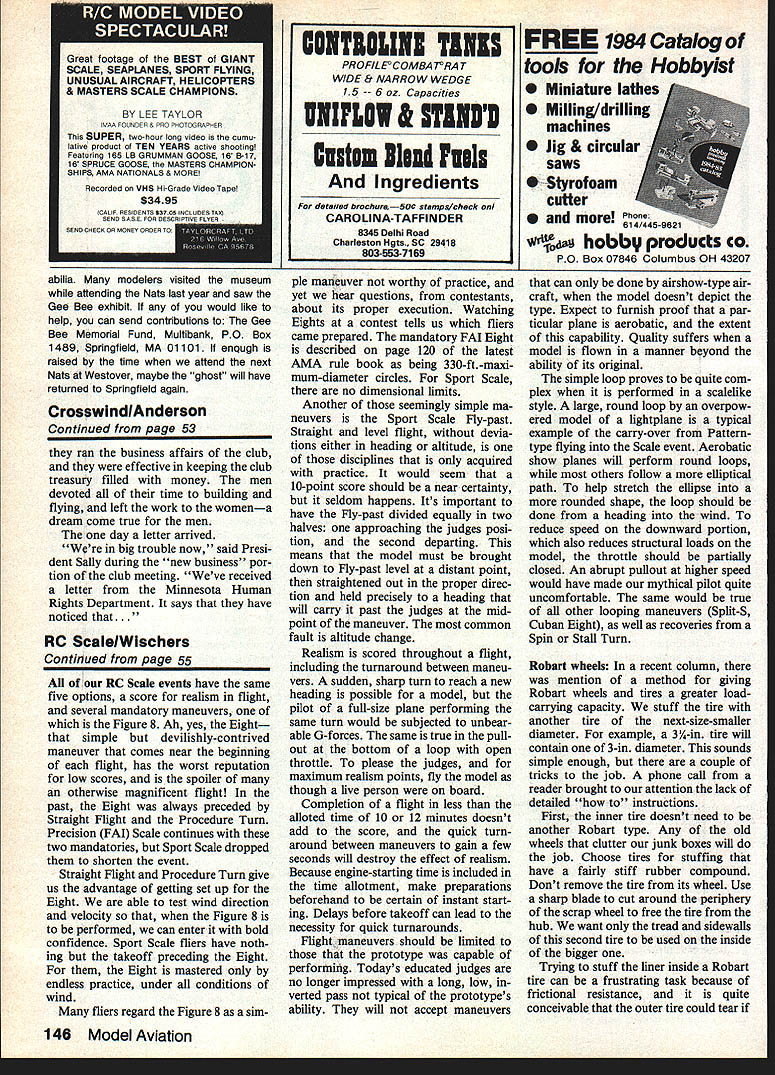
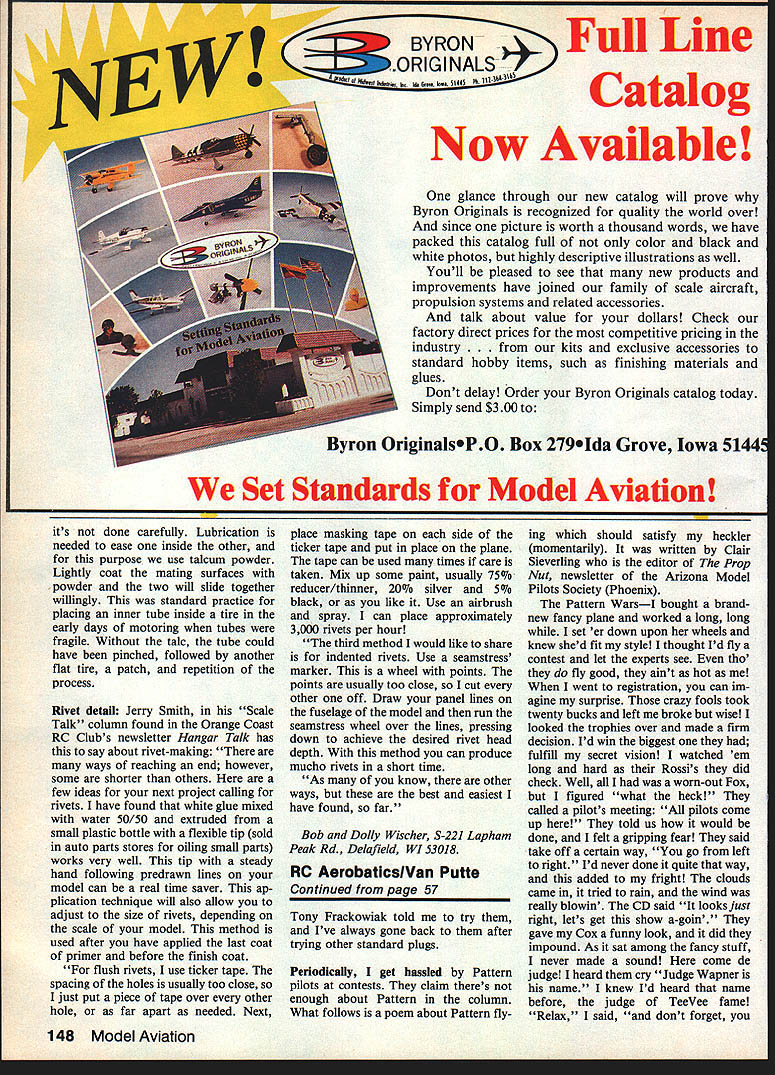
Radio Control: Scale
Flight Quality
In our May 1984 column we discussed subject selection—the steps taken to find a model type that will fly well enough to ensure scale-like flight. A contest modeler needs no urging to seek flight quality at least equal to his aircraft; a non-contestant disciplines himself to fly in a scale-like manner for personal satisfaction and because fellow fliers expect it of a Scale subject. Model quality has escalated far beyond what was once thought possible, and flight quality is beginning to catch up.
Decide early in planning or kit selection the degree of realism desired and the measure of difficulty in acquiring the pilot proficiency to achieve it. Realism and pilot proficiency are tied together and both are affected by model size and weight. Larger models have distinct advantages: they are more easily controlled and more tolerant of high wing loadings. Building too large a model can create difficulty keeping weight within the limits set by class rules. Watch component weights closely during construction and lean toward the light side whenever practicable—experience shows completed models almost always weigh more than intended. For maximum flight realism, build large but watch the weight. Realistic flight with small, heavily loaded models places unreasonable demands on pilots.
Automatic high scores are no longer awarded by flight judges for scale operations such as retracting landing gear, flaps, or bomb drops. Realistic, visible performance has become a necessity. Choose a flight schedule that emphasizes maneuvers and options well within the capability of both aircraft and pilot as a first step toward a good score.
Extending or retracting landing gear isn't a simple matter of snapping a switch. The airplane should be slowed to a reasonable speed before gear is extended, and this should be done while flying a straight path immediately in front of the judges. Full-scale planes slow for both gear and flap extension; our models should demonstrate the same procedure. If the model is heavy and cannot be safely flown at slow speeds, use the landing-gear retraction only for realism during takeoff or landing, not as a scoring flight option.
Flap operation should follow a similar logic. Reduce throttle and lower flaps in a flight position visible to the judges. Before raising flaps, add speed with increased throttle. If flaps are suddenly raised without an increase in power and speed, a stall or loss of altitude may result—grounds for downgrading because the pilot isn't in complete control. If the sequence required for an effective flap demonstration is beyond the pilot's or airplane's capability, use flaps as a landing-only option. Precision Scale (FAI) rules now specify an exact procedure for flap demonstration: lower the flaps, fly a 360° circle with the action visible to the judges, then raise the flaps—demonstrating coordinated control manipulation as in full-scale flight.
Bomb drops and other mechanical operations that were once regarded as automatic high-score options now must closely simulate the real thing to earn top marks. A maximum-score bombing run requires a straight run preceding the drop and bombs placed where the judges can see them. Mechanical options demonstrated effectively and realistically demand the same amount of practice as any aerial maneuver—there are no easy points.
Quality standards have been raised to the extent that many top pilots now emphasize flight maneuvers over scale-only operations. Retracts can promote realism but should not be used solely as a shortcut to points. Decide whether to use scale operations and available options based on the airplane's adaptability and the builder's and pilot's skill. If in doubt, choose a different option. Beware spectacular maneuvers that don't come off consistently—simple options will not score lower than a difficult maneuver performed poorly. With sufficient practice, a formidable maneuver becomes commonplace; when a difficult maneuver is part of a regularly practiced routine and can be performed consistently, judges may see true pilot skill. If a maneuver is badly performed, judges may expect the remainder of the routine to be of similar quality.
Completion of a flight in less than the allotted time (10 or 12 minutes) does not increase the score. Quick turnarounds between maneuvers to save a few seconds harm realism. Because engine-starting time is included in the time allotment, prepare beforehand for instant starts—delays before takeoff can force rushed, unrealistic flying.
Flight maneuvers should be limited to those the prototype could perform. Judges are no longer impressed by maneuvers inconsistent with the prototype—such as long, low inverted passes for planes that were not designed for them. Expect full points by proving aerobatic capability where appropriate; avoid flying a model in ways beyond its original’s ability.
Loops and other basic aerobatic figures must be flown scalelike. A large, round loop by an overpowered lightplane model often reflects Pattern-style flying rather than scale realism. Most non-aerobatic prototypes fly more elliptical loops. To help round an ellipse, perform the loop from a heading into the wind. Reduce throttle on the downward portion to lower speed and structural loads; an abrupt high-speed pullout would be unrealistic. The same scalelike considerations apply to Split-S, Cuban Eight, and recoveries from spins or stall turns.
RC Scale / Wischers
All of our RC Scale events have the same five options, a score for realism in flight, and several mandatory maneuvers—one of which is the Figure 8. The Figure 8 has a reputation for low scores and spoils many otherwise excellent flights. In the past the Eight was preceded by Straight Flight and the Procedure Turn; Precision (FAI) Scale retains these mandatories, while Sport Scale dropped them to shorten the event.
Straight Flight and the Procedure Turn provide the advantage of getting set up for the Eight: they allow testing of wind direction and velocity so the Figure 8 can be entered with confidence. Sport Scale fliers, with only takeoff preceding the Eight, must master the maneuver through endless practice under varied wind conditions.
Many fliers regard the Figure 8 as simple and unworthy of practice, yet questions from contestants show uncertainty about proper execution. Watching Eights at a contest reveals who came prepared. The mandatory FAI Eight is described in the AMA rule book as having circles of maximum 330 ft. diameter; Sport Scale has no dimensional limits.
Another seemingly simple maneuver is the Sport Scale fly-past. Straight and level flight, without deviations in heading or altitude, is a discipline only acquired with practice. A perfect 10-point fly-past is rare. Divide the fly-past equally: one half approaching the judges, the second half departing. The model must be brought down to fly-past level at a distant point, straightened to the proper heading, and held precisely so it passes the judges at the midpoint. The most common fault is altitude change.
Realism is scored throughout the flight, including turnarounds. Sudden, sharp turns or abrupt pullouts that are possible for a model but unrealistic for the full-scale airplane reduce realism points. Fly as though a live person were on board to maximize realism scoring.
Expect to earn points for maneuvers the prototype could actually perform. Aerobatic show maneuvers are acceptable only when the model depicts an aerobatic prototype and proof of capability exists. Quality suffers when a model is flown beyond its original's abilities.
Robart Wheels
Robart wheels and tires can be given greater load-carrying capacity by stuffing the tire with another tire of the next-smaller diameter (for example, a 3½-inch tire can contain a 3-inch tire). The method is simple in concept but has a few practical tricks.
- Choose the inner tire from any old wheel with a fairly stiff rubber compound; it need not be another Robart tire.
- Do not remove the outer tire from its wheel. Use a sharp blade to cut around the periphery of the scrap wheel to free the tire from the hub—retain only the tread and sidewalls for the liner.
- Lubricate the inner tire with soapy water, light silicone spray, or talc to reduce friction during installation.
- Work the inner tire in gradually, stretching and easing it into the outer tire. Use padded pliers, a blunt wooden dowel, or a short section of pipe as a rolling tool to ease the liner into place without cutting it.
- Avoid forcing the liner; excessive force can tear the outer tire. Take time and work the liner evenly around the circumference.
- Once the liner is fully seated, check the tire for proper fit and balance. Trim any irregular edges and reassemble the wheel.
- If desired for permanence, secure the liner with a suitable adhesive applied sparingly to avoid imbalance.
With patience and care, stuffing a Robart tire increases load capacity while preserving a good appearance and reliable performance.
Transcribed from original scans by AI. Minor OCR errors may remain.

