
RADIO CONTROL SCALE AEROBATICS
Eric Hawkinson, 319 Yellowstone Ave., Billings, MT 59101
For many of us, this is the "nonflying" season of the year. That means it's time to be busy working on next year's dream model and/or giving current models a thorough inspection in preparation for a fun-filled 1998. Whichever is the case for you, I hope you're enjoying it!
Mailbox
With a bimonthly column I have twice as much time to collect mail and input from readers. Here are a few samples:
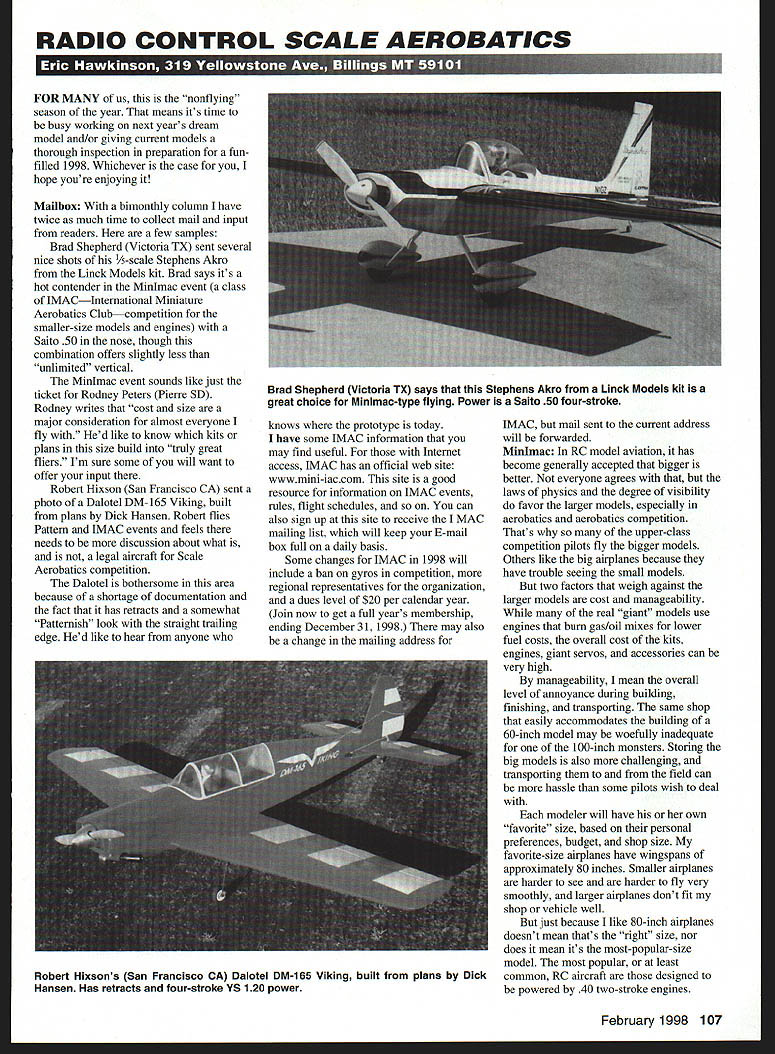
Brad Shepherd (Victoria, TX) sent several nice shots of his 3/5-scale Stephens Akro from the Linck Models kit. Brad says it's a hot contender in the Minimac event (a class of IMAC — International Miniature Aerobatics Club — competition for the smaller-size models and engines) with a Saito 50 in the nose, though this combination offers slightly less than "unlimited" vertical.
The Minimac event sounds like just the ticket for Rodney Peters (Pierre, SD). Rodney writes that "cost and size are a major consideration for almost everyone I fly with. I'd like to know which kits or plans in this size build into 'truly great fliers.'" I'm sure some of you will want to offer your input there.
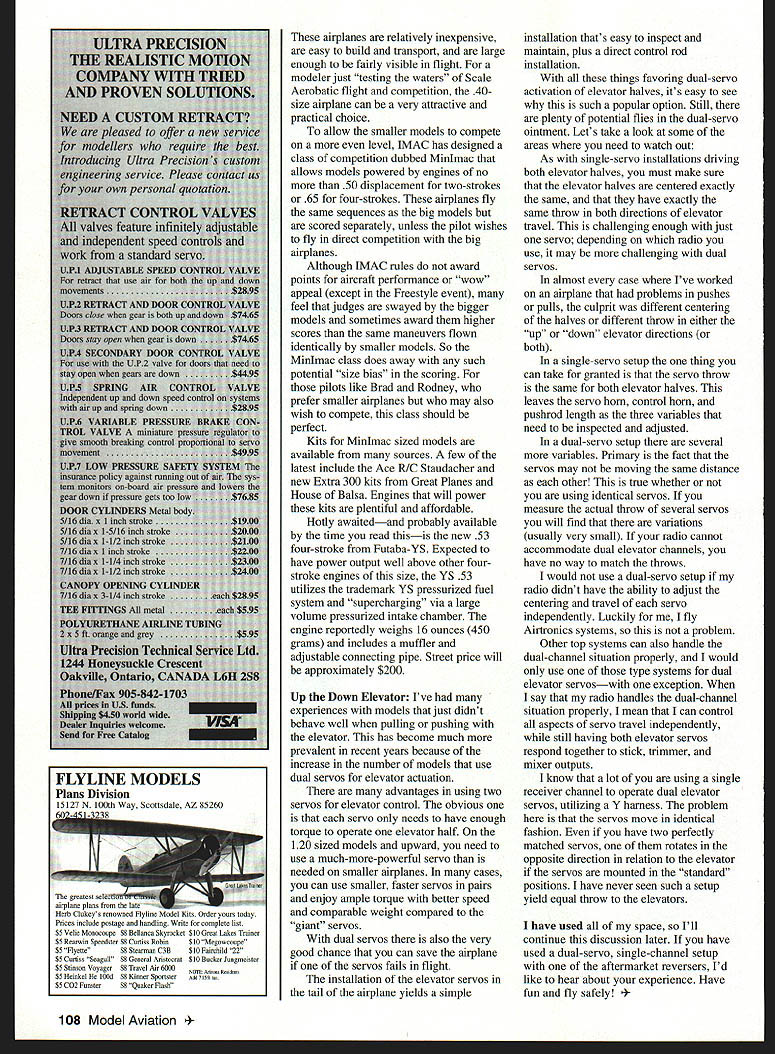
Robert Hixson (San Francisco, CA) sent a photo of a Dalotel DM-165 Viking, built from plans by Dick Hansen. Robert flies Pattern and IMAC events and feels there needs to be more discussion about what is, and is not, a legal aircraft for Scale Aerobatics competition.
The Dalotel is bothersome in this area because of a shortage of documentation and the fact that it has retracts and a somewhat "Patternish" look with the straight trailing edge. He'd like to hear from anyone who knows where the prototype is today.
I have some IMAC information that you may find useful. For those with Internet access, IMAC has an official web site: www.mini-imac.com. This site is a good resource for information on IMAC events, rules, flight schedules, and so on. You can also sign up at this site to receive the IMAC mailing list, which will keep your e-mail box full on a daily basis.
Some changes for IMAC in 1998 will include a ban on gyros in competition, more regional representatives for the organization, and a dues level of $20 per calendar year. (Join now to get a full year's membership, ending December 31, 1998.) There may also be a change in the mailing address for IMAC, but mail sent to the current address will be forwarded.
Minimac
In RC model aviation, it has become generally accepted that bigger is better. Not everyone agrees with that, but the laws of physics and the degree of visibility do favor the larger models, especially in aerobatics and aerobatics competition. That's why so many of the upper-class competition pilots fly the bigger models. Others like the big airplanes because they have trouble seeing the small models.
But two factors weigh against the larger models: cost and manageability. While many of the real "giant" models use engines that burn gas/oil mixes for lower fuel costs, the overall cost of the kits, engines, giant servos, and accessories can be very high.
By manageability, I mean the overall level of annoyance during building, finishing, and transporting. The same shop that easily accommodates the building of a 60-inch model may be woefully inadequate for one of the 100-inch monsters. Storing the big models is also more challenging, and transporting them to and from the field can be more hassle than some pilots wish to deal with.
Each modeler will have his or her own "favorite" size, based on personal preferences, budget, and shop size. My favorite-size airplanes have wingspans of approximately 80 inches. Smaller airplanes are harder to see and are harder to fly very smoothly, and larger airplanes don't fit my shop or vehicle well.
But just because I like 80-inch airplanes doesn't mean that's the "right" size, nor does it mean it's the most popular size. The most common RC aircraft are those designed to be powered by .40 two-stroke engines. These airplanes are relatively inexpensive, are easy to build and transport, and are large enough to be fairly visible in flight. For a modeler just testing the waters of Scale Aerobatic flight and competition, the .40-size airplane can be a very attractive and practical choice.
To allow the smaller models to compete on a more even level, IMAC has designed a class of competition dubbed Minimac that allows models powered by engines of no more than .50 displacement for two-strokes or .65 for four-strokes. These airplanes fly the same sequences as the big models but are scored separately, unless the pilot wishes to fly in direct competition with the big airplanes.
Although IMAC rules do not award points for aircraft performance or "wow" appeal (except in the Freestyle event), many feel that judges are swayed by the bigger models and sometimes award them higher scores than the same maneuvers flown identically by smaller models. The Minimac class removes any such potential size bias in the scoring. For pilots like Brad and Rodney, who prefer smaller airplanes but may also wish to compete, this class should be perfect.
Kits for Minimac-sized models are available from many sources, including:
- Ace R/C Staudacher
- New Extra 300 kits from Great Planes
- Kits from House of Balsa
Engines that will power these kits are plentiful and affordable.
Hotly awaited — and probably available by the time you read this — is the new .53 four-stroke from YS. Expected to have power output well above other four-stroke engines of this size, the YS .53 utilizes the YS pressurized fuel system and "supercharging" via a large-volume pressurized intake chamber. The engine reportedly weighs 16 ounces (450 grams) and includes a muffler and adjustable connecting pipe. Street price will be approximately $200.
Up the Down Elevator
I've had many experiences with models that just didn't behave well when pulling or pushing with the elevator. This has become much more prevalent in recent years because of the increase in the number of models that use dual servos for elevator actuation.
There are many advantages to using two servos for elevator control. The obvious one is that each servo only needs to have enough torque to operate one elevator half. On the 1.20-sized models and upward, you need to use a much more powerful servo than is needed on smaller airplanes. In many cases, you can use smaller, faster servos in pairs and enjoy ample torque with better speed and comparable weight compared to the "giant" servos.
With dual servos there is also the very good chance that you can save the airplane if one of the servos fails in flight. Installing the elevator servos in the tail of the airplane yields a simple installation that's easy to inspect and maintain, plus a direct control rod installation.
With all these advantages, it's easy to see why dual-servo activation of elevator halves is such a popular option. Still, there are plenty of potential flies in the dual-servo ointment. Here are some areas where you need to watch out:
- Centering and throw: As with single-servo installations driving both elevator halves, you must make sure that the elevator halves are centered identically and that they have exactly the same throw in both directions of elevator travel. This is challenging enough with just one servo; depending on which radio you use, it may be more challenging with dual servos.
- Variables in a single-servo setup: With one servo, the servo throw is the same for both elevator halves. The three variables that need inspection and adjustment are:
- The servo horn
- The control horn
- Pushrod length
- Additional variables in a dual-servo setup: There are several more variables when using two servos. Primary is the fact that the servos may not be moving the same distance as each other. This is true whether or not you are using identical servos; if you measure the actual throw of several servos you will find small variations. If your radio cannot accommodate dual elevator channels, you have no way to match the throws.
I would not use a dual-servo setup if my radio didn't have the ability to adjust centering and travel of each servo independently. Luckily for me, I fly Airtronics radios, so this is not a problem. Other top systems can also handle the dual-channel situation properly, and I would only use one of those types of systems for dual elevator servos — with one exception.
When I say my radio handles the dual-channel situation properly, I mean that it can control all aspects of servo travel independently, while still having both elevator servos respond together to the stick via mixer outputs.
I know that a lot of you are using a single receiver channel to operate dual elevator servos, utilizing a Y-harness. The problem here is that the servos move in identical fashion. Even if you have two perfectly matched servos, one of them rotates in the opposite direction relative to the elevator if the servos are mounted in the "standard" positions. I have never seen such a setup yield equal throw to the elevators.
If you have a dual-servo, single-channel setup with one of the aftermarket reversers, I'd like to hear about your experience. I have used all of my space, so I'll continue this discussion later. Have fun and fly safely!
Transcribed from original scans by AI. Minor OCR errors may remain.

