
RADIO CONTROL SCALE AEROBATICS
Paul Kopp, 1013 S. Sedona Ln., Anaheim CA 92808
Understanding the Figures
A pilot's scores will not improve without a good understanding of what each figure is supposed to look like.
Many entry-level figures sound deceptively simple, but the maneuver has to be flown with little or no error to score high—regardless of how simple or complex it is. Many judges are easier on entry-level pilots and focus only on obvious errors. Conversely, mistakes that might have been ignored in Basic will be downgraded in the upper classes.
A perfect figure will receive a 10, but that score is few and far between in front of a good judge, as are pilots who can consistently fly them.
Practice Tools
A vital practice tool is a "stick" plane, to give a pilot a visual representation of the maneuver. A stick airplane can be something as simple as a business card stuck across a pen, or a small model of the pilot's airplane, covered in MonoKote® and complete with graphics.
An experienced judge usually tries to answer questions by using a stick airplane, rather than relying on a verbal explanation. As part of their preparation for Unknowns, pilots "fly" the sequences with stick airplanes. Prior to the scored competition, many contests will have a pilot demonstrate the Unknowns using one of these tiny models, focusing on specific judging elements and answering questions from competitors.
Choice of Airplane
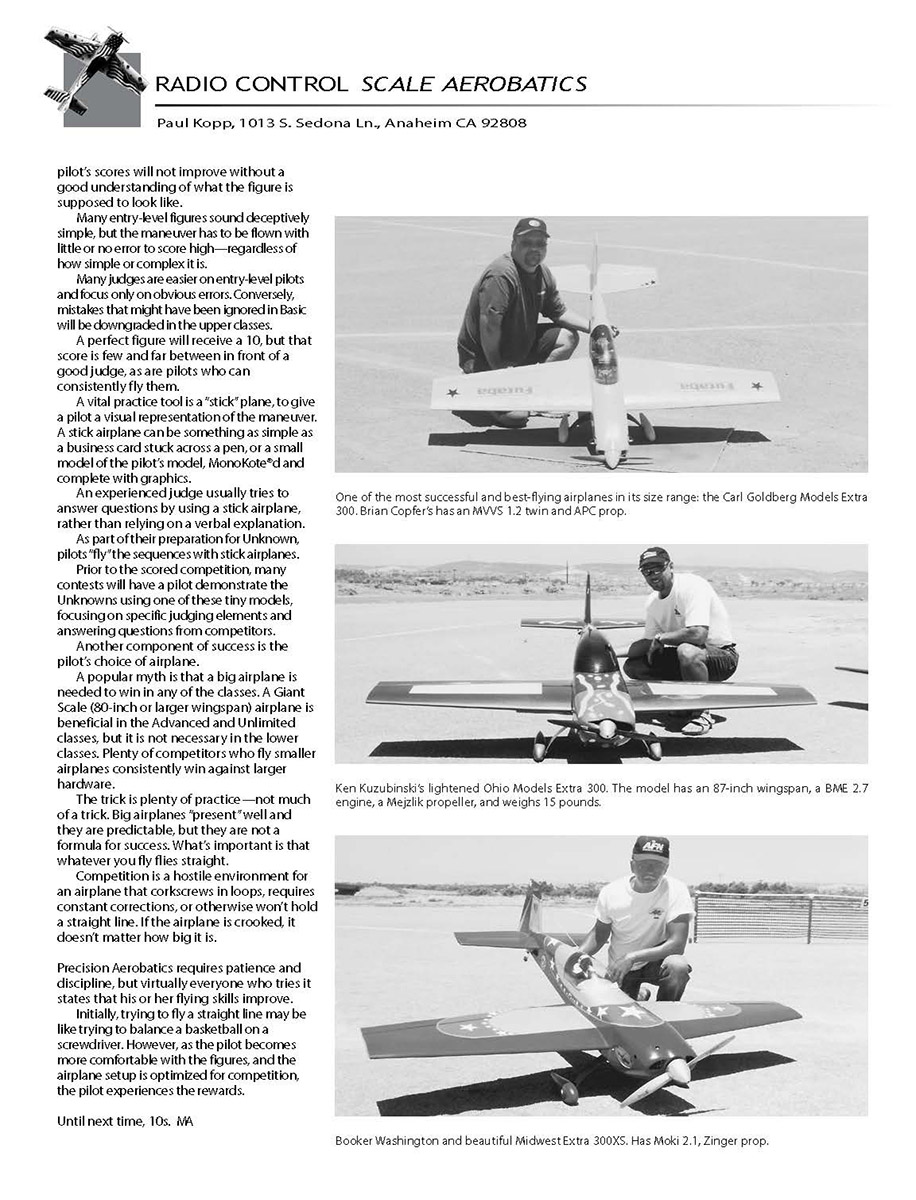
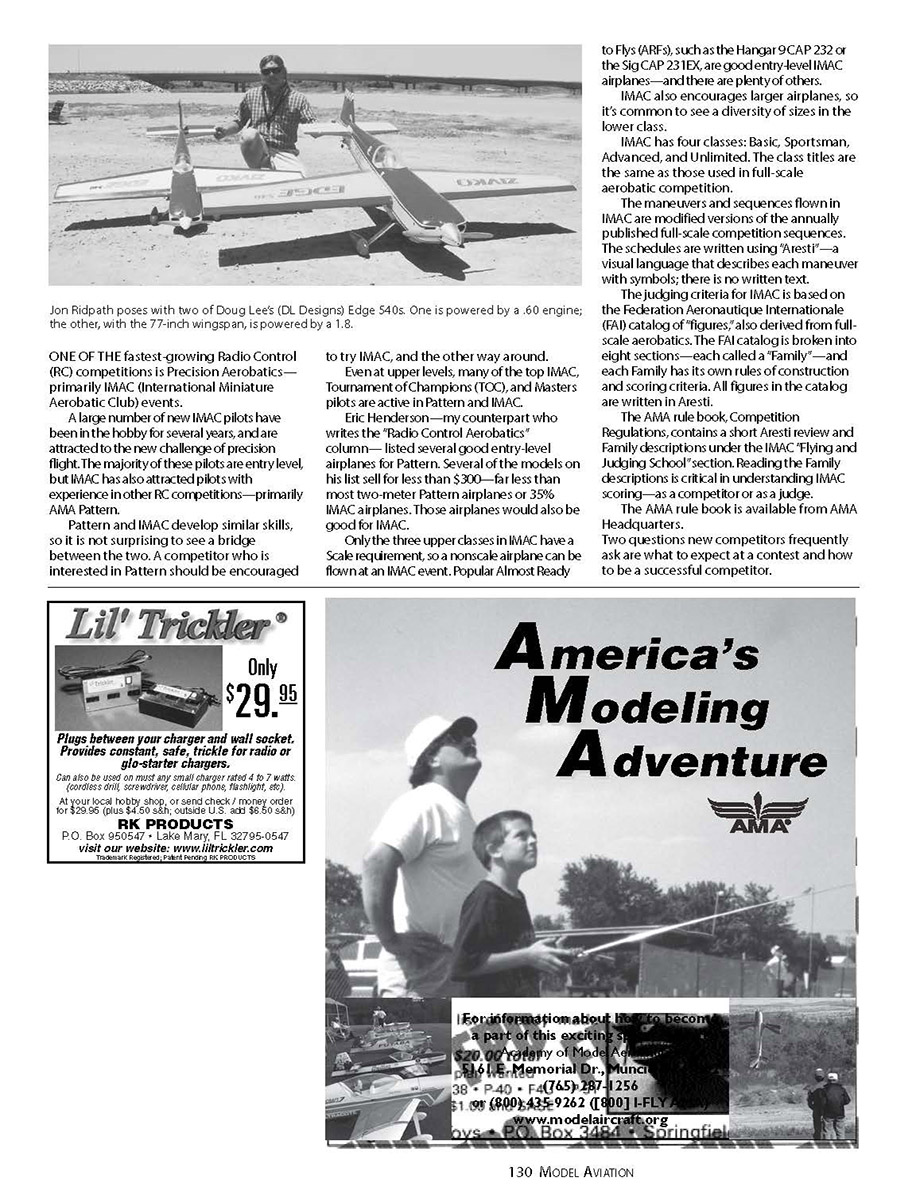
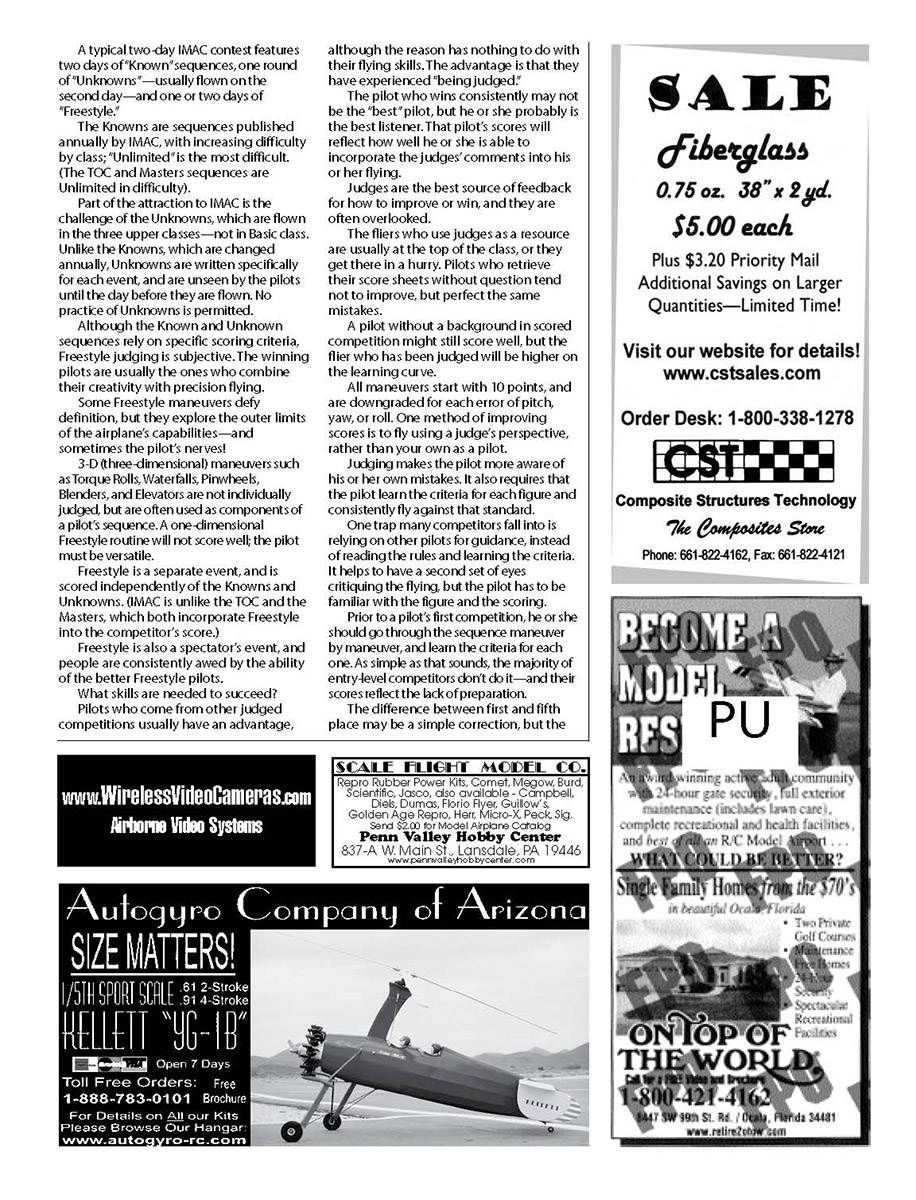
Another component of success is the pilot's choice of airplane. A popular myth is that a big airplane is needed to win in any of the classes. A Giant Scale (80-inch or larger wingspan) airplane is beneficial in the Advanced and Unlimited classes, but it is not necessary in the lower classes. Plenty of competitors who fly smaller airplanes consistently win against larger hardware.
The trick is plenty of practice—not much of a trick. Big airplanes "present" well and they are predictable, but they are not a formula for success. What's important is that whatever you fly flies straight. Competition is a hostile environment for an airplane that corkscrews in loops, requires constant corrections, or otherwise won't hold a straight line. If the airplane is crooked, it doesn't matter how big it is.
Precision aerobatics requires patience and discipline, but virtually everyone who tries it reports that his or her flying skills improve. Initially, trying to fly a straight line may be like trying to balance a basketball on a screwdriver. However, as the pilot becomes more comfortable with the figures and the airplane setup is optimized for competition, the pilot experiences the rewards.
Until next time.
What to Expect at a Contest
Two questions new competitors frequently ask are what to expect at a contest and how to be a successful competitor.
A typical two-day IMAC contest features two days of "Known" sequences, one round of "Unknowns"—usually flown on the second day—and one or two days of "Freestyle." The Knowns are sequences published annually by IMAC, with increasing difficulty by class; "Unlimited" is the most difficult. (The TOC and Masters sequences are Unlimited in difficulty.) Part of the attraction to IMAC is the challenge of the Unknowns, which are flown in the three upper classes—not in Basic class. Unlike the Knowns, which are changed annually, Unknowns are written specifically for each event and are unseen by the pilots until the day before they are flown. No practice of Unknowns is permitted.
Although the Known and Unknown sequences rely on specific scoring criteria, Freestyle judging is subjective. The winning pilots are usually the ones who combine their creativity with precision flying. Some Freestyle maneuvers defy definition, but they explore the outer limits of the airplane's capabilities—and sometimes the pilot's nerves!
3-D (three-dimensional) maneuvers such as:
- Torque Rolls
- Waterfalls
- Pinwheels
- Blenders
- Elevators
are not individually judged, but are often used as components of a pilot's sequence. A one-dimensional Freestyle routine will not score well; the pilot must be versatile.
Freestyle is a separate event and is scored independently of the Knowns and Unknowns. (IMAC is unlike the TOC and the Masters, which both incorporate Freestyle into the competitor's score.) Freestyle is also a spectator event, and people are consistently awed by the ability of the better Freestyle pilots.
What Skills Are Needed to Succeed
Pilots who come from other judged competitions usually have an advantage, although the reason has nothing to do with their flying skills. The advantage is that they have experienced "being judged."
The pilot who wins consistently may not be the "best" pilot, but he or she probably is the best listener. That pilot's scores will reflect how well he or she is able to incorporate the judges' comments into his or her flying. Judges are the best source of feedback for how to improve or win, and they are often overlooked.
Fliers who use judges as a resource are usually at the top of the class, or they get there in a hurry. Pilots who retrieve their score sheets without question tend not to improve, but to perfect the same mistakes. A pilot without a background in scored competition might still score well, but the flier who has been judged will be higher on the learning curve.
All maneuvers start with 10 points and are downgraded for each error of pitch, yaw, or roll. One method of improving scores is to fly using a judge's perspective, rather than your own as a pilot. Judging makes the pilot more aware of his or her own mistakes. It also requires that the pilot learn the criteria for each figure and consistently fly against that standard.
One trap many competitors fall into is relying on other pilots for guidance instead of reading the rules and learning the criteria. It helps to have a second set of eyes critiquing the flying, but the pilot has to be familiar with the figure and the scoring. Prior to a pilot's first competition, he or she should go through the sequence maneuver by maneuver and learn the criteria for each one. As simple as that sounds, the majority of entry-level competitors don't do it—and their scores reflect the lack of preparation.
The difference between first and fifth place may be a simple correction, but the pilot who recognizes and makes that correction will gain a significant advantage.
Transcribed from original scans by AI. Minor OCR errors may remain.

