
RADIO CONTROL SCALE AEROBATICS
Mike Hurley, 11542 Decatur Ct., Westminster CO 80234; E-mail: m.hurley@attbi.com
Aeroworks origins
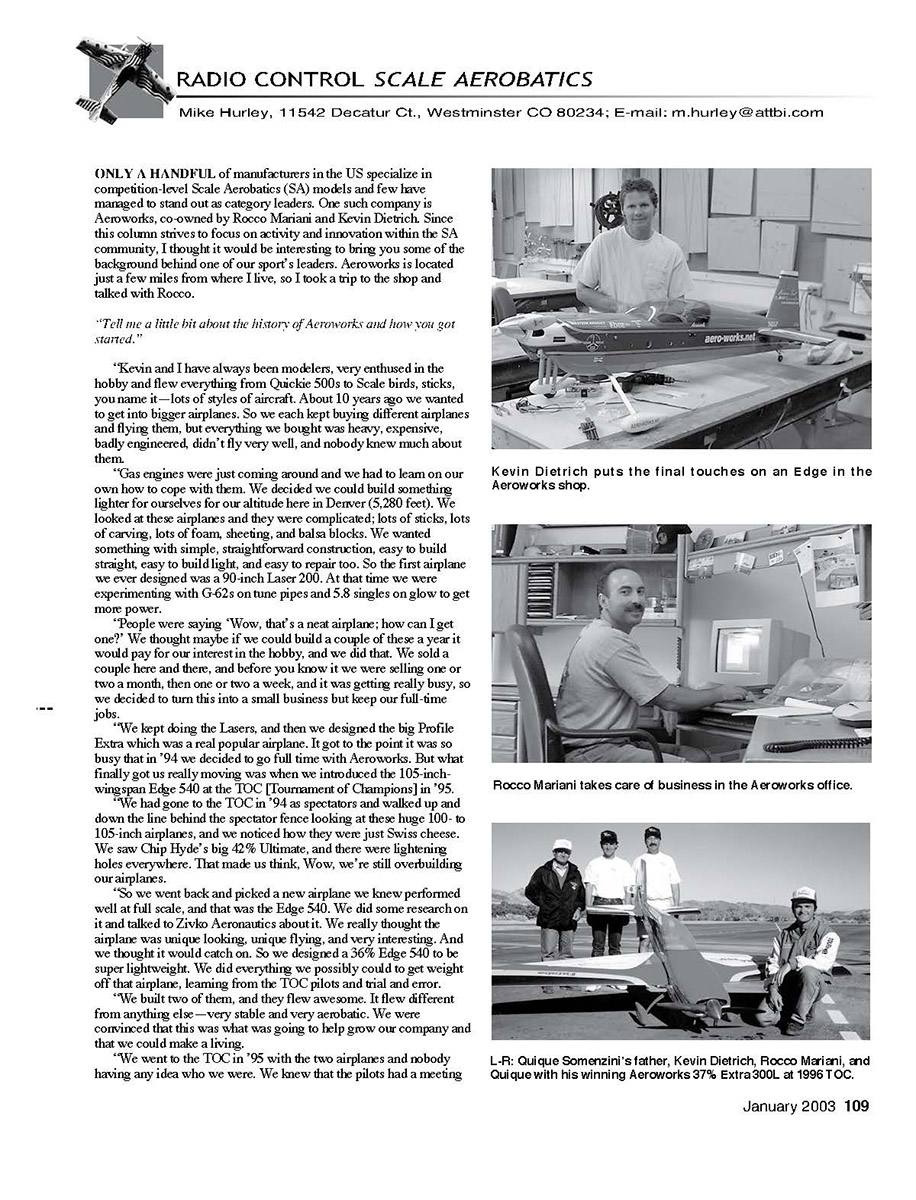
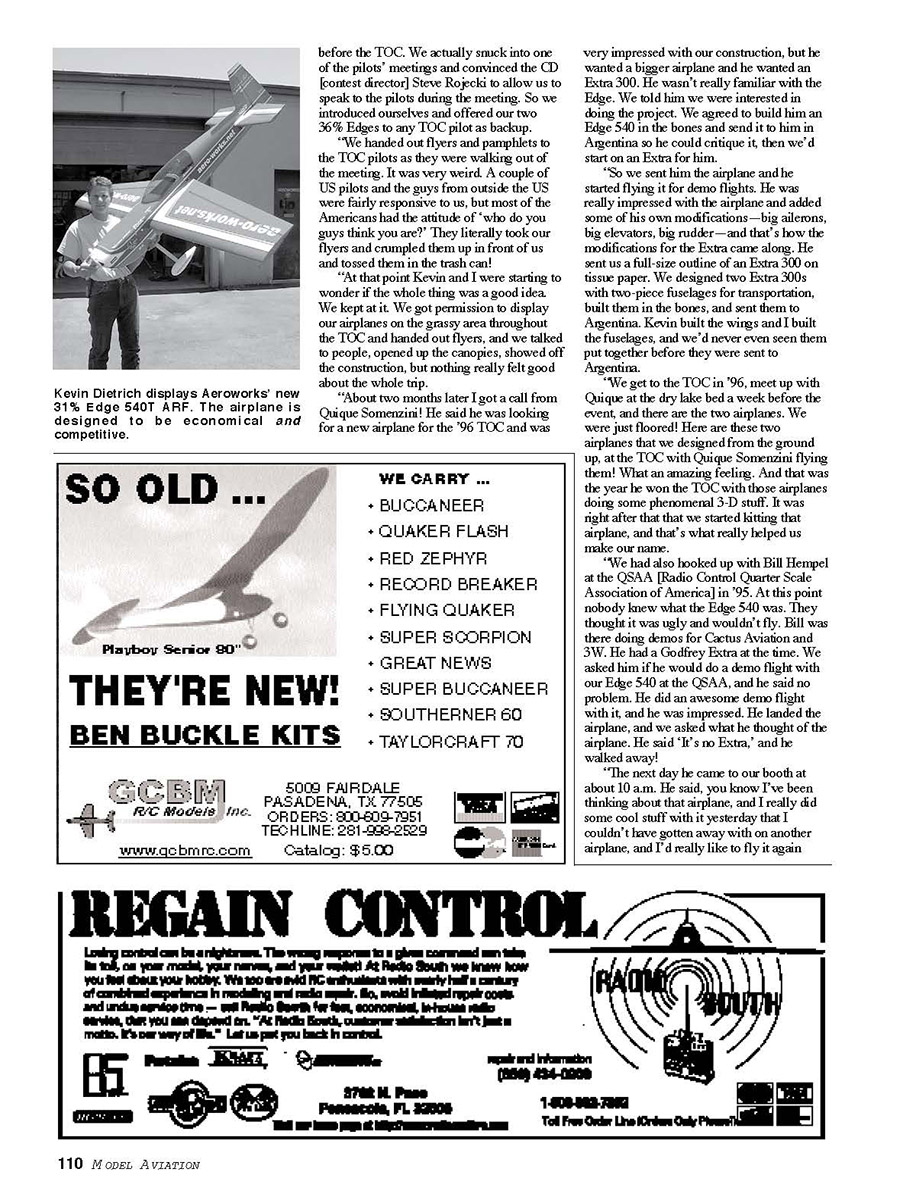
Only a handful of manufacturers in the U.S. specialize in competition-level Scale Aerobatics (SA) models, and few have managed to stand out as category leaders. One such company is Aeroworks, co-owned by Rocco Mariani and Kevin Dietrich. Since this column focuses on activity and innovation within the SA community, I visited Aeroworks—located just a few miles from where I live—and talked with Rocco.
Kevin and Rocco had always been enthusiastic modelers, flying everything from Quickie 500s to scale birds and sticks. About ten years ago they wanted to get into bigger airplanes. Everything they bought was heavy, expensive, badly engineered, didn't fly well, and lacked good support. Gas engines were becoming common and they learned to cope with them on their own. They decided they could build something lighter for flying at Denver altitude (5,280 feet).
They wanted simple, straightforward construction—easy to build straight, light, and easy to repair. The first airplane they designed was a 90-inch Laser 200. Early power experiments included G-62s on tune pipes and .58 singles on glow to get more power.
At first they thought building a couple a year would cover their hobby costs. Sales grew from a few here and there to one or two a month, then one or two a week. They kept producing Lasers and later designed the big Profile Extra, which was popular. Business grew until, in 1994, they went full time with Aeroworks. The real turning point came with the introduction of the 105-inch wingspan Edge 540 at the Tournament of Champions (TOC) in 1995.
TOC inspiration and design approach
At the 1994 TOC they noticed many large airplanes were overbuilt—full of lightening holes and excess structure. Inspired by Chip Hyde's 42% Ultimate and seeing opportunities to reduce weight, they picked a full-scale airplane they felt performed well: the Edge 540. They researched it and consulted Zivko Aeronautics. They designed a 36% Edge 540 to be super lightweight, removing every possible ounce of weight based on TOC pilot feedback and trial and error.
They built two 36% Edges that flew exceptionally well—stable and very aerobatic. Convinced this design could grow their company, they took the planes to the TOC in 1995. With few expectations and no reputation, they managed to speak to the pilots' meeting (with permission from contest director Steve Rojecki) and offered their two 36% Edges as backup airplanes. Initial reception was mixed—some pilots were dismissive—but they persisted.
Quique Somenzini and the Extra 300
A couple months after that TOC, Quique Somenzini contacted them looking for a new airplane for the 1996 TOC. He liked their construction but wanted a larger Extra 300 rather than an Edge. Aeroworks agreed to build an Edge 540 "in the bones" and send it to Argentina for critique, then work on an Extra.
Quique demoed the Edge, was impressed, and made his own modifications—large ailerons, elevators, and rudder—that influenced the Extra design. He provided a full-size outline of an Extra 300 on tissue paper. Aeroworks designed two Extra 300s with two-piece fuselages for transport, built them in the bones, and sent them to Argentina without ever seeing the assembled airplanes.
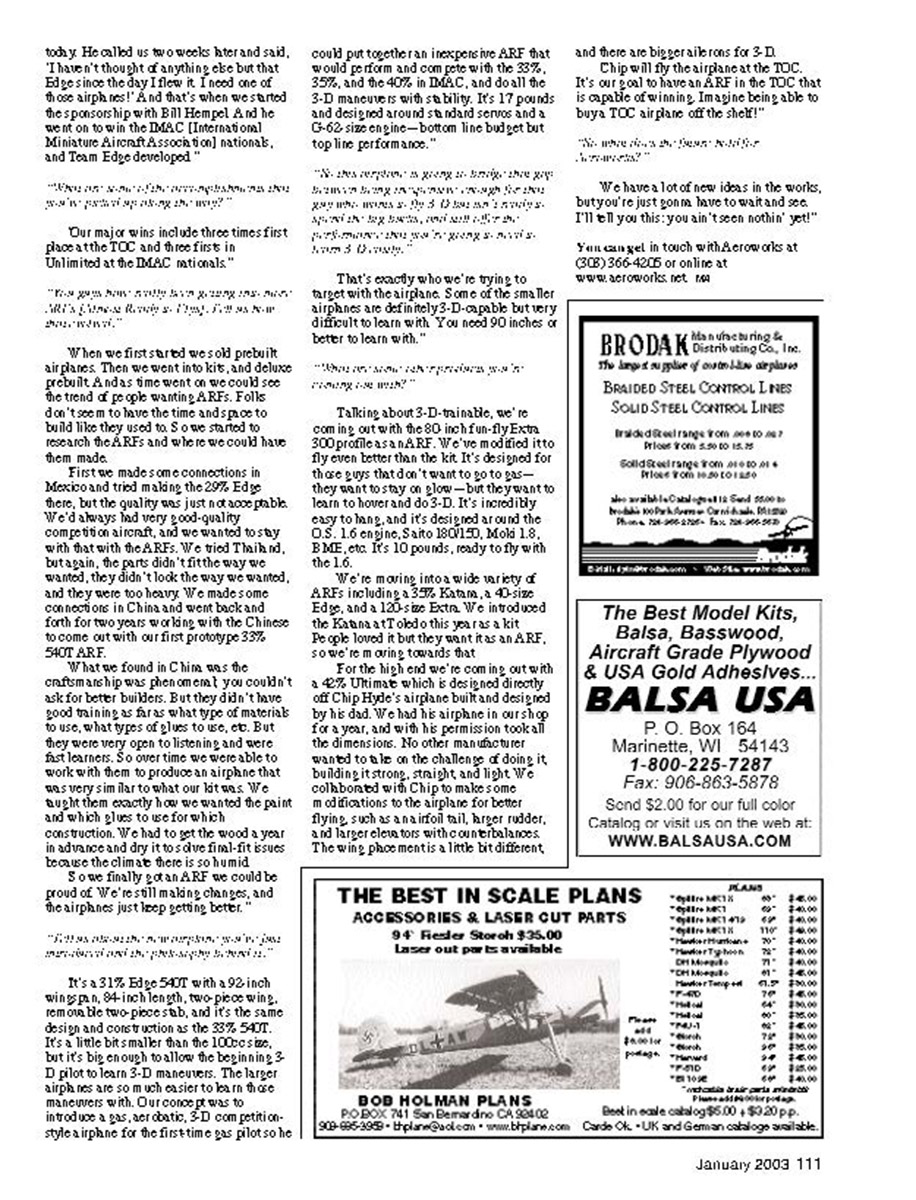
At the 1996 TOC they met Quique a week early at the dry lake bed and saw the two airplanes flown by him. Quique went on to win the TOC that year with those aircraft, performing phenomenal 3-D maneuvers. After that success Aeroworks began kitting the Extra 300, which significantly raised their profile.
QSAA, Bill Hempel and Team Edge
Aeroworks also connected with Bill Hempel at the Radio Control Quarter Scale Association of America (QSAA) in 1995. Bill demoed the Edge 540 and, after initially dismissing it as "no Extra," returned the next day to say he'd been thinking about the Edge constantly and wanted one. That led to a sponsorship with Bill Hempel; he won the DMAC nationals and Team Edge developed from that relationship.
Major wins include:
- Three first-place finishes at the TOC
- Three first-place finishes in Unlimited at the DMAC nationals
Products and ARF development
Aeroworks started by selling prebuilt airplanes, then kits, and deluxe prebuilts. As the market shifted toward ARFs—pilots with less time or desire to build—Aeroworks pursued ARF production.
They first tried Mexico (29% Edge) and Thailand but found quality, fit, and weight unacceptable. After working with Chinese manufacturers for two years they produced a satisfactory prototype 33% Edge 540T ARF. Chinese craftsmanship was excellent, but material selection and glue techniques required training. Aeroworks taught precise paint, glue, and construction methods, and solved wood-fit issues by specifying wood dried a year in advance for the humid climate.
The resulting ARF matched their kit quality and continued to improve.
Key ARF features and concepts:
- 31% Edge 540T: 92-inch wingspan, 84-inch length, two-piece wing, removable two-piece stab; similar design and construction to the 36% 540T. About 17 pounds, designed for standard servos and a G-62-size engine—aimed at budget-conscious pilots wanting top-line performance and 3-D trainability.
- 80-inch fun-fly Extra 300 profile ARF: modified to fly better than the kit, tailored for glow engines (OS .61, Saito 180/150, Moki 1.8, BME, etc.). Ready-to-fly at about 10 pounds and designed for easy hovering and 3-D training.
Planned and current models include:
- 33% Katana (ARF)
- 40-size Edge
- 120-size Extra (introduced as a kit; moving toward ARF)
- High-end 42% Ultimate (designed from Chip Hyde's full-size model, with collaboration and modifications such as two-piece tail, larger rudder, larger ailerons with counterbalances, and a modified wing profile). The goal is an ARF capable of competing at the TOC.
Future and closing
Aeroworks continues to refine designs and expand the ARF lineup. Rocco hinted there are many new ideas in the works.
Contact
You can reach Aeroworks at (303) 366-4206 or online at www.aeroworks.net.
Transcribed from original scans by AI. Minor OCR errors may remain.

