
RADIO CONTROL SCALE AEROBATICS
Mike Hurley 11542 Decatur Ct., Westminster CO 80234 E-mail: mike.hurley1@comcast.net
Introduction
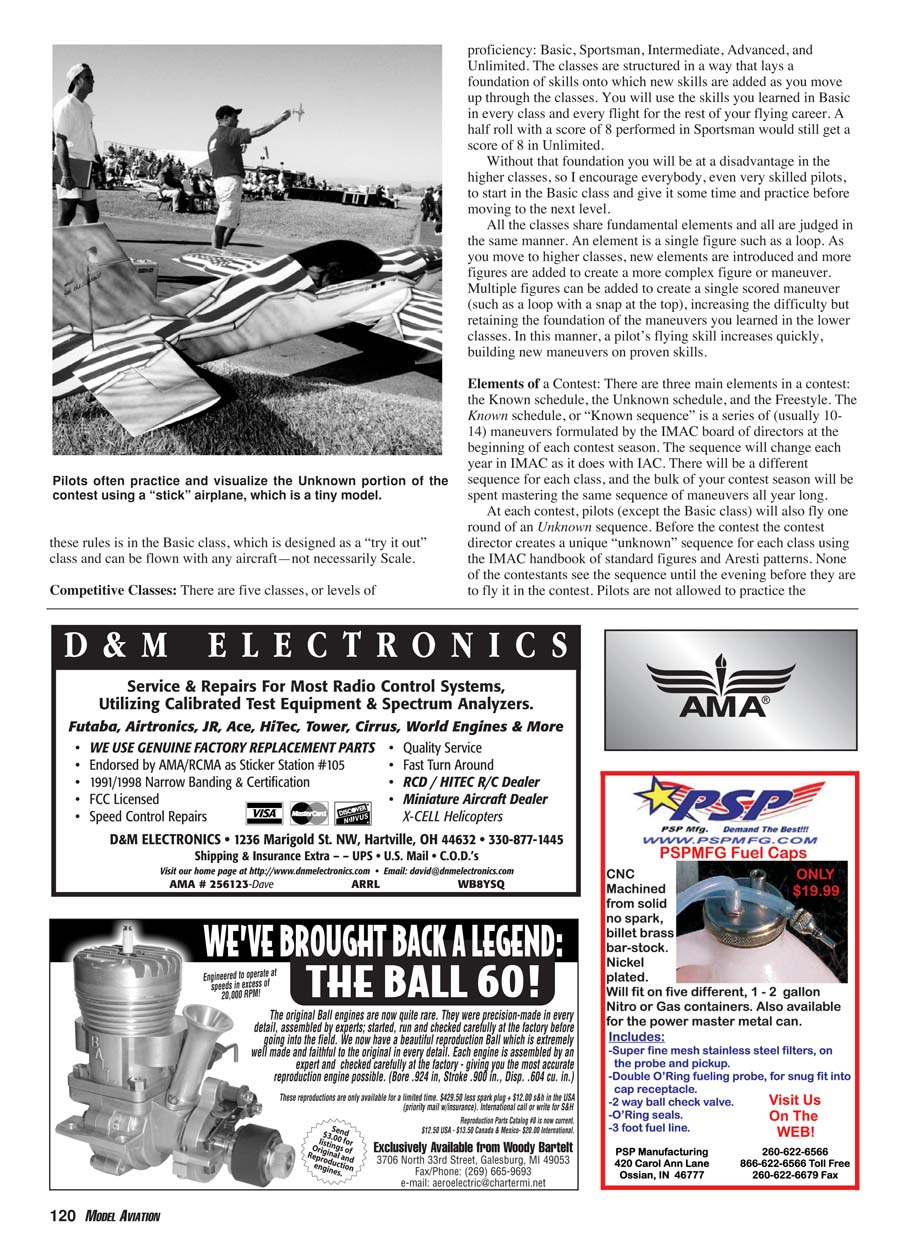
One of the clubs I belong to asked me to give a presentation on IMAC and competing in scale aerobatics. The members were interested to learn about the scale and precision aspects of IMAC, but many of them were also interested in learning about 3-D flight; 3-D is not scale but is often performed in the IMAC Freestyle event with our scale aircraft.
I looked around and asked online if there were any preformatted guidelines for such an introduction to IMAC — it seemed like something that could be helpful for clubs across the country. I could find nothing written as a guide for those who might want to give a talk to their club members, so I’ve outlined my presentation here. If you have a fair amount of IMAC experience, you might use this as a guide to give a presentation to interested members in your own club.
Start With the Basics: What is IMAC?
The International Miniature Aerobatic Club (IMAC) is formulated to emulate near-scale models of the type of aircraft that fly in International Aerobatic Club (IAC) full-scale precision aerobatics. Events, patterns, and figures are formulated to stay true (within our limitations) to the full scale. Because of IMAC’s separate evolution, there are some minor exceptions.
IMAC is competitive precision flying in front of judges, held much like a full-scale competition and similar to Pattern or AMA Precision Aerobatics. IMAC events are contests. Those who fly in IMAC invariably have the desire to be judged on their flying skills against others by their peers.
What Aircraft Can I Use?
Generally, you must fly a model of a full-scale aircraft capable of competing in an IAC contest. There is no specific list of eligible aircraft. A Piper Cub or an AT-6 would be considered legal for IMAC, but superior flight characteristics tend to concentrate entries into a dozen or so of the best full-scale airplanes such as Sukhois, Extras, CAPs, etc.
There are no size or weight requirements or limitations other than those set forth by AMA for all modeling. Because many large airplanes fly in IMAC, some people confuse it with a Giant Scale organization and think that airplanes must be large. Not so — any size aircraft is eligible. A lifelike pilot and an instrument panel are required in the aircraft. The only exception is the Basic class, which is designed as a “try it out” class and can be flown with any aircraft — not necessarily scale.
Competitive Classes
There are five classes, or levels of proficiency:
- Basic
- Sportsman
- Intermediate
- Advanced
- Unlimited
The classes are structured to lay a foundation of skills onto which new skills are added as you move up. You will use the skills you learned in Basic in every class and every flight for the rest of your flying career. For example, a half roll scored as an 8 in Sportsman would still be scored as an 8 in Unlimited.
Without that foundation you will be at a disadvantage in the higher classes, so I encourage everybody, even very skilled pilots, to start in the Basic class and give it some time and practice before moving to the next level.
All classes share fundamental elements and are judged in the same manner. An element is a single figure such as a loop. As you move to higher classes, new elements are introduced and more figures are added to create more complex maneuvers. Multiple figures can be combined into a single scored maneuver (for example, a loop with a snap at the top), increasing the difficulty while retaining the foundational skills learned in lower classes. This method lets a pilot's flying skill increase quickly by building new maneuvers on proven skills.
Elements of a Contest
There are three main elements in a contest:
- The Known schedule (Known sequence)
- The Unknown schedule (Unknown sequence)
- The Freestyle
The Known schedule is a series of usually 10–14 maneuvers formulated by the IMAC board at the beginning of each contest season. The sequence changes each year and there is a different sequence for each class. Much of your contest season will be spent mastering the same sequence of maneuvers all year long.
At each contest (except for Basic class), pilots also fly one round of an Unknown sequence. Before the contest, the contest director creates a unique Unknown sequence for each class using the IMAC handbook of standard figures and Aresti patterns. None of the contestants see the sequence until the evening before they are to fly it in the contest. Pilots are not allowed to practice the sequence before they fly it for the judges, and usually no flying is allowed after the Unknowns are distributed.
Most IMAC contests are two-day events, and the Unknown is typically flown first thing on the morning of the second day. Memorizing the Unknown flight, visualizing your performance, and practicing with your caller are key to succeeding in the Unknown round. You will often see pilots flying the sequence with a handheld "stick" airplane to help with visualization and preparation.
The IMAC Freestyle does not emulate the full-scale version of the Freestyle event. Freestyle is a separate and optional event and is not calculated into your contest score. There are separate awards for Freestyle, and it requires a different skill set. Freestyle uses different judging criteria and is more reliant on excitement and emotional impact than on precision perfection.
IMAC Freestyle does not rely solely on scale-type maneuvers, and 3-D flight is often performed along with difficult scale figures in this four-minute round. Impact is often enhanced by choreographing a routine to music, adding smoke or streamers, and flying extremely low, difficult maneuvers to increase the wow factor.
Freestyle is your chance to show your stuff, and far too many competitors don't take the chance to fly in it. For me, Freestyle is the most fun event of the contest — it’s more like a full-scale air show than the contest version of IAC Freestyle.
How Am I Judged?
To accommodate 20 or more pilots, most IMAC contests have two models in the air at the same time. There are generally two flightlines set up — one at each end of the runway. There are typically two judges at each flightline, although more can be used if available.
Each judge is partnered with a scribe, who reads the maneuvers to the judge as they are being flown and records the scores. Each figure starts with a perfect score of 10. As it is flown, each judge looks for imperfections and deducts as necessary to determine the final score (0–10) for each maneuver.
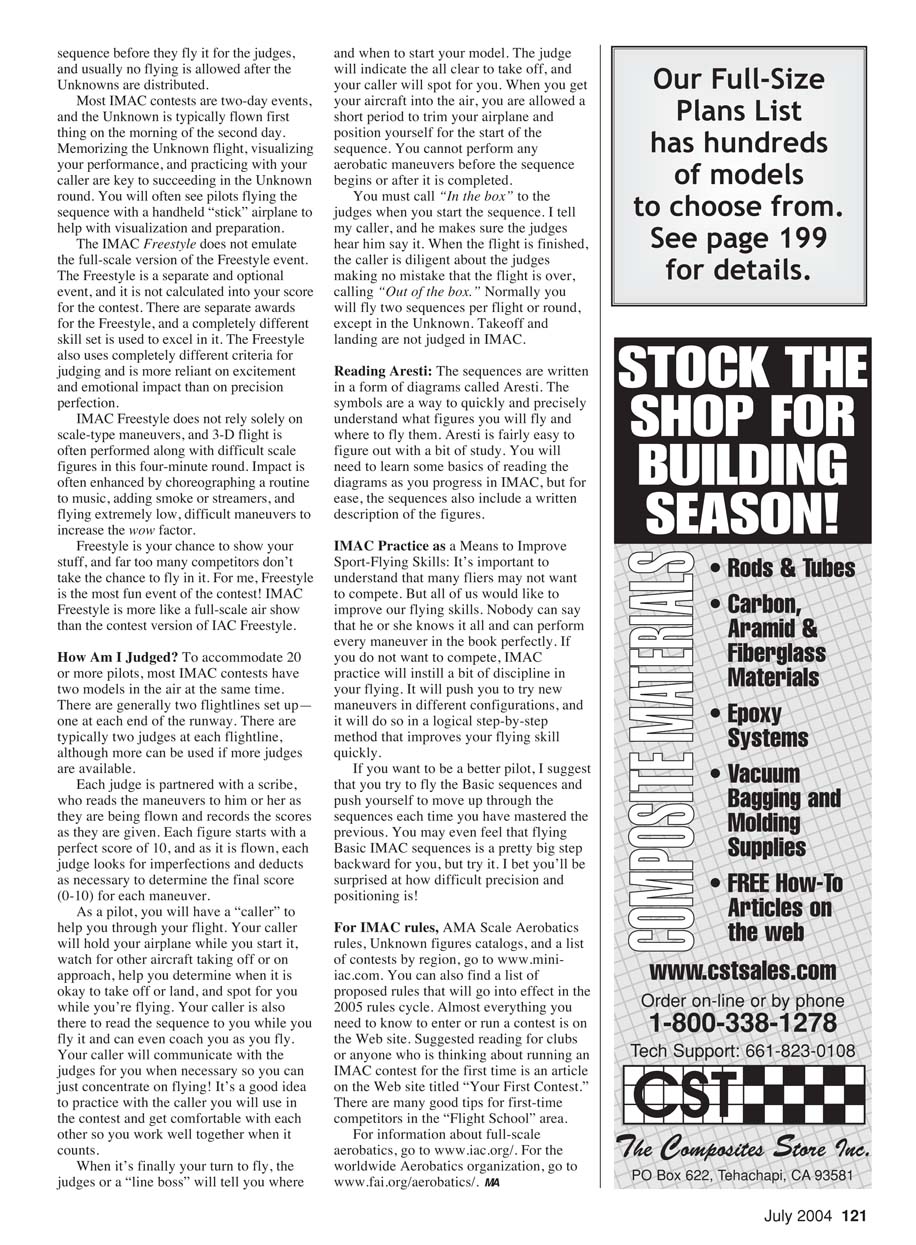
As a pilot, you will have a caller to help you through your flight. The caller will hold your airplane while you start it, watch for other aircraft taking off or on approach, help you determine when it is okay to take off or land, and spot for you while you're flying. The caller is also there to read the sequence to you while you fly and can even coach you. The caller will communicate with the judges when necessary so you can concentrate on flying. Practice with your caller before the contest so you work well together when it counts.
When it's finally your turn to fly, the judges or a line boss will tell you where and when to start your model. The judge will indicate the all clear to take off, and your caller will spot for you. Once airborne, you are allowed a short period to trim your airplane and position yourself for the start of the sequence. You cannot perform any aerobatic maneuvers before the sequence begins or after it is completed.
You must call "In the box" to the judges when you start the sequence. I tell my caller and he makes sure the judges hear him say it. When the flight is finished, the caller must ensure the judges know the flight is over by calling "Out of the box." Normally you will fly two sequences per flight or round, except in the Unknown. Takeoff and landing are not judged in IMAC.
Reading Aresti
The sequences are written in diagrams called Aresti. The symbols are a way to quickly and precisely understand what figures you will fly and where to fly them. Aresti is fairly easy to learn with a bit of study. You will need to learn some basics of reading the diagrams as you progress in IMAC, but for ease, the sequences also include a written description of the figures.
IMAC Practice as a Means to Improve Sport-Flying Skills
Many fliers may not want to compete, but most of us want to improve our flying skills. If you do not want to compete, IMAC practice can instill discipline in your flying. It pushes you to try new maneuvers in different configurations and does so in a logical step-by-step method that improves your flying skill quickly.
If you want to be a better pilot, try flying the Basic sequences and push yourself to move up through the sequences each time you have mastered the previous one. You may feel that flying Basic IMAC sequences is a step backward, but try it — you'll be surprised at how difficult precision and positioning can be.
More Information
For IMAC rules, AMA Scale Aerobatics rules, Unknown figures catalogs, and a list of contests by region, go to www.mini-iac.com. You can also find a list of proposed rules for future cycles. Almost everything you need to know to enter or run a contest is on the website. Suggested reading for clubs or anyone thinking about running an IMAC contest for the first time is the article titled "Your First Contest." There are many good tips for first-time competitors in the "Flight School" area.
For information about full-scale aerobatics, go to www.iac.org. For the worldwide Aerobatics Organization, go to www.fai.org/aerobatics.
MA
Transcribed from original scans by AI. Minor OCR errors may remain.

