
RADIO CONTROL SCALE AEROBATICS
Eric Hawkinson, 319 Yellowstone Ave., Billings MT 59101
Whenever you gather with fellow modelers, you hear many opinions on many subjects. Sometimes meetings result in the collection of valuable information that makes your modeling life simpler or better, and other times the primary value is entertainment. Often you don't know which!
Two subjects that apply to Scale Aerobatics types have been on my mind lately (mostly because of listening in on conversations, real and "cyber"): gyros and scale flying.
Gyros
Gyroscopic stabilizers (gyros) have become all the rage in recent years, in "pure" Scale models and in Scale Aerobatics. Single gyros on the yaw axis are used on Scale aircraft to reduce the pilot's rudder workload. Dual gyros—one each on pitch (elevator) and yaw (rudder) channels—have been installed on IMAC (International Miniature Aerobatic Club)-type airplanes to greatly reduce the effort required to perform torque rolls.
Gyros have been legal in helicopter competition since they became available, and have been illegal in Pattern airplanes for just as long. They became illegal for use in IMAC competition starting in 1998. I believe that this is a good ruling, especially in light of the recent quantum leaps in gyro performance.
I have a split opinion regarding modern electronic conveniences.
On one hand, I feel that it is inherently wrong to have any type of device on an aircraft, used in competition with pilot skill, that makes control inputs for the pilot based on feedback from sensors installed in the airplane.
On the other hand, I find nothing wrong with using a computer radio to perform trimming functions that would otherwise be impossible (but a real pain) to achieve by aerodynamic modifications. Some people feel that these opinions are at cross purposes, but there is a huge leap between passive mixing and active sensing.
The latest gyros make the strongest argument against allowing their use in pilot-skill competitions. Generally known as "heading-lock" gyros, the new units sold by Arcamax and CSM do far more than the gyros that they supersede.
Until these units arrived, the only thing that a gyro (mechanical or piezo) could do was dampen motion. Many pilots thought that they would hold a heading, but that was not the case. The gyros reacted to motion in the installed axis (usually yaw), and moved the servo to apply opposite control until the motion stopped. The motion that was detected in the first place will have changed the heading; the movement would be stopped after some change in heading had occurred.
Reportedly, the heading-lock gyros (in rather simplified terms) go one step farther; not only do they stop the detected motion, but they also put in the control needed to cause the aircraft to move the same rate and time in the opposite direction. If the gyro senses "x" rate of right yaw for one second, it will stop it, then apply an opposite rudder to cause the same rate of yaw for one second in the opposite direction. In effect, it is a single-axis autopilot. The heading or angle of attack the gyro will seek is whatever position was last commanded by the control stick.
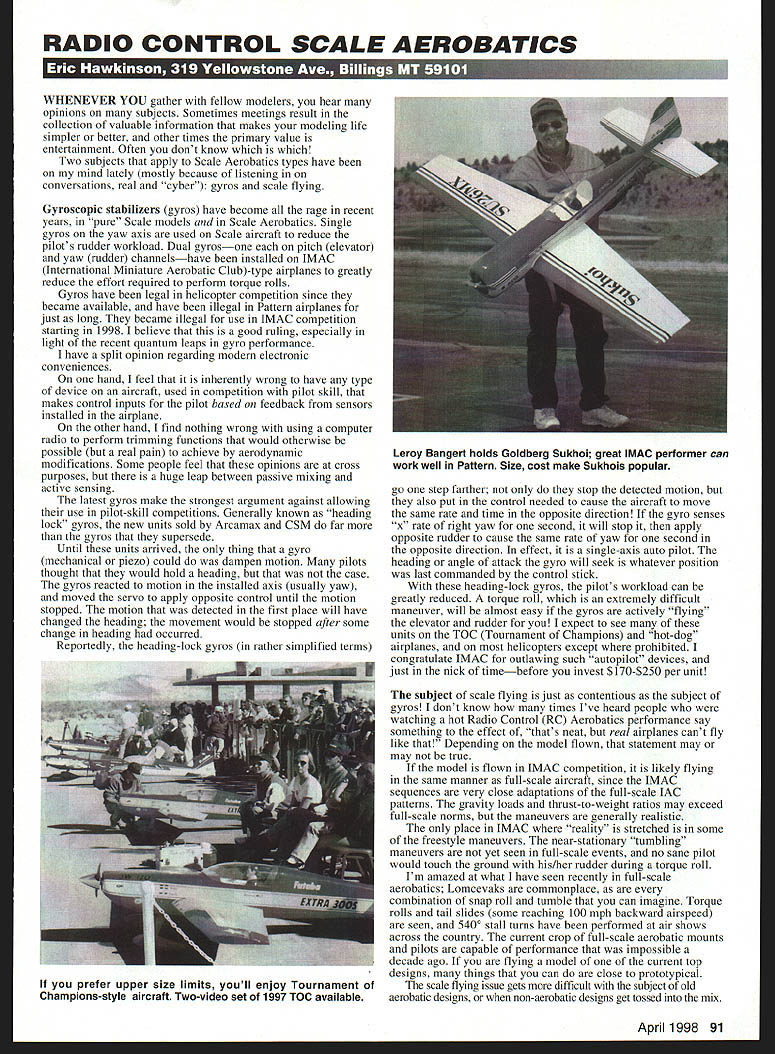
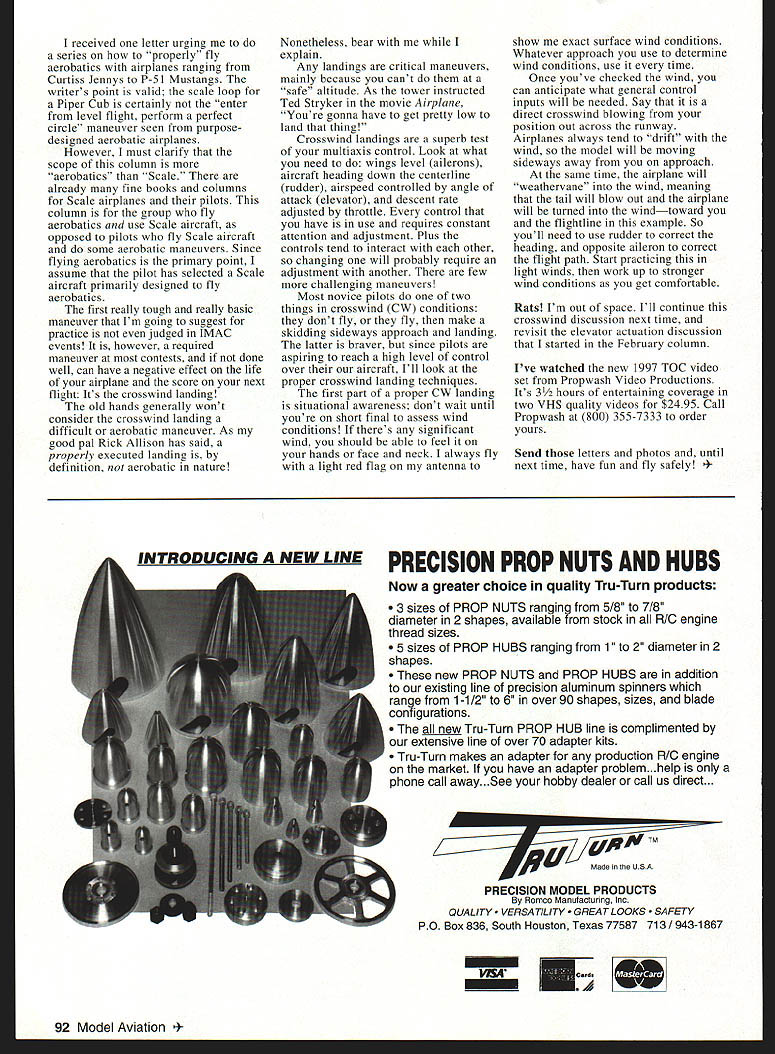
With these heading-lock gyros, the pilot's workload can be greatly reduced. A torque roll, which is an extremely difficult maneuver, will be almost easy if the gyros are actively "flying" the elevator and rudder for you! I expect to see many of these units on the TOC (Tournament of Champions) and "hot-dog" airplanes, and on most helicopters except where prohibited. I congratulate IMAC for outlawing such "autopilot" devices, and just in the nick of time—before you invest $170–$250 per unit!
Scale Flying
The subject of scale flying is just as contentious as the subject of gyros. I don't know how many times I've heard people who were watching a hot Radio Control (RC) Aerobatics performance say something to the effect of, "that's neat, but real airplanes can't fly like that!" Depending on the model flown, that statement may or may not be true.
If the model is flown in IMAC competition, it is likely flying in the same manner as full-scale aircraft, since the IMAC sequences are very close adaptations of the full-scale IAC patterns. The gravity loads and thrust-to-weight ratios may exceed full-scale norms, but the maneuvers are generally realistic.
The only place in IMAC where "reality" is stretched is in some of the freestyle maneuvers. The near-stationary "tumbling" maneuvers are not yet seen in full-scale events, and no sane pilot would touch the ground with his/her rudder during a torque roll.
I'm amazed at what I have seen recently in full-scale aerobatics; Lomcevaks are commonplace, as are every combination of snap roll and tumble that you can imagine. Torque rolls and tail slides (some reaching 100 mph backward airspeed) are seen, and 540° stall turns have been performed at air shows across the country. The current crop of full-scale aerobatic mounts and pilots are capable of performance that was impossible a decade ago. If you are flying a model of one of the current top designs, many things that you can do are close to prototypical.
The scale flying issue gets more difficult with the addition of aerobatic designs, or when non-aerobatic designs get tossed into the mix. I received one letter urging me to do a series on how to "properly" fly aerobatics with airplanes ranging from Curtiss Jennys to P-51 Mustangs. The writer's point is valid; the scale loop for a Piper Cub is certainly not the "enter from level flight, perform a perfect circle" maneuver seen from purpose-designed aerobatic airplanes.
However, I must clarify that the scope of this column is more "aerobatics" than "Scale." There are already many fine books and columns for Scale airplanes and their pilots. This column is for the group who fly aerobatics and use Scale aircraft, as opposed to pilots who fly Scale aircraft and do some acrobatic maneuvers. Since flying aerobatics is the primary point, I assume that the pilot has selected a Scale aircraft primarily designed to fly aerobatics.
Crosswind Landings — A Fundamental Maneuver
The first really tough and really basic maneuver that I'm going to suggest for practice is not even judged in IMAC events! It is, however, a required maneuver at most contests, and if not done well, can have a negative effect on the life of your airplane and the score on your next flight: it's the crosswind landing.
The old hands generally won't consider the crosswind landing a difficult or aerobatic maneuver. As my good pal Rick Allison has said, a properly executed landing is, by definition, not aerobatic in nature!
Nonetheless, bear with me while I explain.
Any landings are critical maneuvers, mainly because you can't do them at a "safe" altitude. As the tower instructed Ted Stryker in the movie Airplane, "You're gonna have to get pretty low to land that thing!"
Crosswind landings are a superb test of your multiaxis control. Look at what you need to do:
- Wings level (ailerons)
- Aircraft heading down the centerline (rudder)
- Airspeed controlled by angle of attack (elevator)
- Descent rate adjusted by throttle
Every control that you have is in use and requires constant attention and adjustment. Plus the controls tend to interact with each other, so changing one will probably require an adjustment with another. There are few more challenging maneuvers!
Most novice pilots do one of two things in crosswind (CW) conditions:
- They don't fly.
- They fly, then make a skidding sideways approach and landing.
The latter is braver, but since pilots are aspiring to reach a high level of control over their own aircraft, I'll look at the proper crosswind landing techniques.
The first part of a proper CW landing is situational awareness; don't wait until you are on short final to assess wind conditions. If there's any significant wind, you should be able to feel it on your hands or face and neck. I always fly with a light red flag on my antenna to show me exact surface wind conditions. Whatever approach you use to determine wind conditions, use it every time.
Once you've checked the wind, you can anticipate what general control inputs will be needed. Say that it is a direct crosswind blowing from your port position out across the runway. Airplanes always tend to "drift" with the wind, so the model will be moving sideways away from you on approach.
At the same time, the airplane will "weathervane" into the wind, meaning that the tail will blow out and the airplane will be turned into the wind—toward your end of the flightline in this example. So you'll need to use rudder to correct the heading, and opposite aileron to correct the flight path. Start practicing this in light winds, then work up to stronger wind conditions as you get comfortable.
I'm out of space. I'll continue this crosswind discussion next time, and revisit the elevator actuation discussion that I started in the February column.
Video and Closing
I've watched the new 1997 TOC video set from Propwash Video Productions. It's 3-1/2 hours of entertaining coverage in two VHS-quality videos for $24.95. Call Propwash at (800) 355-7333 to order yours.
Send those letters and photos and, until next time, have fun and fly safely!
Transcribed from original scans by AI. Minor OCR errors may remain.

