
RADIO CONTROL SCALE AEROBATICS
Eric Hawkinson, 319 Yellowstone Ave., Billings MT 59101
Correction / IMAC gyros
I was informed by an IMAC (International Miniature Aerobatic Club) official that the group had voted to ban gyros from competition, but that was not the case. The official IMAC position remains the same as before: the current Academy of Model Aeronautics (AMA) rulebook does not address gyros at all.
Before you go out and buy a pair of piezo gyros, know that some IMAC officers and Contest Directors (CDs) are against the use of gyros in IMAC contests, and they will be banned at several events. Keep that in mind if you intend to install the devices.
Reader letter: Wayne Norris
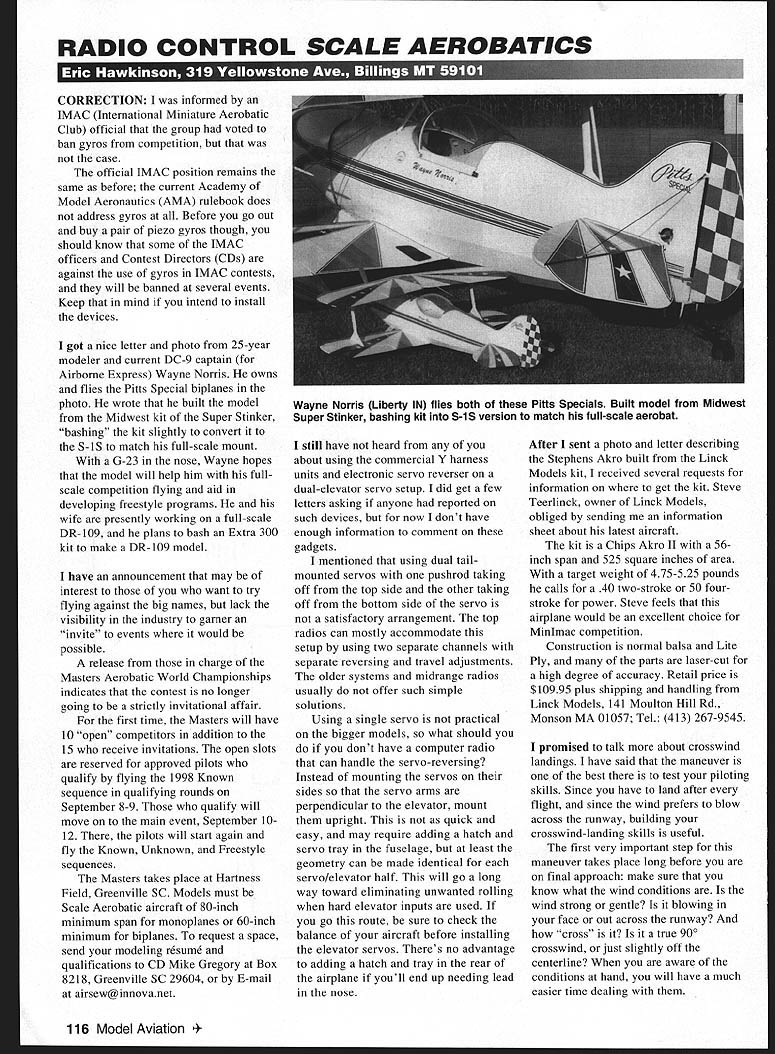
I received a nice letter and photo from 25-year modeler and current DC-9 captain (for Airborne Express) Wayne Norris. He owns and flies the Pitts Special biplanes in the photo. He wrote that he built the model from the Midwest kit of the Super Stinker, "bashing" the kit slightly to convert it to the S-1S to match his full-scale mount.
With a G-23 in the nose, Wayne hopes the model will help him with his full-scale competition flying and aid in developing freestyle programs. He and his wife are presently working on a full-scale DR-109, and he plans to bash an Extra 300 kit to make a DR-109 model.
Masters Aerobatic World Championships — open competition slots
I have an announcement that may interest those who want to try flying against the big names but lack the visibility to get an "invite."
A release from those in charge of the Masters Aerobatic World Championships indicates the contest is no longer strictly invitational. For the first time, the Masters will have 10 "open" competitors in addition to the 15 who receive invitations.
- The open slots are reserved for approved pilots who qualify by flying the 1998 Known sequence in qualifying rounds on September 8–9.
- Those who qualify will move on to the main event, September 10–12. There, the pilots will fly the Known, Unknown, and Freestyle sequences.
- The Masters takes place at Hartness Field, Greenville, SC.
- Models must be Scale Aerobatic aircraft:
- 80-inch minimum span for monoplanes
- 60-inch minimum span for biplanes
To request a space, send your modeling résumé and qualifications to CD Mike Gregory at Box 8218, Greenville SC 29604, or by E-mail at airsew@innovanet.
Equipment questions: Y-harness and dual-elevator servos
I still have not heard from any of you about using the commercial Y-harness units and electronic servo reverser on a dual-elevator servo setup. I did get a few letters asking if anyone had reported on such devices, but for now I don't have enough information to comment on these gadgets.
I mentioned earlier that using dual tail-mounted servos with one pushrod taking from the top side and the other from the bottom side of the servo is not a satisfactory arrangement. Top radios can mostly accommodate this setup by using two separate channels with separate reversing and travel adjustments. Older systems and midrange radios usually do not offer such simple solutions.
Using a single servo is not practical on the bigger models, so what should you do if you don't have a computer radio that can handle the servo reversing? Instead of mounting the servos on their sides so the servo arms are perpendicular to the elevator, mount them upright. This is not as quick and easy and may require adding a hatch and servo tray in the fuselage, but at least the geometry can be made identical for each servo/elevator half. This will go a long way toward eliminating unwanted rolling when hard elevator inputs are used.
If you go this route, be sure to check the balance of your aircraft before installing the elevator servos. There's no advantage to adding a hatch and tray in the rear of the airplane if you'll end up needing lead in the nose.
Kit spotlight: Linck Models — Chips Akro II
After I sent a photo and letter describing the Stephens Akro built from the Linck Models kit, I received several requests for information on where to get the kit. Steve Teerlinck, owner of Linck Models, sent an information sheet about his latest aircraft.
- Model: Chips Akro II (Linck Models)
- Span: 56 inches
- Area: 525 square inches
- Target weight: 475–525 ounces
- Power: .40 two-stroke or .50 four-stroke recommended
- Construction: normal balsa and Lite Ply; many parts laser-cut for accuracy
- Steve feels this airplane would be an excellent choice for MiniMac competition.
- Retail price: $109.95 plus shipping and handling
Order from Linck Models, 141 Moulton Hill Rd., Monson MA 01057; Tel: (413) 267-9545.
Crosswind landings
I promised to talk more about crosswind landings. I have said that the maneuver is one of the best tests of your piloting skills. Since you have to land after every flight and the wind prefers to blow across the runway, building your crosswind-landing skills is useful.
Prep and limits
The first very important step takes place long before you get to final approach: make sure you know the wind conditions.
- Is the wind strong or gentle?
- Is it blowing head-on or across the runway?
- How "cross" is it — a true 90-degree crosswind or slightly off the centerline?
Each airplane has a maximum crosswind component that can be effectively overcome. At some point the crosswind will be more than you can safely overcome while landing. This usually means you will not have enough control effectiveness to continue the landing safely. Most of you will instantly recognize if the winds are beyond the abilities of you or your aircraft.
On our models (and many full-scale aircraft), the ailerons usually lose effectiveness before the rudder as airspeed slows. If you cannot hold the wings level while slowing for landing, you have reached the maximum crosswind component for your airplane.
Technique (example: wind blowing out from the pit area, landing from the left)
You know the wind will tend to move the airplane away from the centerline and the airplane will tend to weathervane into the wind (yaw toward the pits). Your task is to overcome both unwanted movements while controlling airspeed and glide slope.
- Counter the unwanted yaw (to the left in this example) with right rudder so the airplane points along the runway centerline.
- Because the airplane is moving right with the wind, adding rudder alone will increase the drift to the right — so add aileron to correct.
- Use left aileron (in this example) to slightly lower the upwind wing and cause the airplane to fly slightly left, correcting for wind drift.
The controls used in a crosswind will always be crossed — right rudder and left aileron, or left rudder and right aileron, depending on wind direction. The real skill is balancing the control inputs to maintain the "perfect" track to landing. As you increase either rudder or aileron, you'll usually have to decrease the other to keep the balance.
Things to watch for
- Control effectiveness changes with airspeed, and not at the same rate. Ailerons usually lose effectiveness more quickly as airspeed drops (in aerobatic airplanes), so you may need increasing aileron deflection as the model slows.
- The wind is rarely constant, so you must adjust for gusts and lulls.
- As you apply elevator, the airplane will change its lateral track slightly because the wings are not level; you must balance rudder, aileron, and elevator.
Go out and work on crosswind landings in increasing wind as your skills and comfort levels increase. Mastering this maneuver will give you great satisfaction and make you a better pilot.
Next time I'll look at more exciting maneuvers, or whatever you want to talk about. This is your column, so please send letters, photos, suggestions, or questions of general interest, and I'll do my best to use them.
Transcribed from original scans by AI. Minor OCR errors may remain.

