
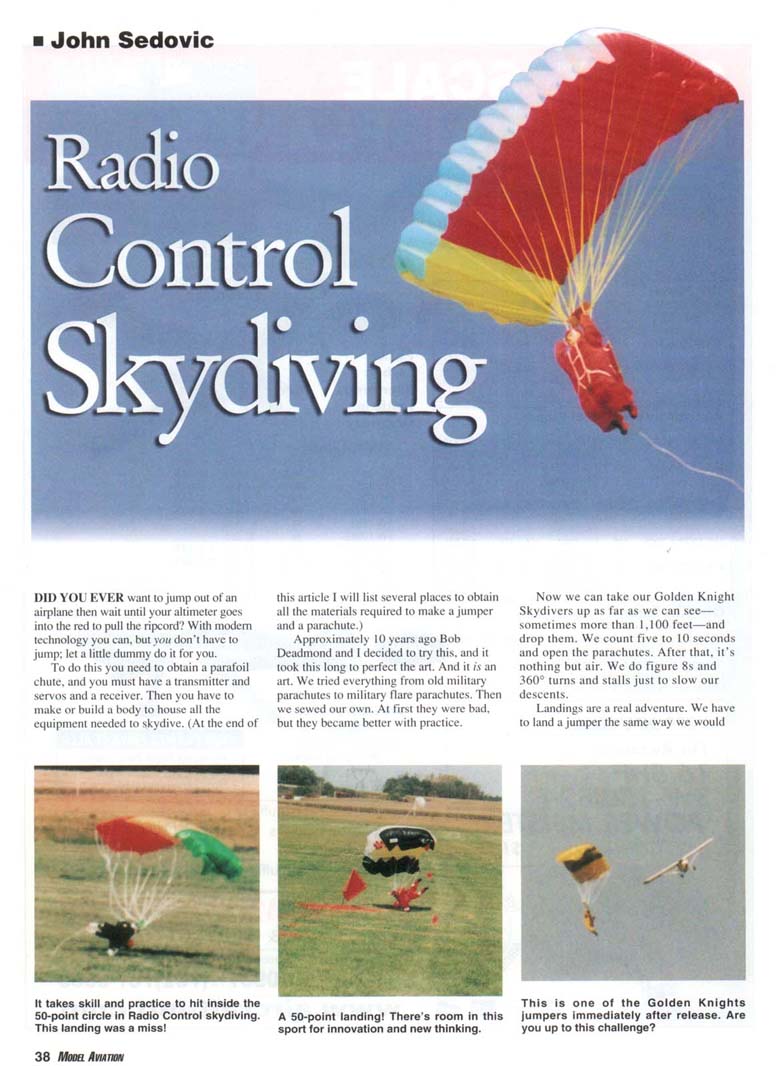
Radio Control Skydiving
John Sedovic
Introduction
Did you ever want to jump out of an airplane then wait until your altimeter goes into the red to pull the ripcord? With modern technology you can—without having to jump yourself. Let a little dummy do it for you.
To do this you need a parafoil chute, a transmitter, servos, and a receiver. You also have to make or build a body to house all the equipment needed to skydive. At the end of this article I list several places to obtain the materials required to make a jumper and a parachute.
Approximately 10 years ago Bob Deadmond and I decided to try this, and it took this long to perfect the art. We tried everything from old military parachutes to military flare parachutes, then sewed our own. At first they were bad, but they became better with practice.
What we've accomplished
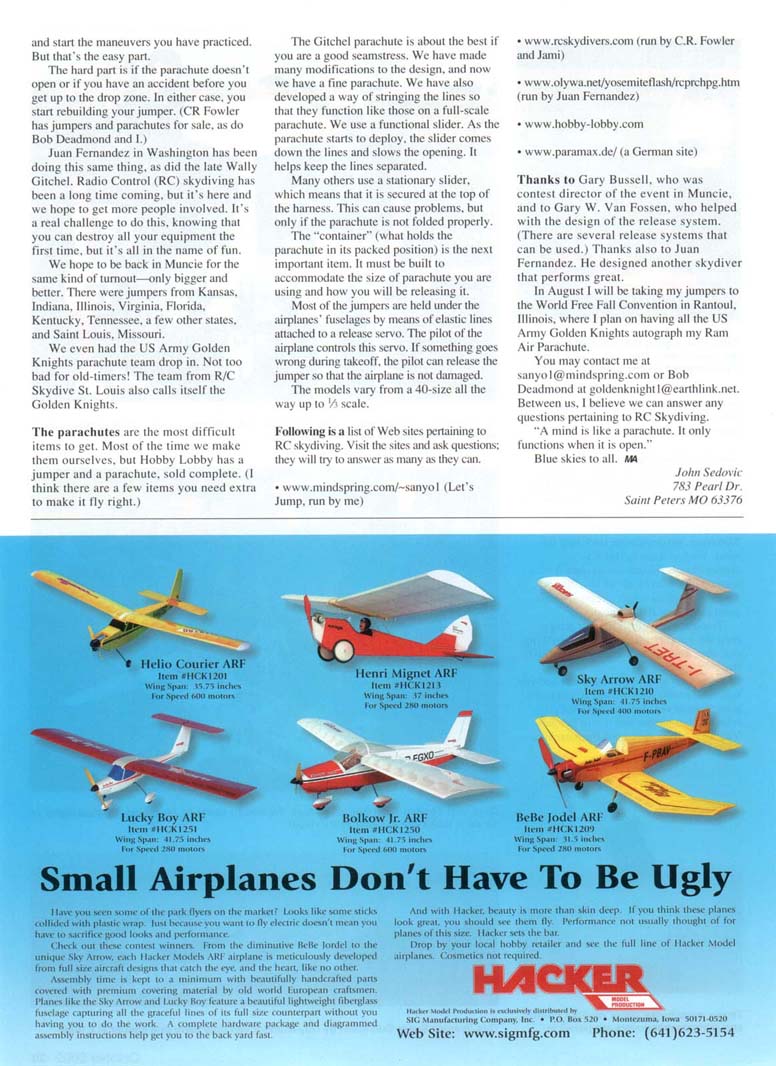
Now we can take our Golden Knight skydivers up as far as we can see—sometimes more than 1,100 feet—and drop them. We count five to 10 seconds and open the parachutes. After that it's nothing but air. We do figure 8s, 360° turns, and stalls just to slow our descents.
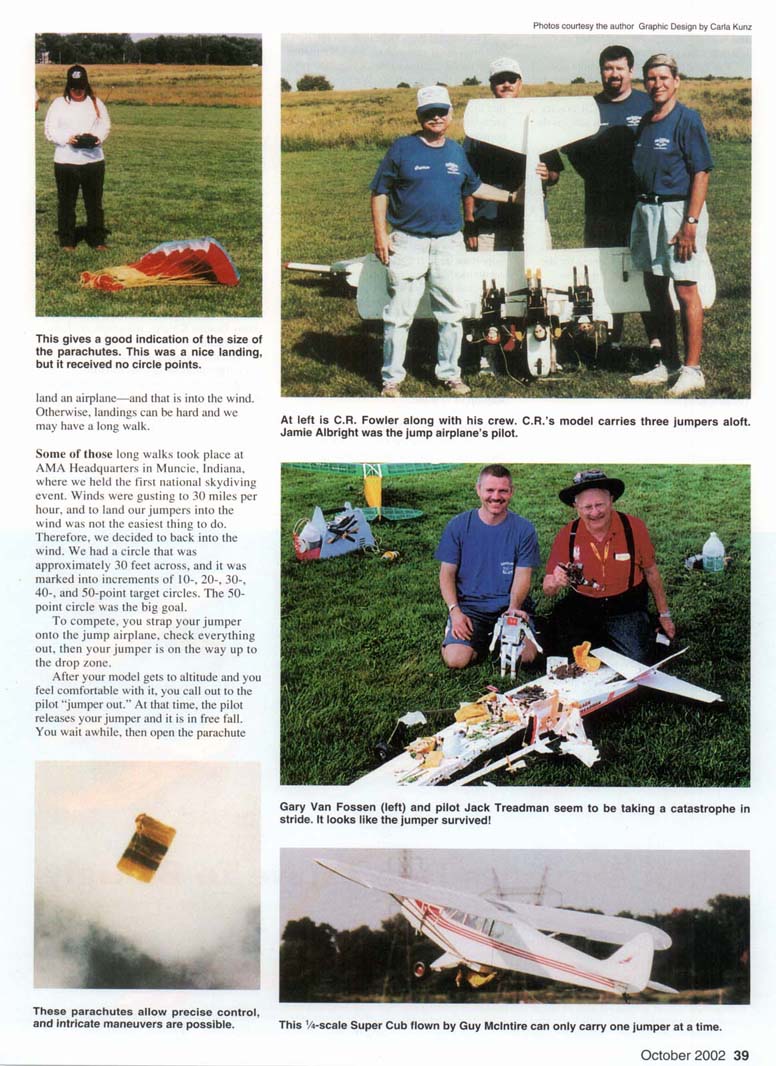
Landings are a real adventure. We have to land a jumper the same way we would land an airplane—into the wind. Otherwise landings can be hard and we may have a long walk. Some of those long walks took place at AMA Headquarters in Muncie, Indiana, where we held the first national skydiving event. Winds were gusting to 30 miles per hour, and to land our jumpers into the wind was not the easiest thing to do, so we decided to back into the wind.
We had a circle approximately 30 feet across, marked into increments of 10-, 20-, 30-, 40-, and 50-point target circles. The 50-point circle was the big goal. To compete, you strap your jumper onto the jump airplane, check everything out, then send your jumper up to the drop zone. After your model gets to altitude and you feel comfortable with it, you call out to the pilot "jumper out." The pilot releases your jumper and it is in free fall. You wait a while, then open the parachute and start the maneuvers you have practiced.
The hard part is when the parachute doesn't open or if you have an accident before you reach the drop zone. In either case you start rebuilding your jumper. C.R. Fowler, Bob Deadmond, and I have jumpers and parachutes for sale. Juan Fernandez in Washington has been doing this same thing, as did the late Wally Gitchel.
RC skydiving has been a long time coming, but it's here and we hope to get more people involved. It's a real challenge—knowing that you can destroy all your equipment the first time—but it's all in the name of fun. We hope to be back in Muncie for the same kind of turnout—only bigger and better.
There were jumpers from Kansas, Indiana, Illinois, Virginia, Florida, Kentucky, Tennessee, several other states, and St. Louis, Missouri. We even had the U.S. Army Golden Knights parachute team drop in. Not too bad for old-timers! The team from R/C Skydive St. Louis also calls itself the Golden Knights.
Parachutes and packing
The parachutes are the most difficult items to get. Most of the time we make them ourselves, but Hobby Lobby sells a jumper and a parachute complete (you may need a few extra items to make it fly right). The Gitchel parachute is about the best if you are a good seamstress. We have made many modifications to the design, and now we have a fine parachute.
We have developed a way of stringing the lines so that they function like those on a full-scale parachute. We use a functional slider: as the parachute starts to deploy, the slider comes down the lines and slows the opening. It helps keep the lines separated. Many others use a stationary slider, secured at the top of the harness; this can cause problems if the parachute is not folded properly.
The container (what holds the parachute in its packed position) is the next important item. If it releases too easily, you will lose your parachute. If it is too stiff, you might not get the chute out in time. Our containers are built from 1/4-inch plywood with a hinged lid and use small quick-release devices or rubber bands to hold them closed. The parachute is folded and packed inside, and the ripcord is attached to the release mechanism. We mount the container on the jumper's back so the canopy can deploy cleanly. The container must be built to accommodate the size of the parachute you are using and how you will be releasing it.
Mounting and release systems
Most jumpers are held under the airplanes' fuselages by means of elastic lines attached to a release servo. The pilot of the airplane controls this servo. If something goes wrong during takeoff, the pilot can release the jumper so that the airplane is not damaged. The models vary from a .40-size all the way up to 1/3-scale.
There are several release systems that can be used; thanks to Gary W. Van Fossen for help with the design of one release system. Juan Fernandez also designed another skydiver that performs well.
Resources
Following is a list of websites pertaining to RC skydiving. Visit the sites and ask questions; they will try to answer as many as they can.
- www.mindspring.com/~sanyol (Let's Jump, run by me)
- www.rcskydivers.com (run by C.R. Fowler and Jami)
- www.olywaet.net/yosemiteflash/rcprchg.htm (run by Juan Fernandez)
- www.hobby-lobby.com
- www.paramax.de/ (German site)
Acknowledgements and upcoming events
Thanks to Gary Bussell, who was contest director of the event in Muncie, and to Gary W. Van Fossen. Thanks also to Juan Fernandez.
In August I will be taking my jumpers to the World Free Fall Convention in Rantoul, Illinois, where I plan on having the U.S. Army Golden Knights autograph my ram-air parachute.
Contact
You may contact me at sanyol@mindspring.com or Bob Deadmond at goldenknight1@earthlink.net. Between us, I believe we can answer any questions pertaining to RC skydiving.
"A mind is like a parachute. It only functions when it is open."
Blue skies to all.
John Sedovic 783 Pearl Dr. Saint Peters, MO 63376
Transcribed from original scans by AI. Minor OCR errors may remain.

